
Search
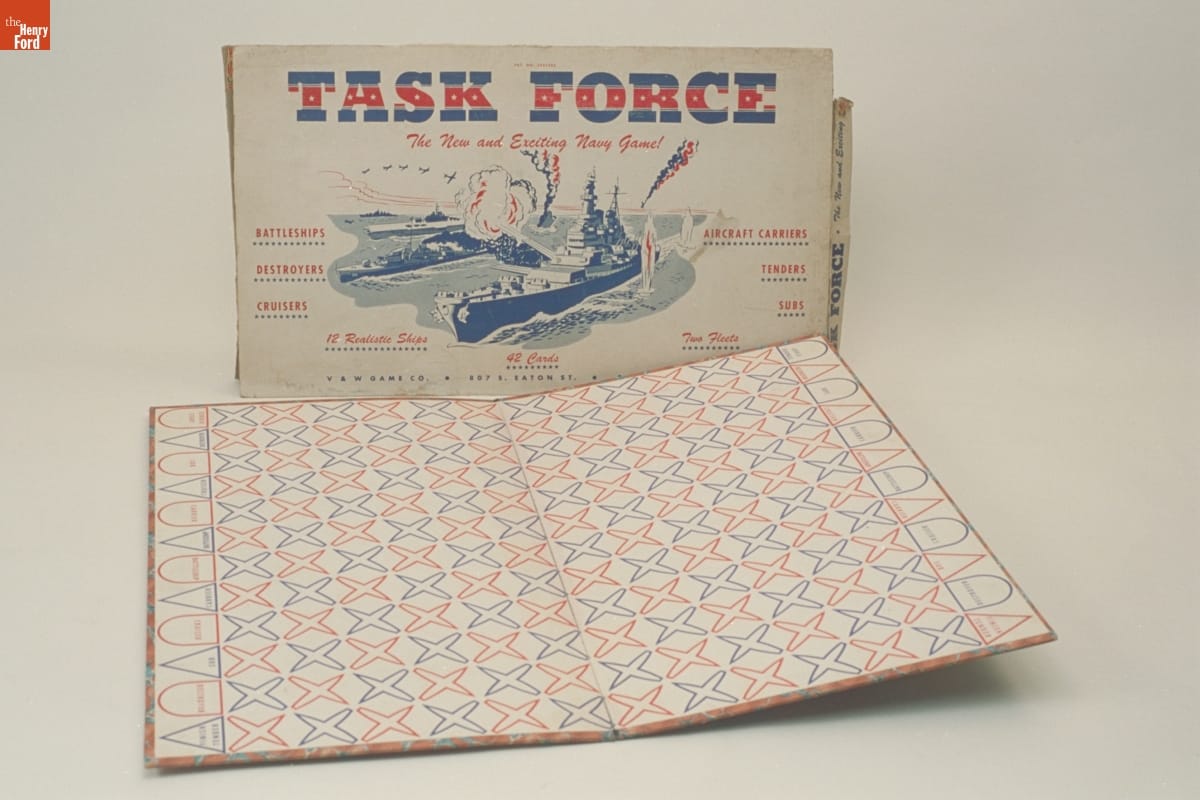
- Game, Task Force, circa 1951 - Guy W. Vitale, a World War II U. S. Navy veteran, patented this game in 1951. Players move ships across the board to their home ports. Along the way, players attack and try to destroy the enemy's (the opposing player's) fleet. The game was produced by a little-known game company in Albion, Michigan.
- circa 1951
- Collections - Artifact
Game, Task Force, circa 1951
Guy W. Vitale, a World War II U. S. Navy veteran, patented this game in 1951. Players move ships across the board to their home ports. Along the way, players attack and try to destroy the enemy's (the opposing player's) fleet. The game was produced by a little-known game company in Albion, Michigan.
- Portrait of Emma Saint Armstrong, circa 1880 -

- circa 1880
- Collections - Artifact
Portrait of Emma Saint Armstrong, circa 1880
- George Washington Carver and Floyd Starr, Starr Commonwealth School for Boys, Albion, Michigan, 1939 - In 1939 George Washington Carver traveled to Albion, Michigan, to visit Floyd E. Starr's Starr Commonwealth for Boys, a school for orphaned, homeless, or "delinquent" young men. Starr's philosophy was that "there was no such thing as a bad boy," and he founded this residential school as a religious and social mission. In this photograph, Carver is being applauded by Starr and a choir member.

- October 01, 1939
- Collections - Artifact
George Washington Carver and Floyd Starr, Starr Commonwealth School for Boys, Albion, Michigan, 1939
In 1939 George Washington Carver traveled to Albion, Michigan, to visit Floyd E. Starr's Starr Commonwealth for Boys, a school for orphaned, homeless, or "delinquent" young men. Starr's philosophy was that "there was no such thing as a bad boy," and he founded this residential school as a religious and social mission. In this photograph, Carver is being applauded by Starr and a choir member.
- Austin W. Curtis Assisting George Washington Carver during Lecture at Starr Commonwealth for Boys School, Albion, Michigan, 1939 - In 1939 George Washington Carver traveled to Albion, Michigan, to visit Floyd E. Starr's Starr Commonwealth for Boys, a school for orphaned, homeless, or "delinquent" young men. In this photograph, taken during Carver's lecture at Starr, Carver's assistant Austin Curtis, Jr., is helping Carver demonstrate the products that can be made from peanuts and other fruits of the soil.

- October 01, 1939
- Collections - Artifact
Austin W. Curtis Assisting George Washington Carver during Lecture at Starr Commonwealth for Boys School, Albion, Michigan, 1939
In 1939 George Washington Carver traveled to Albion, Michigan, to visit Floyd E. Starr's Starr Commonwealth for Boys, a school for orphaned, homeless, or "delinquent" young men. In this photograph, taken during Carver's lecture at Starr, Carver's assistant Austin Curtis, Jr., is helping Carver demonstrate the products that can be made from peanuts and other fruits of the soil.
- George Washington Carver at Starr Commonwealth for Boys School, Albion, Michigan, 1939 - In 1939 George Washington Carver traveled to Albion, Michigan, to visit Floyd E. Starr's Starr Commonwealth for Boys, a school for orphaned, homeless, or "delinquent" young men. In this photograph, taken during Carver's lecture at the Starr Commonwealth, Carver appears to be showing bottles of peanut oil to the audience.

- October 01, 1939
- Collections - Artifact
George Washington Carver at Starr Commonwealth for Boys School, Albion, Michigan, 1939
In 1939 George Washington Carver traveled to Albion, Michigan, to visit Floyd E. Starr's Starr Commonwealth for Boys, a school for orphaned, homeless, or "delinquent" young men. In this photograph, taken during Carver's lecture at the Starr Commonwealth, Carver appears to be showing bottles of peanut oil to the audience.
- George Washington Carver at Starr Commonwealth for Boys School, Albion, Michigan, 1939 - In 1939 George Washington Carver traveled to Albion, Michigan, to visit Floyd E. Starr's Starr Commonwealth for Boys, a school for orphaned, homeless, or "delinquent" young men. Carver stayed in a guest cabin at Starr, which is likely where this portrait was taken.

- October 01, 1939
- Collections - Artifact
George Washington Carver at Starr Commonwealth for Boys School, Albion, Michigan, 1939
In 1939 George Washington Carver traveled to Albion, Michigan, to visit Floyd E. Starr's Starr Commonwealth for Boys, a school for orphaned, homeless, or "delinquent" young men. Carver stayed in a guest cabin at Starr, which is likely where this portrait was taken.
- Portrait of Reverend Joseph Clay Armstrong, circa 1880 -

- circa 1880
- Collections - Artifact
Portrait of Reverend Joseph Clay Armstrong, circa 1880
- Floyd Starr Watches as George Washington Carver Shells Corn, Starr Commonwealth School, Albion, Michigan, 1939 - In 1939 George Washington Carver traveled to Albion, Michigan, to visit Floyd E. Starr's Starr Commonwealth for Boys, a school for orphaned, homeless, or "delinquent" young men. Starr's philosophy was that "there was no such thing as a bad boy," and he founded this residential school as a religious and social mission. In this photograph, Carver is shelling corn while Starr looks on.

- October 01, 1939
- Collections - Artifact
Floyd Starr Watches as George Washington Carver Shells Corn, Starr Commonwealth School, Albion, Michigan, 1939
In 1939 George Washington Carver traveled to Albion, Michigan, to visit Floyd E. Starr's Starr Commonwealth for Boys, a school for orphaned, homeless, or "delinquent" young men. Starr's philosophy was that "there was no such thing as a bad boy," and he founded this residential school as a religious and social mission. In this photograph, Carver is shelling corn while Starr looks on.
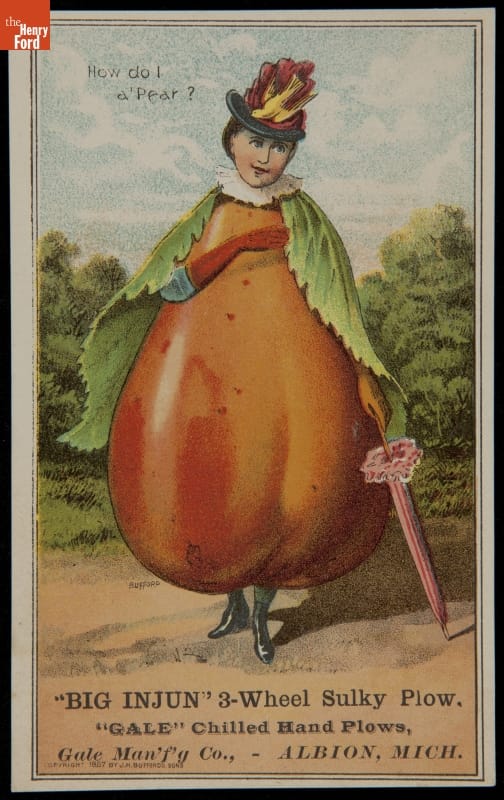
- Trade Card for Sulky Plows & Chilled Hand Plows, "How do I a'Pear?," 1887 - In the last third of the nineteenth century, an unprecedented variety of consumer goods and services flooded the American market. Advertisers, armed with new methods of color printing, bombarded potential customers with trade cards. Americans enjoyed and often saved the vibrant little advertisements found in product packages or distributed by local merchants. Many survive as historical records of commercialism in the United States.
- 1887
- Collections - Artifact
Trade Card for Sulky Plows & Chilled Hand Plows, "How do I a'Pear?," 1887
In the last third of the nineteenth century, an unprecedented variety of consumer goods and services flooded the American market. Advertisers, armed with new methods of color printing, bombarded potential customers with trade cards. Americans enjoyed and often saved the vibrant little advertisements found in product packages or distributed by local merchants. Many survive as historical records of commercialism in the United States.
- Trade Card for White Sewing Machine Company, 1876-1890 - In the last third of the nineteenth century, an unprecedented variety of consumer goods and services flooded the American market. Advertisers, armed with new methods of color printing, bombarded potential customers with trade cards. Americans enjoyed and often saved the vibrant little advertisements found in product packages or distributed by local merchants. Many survive as historical records of commercialism in the United States.

- 1876-1890
- Collections - Artifact
Trade Card for White Sewing Machine Company, 1876-1890
In the last third of the nineteenth century, an unprecedented variety of consumer goods and services flooded the American market. Advertisers, armed with new methods of color printing, bombarded potential customers with trade cards. Americans enjoyed and often saved the vibrant little advertisements found in product packages or distributed by local merchants. Many survive as historical records of commercialism in the United States.