
Search
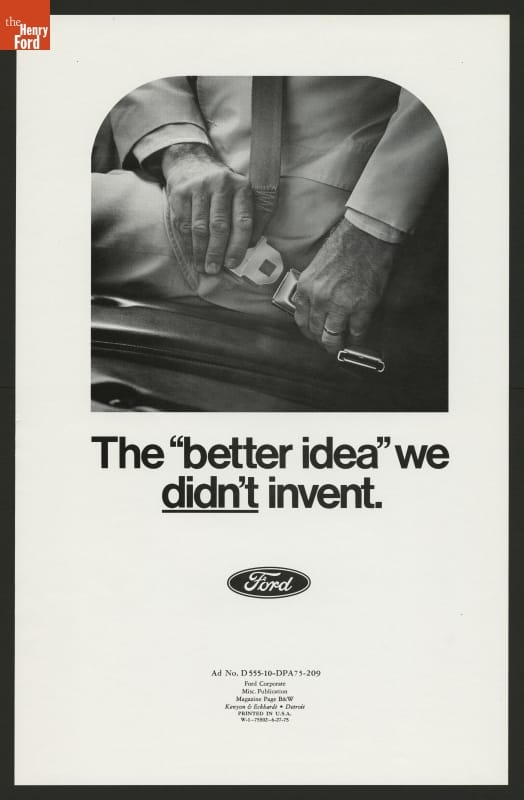
- 1975 Ford Advertisement for Using Seat Belts, "The Better Idea We Didn't Invent" - Ford offered factory-installed seat belts as optional equipment in some models in 1955. But people did not have to use them -- and most would not. By 1975, the time of this ad, seat belts were required equipment. And beginning in the 1980s, most states would pass laws enforcing passenger use of seat belts.
- June 27, 1975
- Collections - Artifact
1975 Ford Advertisement for Using Seat Belts, "The Better Idea We Didn't Invent"
Ford offered factory-installed seat belts as optional equipment in some models in 1955. But people did not have to use them -- and most would not. By 1975, the time of this ad, seat belts were required equipment. And beginning in the 1980s, most states would pass laws enforcing passenger use of seat belts.
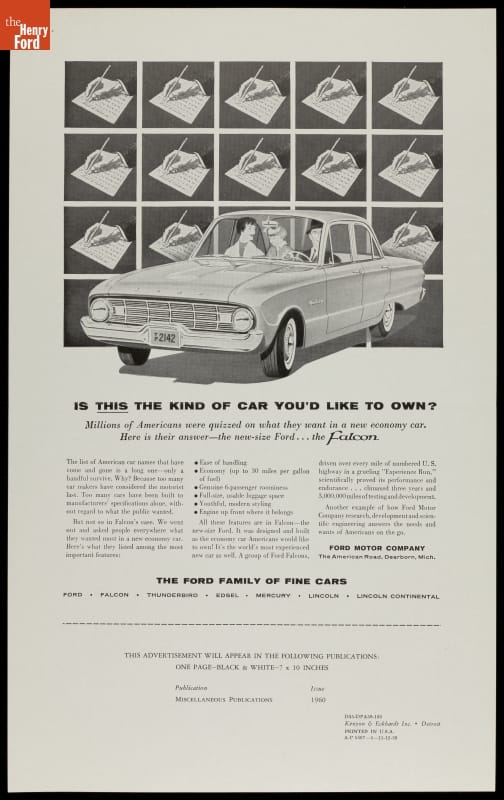
- "Is This the Kind of Car You'd Like to Own?" Ford Motor Company Advertising Proof, 1960 - Like Chrysler and General Motors, Ford entered the small-car market for 1960. The company's six-cylinder Falcon was a hit, selling 435,676 units in its first year -- more than either of Ford's crosstown rivals. One line in this advertisement, describing the Falcon's "engine up front where it belongs," was a direct reference to Chevrolet's rear-engine compact car, the Corvair.
- 1960
- Collections - Artifact
"Is This the Kind of Car You'd Like to Own?" Ford Motor Company Advertising Proof, 1960
Like Chrysler and General Motors, Ford entered the small-car market for 1960. The company's six-cylinder Falcon was a hit, selling 435,676 units in its first year -- more than either of Ford's crosstown rivals. One line in this advertisement, describing the Falcon's "engine up front where it belongs," was a direct reference to Chevrolet's rear-engine compact car, the Corvair.
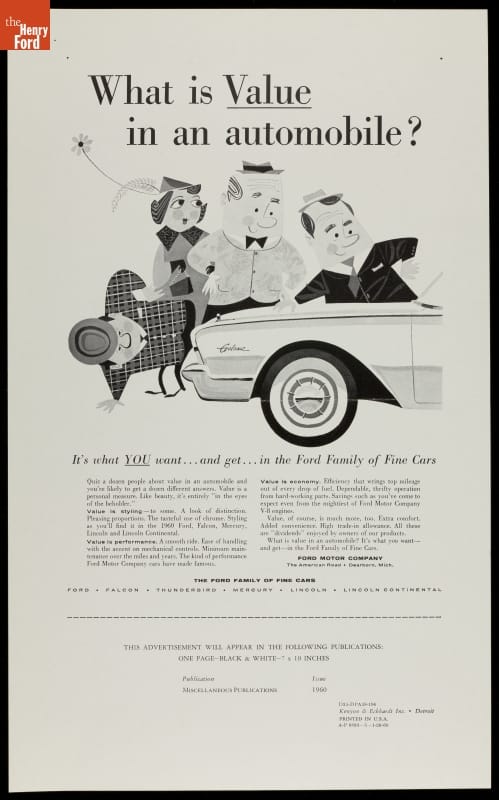
- "What is Value in an Automobile?" Ford Motor Company Advertising Proof, 1960 -
- 1960
- Collections - Artifact
"What is Value in an Automobile?" Ford Motor Company Advertising Proof, 1960
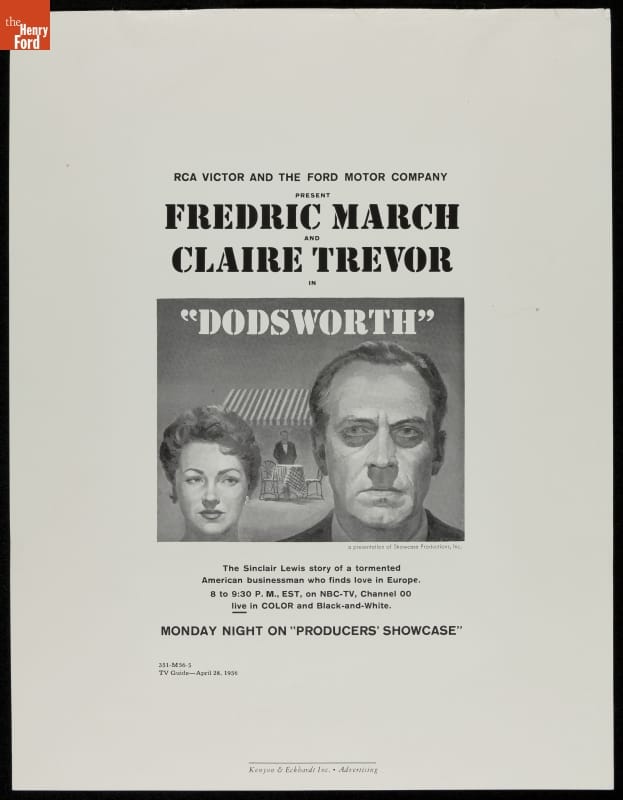
- 1956 Ford Advertising Proof, "RCA Victor and Ford Motor Company Present Fredric March and Claire Trevor in 'Dodsworth'" - The Ford Motor Company and RCA sponsored the award-winning anthology series <EM>Producers' Showcase</EM>. The NBC series ran for 37 episodes from 1954 to 1957. This advertisement, slated for <EM>TV Guide</EM>, promoted the show's treatment of <EM>Dodsworth</EM>, a television adaptation of the 1934 play based on the Sinclair Lewis novel. Claire Trevor would win an Emmy for her performance.
- 1956
- Collections - Artifact
1956 Ford Advertising Proof, "RCA Victor and Ford Motor Company Present Fredric March and Claire Trevor in 'Dodsworth'"
The Ford Motor Company and RCA sponsored the award-winning anthology series Producers' Showcase. The NBC series ran for 37 episodes from 1954 to 1957. This advertisement, slated for TV Guide, promoted the show's treatment of Dodsworth, a television adaptation of the 1934 play based on the Sinclair Lewis novel. Claire Trevor would win an Emmy for her performance.
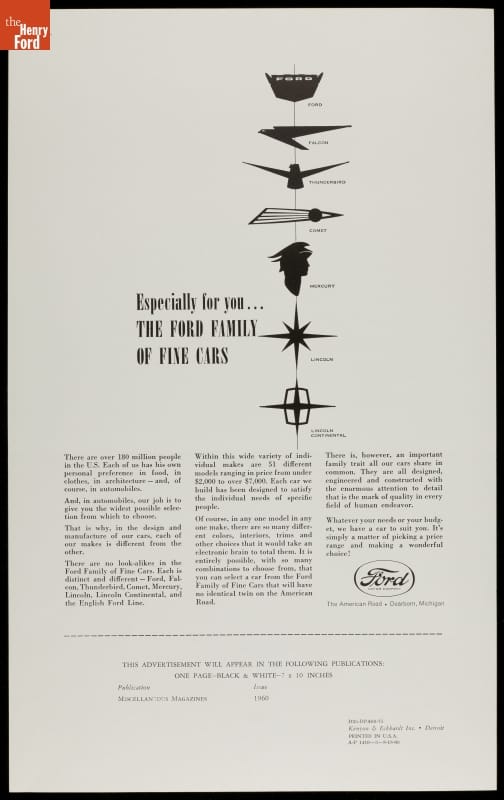
- "Especially for You . . . The Ford Family of Fine Cars" Ford Motor Company Advertising Proof, 1960 -
- 1960
- Collections - Artifact
"Especially for You . . . The Ford Family of Fine Cars" Ford Motor Company Advertising Proof, 1960
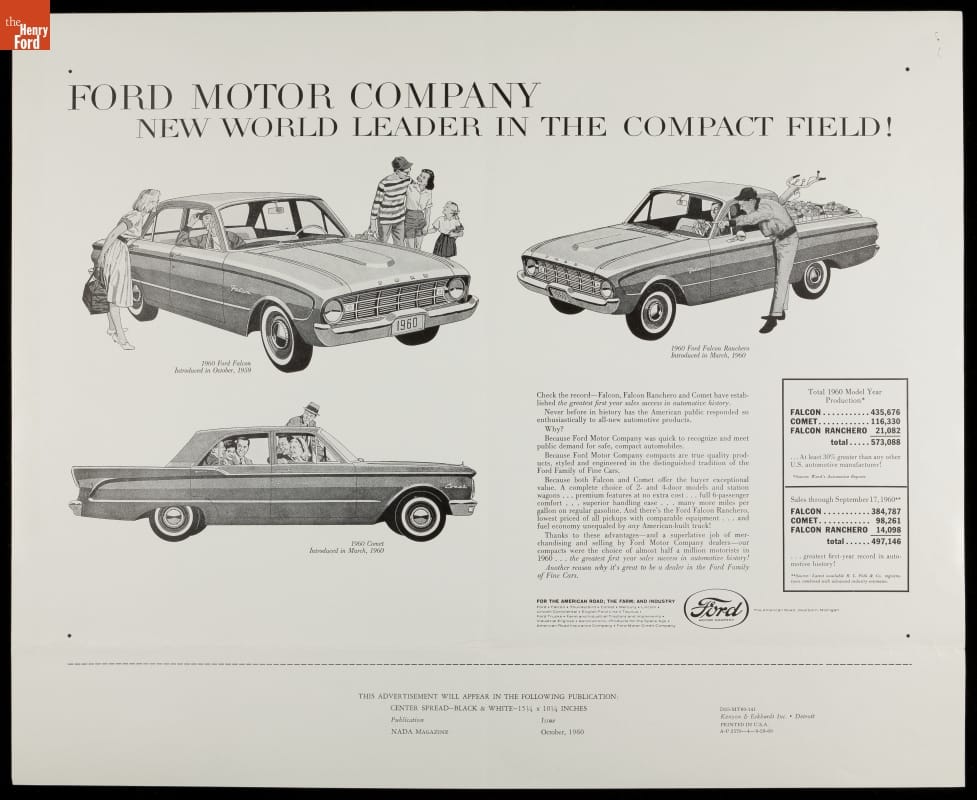
- "Ford Motor Company - New World Leader in the Compact Field" Ford Motor Company Advertising Proof, 1960 - Like Chrysler and General Motors, Ford entered the small-car market for 1960. The company's six-cylinder Falcon was a hit, selling 435,676 units in its first year -- more than either of Ford's crosstown rivals. Falcon Ranchero featured a utility cargo bed, while Comet offered compact convenience in a more upscale package. Comet became a Mercury model for 1962.
- October 01, 1960
- Collections - Artifact
"Ford Motor Company - New World Leader in the Compact Field" Ford Motor Company Advertising Proof, 1960
Like Chrysler and General Motors, Ford entered the small-car market for 1960. The company's six-cylinder Falcon was a hit, selling 435,676 units in its first year -- more than either of Ford's crosstown rivals. Falcon Ranchero featured a utility cargo bed, while Comet offered compact convenience in a more upscale package. Comet became a Mercury model for 1962.
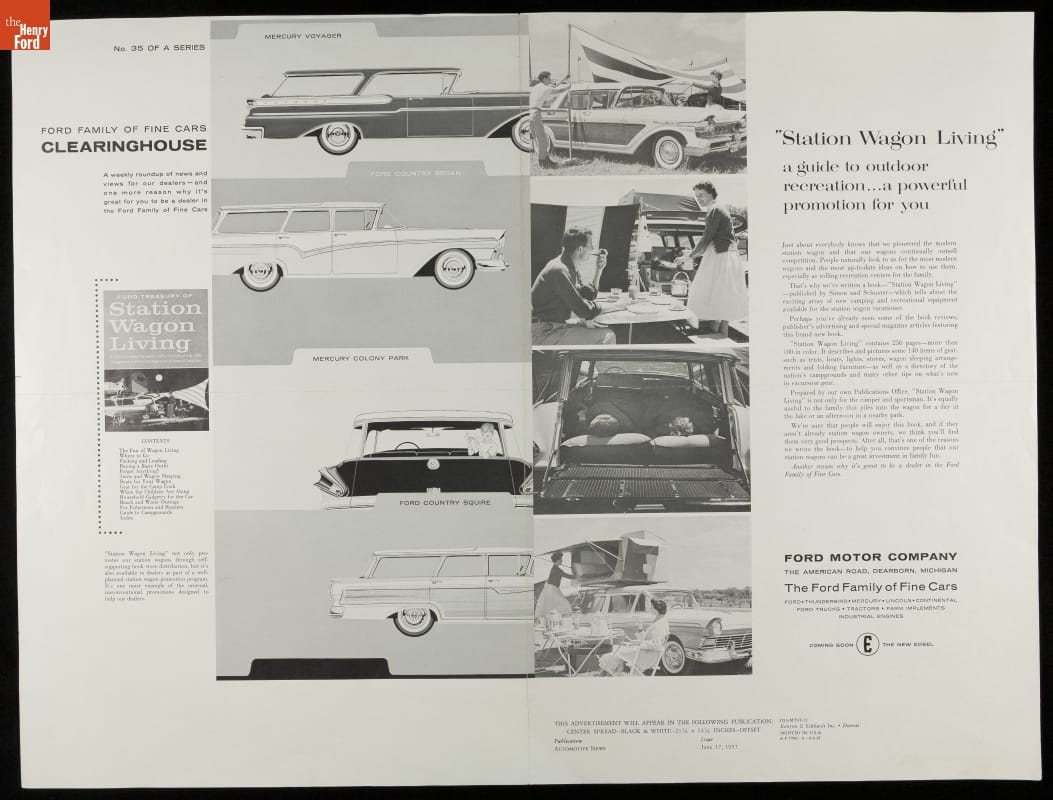
- Advertisement, "Station Wagon Living, A Guide to Outdoor Recreation," Ford Motor Company, 1957 - Ford's station wagons came in three trim levels for 1957: the basic two-door Ranch Wagon, the mid-level four-door Country Sedan, and the top-of-the-line four-door Country Squire. Each series was available with either a six- or eight-cylinder engine. Mercury offered the Commuter, the Voyager, and the top-level Colony Park, all with V-8 power. Advertisements promoted the station wagon's advantages for outdoor recreation.
- June 17, 1957
- Collections - Artifact
Advertisement, "Station Wagon Living, A Guide to Outdoor Recreation," Ford Motor Company, 1957
Ford's station wagons came in three trim levels for 1957: the basic two-door Ranch Wagon, the mid-level four-door Country Sedan, and the top-of-the-line four-door Country Squire. Each series was available with either a six- or eight-cylinder engine. Mercury offered the Commuter, the Voyager, and the top-level Colony Park, all with V-8 power. Advertisements promoted the station wagon's advantages for outdoor recreation.
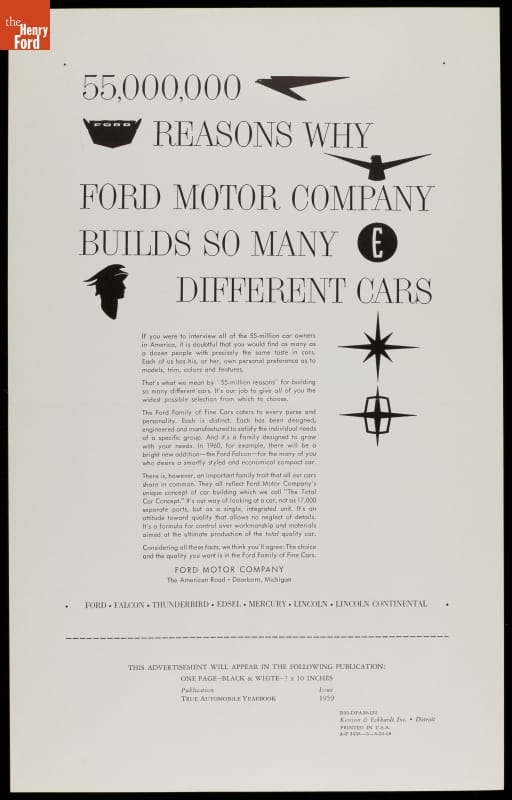
- "55,000,000 Reasons Why Ford Motor Company Builds So Many Different Cars" Ford Motor Company Advertising Proof, 1960 - Ford Motor Company offered four different brands in 1960: entry-level Ford (including Falcon and Thunderbird), mid-priced Edsel and Mercury, and premium Lincoln (including Continental). This advertisement noted that there were 55 million car owners in the United States at the time, and Ford gave them a variety of options. The unsuccessful Edsel line was discontinued during the 1960 model year.
- 1960
- Collections - Artifact
"55,000,000 Reasons Why Ford Motor Company Builds So Many Different Cars" Ford Motor Company Advertising Proof, 1960
Ford Motor Company offered four different brands in 1960: entry-level Ford (including Falcon and Thunderbird), mid-priced Edsel and Mercury, and premium Lincoln (including Continental). This advertisement noted that there were 55 million car owners in the United States at the time, and Ford gave them a variety of options. The unsuccessful Edsel line was discontinued during the 1960 model year.
- "Toast of the Town" Scrapbook, 1948-1949 -
- 1948-1949
- Collections - Artifact
"Toast of the Town" Scrapbook, 1948-1949
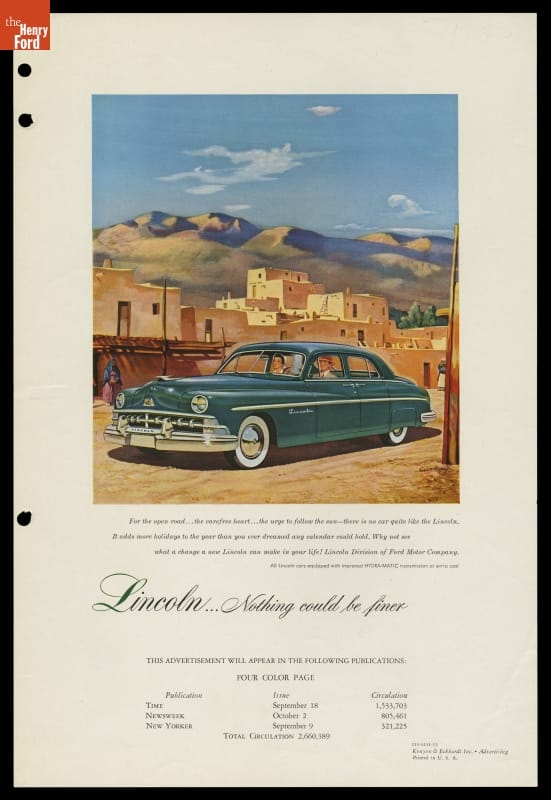
- 1950 Lincoln Sport Sedan Advertisement, "Nothing Could be Finer" - Lincoln introduced its first all-new postwar cars in the 1949 model year, and the basic look was unchanged the next year. The 1950 Lincoln Sport Sedan, illustrated here, started at $2,576. Extra-cost options included power windows, a power radio antenna, and a GM-built Hydra-Matic automatic transmission. Lincoln produced 11,741 Sport Sedans that year.
- 1950
- Collections - Artifact
1950 Lincoln Sport Sedan Advertisement, "Nothing Could be Finer"
Lincoln introduced its first all-new postwar cars in the 1949 model year, and the basic look was unchanged the next year. The 1950 Lincoln Sport Sedan, illustrated here, started at $2,576. Extra-cost options included power windows, a power radio antenna, and a GM-built Hydra-Matic automatic transmission. Lincoln produced 11,741 Sport Sedans that year.