
Search
- "Scientific American," Vol. 39, July-December 1878 -

- July 1878-December 1878
- Collections - Artifact
"Scientific American," Vol. 39, July-December 1878
- "Scientific American," Vol. 38, January-June 1878 -

- July 1878-December 1878
- Collections - Artifact
"Scientific American," Vol. 38, January-June 1878
- "Scientific American," Volume 4, July-December 1882 -

- July 1882-December 1882
- Collections - Artifact
"Scientific American," Volume 4, July-December 1882
- "Scientific American," Volume 46, January-June 1882 -

- January 1882-June 1882
- Collections - Artifact
"Scientific American," Volume 46, January-June 1882
- Bound Volume of Scientific American, January-July 1880 -

- January 1880-July 1880
- Collections - Artifact
Bound Volume of Scientific American, January-July 1880
- Scientific American Supplement, Vol. 21, January-June 1886 -

- January 1886-June 1886
- Collections - Artifact
Scientific American Supplement, Vol. 21, January-June 1886
- Scientific American, Bound Volume for July-December 1864, Vol. 11 - Massachusetts machinist Sylvester Roper patented a hot air engine that produced motion by harnessing the expansion and contraction of warming and cooling air. The December 3, 1864, issue of <em>Scientific American</em> described his engine. Roper also built at least seven steam-powered carriages and two steam-powered motorcycles years before automobiles -- as we know them -- appeared.

- 02 July 1864 - 24 December 1864
- Collections - Artifact
Scientific American, Bound Volume for July-December 1864, Vol. 11
Massachusetts machinist Sylvester Roper patented a hot air engine that produced motion by harnessing the expansion and contraction of warming and cooling air. The December 3, 1864, issue of Scientific American described his engine. Roper also built at least seven steam-powered carriages and two steam-powered motorcycles years before automobiles -- as we know them -- appeared.
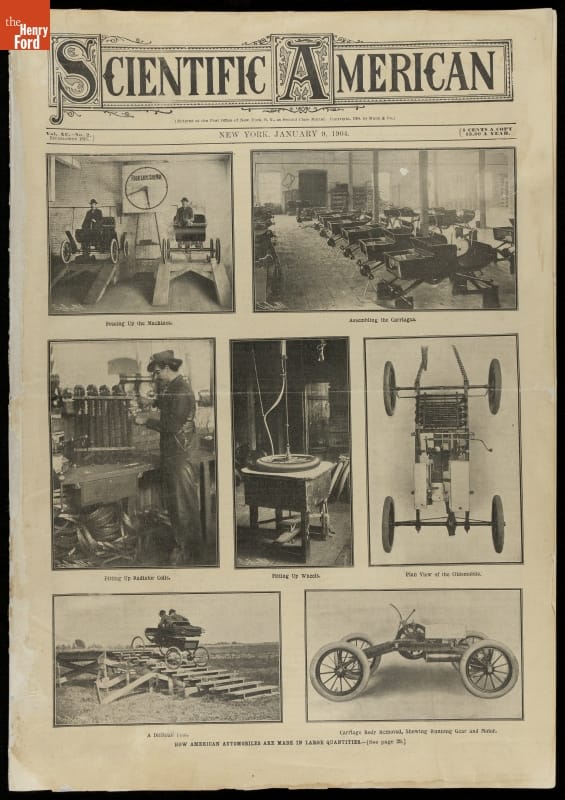
- Magazine, "Scientific American," January 9, 1904 - The Curved Dash Oldsmobile was the first mass-produced automobile in the United States. Olds Motor Works built 5,000 of them in 1904. At just $650, the little runabout was within the means of middle-class buyers. The January 9, 1904, issue of <em>Scientific American</em> featured a visit to the Olds factory to discover "how American automobiles are made in large quantities."
- January 09, 1904
- Collections - Artifact
Magazine, "Scientific American," January 9, 1904
The Curved Dash Oldsmobile was the first mass-produced automobile in the United States. Olds Motor Works built 5,000 of them in 1904. At just $650, the little runabout was within the means of middle-class buyers. The January 9, 1904, issue of Scientific American featured a visit to the Olds factory to discover "how American automobiles are made in large quantities."
- "Scientific American," Vol. 51, July-December 1884 -
- July 1884-December 1884
- Collections - Artifact
"Scientific American," Vol. 51, July-December 1884
- Scientific American, Vol. 27, July-December 1872 - In 1867, Carlos Glidden showed an article about the mechanical "pterotype" writing machine to colleagues Christopher Latham Sholes and Samuel Soule. At the time, the group was inventing a page numbering machine, and was inspired to add text printing capabilities. The eventual result became the first commercially successful typewriter, featured on the cover of this 1872 issue of Scientific American.

- July 1872 - December 1872
- Collections - Artifact
Scientific American, Vol. 27, July-December 1872
In 1867, Carlos Glidden showed an article about the mechanical "pterotype" writing machine to colleagues Christopher Latham Sholes and Samuel Soule. At the time, the group was inventing a page numbering machine, and was inspired to add text printing capabilities. The eventual result became the first commercially successful typewriter, featured on the cover of this 1872 issue of Scientific American.