
Search
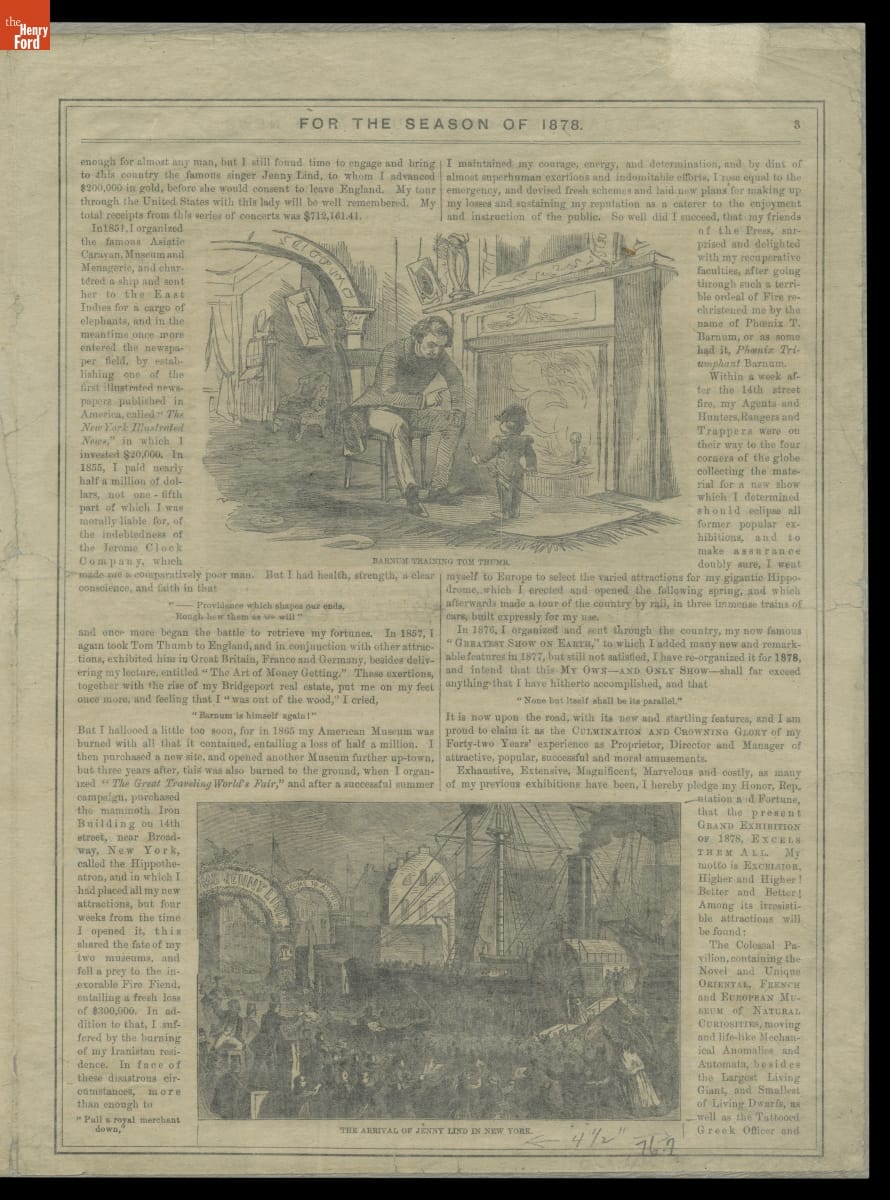
- "P.T. Barnum's Own Illustrated News for the Season of 1878" - Phineas Taylor (P.T.) Barnum (1810-1891) entered the circus business in 1876 after a 40-year career as a showman. In this presumably self-published newspaper, Barnum highlighted his past entertainment endeavor and announced his lineup for the 1878 "Greatest Show on Earth" circus. Barnum's circus featured animal menageries, clowns, automata, acrobatic horse-riders, and human "curiosities" such as Captain George Costentenus--a heavily tattooed man.
- 1878
- Collections - Artifact
"P.T. Barnum's Own Illustrated News for the Season of 1878"
Phineas Taylor (P.T.) Barnum (1810-1891) entered the circus business in 1876 after a 40-year career as a showman. In this presumably self-published newspaper, Barnum highlighted his past entertainment endeavor and announced his lineup for the 1878 "Greatest Show on Earth" circus. Barnum's circus featured animal menageries, clowns, automata, acrobatic horse-riders, and human "curiosities" such as Captain George Costentenus--a heavily tattooed man.
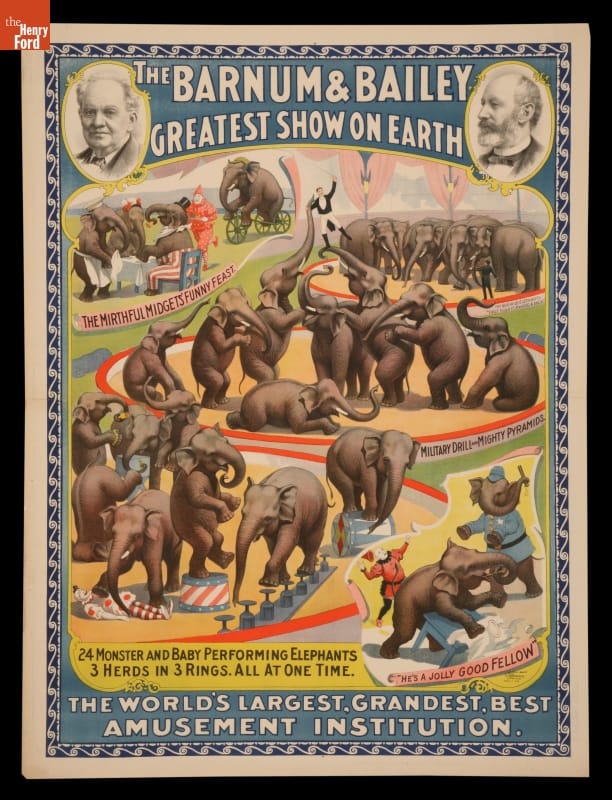
- Circus Poster, Barnum and Bailey Circus Presents "24 Monster and Baby Performing Elephants," 1896 - In the late nineteenth century, printers developed a lithograph method that produced brightly colored posters. In advance of a circus coming to town, general agents glued these eye-catching generic posters to building walls, fences, and in window displays. To announce when and where the performances would happen, local printers sometimes provided letterpress paper date strips to paste onto the posters' lower margin.
- 1896
- Collections - Artifact
Circus Poster, Barnum and Bailey Circus Presents "24 Monster and Baby Performing Elephants," 1896
In the late nineteenth century, printers developed a lithograph method that produced brightly colored posters. In advance of a circus coming to town, general agents glued these eye-catching generic posters to building walls, fences, and in window displays. To announce when and where the performances would happen, local printers sometimes provided letterpress paper date strips to paste onto the posters' lower margin.
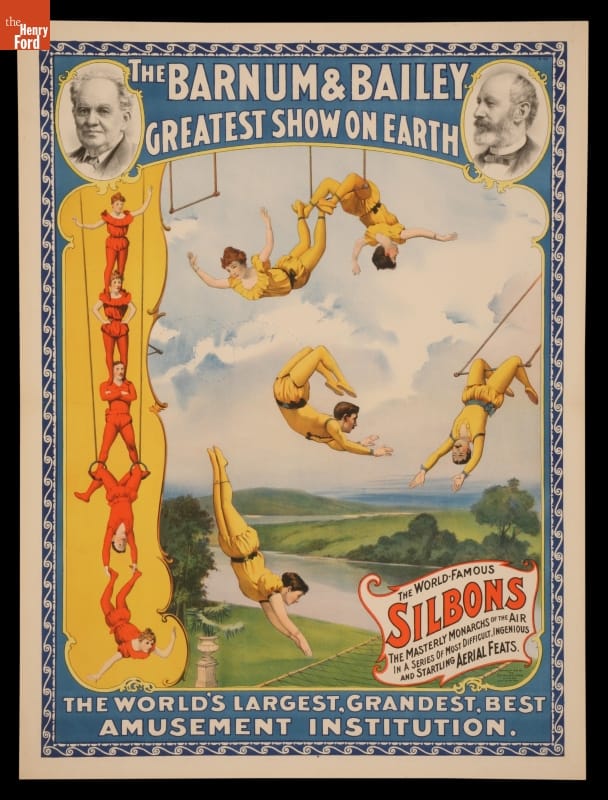
- Circus Poster, Barnum and Bailey Circus Presents "The World-Famous Silbons, The Masterly Monarchs of the Air," 1896 - In the late nineteenth century, printers developed a lithograph method that produced brightly colored posters. In advance of a circus coming to town, general agents glued these eye-catching generic posters to building walls, fences, and in window displays. To announce when and where the performances would happen, local printers sometimes provided letterpress paper date strips to paste onto the posters' lower margin.
- 1896
- Collections - Artifact
Circus Poster, Barnum and Bailey Circus Presents "The World-Famous Silbons, The Masterly Monarchs of the Air," 1896
In the late nineteenth century, printers developed a lithograph method that produced brightly colored posters. In advance of a circus coming to town, general agents glued these eye-catching generic posters to building walls, fences, and in window displays. To announce when and where the performances would happen, local printers sometimes provided letterpress paper date strips to paste onto the posters' lower margin.
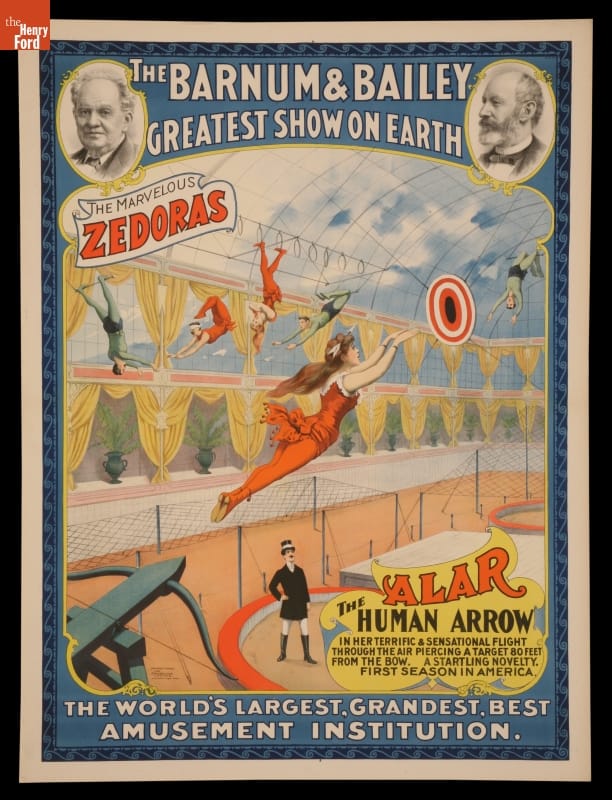
- Circus Poster, Barnum and Bailey Circus Presents "The Marvelous Zedoras and Alar the Human Arrow," 1896 - In the late nineteenth century, printers developed a lithograph method that produced brightly colored posters. In advance of a circus coming to town, general agents glued these eye-catching generic posters to building walls, fences, and in window displays. To announce when and where the performances would happen, local printers sometimes provided letterpress paper date strips to paste onto the posters' lower margin.
- 1896
- Collections - Artifact
Circus Poster, Barnum and Bailey Circus Presents "The Marvelous Zedoras and Alar the Human Arrow," 1896
In the late nineteenth century, printers developed a lithograph method that produced brightly colored posters. In advance of a circus coming to town, general agents glued these eye-catching generic posters to building walls, fences, and in window displays. To announce when and where the performances would happen, local printers sometimes provided letterpress paper date strips to paste onto the posters' lower margin.
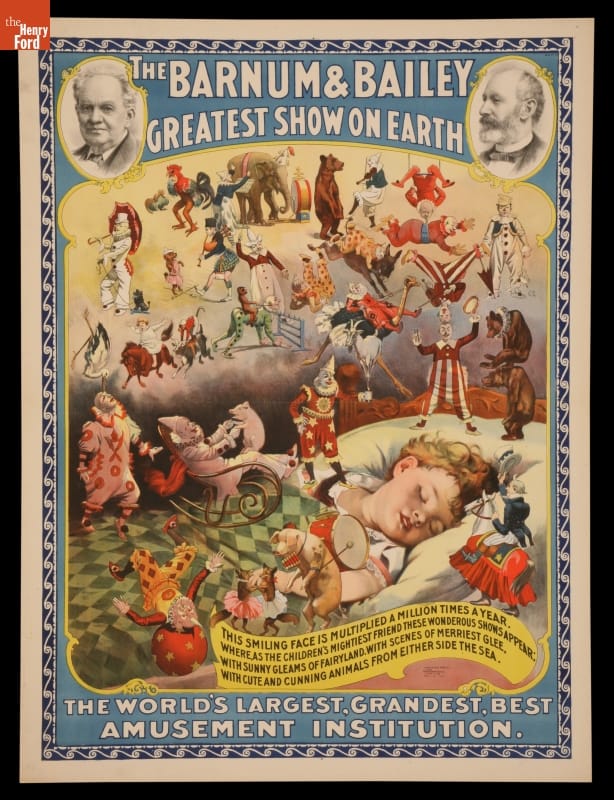
- Circus Poster, Barnum & Bailey, A Child Dreaming of a Circus, 1896 - In the late nineteenth century, printers developed a lithograph method that produced brightly colored posters. In advance of a circus coming to town, general agents glued these eye-catching generic posters to building walls, fences, and in window displays. To announce when and where the performances would happen, local printers sometimes provided letterpress paper date strips to paste onto the posters' lower margin.
- 1896
- Collections - Artifact
Circus Poster, Barnum & Bailey, A Child Dreaming of a Circus, 1896
In the late nineteenth century, printers developed a lithograph method that produced brightly colored posters. In advance of a circus coming to town, general agents glued these eye-catching generic posters to building walls, fences, and in window displays. To announce when and where the performances would happen, local printers sometimes provided letterpress paper date strips to paste onto the posters' lower margin.
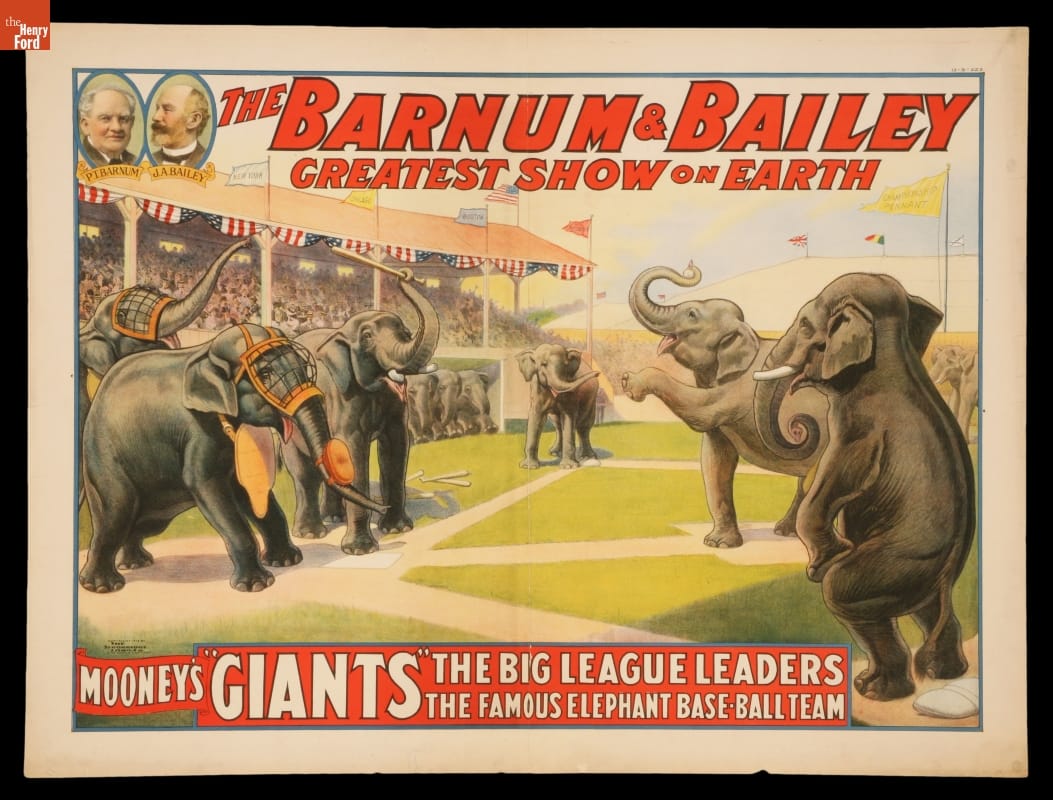
- Circus Poster, Barnum & Bailey Circus Presents Mooney's "Giants," The Famous Elephant Base-Ball Team, 1913 - In the late nineteenth century, printers developed a lithograph method that produced brightly colored posters. In advance of a circus coming to town, general agents glued these eye-catching generic posters to building walls, fences, and in window displays. To announce when and where the performances would happen, local printers sometimes provided letterpress paper date strips to paste onto the posters' lower margin.
- 1913
- Collections - Artifact
Circus Poster, Barnum & Bailey Circus Presents Mooney's "Giants," The Famous Elephant Base-Ball Team, 1913
In the late nineteenth century, printers developed a lithograph method that produced brightly colored posters. In advance of a circus coming to town, general agents glued these eye-catching generic posters to building walls, fences, and in window displays. To announce when and where the performances would happen, local printers sometimes provided letterpress paper date strips to paste onto the posters' lower margin.
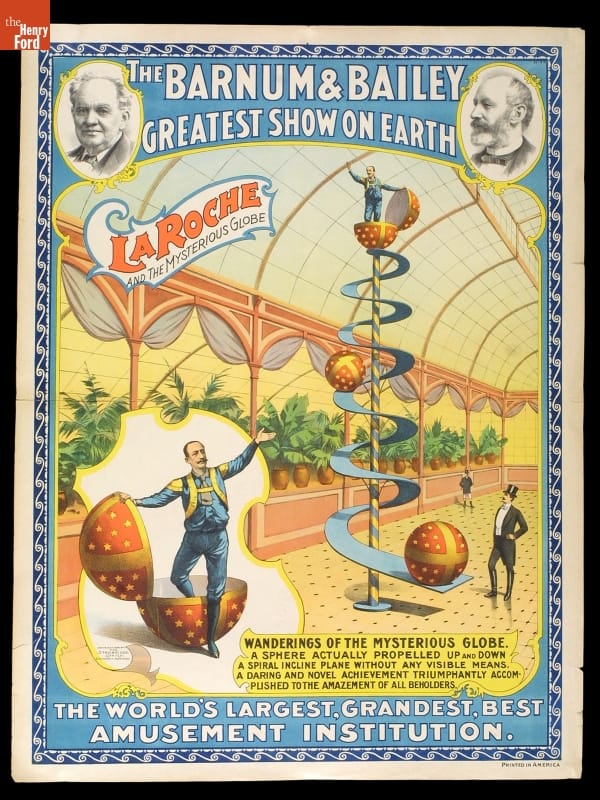
- Circus Poster, "The Barnum & Bailey Greatest Show on Earth, La Roche and the Mysterious Globe," 1896 - In the late nineteenth century, printers developed a lithograph method that produced brightly colored posters. In advance of a circus coming to town, general agents glued these eye-catching generic posters to building walls, fences, and in window displays. To announce when and where the performances would happen, local printers sometimes provided letterpress paper date strips to paste onto the posters' lower margin.
- 1896
- Collections - Artifact
Circus Poster, "The Barnum & Bailey Greatest Show on Earth, La Roche and the Mysterious Globe," 1896
In the late nineteenth century, printers developed a lithograph method that produced brightly colored posters. In advance of a circus coming to town, general agents glued these eye-catching generic posters to building walls, fences, and in window displays. To announce when and where the performances would happen, local printers sometimes provided letterpress paper date strips to paste onto the posters' lower margin.
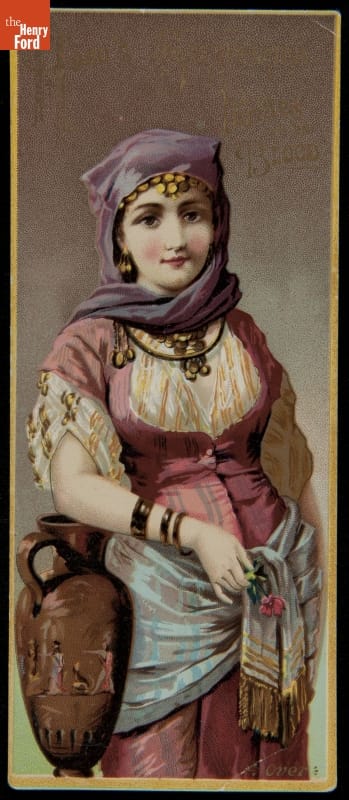
- Trade Card for C.I. Hood & Company, circa 1884 - In the late 19th century, trade cards were a major means for advertising goods and services. Patent medicine producer, C.I. Hood & Co., had its own advertising department, creating cookbooks, calendars, and, most abundantly, trade cards. Hood's Sarsaparilla became the company's most popular product and trade cards, like this one, promoted its medicinal qualities as a blood purifier.
- circa 1884
- Collections - Artifact
Trade Card for C.I. Hood & Company, circa 1884
In the late 19th century, trade cards were a major means for advertising goods and services. Patent medicine producer, C.I. Hood & Co., had its own advertising department, creating cookbooks, calendars, and, most abundantly, trade cards. Hood's Sarsaparilla became the company's most popular product and trade cards, like this one, promoted its medicinal qualities as a blood purifier.
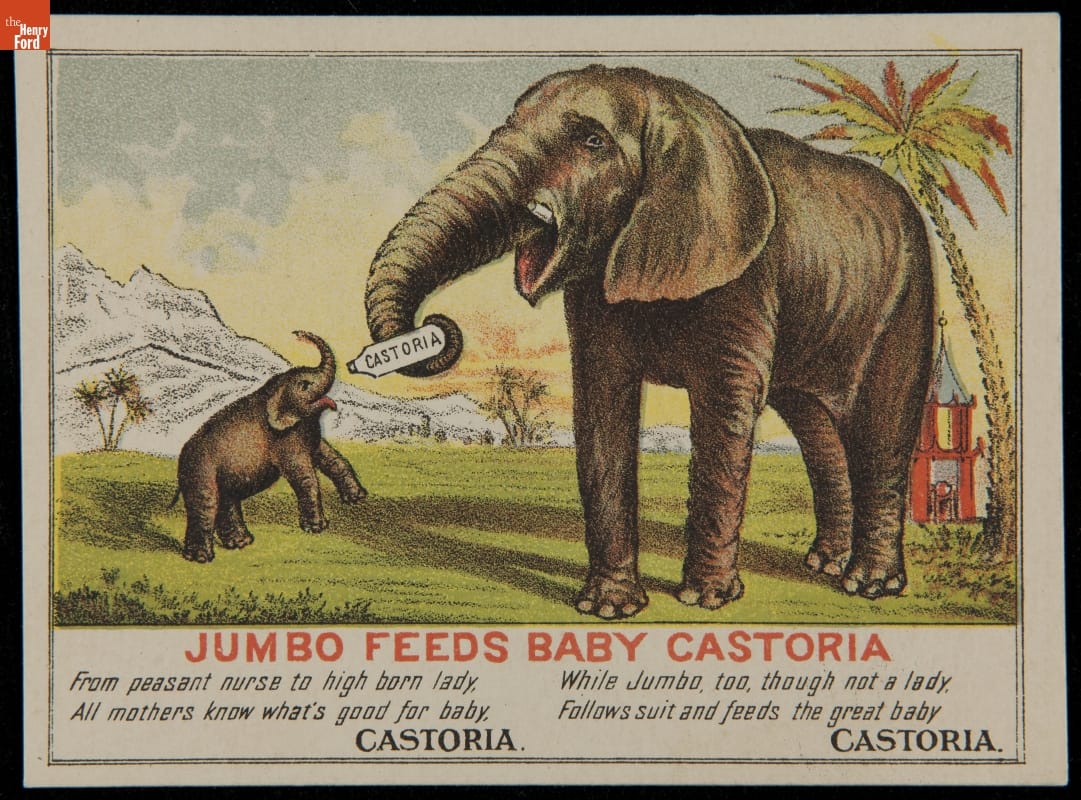
- Trade Card for Centaur Company, "Jumbo Feeds Baby Castoria," 1883 - In the last third of the nineteenth century, an unprecedented variety of consumer goods and services flooded the American market. Advertisers, armed with new methods of color printing, bombarded potential customers with trade cards. Americans enjoyed and often saved the vibrant little advertisements found in product packages or distributed by local merchants. Many survive as historical records of commercialism in the United States.
- 1883
- Collections - Artifact
Trade Card for Centaur Company, "Jumbo Feeds Baby Castoria," 1883
In the last third of the nineteenth century, an unprecedented variety of consumer goods and services flooded the American market. Advertisers, armed with new methods of color printing, bombarded potential customers with trade cards. Americans enjoyed and often saved the vibrant little advertisements found in product packages or distributed by local merchants. Many survive as historical records of commercialism in the United States.
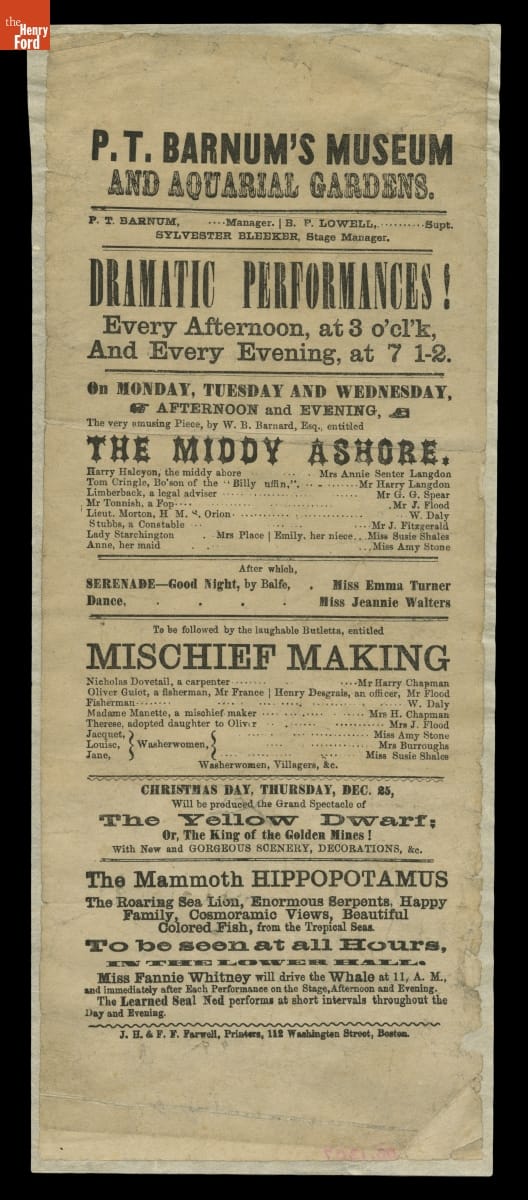
- "P.T. Barnum's Museum and Aquarial Gardens," December 1862 - Following the success of his American Museum in New York City, showman Phineas Taylor (P.T.) Barnum (1810-1891) bought and expanded a Boston-based museum and aquarium in 1862. Like its New York counterpart, the Boston museum was an entertainment venue that housed animals, theatrical performances, and several "human curiosity" exhibitions. The museum closed just eight months after re-opening.
- 22 December 1862-25 December 1862
- Collections - Artifact
"P.T. Barnum's Museum and Aquarial Gardens," December 1862
Following the success of his American Museum in New York City, showman Phineas Taylor (P.T.) Barnum (1810-1891) bought and expanded a Boston-based museum and aquarium in 1862. Like its New York counterpart, the Boston museum was an entertainment venue that housed animals, theatrical performances, and several "human curiosity" exhibitions. The museum closed just eight months after re-opening.