
Search
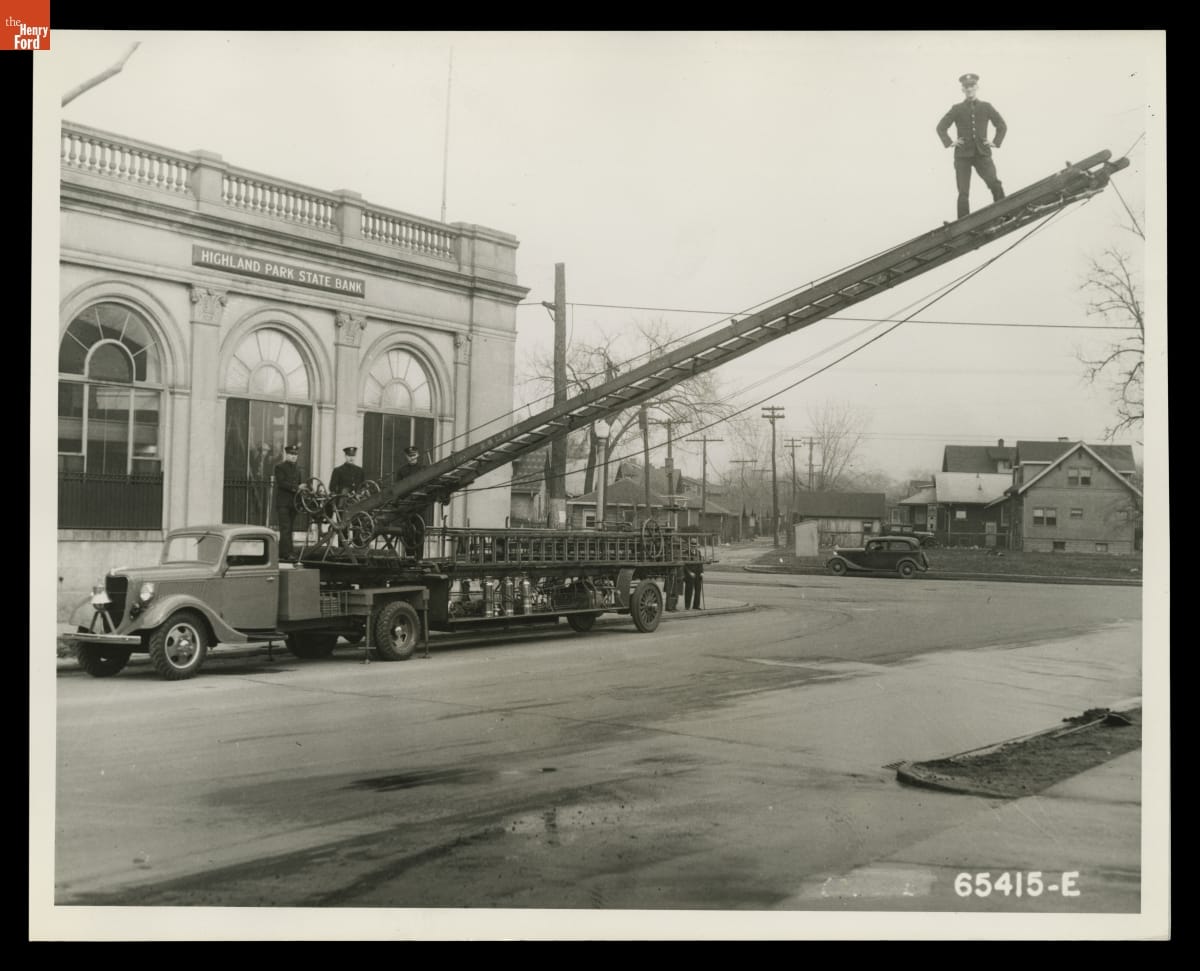
- Ford V-8 Fire Truck Tractor with Hook and Ladder Trailer at the Highland Park State Bank, March 12, 1936 - This 1936 Ford Model 51 truck included a fire bell on its front bumper and a large tank behind its cab. The truck hauled a 75-foot aerial ladder manufactured by American LaFrance. "Hook and ladder" refers to two essential pieces of firefighting equipment: hooks to tear down potential fire fuel, and ladders to reach people trapped on upper floors.
- March 12, 1936
- Collections - Artifact
Ford V-8 Fire Truck Tractor with Hook and Ladder Trailer at the Highland Park State Bank, March 12, 1936
This 1936 Ford Model 51 truck included a fire bell on its front bumper and a large tank behind its cab. The truck hauled a 75-foot aerial ladder manufactured by American LaFrance. "Hook and ladder" refers to two essential pieces of firefighting equipment: hooks to tear down potential fire fuel, and ladders to reach people trapped on upper floors.
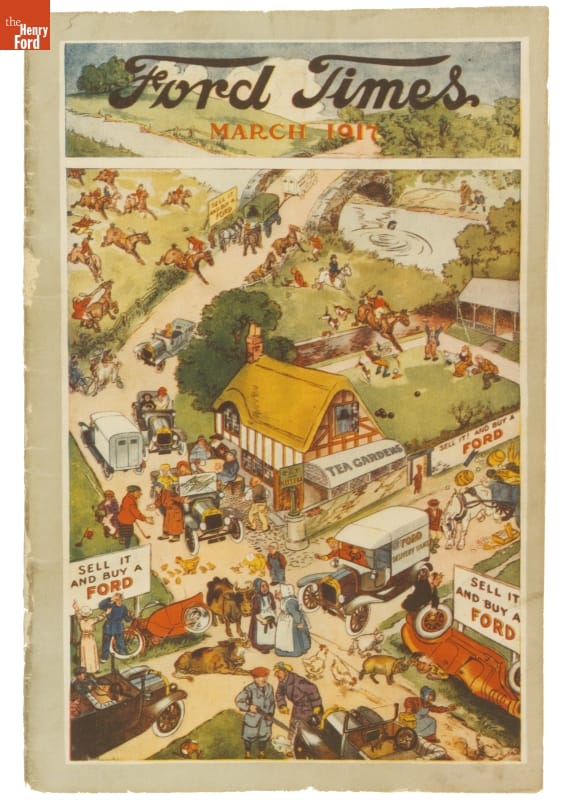
- Ford Times Cover, March 1917 - Norval Hawkins, the sales manager for Ford Motor Company, developed the idea for a company magazine, <EM>Ford Times</EM>. Hawkins filled the magazine with information ranging from production methods and testimonials to Ford race victories. Always lively and well illustrated, <EM>Ford Times</EM> boosted morale at the agencies and branches while serving as another advertising medium.
- March 01, 1917
- Collections - Artifact
Ford Times Cover, March 1917
Norval Hawkins, the sales manager for Ford Motor Company, developed the idea for a company magazine, Ford Times. Hawkins filled the magazine with information ranging from production methods and testimonials to Ford race victories. Always lively and well illustrated, Ford Times boosted morale at the agencies and branches while serving as another advertising medium.
- Drawing, "Side Panel," Ford Model TT Truck, January 28, 1927 - The Ford Motor Company created over a million parts drawings from 1903 to 1957. Many of these drawings specify engineering requirements for the components of Ford-made vehicles--including automobiles, trucks, tractors, military vehicles and Tri-motor airplanes. Others document assembly components, stages of casting and forging, or experimental designs. Beginning in the 1940s, Ford transferred the drawings to microfilm.

- January 28, 1927
- Collections - Artifact
Drawing, "Side Panel," Ford Model TT Truck, January 28, 1927
The Ford Motor Company created over a million parts drawings from 1903 to 1957. Many of these drawings specify engineering requirements for the components of Ford-made vehicles--including automobiles, trucks, tractors, military vehicles and Tri-motor airplanes. Others document assembly components, stages of casting and forging, or experimental designs. Beginning in the 1940s, Ford transferred the drawings to microfilm.
- Drawing, "Worm," Forging Size, Ford Model TT Truck, August 26, 1926 - The Ford Motor Company created over a million parts drawings from 1903 to 1957. Many of these drawings specify engineering requirements for the components of Ford-made vehicles--including automobiles, trucks, tractors, military vehicles and Tri-motor airplanes. Others document assembly components, stages of casting and forging, or experimental designs. Beginning in the 1940s, Ford transferred the drawings to microfilm.

- August 26, 1926
- Collections - Artifact
Drawing, "Worm," Forging Size, Ford Model TT Truck, August 26, 1926
The Ford Motor Company created over a million parts drawings from 1903 to 1957. Many of these drawings specify engineering requirements for the components of Ford-made vehicles--including automobiles, trucks, tractors, military vehicles and Tri-motor airplanes. Others document assembly components, stages of casting and forging, or experimental designs. Beginning in the 1940s, Ford transferred the drawings to microfilm.
- Drawing, "Worm (High Speed)," Ford Model TT Truck, August 26, 1926 - The Ford Motor Company created over a million parts drawings from 1903 to 1957. Many of these drawings specify engineering requirements for the components of Ford-made vehicles--including automobiles, trucks, tractors, military vehicles and Tri-motor airplanes. Others document assembly components, stages of casting and forging, or experimental designs. Beginning in the 1940s, Ford transferred the drawings to microfilm.

- August 26, 1926
- Collections - Artifact
Drawing, "Worm (High Speed)," Ford Model TT Truck, August 26, 1926
The Ford Motor Company created over a million parts drawings from 1903 to 1957. Many of these drawings specify engineering requirements for the components of Ford-made vehicles--including automobiles, trucks, tractors, military vehicles and Tri-motor airplanes. Others document assembly components, stages of casting and forging, or experimental designs. Beginning in the 1940s, Ford transferred the drawings to microfilm.
- Drawing, "Demountable Rim Bolt," Ford Model TT Truck, August 5, 1924 - The Ford Motor Company created over a million parts drawings from 1903 to 1957. Many of these drawings specify engineering requirements for the components of Ford-made vehicles--including automobiles, trucks, tractors, military vehicles and Tri-motor airplanes. Others document assembly components, stages of casting and forging, or experimental designs. Beginning in the 1940s, Ford transferred the drawings to microfilm.

- August 05, 1924
- Collections - Artifact
Drawing, "Demountable Rim Bolt," Ford Model TT Truck, August 5, 1924
The Ford Motor Company created over a million parts drawings from 1903 to 1957. Many of these drawings specify engineering requirements for the components of Ford-made vehicles--including automobiles, trucks, tractors, military vehicles and Tri-motor airplanes. Others document assembly components, stages of casting and forging, or experimental designs. Beginning in the 1940s, Ford transferred the drawings to microfilm.
- 1941 Ford Pickup Truck - Ford pickup trucks received minor styling updates for 1941. New parking lamp lenses and rectangular nameplates on the sides of the hood were among them. Four-cylinder models came with a standard four-speed transmission, while six- and eight-cylinder trucks had a three-speed unit. Ford built 70,190 half-ton pickups that year.

- September 13, 1940
- Collections - Artifact
1941 Ford Pickup Truck
Ford pickup trucks received minor styling updates for 1941. New parking lamp lenses and rectangular nameplates on the sides of the hood were among them. Four-cylinder models came with a standard four-speed transmission, while six- and eight-cylinder trucks had a three-speed unit. Ford built 70,190 half-ton pickups that year.
- "1978 Ford Bronco" - Ford introduced the Bronco for 1966. It competed against similar compact four-wheel-drive models from Jeep and International Harvester. Originally built on its own platform, the Bronco was redesigned to use Ford's F-series pickup platform for 1978. Bronco production ended in 1996, but the off-roader returned to the market starting with the 2021 model year.

- 1978
- Collections - Artifact
"1978 Ford Bronco"
Ford introduced the Bronco for 1966. It competed against similar compact four-wheel-drive models from Jeep and International Harvester. Originally built on its own platform, the Bronco was redesigned to use Ford's F-series pickup platform for 1978. Bronco production ended in 1996, but the off-roader returned to the market starting with the 2021 model year.
- Strathmoor Motor Sales Ford Delivery Truck at Parsons Service Station, July 1934 -

- July 06, 1934
- Collections - Artifact
Strathmoor Motor Sales Ford Delivery Truck at Parsons Service Station, July 1934
- Hallmark "All-American Trucks Series: 1957 Ford Ranchero" Christmas Ornament, 2002 - Already known for greeting cards, Hallmark introduced a line of Christmas ornaments in 1973. The company's annual release of an increasing array of ornaments revolutionized Christmas decorating, appealing to customers' interest in marking memories and milestones as well as expressing one's personality and unique tastes.

- 1957
- Collections - Artifact
Hallmark "All-American Trucks Series: 1957 Ford Ranchero" Christmas Ornament, 2002
Already known for greeting cards, Hallmark introduced a line of Christmas ornaments in 1973. The company's annual release of an increasing array of ornaments revolutionized Christmas decorating, appealing to customers' interest in marking memories and milestones as well as expressing one's personality and unique tastes.