
Search
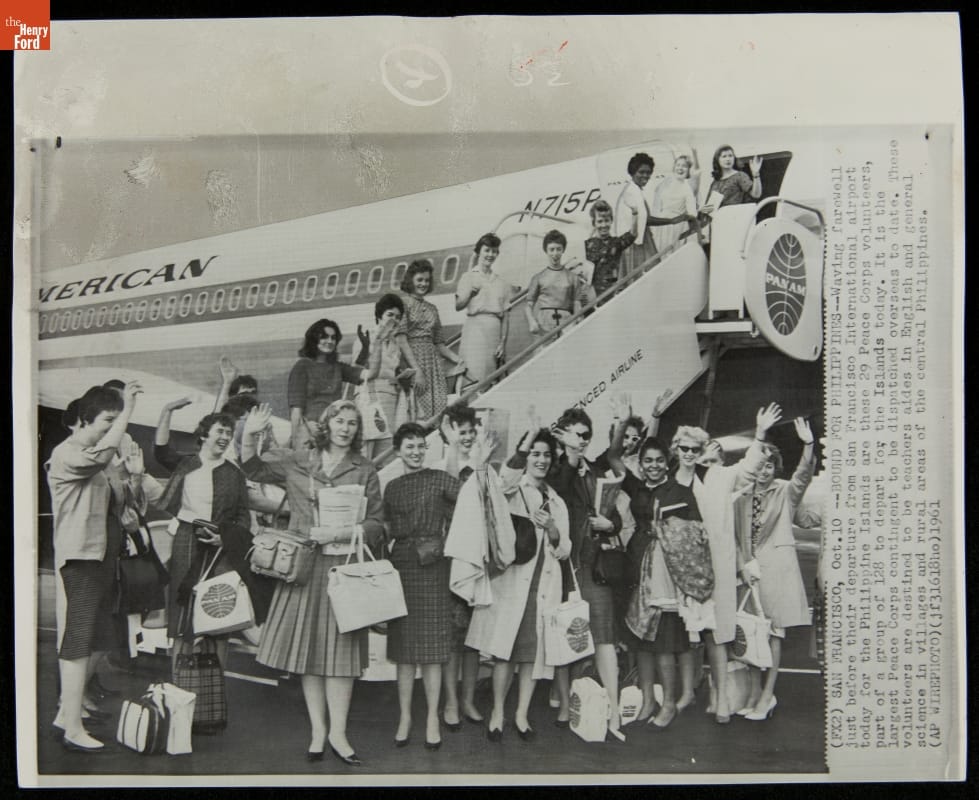
- Wire Photograph, Peace Corps Volunteers at San Francisco International Airport, "Bound for Philippines," 1961 - President John F. Kennedy recognized the Peace Corps as an opportunity to spread goodwill and as a positive weapon against the Cold War. Established March 1, 1961, by the end of the year, many Peace Corps volunteers had been trained and placed in overseas assignments. Here, a group leaves for the Philippines to serve as teachers' aides in country villages.
- October 12, 1961
- Collections - Artifact
Wire Photograph, Peace Corps Volunteers at San Francisco International Airport, "Bound for Philippines," 1961
President John F. Kennedy recognized the Peace Corps as an opportunity to spread goodwill and as a positive weapon against the Cold War. Established March 1, 1961, by the end of the year, many Peace Corps volunteers had been trained and placed in overseas assignments. Here, a group leaves for the Philippines to serve as teachers' aides in country villages.
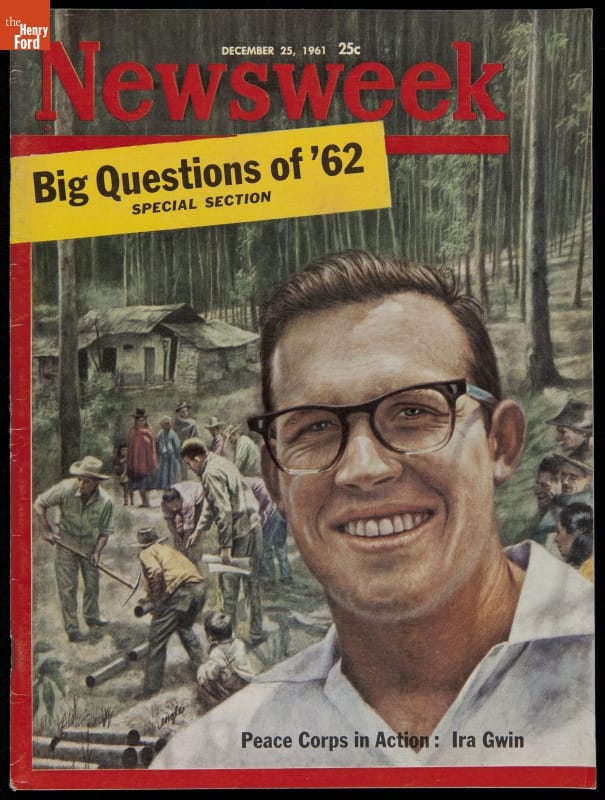
- Newsweek Magazine for December 25, 1961, "Peace Corps in Action: Ira Gwin" - President John F. Kennedy recognized the Peace Corps as an opportunity to spread goodwill and as a positive weapon against the Cold War. Established March 1, 1961, at the end of the program's second year, <EM>Newsweek</EM> magazine reported on the work of the volunteers. Their cover illustration featured Peace Corps volunteer Ira Gwin, from Barstow, California, serving in Tunía, Columbia.
- December 25, 1961
- Collections - Artifact
Newsweek Magazine for December 25, 1961, "Peace Corps in Action: Ira Gwin"
President John F. Kennedy recognized the Peace Corps as an opportunity to spread goodwill and as a positive weapon against the Cold War. Established March 1, 1961, at the end of the program's second year, Newsweek magazine reported on the work of the volunteers. Their cover illustration featured Peace Corps volunteer Ira Gwin, from Barstow, California, serving in Tunía, Columbia.
- "Peace Corps Malawi Cookbook," 1973-1989 -

- 1973-1989
- Collections - Artifact
"Peace Corps Malawi Cookbook," 1973-1989
- Look Magazine for June 14, 1966, "JFK's Legacy: The Peace Corps" - Less than three years after President John F. Kennedy's tragic death, <EM>Look</EM> magazine commissioned Norman Rockwell to portray Kennedy's Peace Corps legacy. Rockwell symbolically depicted Kennedy leading the vanguard of Americans of all ethnicities in service to their country and the world. Kennedy viewed the Peace Corps as an opportunity to spread goodwill and as a positive weapon against the Cold War.

- June 14, 1966
- Collections - Artifact
Look Magazine for June 14, 1966, "JFK's Legacy: The Peace Corps"
Less than three years after President John F. Kennedy's tragic death, Look magazine commissioned Norman Rockwell to portray Kennedy's Peace Corps legacy. Rockwell symbolically depicted Kennedy leading the vanguard of Americans of all ethnicities in service to their country and the world. Kennedy viewed the Peace Corps as an opportunity to spread goodwill and as a positive weapon against the Cold War.
- Book, "Guide to the Peace Corps," 1963 - President John F. Kennedy recognized the Peace Corps as an opportunity to spread goodwill and as a positive weapon against the Cold War. Established March 1, 1961, this 1965 paperback book includes a quote from President Lyndon Johnson, who supported continuing the program Kennedy began. Interested people could learn about how they could contribute to the Peace Corps by reading this book.

- 1963
- Collections - Artifact
Book, "Guide to the Peace Corps," 1963
President John F. Kennedy recognized the Peace Corps as an opportunity to spread goodwill and as a positive weapon against the Cold War. Established March 1, 1961, this 1965 paperback book includes a quote from President Lyndon Johnson, who supported continuing the program Kennedy began. Interested people could learn about how they could contribute to the Peace Corps by reading this book.
- Recruiting Advertisement for the Peace Corps, "Can You Teach?," 1963 - President John F. Kennedy established the Peace Corps in 1961 as an opportunity to spread goodwill and as a positive weapon against the Cold War. In 1963 <EM>Life</EM> magazine published this Peace Corps recruiting advertisement as a public service in cooperation with The Advertising Council. The ad "Can You Teach?" seen at the lower right, spoke to Americans who identified with Kennedy's "New Frontier" ideals.

- October 25, 1963
- Collections - Artifact
Recruiting Advertisement for the Peace Corps, "Can You Teach?," 1963
President John F. Kennedy established the Peace Corps in 1961 as an opportunity to spread goodwill and as a positive weapon against the Cold War. In 1963 Life magazine published this Peace Corps recruiting advertisement as a public service in cooperation with The Advertising Council. The ad "Can You Teach?" seen at the lower right, spoke to Americans who identified with Kennedy's "New Frontier" ideals.
- Book, "An International Peace Corps...the Promise and Problems," 1961 - President John F. Kennedy recognized the Peace Corps as an opportunity to spread goodwill and as a positive weapon against the Cold War. Established March 1, 1961, during that year the author of this book provided an early assessment of what a program like the Peace Corps could accomplish.

- 1961
- Collections - Artifact
Book, "An International Peace Corps...the Promise and Problems," 1961
President John F. Kennedy recognized the Peace Corps as an opportunity to spread goodwill and as a positive weapon against the Cold War. Established March 1, 1961, during that year the author of this book provided an early assessment of what a program like the Peace Corps could accomplish.
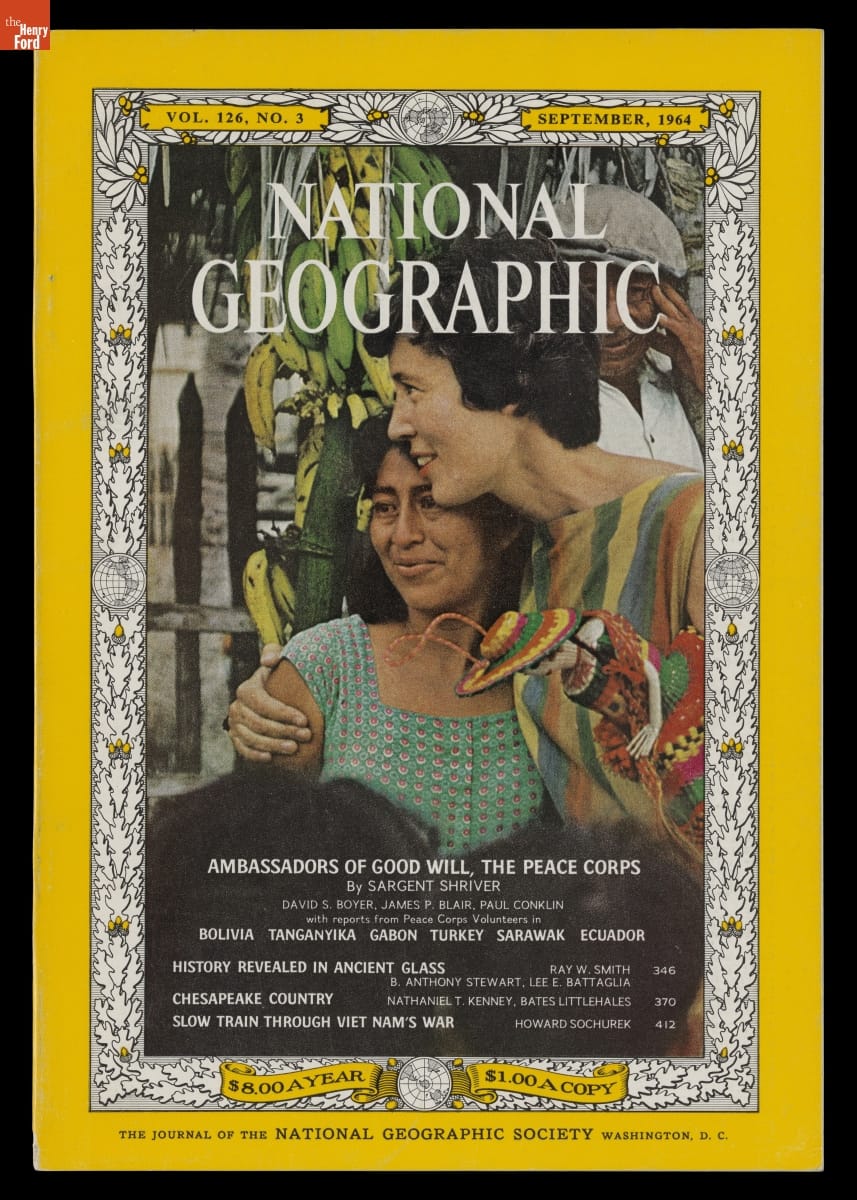
- "National Geographic," Vol. 126, No. 3, September 1964 - The National Geographic Society published the first issue of its magazine in the fall of 1888, within a year of its founding. <i>National Geographic</i>, initially a scholarly magazine for the Society's members, would not include a photograph in its pages until 1905; its distinctive yellow border would not appear until 1910. By 2024, more than one-and-a-half million subscribers received a digital or print version.
- September 01, 1964
- Collections - Artifact
"National Geographic," Vol. 126, No. 3, September 1964
The National Geographic Society published the first issue of its magazine in the fall of 1888, within a year of its founding. National Geographic, initially a scholarly magazine for the Society's members, would not include a photograph in its pages until 1905; its distinctive yellow border would not appear until 1910. By 2024, more than one-and-a-half million subscribers received a digital or print version.
- Booklet and Information Request Form, "Peace Corps Facts," 1964 - President John F. Kennedy recognized the Peace Corps as an opportunity to spread goodwill and as a positive weapon against the Cold War. Established March 1, 1961, by 1964 the program received over 45,000 applications--a record not surpassed in following years. In this 1964 U.S. government booklet, interested people learned how they could contribute to the Peace Corps.

- May 01, 1964
- Collections - Artifact
Booklet and Information Request Form, "Peace Corps Facts," 1964
President John F. Kennedy recognized the Peace Corps as an opportunity to spread goodwill and as a positive weapon against the Cold War. Established March 1, 1961, by 1964 the program received over 45,000 applications--a record not surpassed in following years. In this 1964 U.S. government booklet, interested people learned how they could contribute to the Peace Corps.
- Peace Corps Volunteer Questionnaire, 1964 - President John F. Kennedy recognized the Peace Corps as an opportunity to spread goodwill and as a positive weapon against the Cold War. Established March 1, 1961, by 1964 the program received over 45,000 applications--a record not surpassed in following years. People interested in contributing to the Peace Corps that year could apply using this U.S. government questionnaire.

- September 18, 1964
- Collections - Artifact
Peace Corps Volunteer Questionnaire, 1964
President John F. Kennedy recognized the Peace Corps as an opportunity to spread goodwill and as a positive weapon against the Cold War. Established March 1, 1961, by 1964 the program received over 45,000 applications--a record not surpassed in following years. People interested in contributing to the Peace Corps that year could apply using this U.S. government questionnaire.