
Search
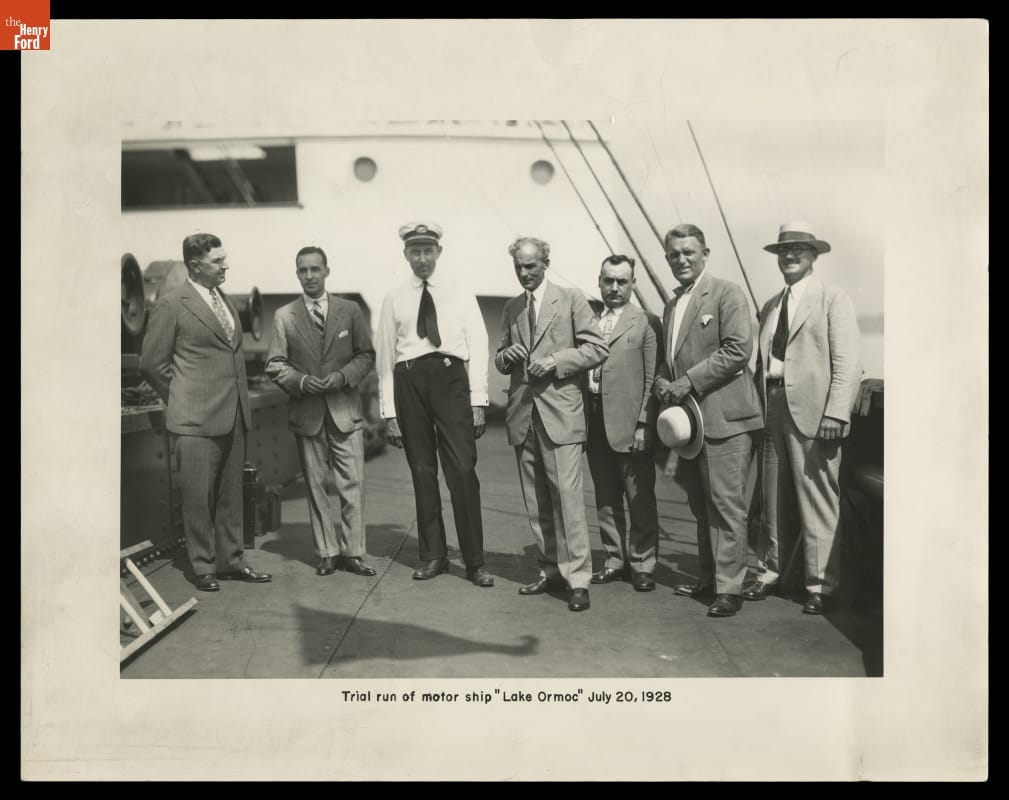
- Edsel Ford and Henry Ford with Others on Trial Run of the Lake Ormoc, July 20, 1928 - Henry Ford established Fordlandia and Belterra in the Brazilian rainforest to supply rubber for automobile production. He began shipping machinery and supplies to the Amazon in 1928. Two ships, <EM>Lake Ormoc</EM> and <EM>Lake Farge</EM>, left Dearborn, Michigan, that July. Ford and other executives posed for this photograph on the <EM>Lake Ormoc</EM> to commemorate the start of the project.
- July 20, 1928
- Collections - Artifact
Edsel Ford and Henry Ford with Others on Trial Run of the Lake Ormoc, July 20, 1928
Henry Ford established Fordlandia and Belterra in the Brazilian rainforest to supply rubber for automobile production. He began shipping machinery and supplies to the Amazon in 1928. Two ships, Lake Ormoc and Lake Farge, left Dearborn, Michigan, that July. Ford and other executives posed for this photograph on the Lake Ormoc to commemorate the start of the project.
- Henry Ford and Ford Motor Company Executives, March 29, 1932 - Ford Motor Company executives posed for this photograph in 1932. Left to right: P.E. Martin, vice president of manufacturing; Henry Ford; Charles Sorensen, production superintendent; B.J. Craig, secretary and treasurer; Eddie Maylon; Laurence Sheldrick, engineer; Ray Dahlinger, Ford Farms manager; William J. Cameron, public relations; Louis Walters; Harold Hicks, engineer; and A.M. Wiebel, vice president of purchasing.

- March 29, 1932
- Collections - Artifact
Henry Ford and Ford Motor Company Executives, March 29, 1932
Ford Motor Company executives posed for this photograph in 1932. Left to right: P.E. Martin, vice president of manufacturing; Henry Ford; Charles Sorensen, production superintendent; B.J. Craig, secretary and treasurer; Eddie Maylon; Laurence Sheldrick, engineer; Ray Dahlinger, Ford Farms manager; William J. Cameron, public relations; Louis Walters; Harold Hicks, engineer; and A.M. Wiebel, vice president of purchasing.
- Henry Ford and Ford Motor Company Executives at Henry Ford Museum, 1933 - One of the most important decisions that Henry Ford made early in his career was to identify talented individuals who could bring his vision for a universal car for the masses to reality. Each man pictured here was, in one way or another, directly responsible for Ford Motor Company's success, and failures, in the years leading up to World War II. P. E. Martin and Charles Sorensen were the hard-driving production and manufacturing heads that ensured Ford's plants operated at peak levels and achieved record production levels in the mid-1920s. B. J. Craig, as treasurer and secretary, was responsible for the hundreds of millions of dollars that funded all of Ford's operations. A. M. Wibel managed purchasing of everything from cotter pins and lubrication oil to coal mines and freighters at Ford's River Rouge plant, Highland Park, and ultimately for Ford operations worldwide. Raymond Dahlinger managed hundreds of thousands of acres of farmland for Henry Ford and Ford Motor Company. Left to right: P.E. (Peter Edmund) Martin, Vice President in charge of Manufacturing; B.J. (Burt John) Craig, Treasurer and Secretary; Charles E. Sorensen, Production Superintendent; Henry Ford; Raymond Dahlinger, Manager of Ford Farms; Edsel Ford; A.M. (Albert M.) Wibel, Vice President of Purchasing.

- July 20, 1933
- Collections - Artifact
Henry Ford and Ford Motor Company Executives at Henry Ford Museum, 1933
One of the most important decisions that Henry Ford made early in his career was to identify talented individuals who could bring his vision for a universal car for the masses to reality. Each man pictured here was, in one way or another, directly responsible for Ford Motor Company's success, and failures, in the years leading up to World War II. P. E. Martin and Charles Sorensen were the hard-driving production and manufacturing heads that ensured Ford's plants operated at peak levels and achieved record production levels in the mid-1920s. B. J. Craig, as treasurer and secretary, was responsible for the hundreds of millions of dollars that funded all of Ford's operations. A. M. Wibel managed purchasing of everything from cotter pins and lubrication oil to coal mines and freighters at Ford's River Rouge plant, Highland Park, and ultimately for Ford operations worldwide. Raymond Dahlinger managed hundreds of thousands of acres of farmland for Henry Ford and Ford Motor Company. Left to right: P.E. (Peter Edmund) Martin, Vice President in charge of Manufacturing; B.J. (Burt John) Craig, Treasurer and Secretary; Charles E. Sorensen, Production Superintendent; Henry Ford; Raymond Dahlinger, Manager of Ford Farms; Edsel Ford; A.M. (Albert M.) Wibel, Vice President of Purchasing.
- Henry Ford, Edsel Ford, and Ford Executives at Roundtable Luncheon in Dearborn Engineering Laboratory, July 1933 - In the early 1930s, Ford Motor Company's nerve center was the executive dining room at the Ford Engineering Laboratory in Dearborn. Every day at 1:00 p.m., Henry Ford sat down with his senior engineering, production, and sales executives for a working lunch. The mealtime discussions, which lasted anywhere from one to five hours, kept Mr. Ford informed on all company matters.

- July 01, 1933
- Collections - Artifact
Henry Ford, Edsel Ford, and Ford Executives at Roundtable Luncheon in Dearborn Engineering Laboratory, July 1933
In the early 1930s, Ford Motor Company's nerve center was the executive dining room at the Ford Engineering Laboratory in Dearborn. Every day at 1:00 p.m., Henry Ford sat down with his senior engineering, production, and sales executives for a working lunch. The mealtime discussions, which lasted anywhere from one to five hours, kept Mr. Ford informed on all company matters.
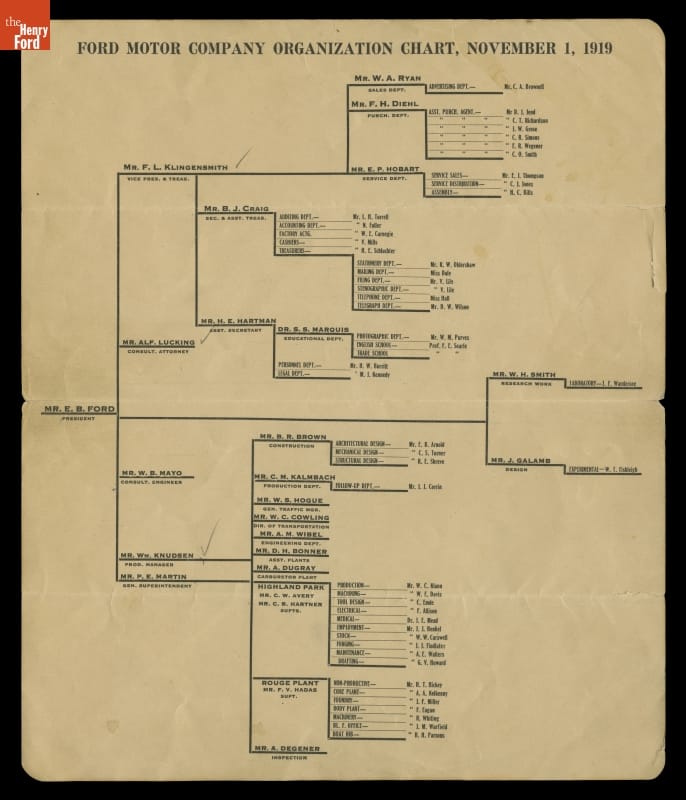
- Ford Motor Company Organization Chart, November 1, 1919 - Organizational charts and corporate hierarchies weren't strictly followed or enforced in Ford Motor Company's first decades -- largely because of founder Henry Ford's indifference to them. But this chart, issued in November 1919, illustrates a formal chain of command from president Edsel Ford down through company officers, superintendents, managers, and department heads.
- November 01, 1919
- Collections - Artifact
Ford Motor Company Organization Chart, November 1, 1919
Organizational charts and corporate hierarchies weren't strictly followed or enforced in Ford Motor Company's first decades -- largely because of founder Henry Ford's indifference to them. But this chart, issued in November 1919, illustrates a formal chain of command from president Edsel Ford down through company officers, superintendents, managers, and department heads.
- Edsel Ford, Henry Ford and Ford Executives at Roundtable Luncheon, Dearborn Engineering Laboratory, July 1933 - In the early 1930s, Ford Motor Company's nerve center was the executive dining room at the Ford Engineering Laboratory in Dearborn. Every day at 1:00 p.m., Henry Ford sat down with his senior engineering, production, and sales executives for a working lunch. The mealtime discussions, which lasted anywhere from one to five hours, kept Mr. Ford informed on all company matters.

- July 01, 1933
- Collections - Artifact
Edsel Ford, Henry Ford and Ford Executives at Roundtable Luncheon, Dearborn Engineering Laboratory, July 1933
In the early 1930s, Ford Motor Company's nerve center was the executive dining room at the Ford Engineering Laboratory in Dearborn. Every day at 1:00 p.m., Henry Ford sat down with his senior engineering, production, and sales executives for a working lunch. The mealtime discussions, which lasted anywhere from one to five hours, kept Mr. Ford informed on all company matters.
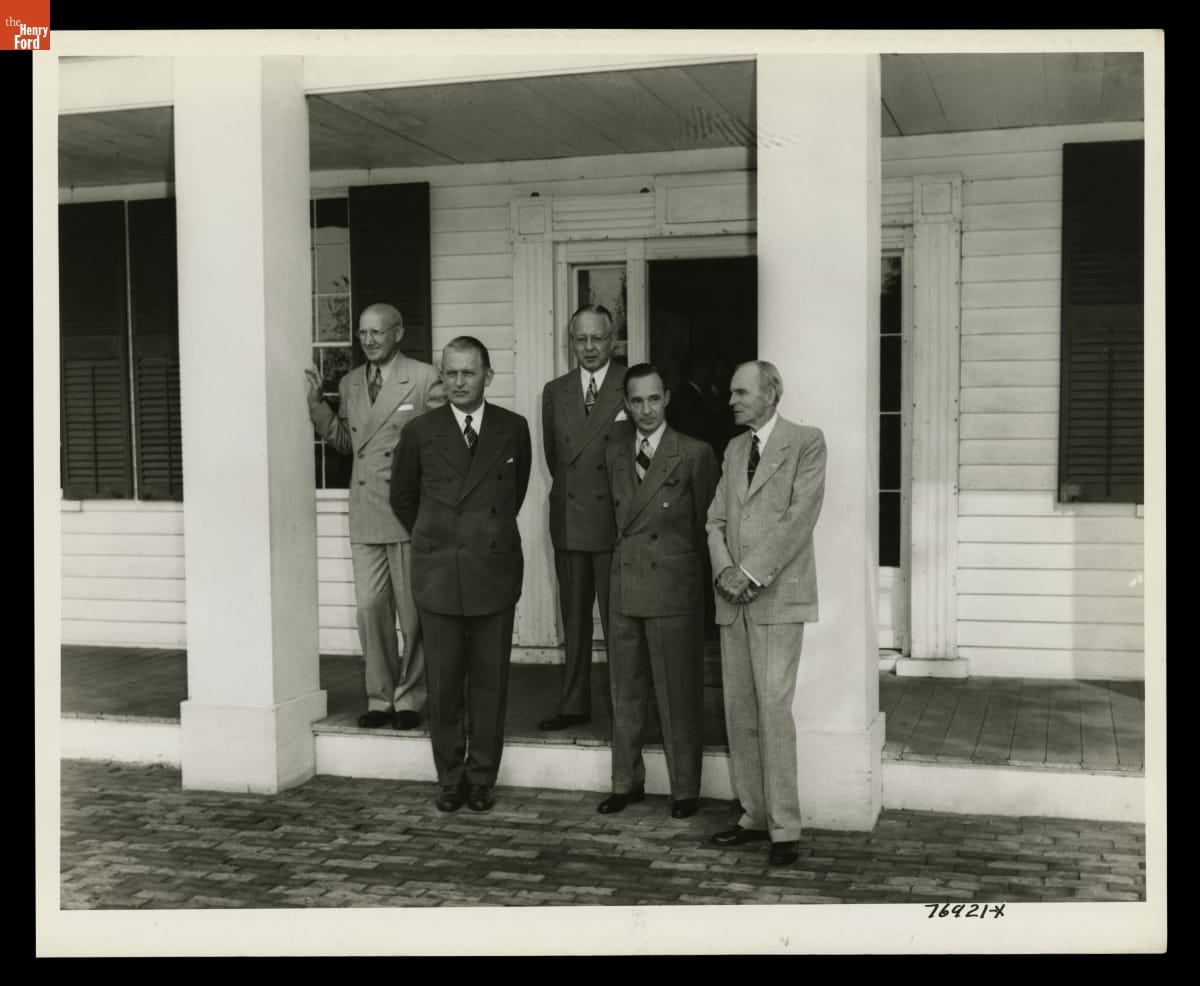
- Henry Ford, Edsel Ford, and Ford Motor Company Executives at Eagle Tavern in Greenfield Village, July 30, 1942 - Henry Ford, Clara Ford, Edsel Ford, and senior Ford Motor Company executives came to Greenfield Village, Henry Ford's living history museum in Dearborn, Michigan, on July 30, 1942. It was Henry Ford's 79th birthday, and family and coworkers gathered to wish him well.
- July 30, 1942
- Collections - Artifact
Henry Ford, Edsel Ford, and Ford Motor Company Executives at Eagle Tavern in Greenfield Village, July 30, 1942
Henry Ford, Clara Ford, Edsel Ford, and senior Ford Motor Company executives came to Greenfield Village, Henry Ford's living history museum in Dearborn, Michigan, on July 30, 1942. It was Henry Ford's 79th birthday, and family and coworkers gathered to wish him well.
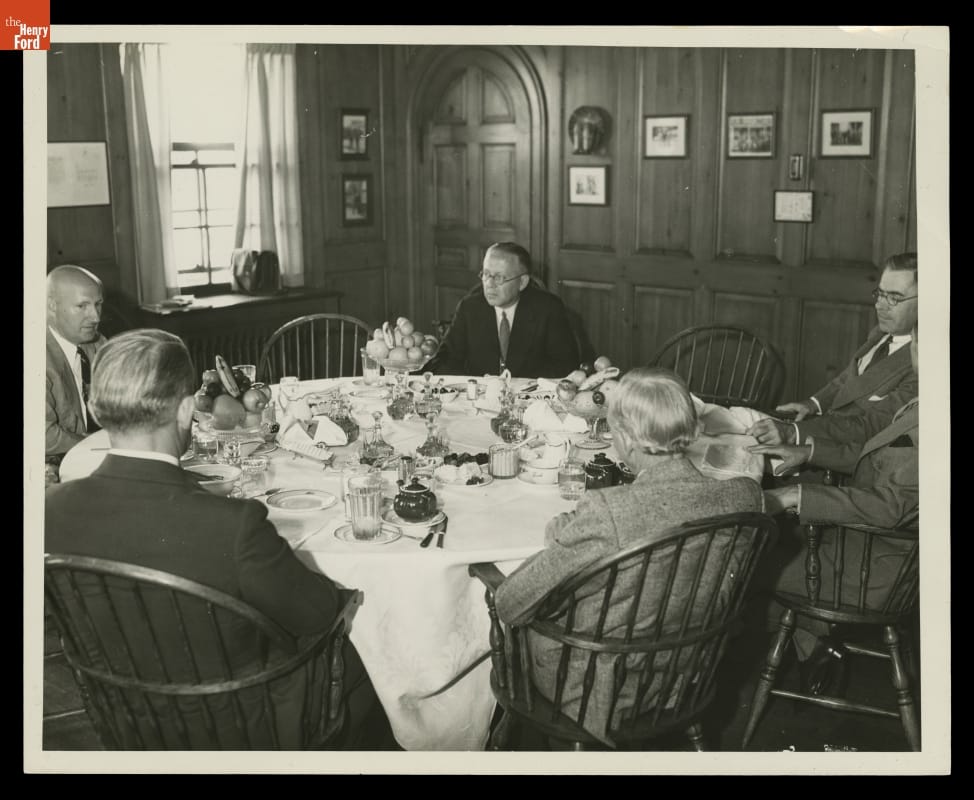
- Henry Ford, Edsel Ford, and Ford Executives at Roundtable Luncheon in Dearborn Engineering Laboratory, July 1933 - In the early 1930s, Ford Motor Company's nerve center was the executive dining room at the Ford Engineering Laboratory in Dearborn. Every day at 1:00 p.m., Henry Ford sat down with his senior engineering, production, and sales executives for a working lunch. The mealtime discussions, which lasted anywhere from one to five hours, kept Mr. Ford informed on all company matters.
- July 01, 1933
- Collections - Artifact
Henry Ford, Edsel Ford, and Ford Executives at Roundtable Luncheon in Dearborn Engineering Laboratory, July 1933
In the early 1930s, Ford Motor Company's nerve center was the executive dining room at the Ford Engineering Laboratory in Dearborn. Every day at 1:00 p.m., Henry Ford sat down with his senior engineering, production, and sales executives for a working lunch. The mealtime discussions, which lasted anywhere from one to five hours, kept Mr. Ford informed on all company matters.
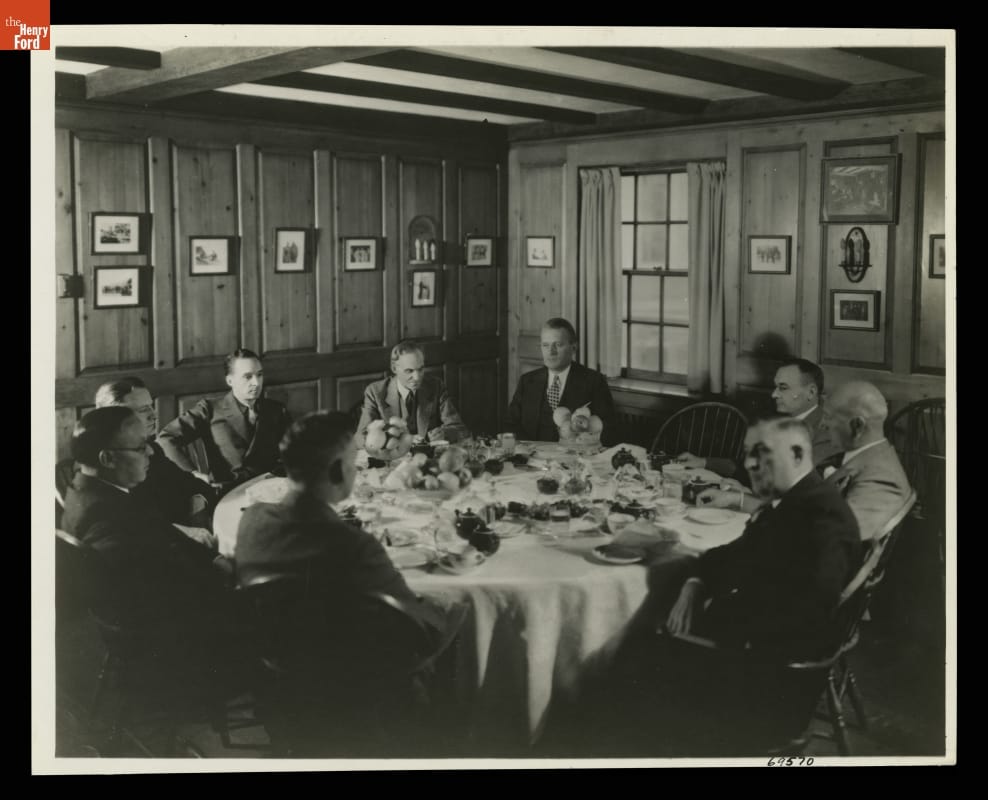
- Edsel Ford, Henry Ford, Charles Sorensen, P.E. Martin, and Other Ford Motor Company Executives at Roundtable Luncheon, circa 1933 - In the early 1930s, Ford Motor Company's nerve center was the executive dining room at the Ford Engineering Laboratory in Dearborn. Every day at 1:00 p.m., Henry Ford sat down with his senior engineering, production, and sales executives for a working lunch. The mealtime discussions, which lasted anywhere from one to five hours, kept Mr. Ford informed on all company matters.
- circa 1933
- Collections - Artifact
Edsel Ford, Henry Ford, Charles Sorensen, P.E. Martin, and Other Ford Motor Company Executives at Roundtable Luncheon, circa 1933
In the early 1930s, Ford Motor Company's nerve center was the executive dining room at the Ford Engineering Laboratory in Dearborn. Every day at 1:00 p.m., Henry Ford sat down with his senior engineering, production, and sales executives for a working lunch. The mealtime discussions, which lasted anywhere from one to five hours, kept Mr. Ford informed on all company matters.
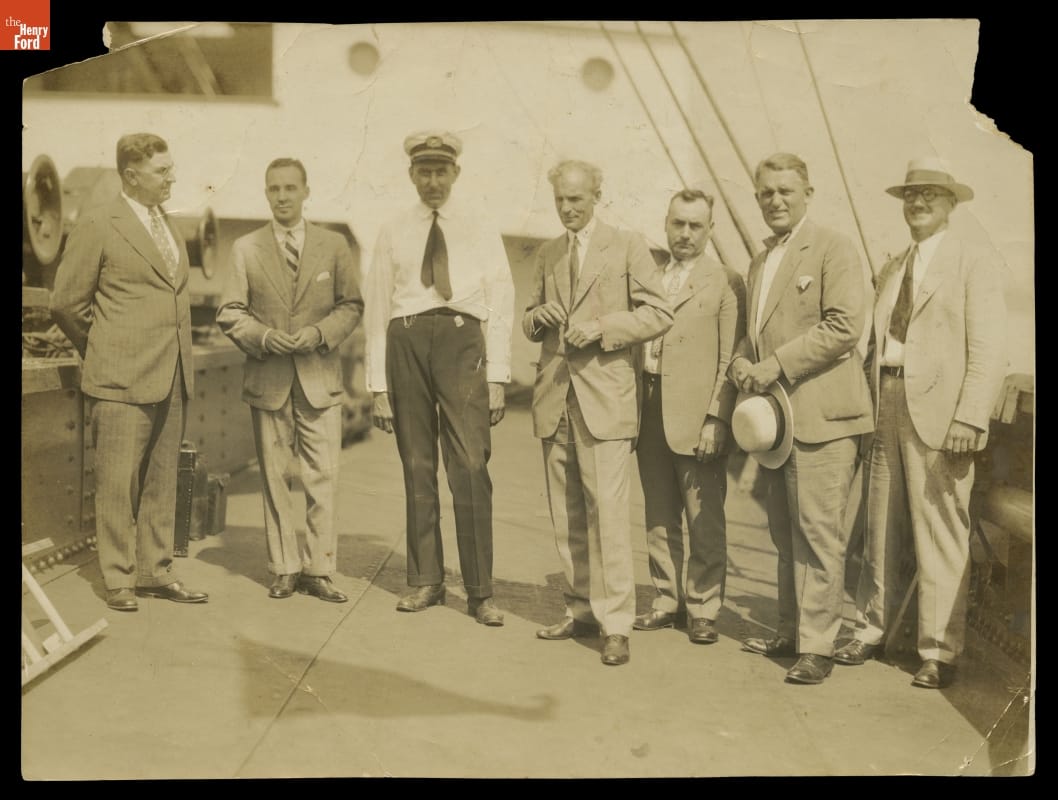
- Henry Ford and Edsel Ford with Others Aboard the MS Lake Ormoc, July 20, 1928 - Henry Ford established Fordlandia and Belterra in the Brazilian rainforest to supply rubber for automobile production. He began shipping machinery and supplies to the Amazon in 1928. Two ships, <EM>Lake Ormoc</EM> and <EM>Lake Farge</EM>, left Dearborn, Michigan, that July. Ford and other executives posed for this photograph on the <EM>Lake Ormoc</EM> to commemorate the start of the project.
- July 20, 1928
- Collections - Artifact
Henry Ford and Edsel Ford with Others Aboard the MS Lake Ormoc, July 20, 1928
Henry Ford established Fordlandia and Belterra in the Brazilian rainforest to supply rubber for automobile production. He began shipping machinery and supplies to the Amazon in 1928. Two ships, Lake Ormoc and Lake Farge, left Dearborn, Michigan, that July. Ford and other executives posed for this photograph on the Lake Ormoc to commemorate the start of the project.