
Search
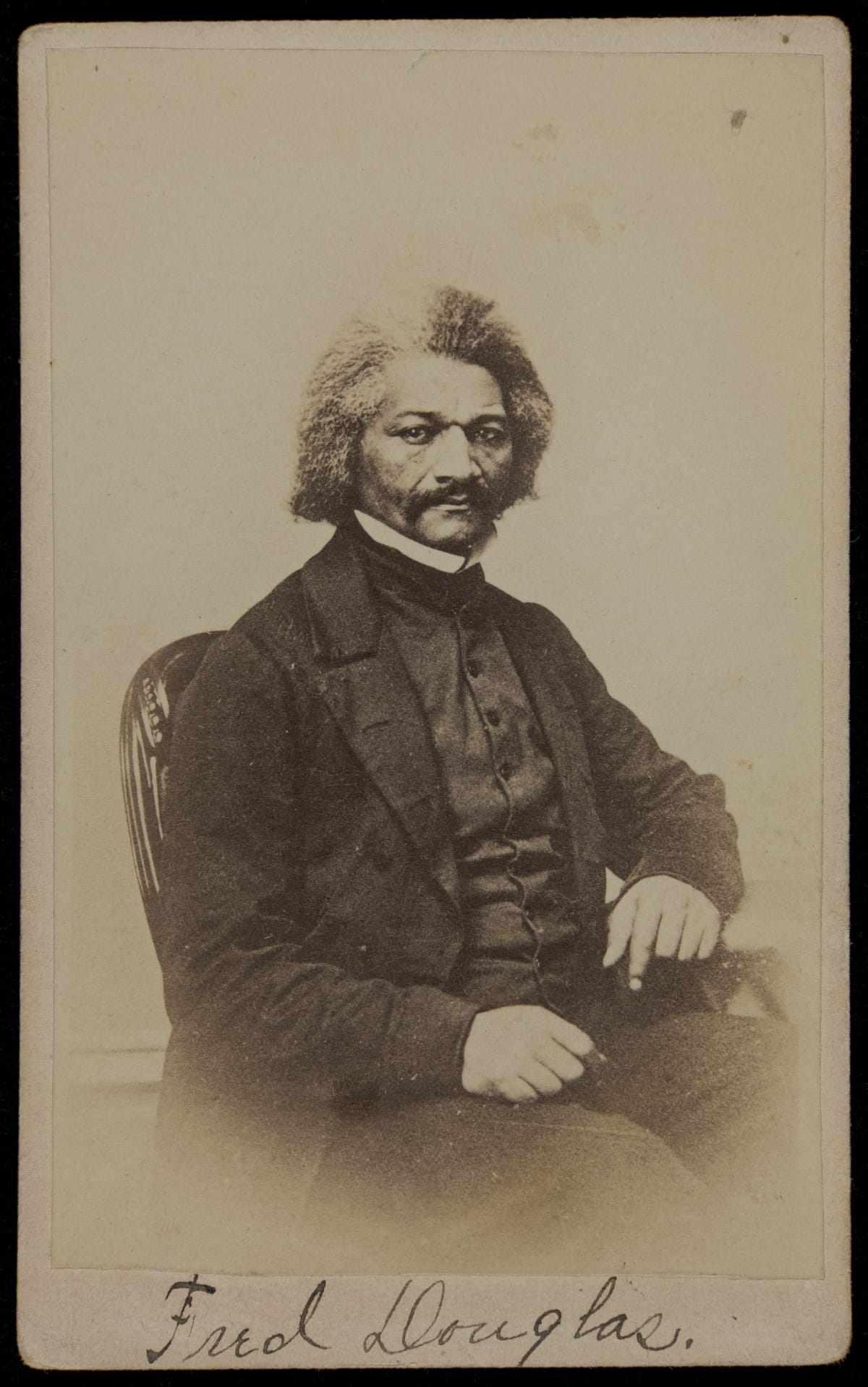
- Portrait of Frederick Douglass, circa 1860 - Frederick Douglass, abolitionist and reform journalist, is shown in this portrait about the time that he advised President Lincoln regarding African Americans. Douglass became a leader in the anti-slavery movement when he spontaneously stood up and spoke at an abolitionist meeting in 1841. His gut-wrenching tales about life on the plantation in Maryland turned thousands of skeptical Americans into active abolitionists.
- circa 1860
- Collections - Artifact
Portrait of Frederick Douglass, circa 1860
Frederick Douglass, abolitionist and reform journalist, is shown in this portrait about the time that he advised President Lincoln regarding African Americans. Douglass became a leader in the anti-slavery movement when he spontaneously stood up and spoke at an abolitionist meeting in 1841. His gut-wrenching tales about life on the plantation in Maryland turned thousands of skeptical Americans into active abolitionists.
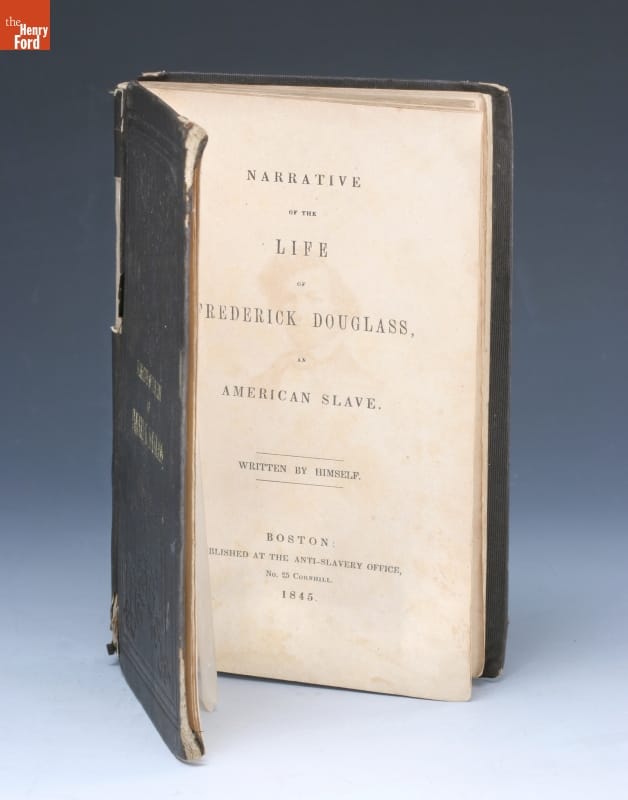
- "Narrative of the Life of Frederick Douglass," 1845 - Frederick Douglass became a leader in the anti-slavery movement when he spontaneously stood up and spoke at an abolitionist meeting in 1841. Douglass wrote about his life as a slave to support the growing abolitionist movement. This book led to his career as a reform journalist. His gut-wrenching tales about life on the plantation in Maryland turned thousands of skeptical Americans into active abolitionists.
- 1817?-1845
- Collections - Artifact
"Narrative of the Life of Frederick Douglass," 1845
Frederick Douglass became a leader in the anti-slavery movement when he spontaneously stood up and spoke at an abolitionist meeting in 1841. Douglass wrote about his life as a slave to support the growing abolitionist movement. This book led to his career as a reform journalist. His gut-wrenching tales about life on the plantation in Maryland turned thousands of skeptical Americans into active abolitionists.
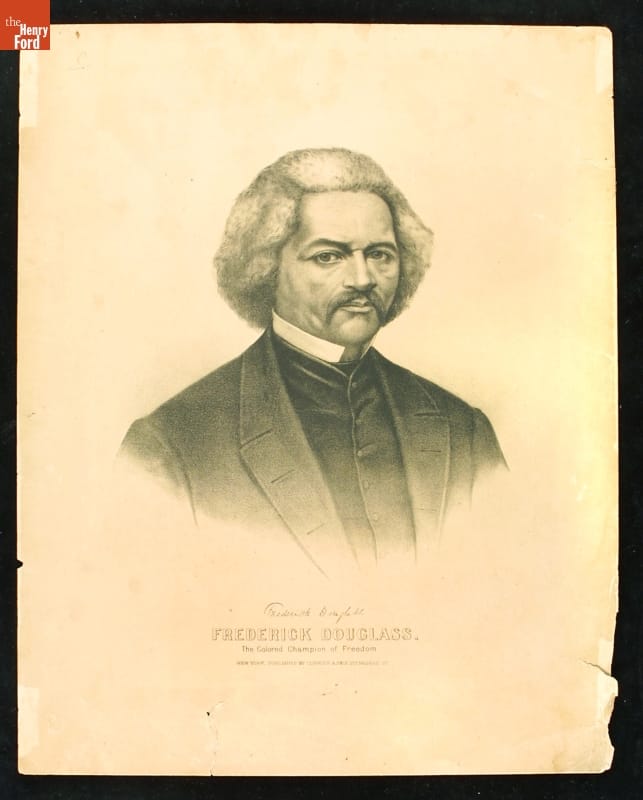
- "Frederick Douglass, The Colored Champion of Freedom," 1872-1874 - Frederick Douglass, abolitionist and reform journalist, is depicted in the early 1860s around the time that he advised President Lincoln regarding African Americans. Douglass became a leader in the anti-slavery movement when he spontaneously stood up and spoke at an abolitionist meeting in 1841. His gut-wrenching tales about life on the plantation in Maryland turned thousands of skeptical Americans into active abolitionists.
- circa 1860
- Collections - Artifact
"Frederick Douglass, The Colored Champion of Freedom," 1872-1874
Frederick Douglass, abolitionist and reform journalist, is depicted in the early 1860s around the time that he advised President Lincoln regarding African Americans. Douglass became a leader in the anti-slavery movement when he spontaneously stood up and spoke at an abolitionist meeting in 1841. His gut-wrenching tales about life on the plantation in Maryland turned thousands of skeptical Americans into active abolitionists.
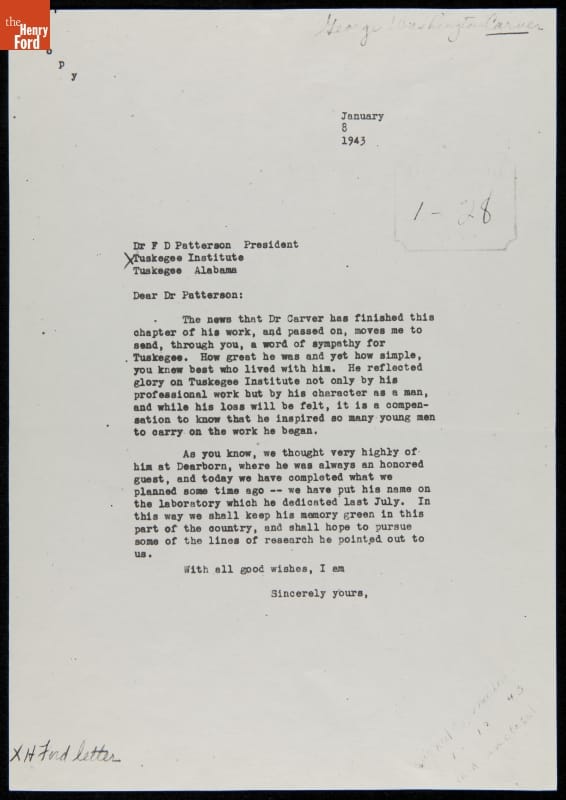
- Letter from Henry Ford to Frederick Douglass Patterson, January 8, 1943 - George Washington Carver died January 5, 1943. After hearing the news, his friend Henry Ford sent a letter of sympathy and appreciation to Frederick Douglass Patterson, president of the Tuskegee Institute, the university in Alabama where Carver had worked since 1896. Ford and the noted agricultural scientist had been friends and colleagues since the late 1930s.
- January 08, 1943
- Collections - Artifact
Letter from Henry Ford to Frederick Douglass Patterson, January 8, 1943
George Washington Carver died January 5, 1943. After hearing the news, his friend Henry Ford sent a letter of sympathy and appreciation to Frederick Douglass Patterson, president of the Tuskegee Institute, the university in Alabama where Carver had worked since 1896. Ford and the noted agricultural scientist had been friends and colleagues since the late 1930s.
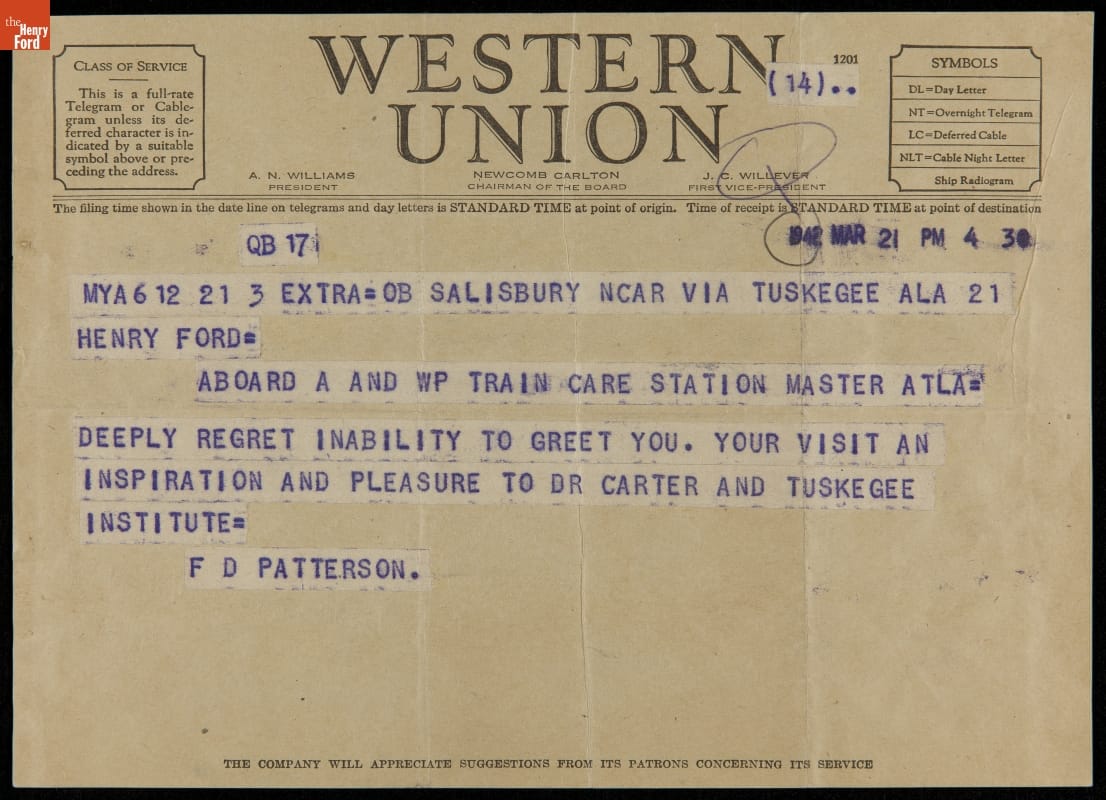
- Telegram from Frederick Douglass Patterson to Henry Ford, March 21, 1942 - Frederick Douglass Patterson, president of the Tuskegee Institute in Alabama from 1935-1953, knew Henry Ford through their mutual friendship with George Washington Carver -- the famous agriculture scientist and educator. Ford and Carver had become friends in the late 1930s. In this telegram, Patterson sends his regrets at not greeting Ford during one of Ford's visits.
- March 21, 1942
- Collections - Artifact
Telegram from Frederick Douglass Patterson to Henry Ford, March 21, 1942
Frederick Douglass Patterson, president of the Tuskegee Institute in Alabama from 1935-1953, knew Henry Ford through their mutual friendship with George Washington Carver -- the famous agriculture scientist and educator. Ford and Carver had become friends in the late 1930s. In this telegram, Patterson sends his regrets at not greeting Ford during one of Ford's visits.
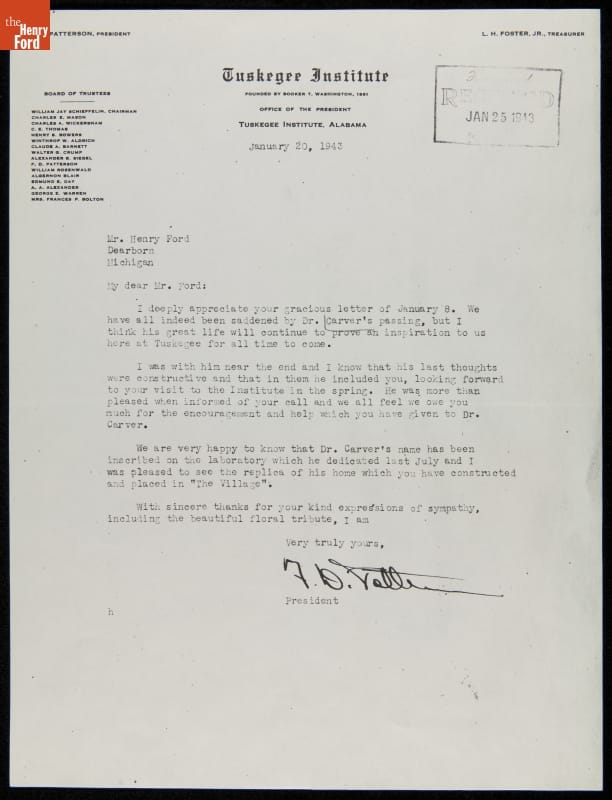
- Letter from Frederick Douglass Patterson to Henry Ford, January 20, 1943 - Frederick Douglass Patterson, President of the Tuskegee Institute in Alabama from 1935-1953, wrote to Henry Ford several times. Patterson thanked Ford for his kindness to Ford's friend, and longtime Tuskegee agricultural sciences educator and researcher, George Washington Carver.
- January 20, 1943
- Collections - Artifact
Letter from Frederick Douglass Patterson to Henry Ford, January 20, 1943
Frederick Douglass Patterson, President of the Tuskegee Institute in Alabama from 1935-1953, wrote to Henry Ford several times. Patterson thanked Ford for his kindness to Ford's friend, and longtime Tuskegee agricultural sciences educator and researcher, George Washington Carver.
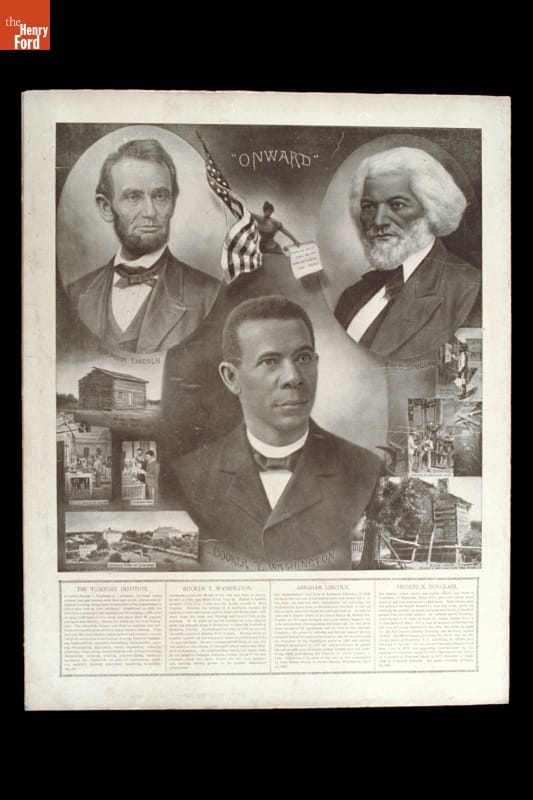
- Print of Abraham Lincoln, Frederick Douglass, and Booker T. Washington, "Onward," 1903 - This poster depicts three leading Americans who advanced African-American life at the turn of the 20th century. Frederick Douglass challenged slavery and worked for its abolition. President Abraham Lincoln signed the Emancipation Proclamation to preserve the Union by declaring freedom to slaves in rebel states. Booker T. Washington, leader of the Tuskegee Institute, promoted African-American rights through education and industry.
- 1903
- Collections - Artifact
Print of Abraham Lincoln, Frederick Douglass, and Booker T. Washington, "Onward," 1903
This poster depicts three leading Americans who advanced African-American life at the turn of the 20th century. Frederick Douglass challenged slavery and worked for its abolition. President Abraham Lincoln signed the Emancipation Proclamation to preserve the Union by declaring freedom to slaves in rebel states. Booker T. Washington, leader of the Tuskegee Institute, promoted African-American rights through education and industry.
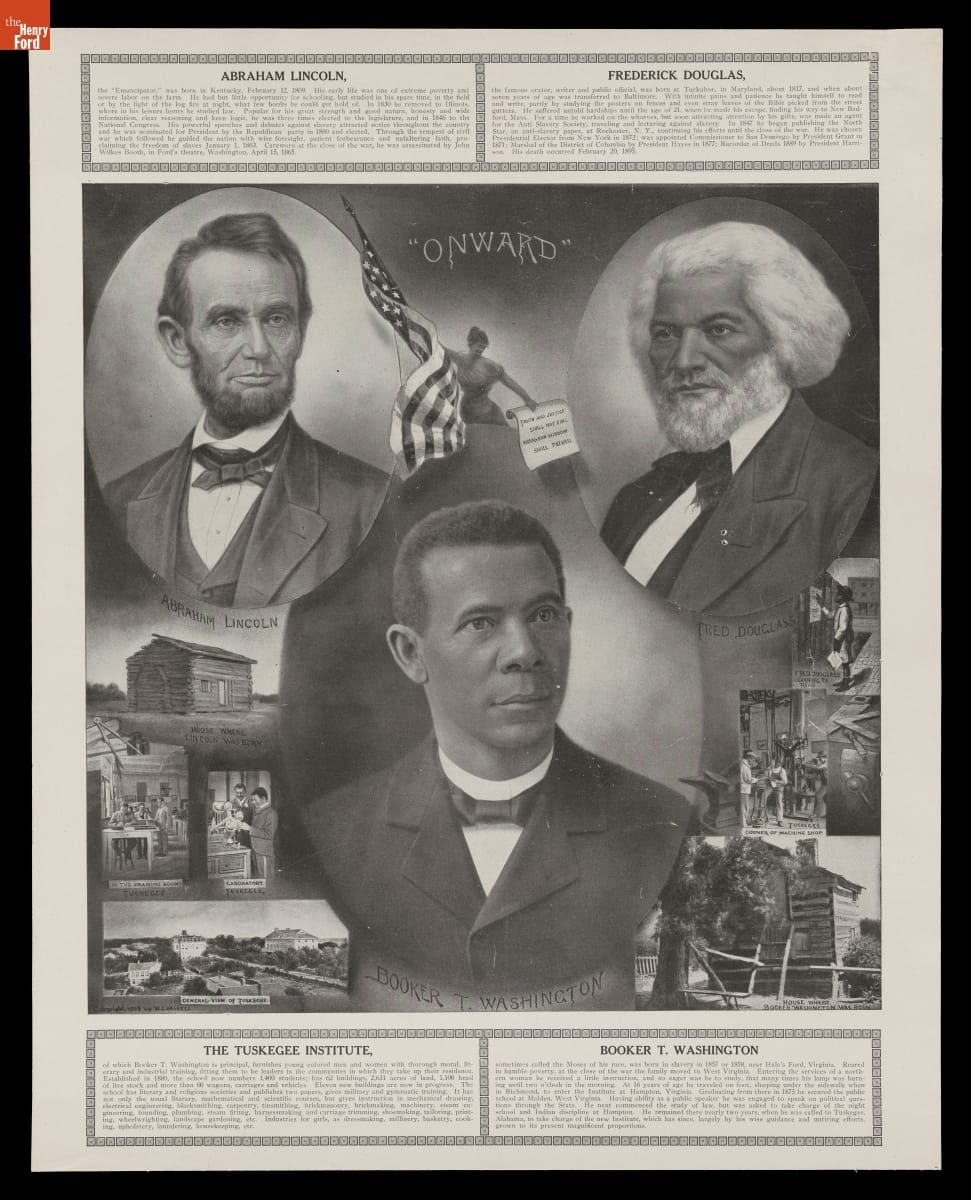
- Print of Abraham Lincoln, Frederick Douglass, and Booker T. Washington, "Onward," 1903 - This poster depicts three leading Americans who advanced African-American life at the turn of the 20th century. Frederick Douglass challenged slavery and worked for its abolition. President Abraham Lincoln signed the Emancipation Proclamation to preserve the Union by declaring freedom to slaves in rebel states. Booker T. Washington, leader of the Tuskegee Institute, promoted African-American rights through education and industry.
- 1903
- Collections - Artifact
Print of Abraham Lincoln, Frederick Douglass, and Booker T. Washington, "Onward," 1903
This poster depicts three leading Americans who advanced African-American life at the turn of the 20th century. Frederick Douglass challenged slavery and worked for its abolition. President Abraham Lincoln signed the Emancipation Proclamation to preserve the Union by declaring freedom to slaves in rebel states. Booker T. Washington, leader of the Tuskegee Institute, promoted African-American rights through education and industry.
- Letter from Frederick Douglass Patterson, President of Tuskegee Institute, to Henry Ford, March 18, 1940 - Frederick Douglass Patterson, President of the Tuskegee Institute in Alabama from 1935-1953, wrote to Henry Ford several times. Patterson thanked Ford for his kindness to Ford's friend, and longtime Tuskegee agricultural sciences educator and researcher, George Washington Carver.
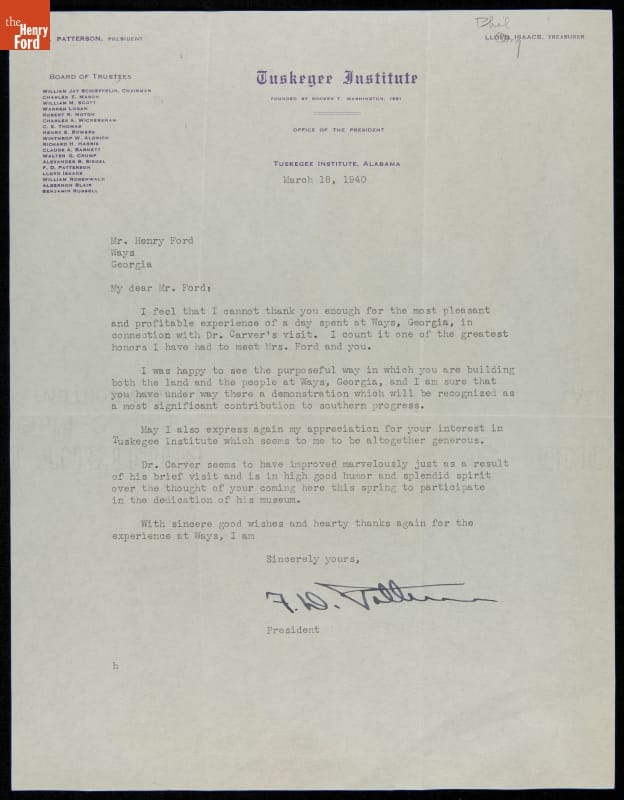
- March 18, 1940
- Collections - Artifact
Letter from Frederick Douglass Patterson, President of Tuskegee Institute, to Henry Ford, March 18, 1940
Frederick Douglass Patterson, President of the Tuskegee Institute in Alabama from 1935-1953, wrote to Henry Ford several times. Patterson thanked Ford for his kindness to Ford's friend, and longtime Tuskegee agricultural sciences educator and researcher, George Washington Carver.
- The Incredible Life of Frederick Douglass - Explore the life of Frederick Douglass, one of the most inspirational figures in American history, through artifacts from the collections of The Henry Ford. Follow along from his birth into slavery, through his escape to freedom.

- February 22, 2021
- Collections - article
The Incredible Life of Frederick Douglass
Explore the life of Frederick Douglass, one of the most inspirational figures in American history, through artifacts from the collections of The Henry Ford. Follow along from his birth into slavery, through his escape to freedom.