
Search
- "Keep the Buses Rolling" Button, 1975-1980 -
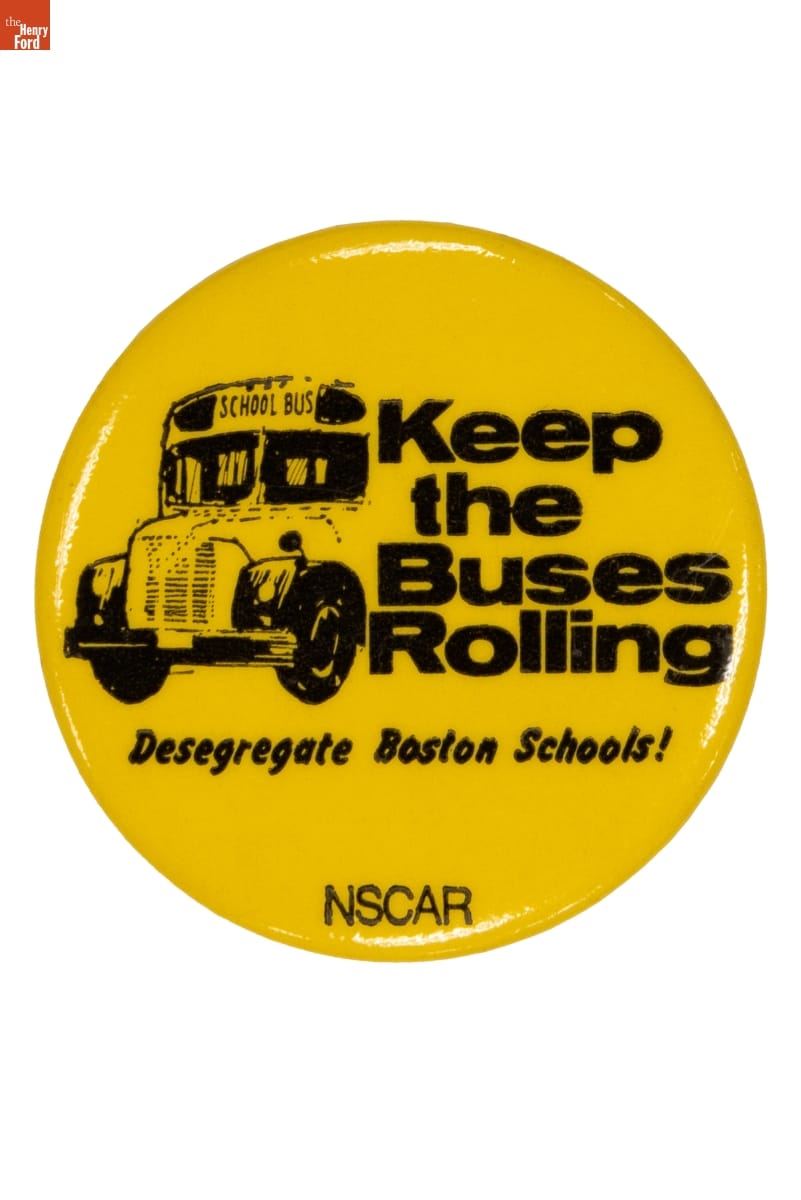
- 1975-1980
- Collections - Artifact
"Keep the Buses Rolling" Button, 1975-1980
- 60 Years of the Civil Rights Act of 1964 - <p>2024 marks 60 years since the passage of the 1964 Civil Rights Act. In the culmination of decades-long grassroots activism from people of all colors and backgrounds, the act countered the racism of Jim Crow laws. This previously recorded presentation, led by Heather Bruegl (Oneida/Stockbridge-Munsee), Curator of Political and Civic Engagement, and Amber N. Mitchell, Curator of Black History, explores this act that changed the course of America, including its origins and legacy and the call to action that it still has for Americans today. </p>

- September 19, 2024
- Collections - Video
60 Years of the Civil Rights Act of 1964
2024 marks 60 years since the passage of the 1964 Civil Rights Act. In the culmination of decades-long grassroots activism from people of all colors and backgrounds, the act countered the racism of Jim Crow laws. This previously recorded presentation, led by Heather Bruegl (Oneida/Stockbridge-Munsee), Curator of Political and Civic Engagement, and Amber N. Mitchell, Curator of Black History, explores this act that changed the course of America, including its origins and legacy and the call to action that it still has for Americans today.
- Connecting with Community: What We’re Reading and Watching - Staff from The Henry Ford recommend books, podcasts, and TV shows that speak to the idea of “connecting with community” through the lenses of social activism, social justice and injustice, and diversity.

- December 24, 2021
- Collections - article
Connecting with Community: What We’re Reading and Watching
Staff from The Henry Ford recommend books, podcasts, and TV shows that speak to the idea of “connecting with community” through the lenses of social activism, social justice and injustice, and diversity.
- Food Soldiers: Nutrition and Race Activism - Find out what a food soldier is, as well as how food and nutrition relate to issues of institutional racism and equity for African Americans.

- February 10, 2021
- Collections - article
Food Soldiers: Nutrition and Race Activism
Find out what a food soldier is, as well as how food and nutrition relate to issues of institutional racism and equity for African Americans.
- Wendell Scott: Breaking NASCAR’s Color Barrier - Wendell Scott overcame obstacles, including the insidious challenge of racism, to become the first African American driver to compete full-time in NASCAR’s top-level Cup Series. Learn his story on our blog.

- February 12, 2021
- Collections - article
Wendell Scott: Breaking NASCAR’s Color Barrier
Wendell Scott overcame obstacles, including the insidious challenge of racism, to become the first African American driver to compete full-time in NASCAR’s top-level Cup Series. Learn his story on our blog.
- A Rosa Parks Baseball?: Inspiring Curt Flood's Battle with Major League Baseball - Learn how Curt Flood took on racism and injustice in Major League Baseball, the toll this work had on him, and how he turned his life around—and met a civil rights icon.

- February 03, 2022
- Collections - article
A Rosa Parks Baseball?: Inspiring Curt Flood's Battle with Major League Baseball
Learn how Curt Flood took on racism and injustice in Major League Baseball, the toll this work had on him, and how he turned his life around—and met a civil rights icon.
- "We Shall Overcome" Print Portfolio - Learn the story behind a series of silkscreen prints by artist Louis Lo Monaco and their role in the 1963 March on Washington for Jobs and Freedom—and today—to inspire communal action and equitable justice.

- February 08, 2021
- Collections - article
"We Shall Overcome" Print Portfolio
Learn the story behind a series of silkscreen prints by artist Louis Lo Monaco and their role in the 1963 March on Washington for Jobs and Freedom—and today—to inspire communal action and equitable justice.
- Elijah McCoy’s Steam Engine Lubricator - Learn how Elijah McCoy, the Black son of formerly enslaved parents, secured at least 52 patents and design registrations during his lifetime--and explore his 1882 steam engine lubricator, on exhibit in Henry Ford Museum of American Innovation.

- February 03, 2021
- Collections - article
Elijah McCoy’s Steam Engine Lubricator
Learn how Elijah McCoy, the Black son of formerly enslaved parents, secured at least 52 patents and design registrations during his lifetime--and explore his 1882 steam engine lubricator, on exhibit in Henry Ford Museum of American Innovation.
- A Quilt with a Cause - Learn the story behind the "Nude is Not a Color" quilt, created in 2017, and hear from the worldwide community of women who gathered virtually to take a stand against racial bias. You can see it for yourself on exhibit as part of What We Wore in Henr

- March 08, 2021
- Collections - article
A Quilt with a Cause
Learn the story behind the "Nude is Not a Color" quilt, created in 2017, and hear from the worldwide community of women who gathered virtually to take a stand against racial bias. You can see it for yourself on exhibit as part of What We Wore in Henr
- Weaving Stories: Spotlight on The Henry Ford's Indigenous Artist in Residence - This year, The Henry Ford took steps toward building community with Indigenous nations by expanding the institution’s Artists in Residence program, offered annually in Greenfield Village. To kick off Celebrate Indigenous History programming, we welcomed Maggie Thompson (Fond du Lac Ojibwe) as the inaugural Indigenous Artist in Residence.

- November 25, 2025
- Collections - article
Weaving Stories: Spotlight on The Henry Ford's Indigenous Artist in Residence
This year, The Henry Ford took steps toward building community with Indigenous nations by expanding the institution’s Artists in Residence program, offered annually in Greenfield Village. To kick off Celebrate Indigenous History programming, we welcomed Maggie Thompson (Fond du Lac Ojibwe) as the inaugural Indigenous Artist in Residence.