Search
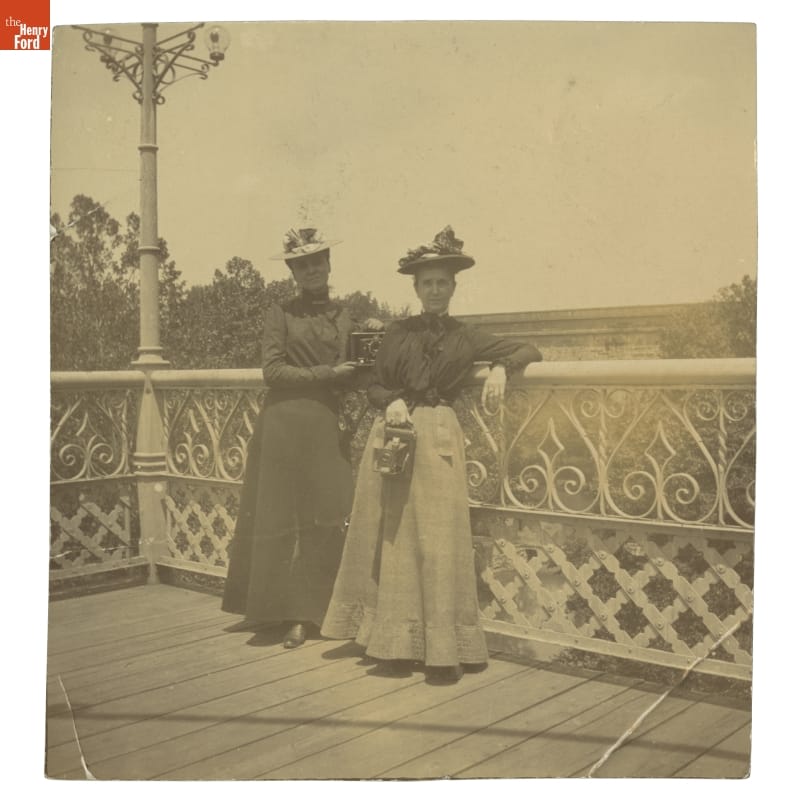
- Francis Riggs and Friend with Cameras at Cabin John Bridge, Maryland, 1901 - Developed by the end of the 19th century, portable cameras allowed amateur photographers to capture their excursions on film. This snapshot helped the travelers relive their vacation and encouraged friends and family to take similar trips.
- June 01, 1901
- Collections - Artifact
Francis Riggs and Friend with Cameras at Cabin John Bridge, Maryland, 1901
Developed by the end of the 19th century, portable cameras allowed amateur photographers to capture their excursions on film. This snapshot helped the travelers relive their vacation and encouraged friends and family to take similar trips.
- Voightlander Folding Camera, 1930-1940 - Folding cameras were designed to be portable and rugged. The lens sits at the end of a collapsible bellows system, often adjustable to provide better focus. The camera's back typically contains 120 roll film, with multiple exposures on a roll. Popular from 1900 until the introduction of 35mm film in 1945, many amateur photographers owned cameras like this.

- 1930-1940
- Collections - Artifact
Voightlander Folding Camera, 1930-1940
Folding cameras were designed to be portable and rugged. The lens sits at the end of a collapsible bellows system, often adjustable to provide better focus. The camera's back typically contains 120 roll film, with multiple exposures on a roll. Popular from 1900 until the introduction of 35mm film in 1945, many amateur photographers owned cameras like this.
- Polaroid Square Shooter Land Camera, 1971-1972 - This is among the first of Polaroid's cameras to use the company's now-iconic square format film. A 1971 advertisement reasons with customers: "You lose a little picture… but you save on the cost of film," and hypes the abridged image as "a square deal." Promising color photographs in 60 seconds, this forerunner of the digital camera offered (nearly) instant results.

- 1971-1972
- Collections - Artifact
Polaroid Square Shooter Land Camera, 1971-1972
This is among the first of Polaroid's cameras to use the company's now-iconic square format film. A 1971 advertisement reasons with customers: "You lose a little picture… but you save on the cost of film," and hypes the abridged image as "a square deal." Promising color photographs in 60 seconds, this forerunner of the digital camera offered (nearly) instant results.
- Kodak Vest Pocket Autographic Camera, 1915-1926 - Folding cameras were designed to be portable and rugged. The lens sits at the end of a collapsible bellows system, often adjustable to provide better focus. The camera's back typically contains 120 roll film, with multiple exposures on a roll. Popular from 1900 until the introduction of 35mm film in 1945, many amateur photographers owned cameras like this.

- 1915-1926
- Collections - Artifact
Kodak Vest Pocket Autographic Camera, 1915-1926
Folding cameras were designed to be portable and rugged. The lens sits at the end of a collapsible bellows system, often adjustable to provide better focus. The camera's back typically contains 120 roll film, with multiple exposures on a roll. Popular from 1900 until the introduction of 35mm film in 1945, many amateur photographers owned cameras like this.
- Realist Stereo Camera, Model ST55, 1950-1960 - This camera is creates 3D images. Three lenses capture two slightly different views, simulating human binocular vision. Images are exposed on slide film, mounted into cards, and observed through special viewers that reassemble the two images as one. In 1947, the David White Company began manufacturing stereo cameras, producing the most popular models and sparking amateur use of stereo photography.

- 1950-1960
- Collections - Artifact
Realist Stereo Camera, Model ST55, 1950-1960
This camera is creates 3D images. Three lenses capture two slightly different views, simulating human binocular vision. Images are exposed on slide film, mounted into cards, and observed through special viewers that reassemble the two images as one. In 1947, the David White Company began manufacturing stereo cameras, producing the most popular models and sparking amateur use of stereo photography.
- Kodak No. 3 Folding Pocket Camera, Model H, 1914-1915 - Folding cameras were designed to be portable and rugged. The lens sits at the end of a collapsible bellows system, often adjustable to provide better focus. The camera's back typically contains 120 roll film, with multiple exposures on a roll. Popular from 1900 until the introduction of 35mm film in 1945, many amateur photographers owned cameras like this.

- 1914-1915
- Collections - Artifact
Kodak No. 3 Folding Pocket Camera, Model H, 1914-1915
Folding cameras were designed to be portable and rugged. The lens sits at the end of a collapsible bellows system, often adjustable to provide better focus. The camera's back typically contains 120 roll film, with multiple exposures on a roll. Popular from 1900 until the introduction of 35mm film in 1945, many amateur photographers owned cameras like this.
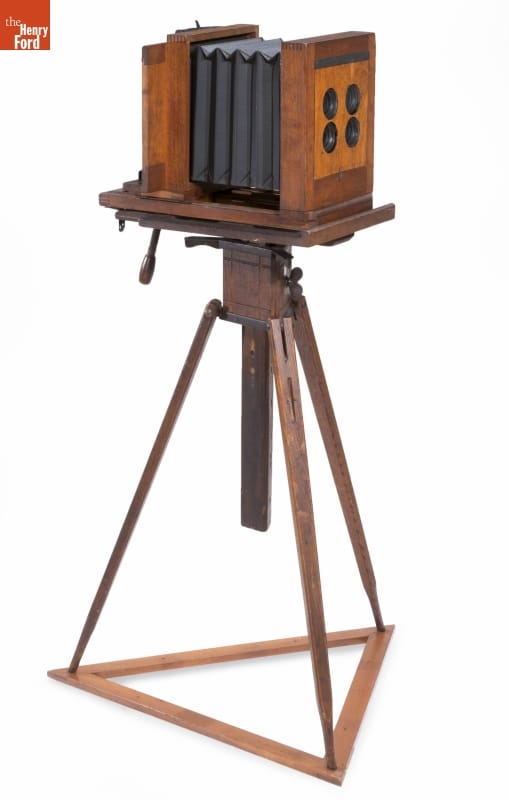
- Rochester Optical Company View Camera, New Model Style, circa 1895 - Folding cameras were designed to be portable and rugged. The lens sits at the end of a collapsible bellows system, often adjustable to provide better focus. The back of this camera held glass plates for exposure; some models contained cartridges with multiple plates. Once user-friendly roll film cameras were perfected around 1900, plate cameras began to wane.

- circa 1895
- Collections - Artifact
Rochester Optical Company View Camera, New Model Style, circa 1895
Folding cameras were designed to be portable and rugged. The lens sits at the end of a collapsible bellows system, often adjustable to provide better focus. The back of this camera held glass plates for exposure; some models contained cartridges with multiple plates. Once user-friendly roll film cameras were perfected around 1900, plate cameras began to wane.
- Conley Senior Box Camera, circa 1900 - Box cameras were simple: a lens at one end, a glass plate or film at the other. Introduced in the 1880s--and mass marketed with Kodak's Brownie in 1900--these cameras were accessible and affordable for amateur photographers. Conley box cameras were distributed through Sears, Roebuck & Co.; this single-shot model had a storage compartment for extra plates.

- circa 1900
- Collections - Artifact
Conley Senior Box Camera, circa 1900
Box cameras were simple: a lens at one end, a glass plate or film at the other. Introduced in the 1880s--and mass marketed with Kodak's Brownie in 1900--these cameras were accessible and affordable for amateur photographers. Conley box cameras were distributed through Sears, Roebuck & Co.; this single-shot model had a storage compartment for extra plates.
- Conley No. 2 Kewpie Box Camera, 1917-1922 - Box cameras were simple: a lens at one end, a glass plate or film at the other. Introduced in the 1880s--and mass marketed with Kodak's Brownie in 1900--these cameras were accessible and affordable for amateur photographers. Conley box cameras were distributed through Sears, Roebuck & Co.; this model made 8 exposures on 120 roll film.

- 1917-1922
- Collections - Artifact
Conley No. 2 Kewpie Box Camera, 1917-1922
Box cameras were simple: a lens at one end, a glass plate or film at the other. Introduced in the 1880s--and mass marketed with Kodak's Brownie in 1900--these cameras were accessible and affordable for amateur photographers. Conley box cameras were distributed through Sears, Roebuck & Co.; this model made 8 exposures on 120 roll film.
- Seneca Folding Plate Camera, 1907-1923 - Folding cameras were designed to be portable and rugged. The lens sits at the end of a collapsible bellows system, often adjustable to provide better focus. The back of this camera held glass plates for exposure; some models contained cartridges with multiple plates. Once user-friendly roll film cameras were perfected around 1900, plate cameras began to wane.

- 1907-1923
- Collections - Artifact
Seneca Folding Plate Camera, 1907-1923
Folding cameras were designed to be portable and rugged. The lens sits at the end of a collapsible bellows system, often adjustable to provide better focus. The back of this camera held glass plates for exposure; some models contained cartridges with multiple plates. Once user-friendly roll film cameras were perfected around 1900, plate cameras began to wane.