
Search
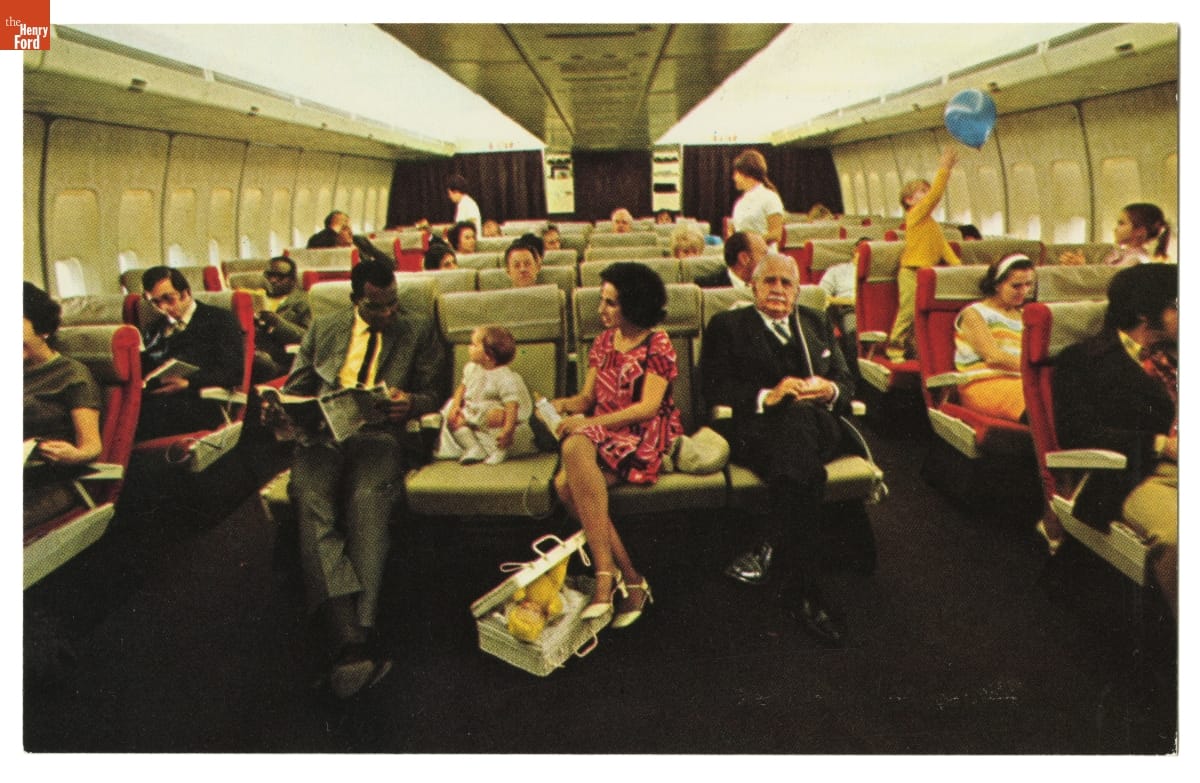
- Advertising Postcard for Pan American Airlines, circa 1970, "The Plane with All the Room in the World" - For much of the 20th century, Pan American World Airways exemplified innovation in air travel. The carrier pioneered the use of wide-body jumbo jets, like the Boeing 747 featured on this postcard, in the 1970s. But rising fuel costs and difficulty establishing domestic U.S. routes strained the company in the 1980s. Pan Am ended operations in 1991.
- circa 1970
- Collections - Artifact
Advertising Postcard for Pan American Airlines, circa 1970, "The Plane with All the Room in the World"
For much of the 20th century, Pan American World Airways exemplified innovation in air travel. The carrier pioneered the use of wide-body jumbo jets, like the Boeing 747 featured on this postcard, in the 1970s. But rising fuel costs and difficulty establishing domestic U.S. routes strained the company in the 1980s. Pan Am ended operations in 1991.
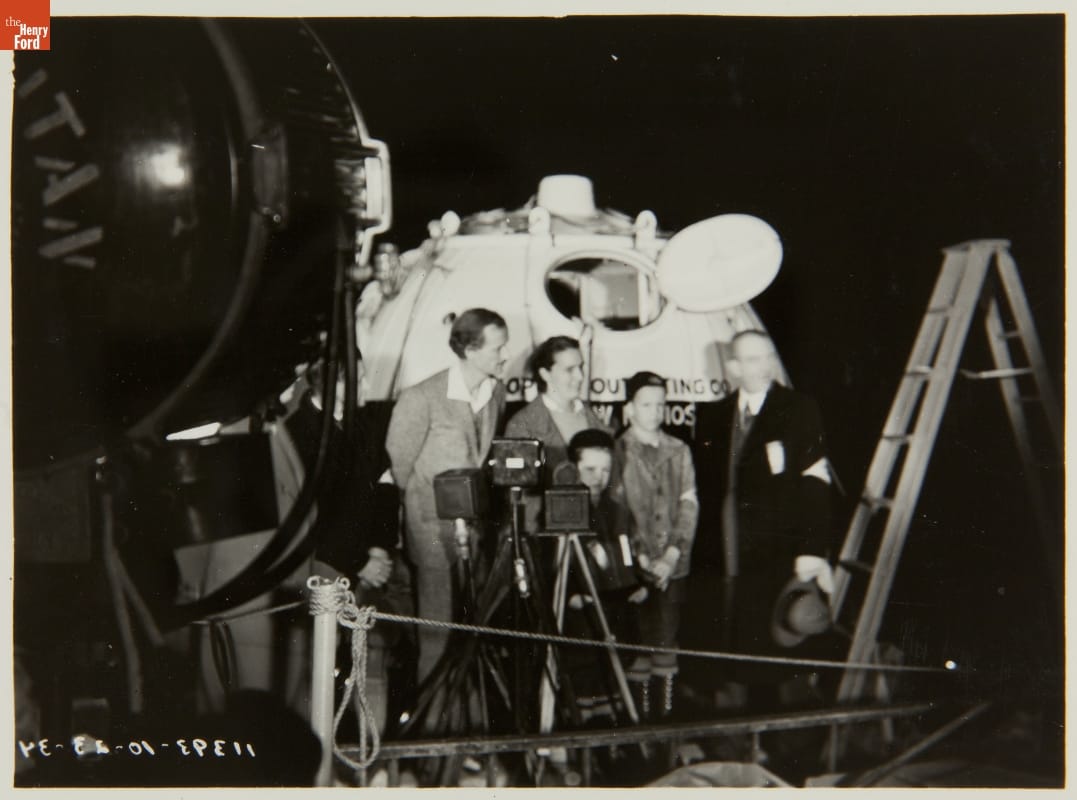
- Jean and Jeannette Piccard and Others with Balloon Gondola before the Stratosphere Flight, Ford Airport, October 23, 1934 - The Piccard stratosphere flight departed Ford Airport field on October 23, 1934. Spouses Jean and Jeannette Piccard ascended 10.9 miles in a lightweight magnesium gondola carried by a hydrogen balloon. The explorers are shown here in the early morning hours just before their launch from Ford Airport, in the midst of media fanfare.
- October 23, 1934
- Collections - Artifact
Jean and Jeannette Piccard and Others with Balloon Gondola before the Stratosphere Flight, Ford Airport, October 23, 1934
The Piccard stratosphere flight departed Ford Airport field on October 23, 1934. Spouses Jean and Jeannette Piccard ascended 10.9 miles in a lightweight magnesium gondola carried by a hydrogen balloon. The explorers are shown here in the early morning hours just before their launch from Ford Airport, in the midst of media fanfare.
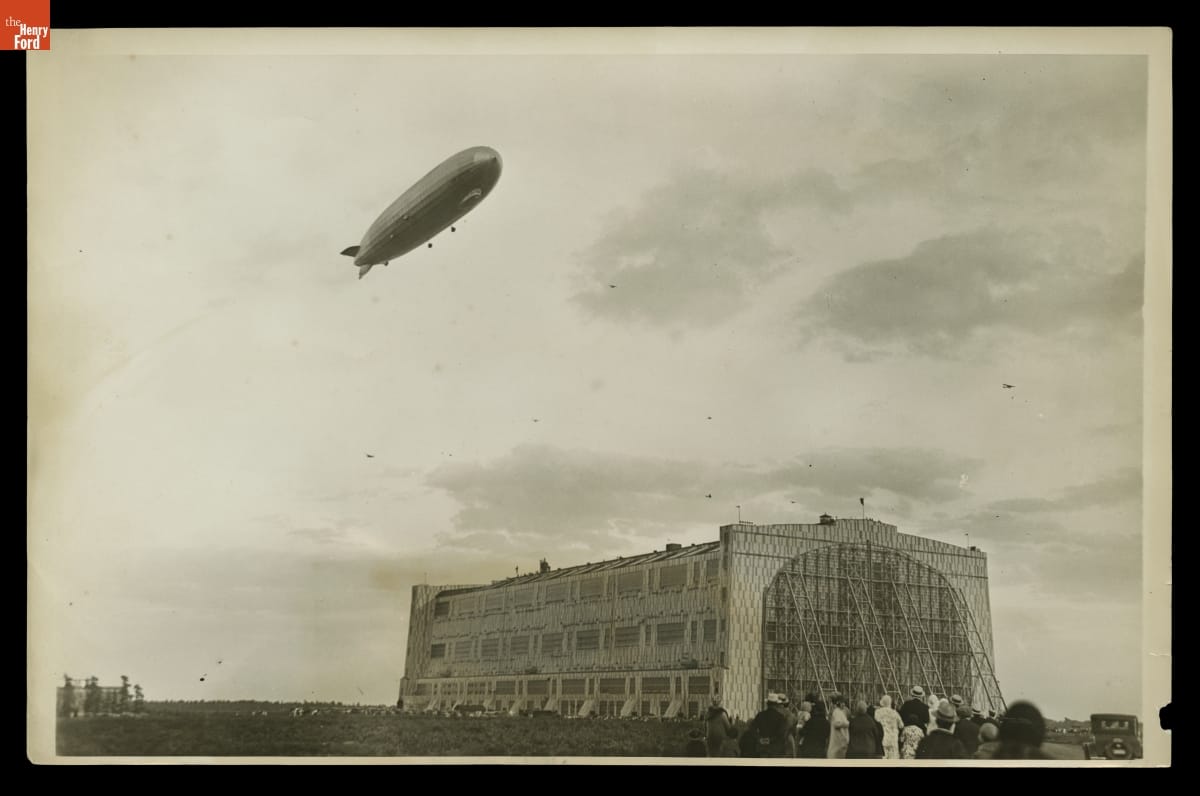
- Airship "Graf Zeppelin" Arriving at Lakehurst, New Jersey Naval Hangar, August 4, 1929 - Launched in 1928, Germany's <em>Graf Zeppelin</em> was the most successful of the passenger airships that provided intercontinental service during the 1930s. It made 590 flights and traveled more than a million miles in its nine-year career. Despite its exemplary safety record, <em>Graf Zeppelin</em> was retired following the loss of the airship <em>Hindenburg</em> in 1937.
- August 04, 1929
- Collections - Artifact
Airship "Graf Zeppelin" Arriving at Lakehurst, New Jersey Naval Hangar, August 4, 1929
Launched in 1928, Germany's Graf Zeppelin was the most successful of the passenger airships that provided intercontinental service during the 1930s. It made 590 flights and traveled more than a million miles in its nine-year career. Despite its exemplary safety record, Graf Zeppelin was retired following the loss of the airship Hindenburg in 1937.
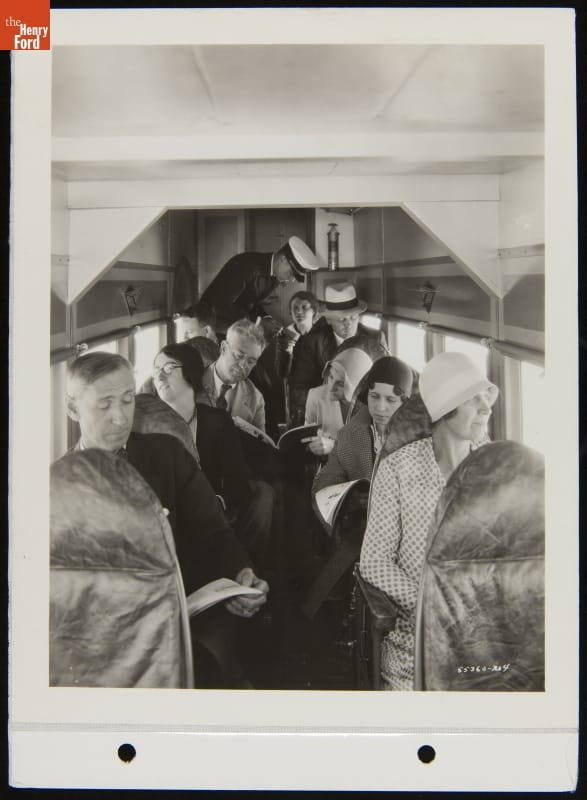
- Ford Tri-Motor Airplane, Interior Cabin Showing Steward Serving Passengers, September 1929 - Passenger air travel was a completely new -- and perhaps fearsome -- concept for most Americans in the 1920s. National advertisements for the Ford Tri-Motor promoted "roomy and comfortable" wicker passenger chairs -- one of the many advertised amenities used to convince a skeptical public of the appeal of flying in a Ford plane. Later models of the Ford Tri-Motor featured almuminum seats covered with leather.
- September 01, 1930
- Collections - Artifact
Ford Tri-Motor Airplane, Interior Cabin Showing Steward Serving Passengers, September 1929
Passenger air travel was a completely new -- and perhaps fearsome -- concept for most Americans in the 1920s. National advertisements for the Ford Tri-Motor promoted "roomy and comfortable" wicker passenger chairs -- one of the many advertised amenities used to convince a skeptical public of the appeal of flying in a Ford plane. Later models of the Ford Tri-Motor featured almuminum seats covered with leather.
- "Interior of Northwest Orient Airlines DC-6B's," circa 1955 - Northwest Airlines was established in Detroit in 1926 and relocated to the Minneapolis-St. Paul area in 1933. The company grew to serve destinations around the world, especially through transpacific flights via a hub in Japan -- emphasized with "Northwest Orient" branding. Northwest merged with Delta Airlines in 2008 but continued to operate under its own name until 2010.
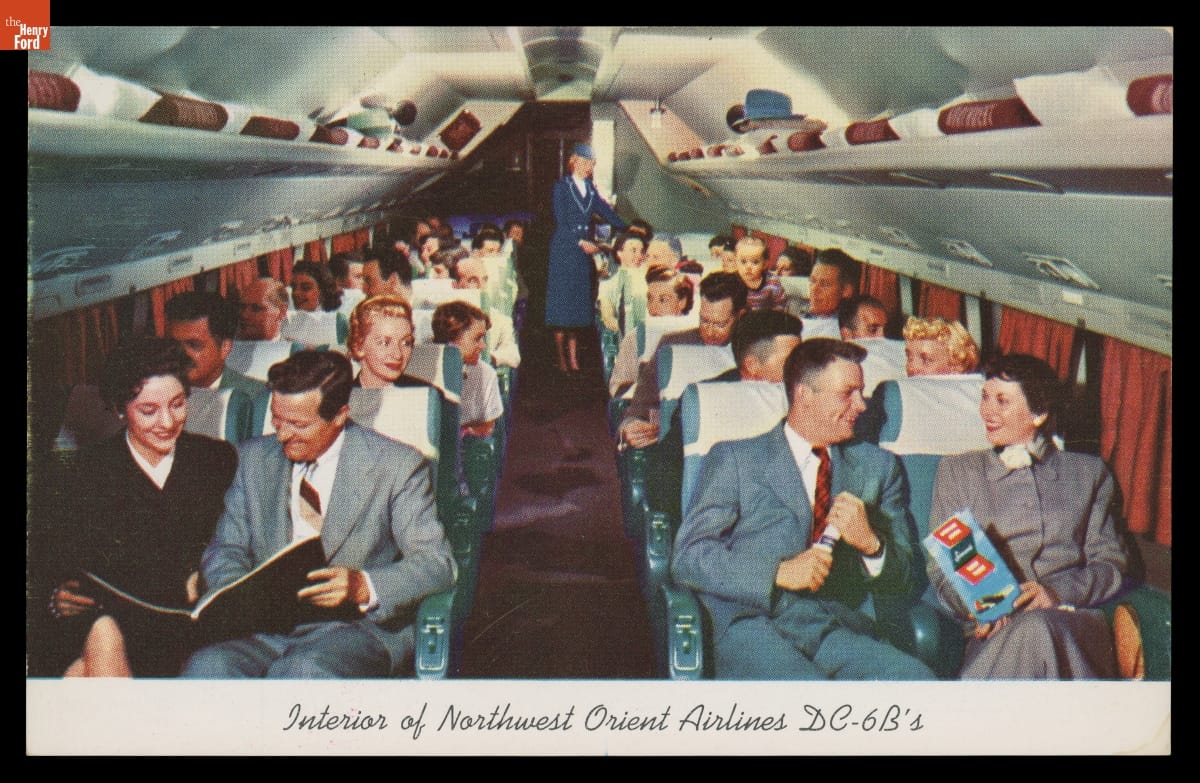
- circa 1955
- Collections - Artifact
"Interior of Northwest Orient Airlines DC-6B's," circa 1955
Northwest Airlines was established in Detroit in 1926 and relocated to the Minneapolis-St. Paul area in 1933. The company grew to serve destinations around the world, especially through transpacific flights via a hub in Japan -- emphasized with "Northwest Orient" branding. Northwest merged with Delta Airlines in 2008 but continued to operate under its own name until 2010.
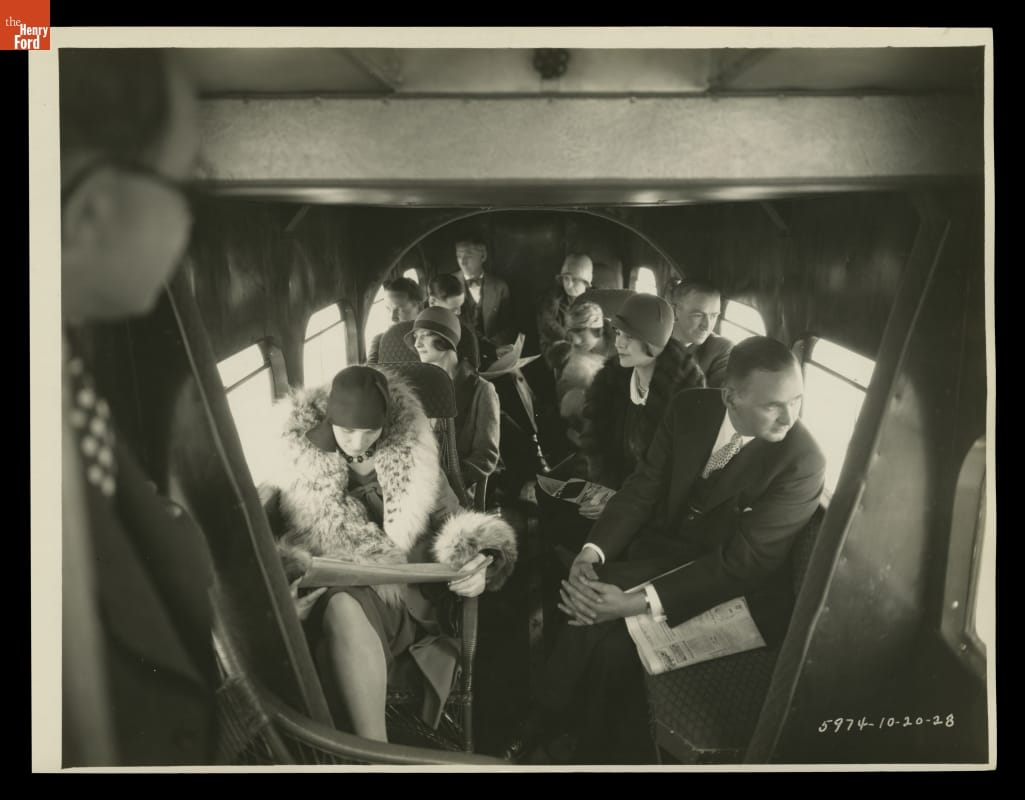
- Passengers Seated Inside a Ford Tri-Motor Airplane, October 1928 - Americans initially wondered if air travel was safe. Fatal crashes by barnstorming pilots were well publicized, and wood and cloth airplanes did not inspire confidence. But when Henry Ford began making planes, the industrialist's solid reputation eased people's fears. Ford's all-metal Tri-Motors were rugged, dependable and safe. By the late 1920s these planes were the backbone of the budding airline industry.
- October 20, 1928
- Collections - Artifact
Passengers Seated Inside a Ford Tri-Motor Airplane, October 1928
Americans initially wondered if air travel was safe. Fatal crashes by barnstorming pilots were well publicized, and wood and cloth airplanes did not inspire confidence. But when Henry Ford began making planes, the industrialist's solid reputation eased people's fears. Ford's all-metal Tri-Motors were rugged, dependable and safe. By the late 1920s these planes were the backbone of the budding airline industry.
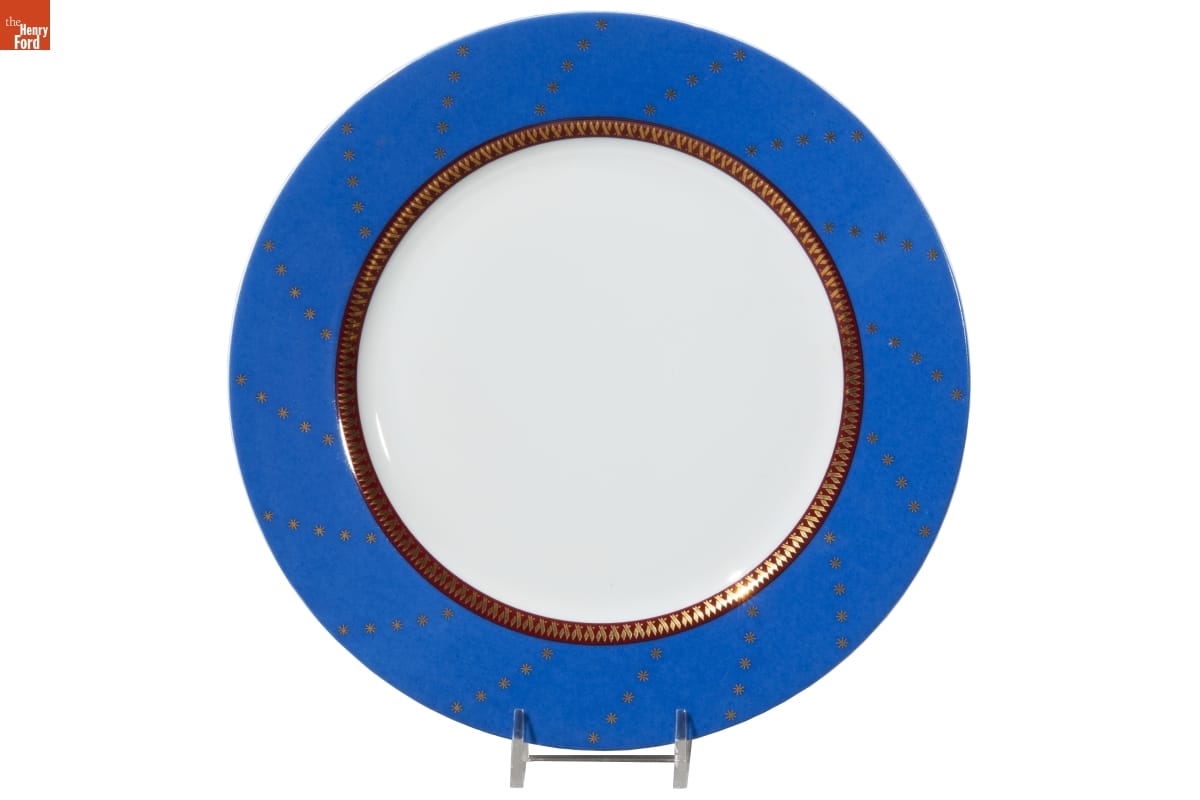
- American Airlines Plate, 1988 - Starting in the early 1980s--and already established as an internationally recognized architect--Michael Graves began to pursue a parallel career as a product designer. Over the following three and a half decades he and his collaborators designed everything from humble household goods to limited edition luxury items for clients as diverse as Steuben, Alessi, Target, J. C. Penney, and Disney.
- 1988
- Collections - Artifact
American Airlines Plate, 1988
Starting in the early 1980s--and already established as an internationally recognized architect--Michael Graves began to pursue a parallel career as a product designer. Over the following three and a half decades he and his collaborators designed everything from humble household goods to limited edition luxury items for clients as diverse as Steuben, Alessi, Target, J. C. Penney, and Disney.
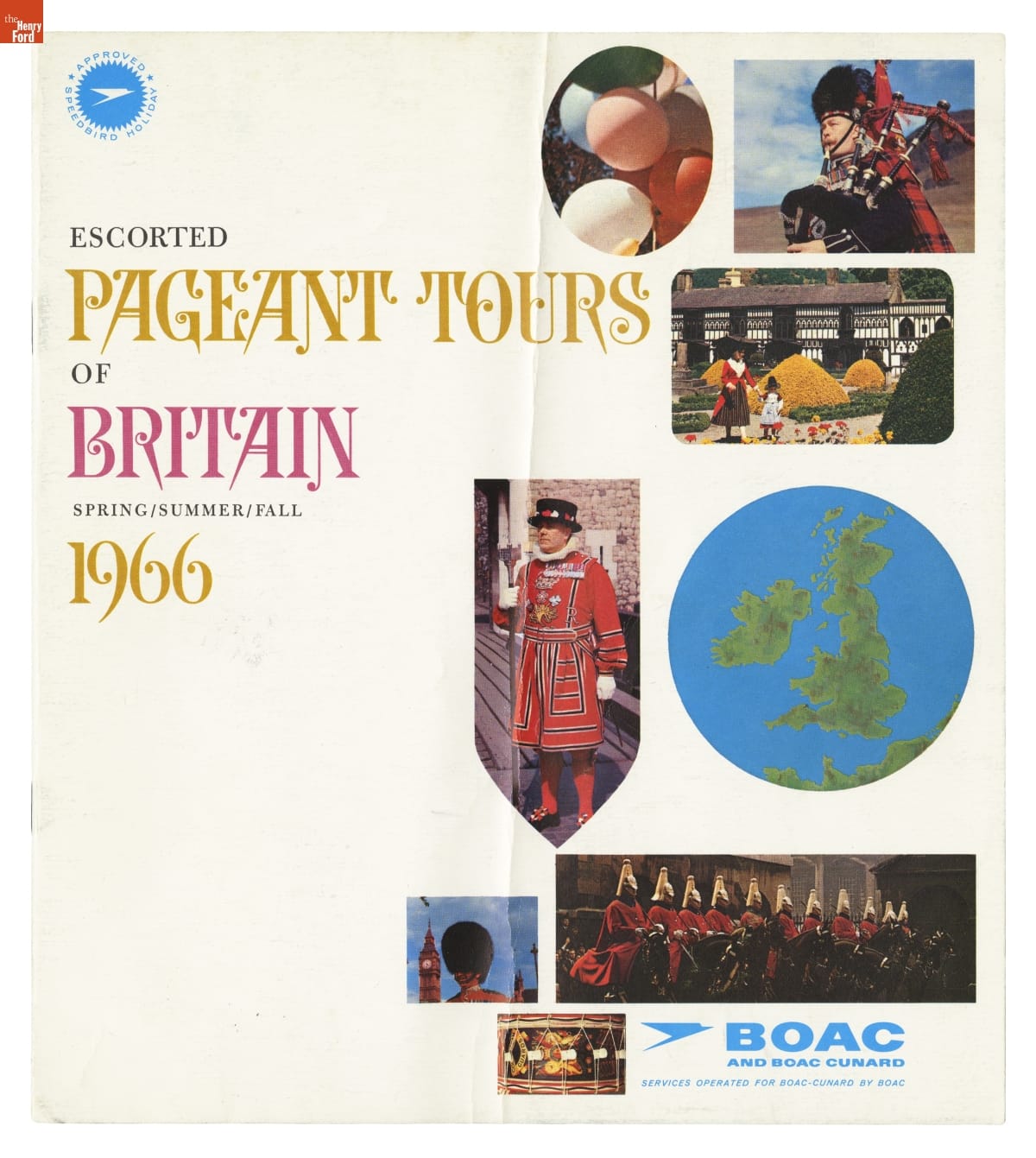
- Escorted Pageant Tours of Britain, Spring/Summer/Fall 1966 -
- 1966
- Collections - Artifact
Escorted Pageant Tours of Britain, Spring/Summer/Fall 1966
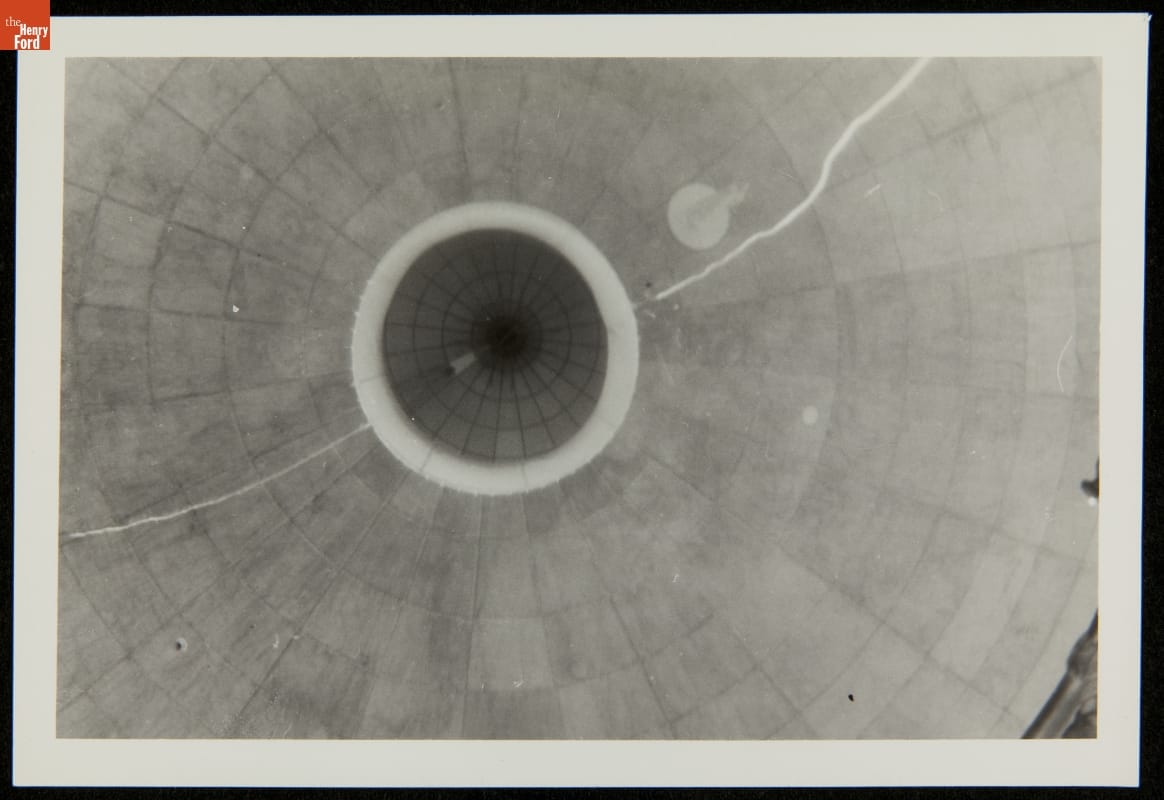
- View of Balloon from Gondola during Piccard Stratosphere Flight, Altitude 57,579 Feet, October 23, 1934 - The Piccard stratosphere flight departed Ford Airport field on October 23, 1934. Spouses Jean and Jeannette Piccard ascended 10.9 miles in a metal gondola carried by a hydrogen balloon. Jeannette was the first American woman licensed as a balloonist, and first to reach the stratosphere. While Jeannette piloted, Jean gathered scientific data. Balloon is fully inflated here, at 57,579 feet.
- October 23, 1934
- Collections - Artifact
View of Balloon from Gondola during Piccard Stratosphere Flight, Altitude 57,579 Feet, October 23, 1934
The Piccard stratosphere flight departed Ford Airport field on October 23, 1934. Spouses Jean and Jeannette Piccard ascended 10.9 miles in a metal gondola carried by a hydrogen balloon. Jeannette was the first American woman licensed as a balloonist, and first to reach the stratosphere. While Jeannette piloted, Jean gathered scientific data. Balloon is fully inflated here, at 57,579 feet.
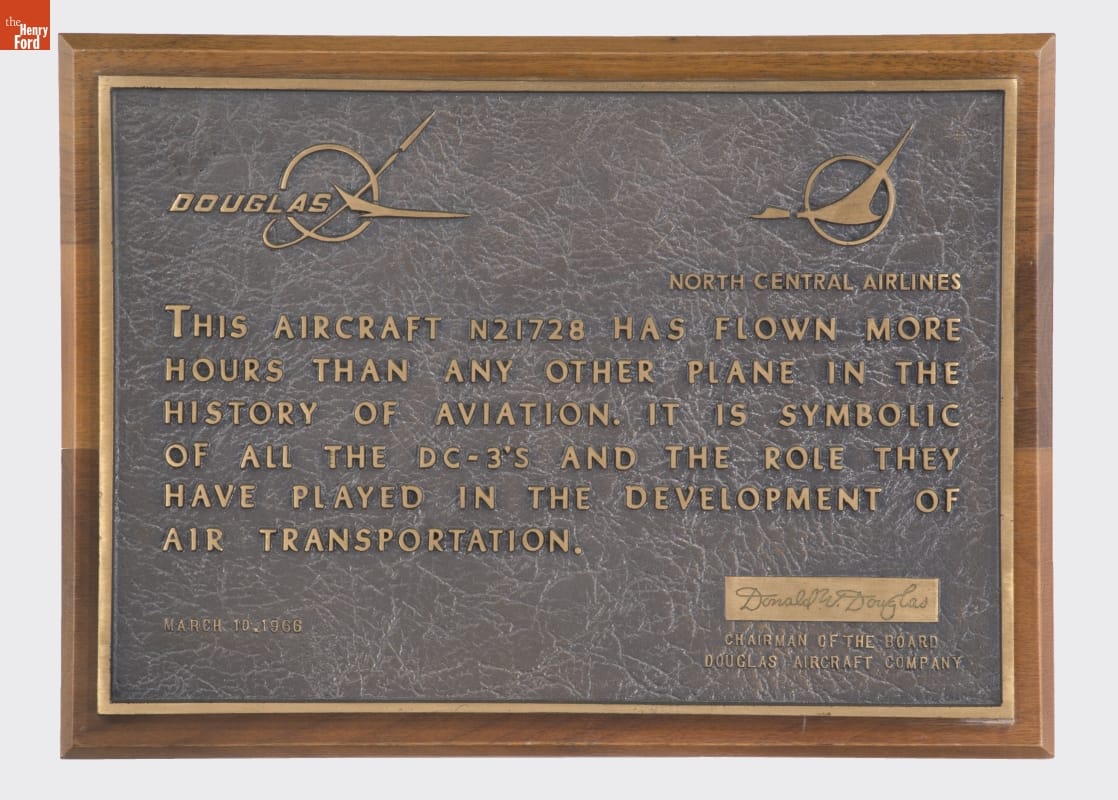
- Plaque Commemorating the Record Number of Hours Flown by the Douglas DC-3 - The Douglas DC-3 is one of history's most significant aircraft, with important achievements in civil and military applications. DC-3 N21728, operated by Eastern Airlines and North Central Airlines from 1939 to 1975, is a special example. The airplane logged 84,875 flight hours before being retired to The Henry Ford. It was a record for a commercial aircraft at that time.
- March 10, 1966
- Collections - Artifact
Plaque Commemorating the Record Number of Hours Flown by the Douglas DC-3
The Douglas DC-3 is one of history's most significant aircraft, with important achievements in civil and military applications. DC-3 N21728, operated by Eastern Airlines and North Central Airlines from 1939 to 1975, is a special example. The airplane logged 84,875 flight hours before being retired to The Henry Ford. It was a record for a commercial aircraft at that time.