
Search
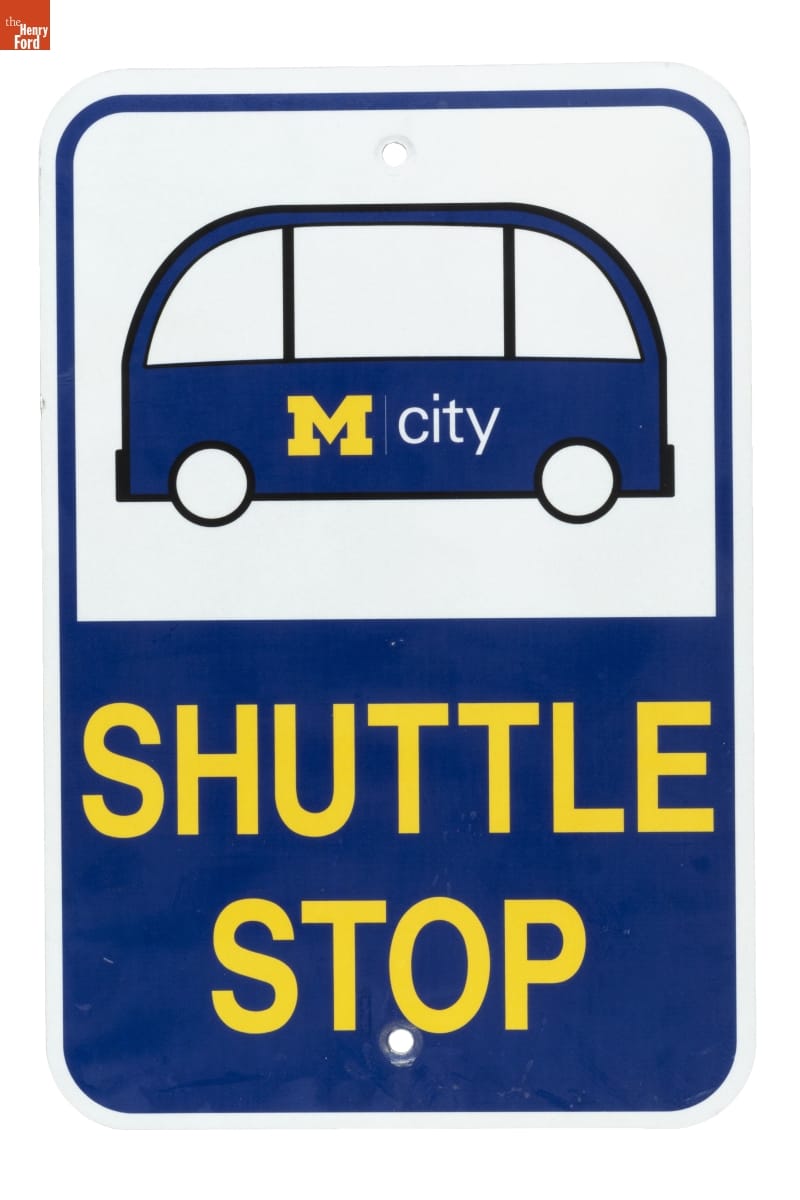
- "Mcity Shuttle Stop" Sign, 2018 - Mcity, an advanced mobility research center at the University of Michigan, operated two driverless shuttles on its campus for 18 months in 2018-19. The research project studied public attitudes toward autonomous vehicles. This sign indicated one of the two stops on the shuttles' one-mile looping route around the university's North Campus.
- 2018
- Collections - Artifact
"Mcity Shuttle Stop" Sign, 2018
Mcity, an advanced mobility research center at the University of Michigan, operated two driverless shuttles on its campus for 18 months in 2018-19. The research project studied public attitudes toward autonomous vehicles. This sign indicated one of the two stops on the shuttles' one-mile looping route around the university's North Campus.
- "Autonomous Vehicles," Clip for Interview with Jessica Robinson, August 28, 2020 - Jessica Robinson, co-founder of Detroit Mobility Lab, Michigan Mobility Institute, and Assembly Ventures, was the Spring 2020 Entrepreneur-in-Residence at The Henry Ford, funded by the William Davidson Foundation Initiative for Entrepreneurship. During her interview, Robinson describes how her organizations -- and her residency projects -- encourage technological education in the midst of dramatic new transportation technologies.
- August 28, 2020
- Collections - Artifact
"Autonomous Vehicles," Clip for Interview with Jessica Robinson, August 28, 2020
Jessica Robinson, co-founder of Detroit Mobility Lab, Michigan Mobility Institute, and Assembly Ventures, was the Spring 2020 Entrepreneur-in-Residence at The Henry Ford, funded by the William Davidson Foundation Initiative for Entrepreneurship. During her interview, Robinson describes how her organizations -- and her residency projects -- encourage technological education in the midst of dramatic new transportation technologies.
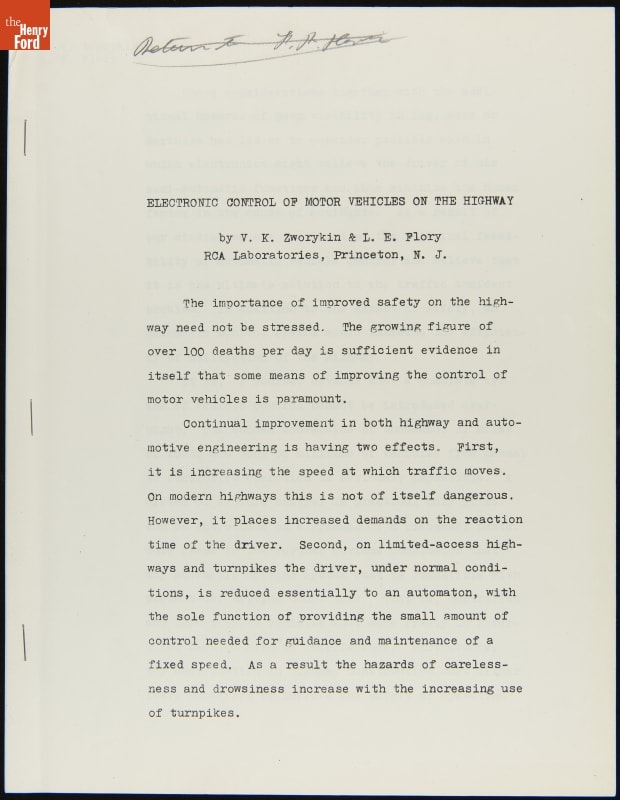
- "Electronic Control of Motor Vehicles on the Highway," 1957-1958 - In the late 1950s, RCA experimented with a system that guided a car -- without input from a driver -- along a highway via electromagnetic circuits buried under the road surface. Partnering with General Motors and the State of Nebraska, RCA built a 400-foot-long working prototype road near Lincoln, Nebraska. But RCA's system was too expensive for practical use.
- 1957-1958
- Collections - Artifact
"Electronic Control of Motor Vehicles on the Highway," 1957-1958
In the late 1950s, RCA experimented with a system that guided a car -- without input from a driver -- along a highway via electromagnetic circuits buried under the road surface. Partnering with General Motors and the State of Nebraska, RCA built a 400-foot-long working prototype road near Lincoln, Nebraska. But RCA's system was too expensive for practical use.
- "The Future of Mobility," Clip for Interview with Jessica Robinson, August 28, 2020 - Jessica Robinson, co-founder of Detroit Mobility Lab, Michigan Mobility Institute, and Assembly Ventures, was the Spring 2020 Entrepreneur-in-Residence at The Henry Ford, funded by the William Davidson Foundation Initiative for Entrepreneurship. During her interview, Robinson describes how her organizations -- and her residency projects -- encourage technological education in the midst of dramatic new transportation technologies.
- August 28, 2020
- Collections - Artifact
"The Future of Mobility," Clip for Interview with Jessica Robinson, August 28, 2020
Jessica Robinson, co-founder of Detroit Mobility Lab, Michigan Mobility Institute, and Assembly Ventures, was the Spring 2020 Entrepreneur-in-Residence at The Henry Ford, funded by the William Davidson Foundation Initiative for Entrepreneurship. During her interview, Robinson describes how her organizations -- and her residency projects -- encourage technological education in the midst of dramatic new transportation technologies.
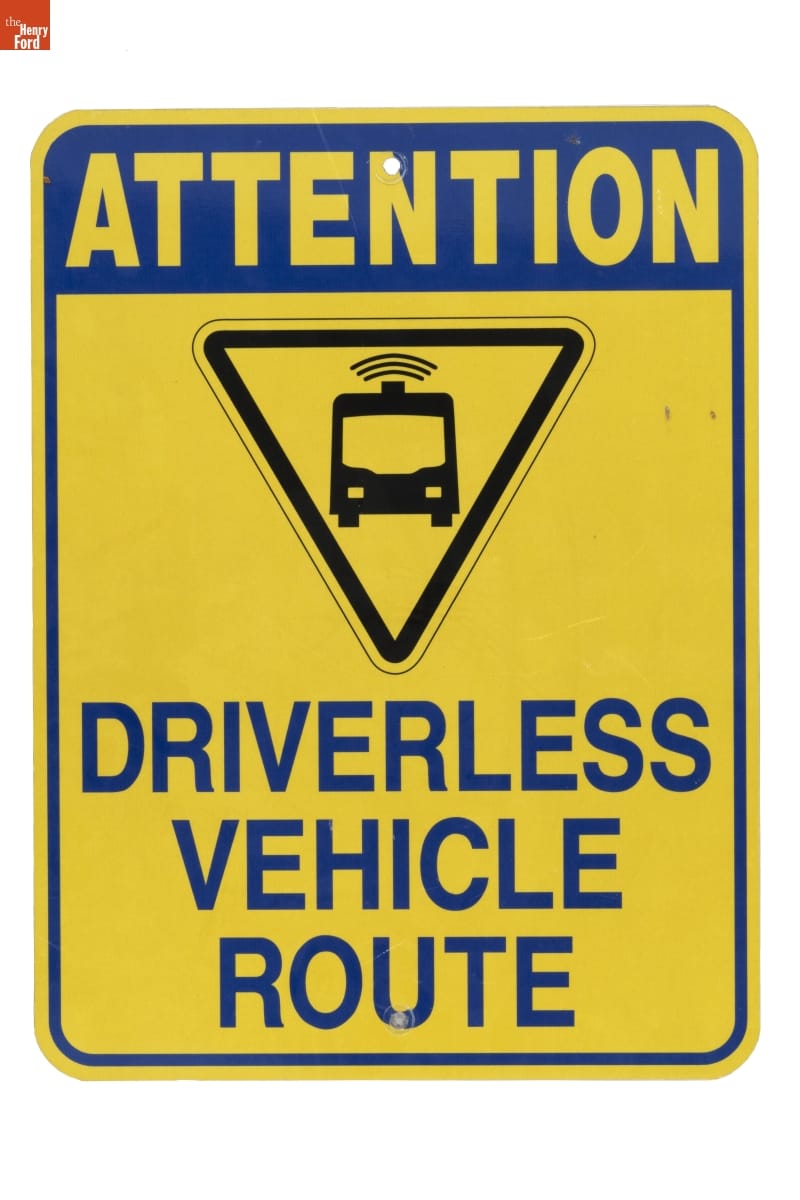
- "Attention Driverless Vehicle Route" Sign, 2018 - Mcity, an advanced mobility research center at the University of Michigan, operated two driverless shuttles on its campus for 18 months in 2018-19. The research project studied public attitudes toward autonomous vehicles. On their one-mile route, the shuttles traveled over two-way streets mixed with conventional traffic. Signs like this alerted other street users to the shuttles' presence.
- 2018
- Collections - Artifact
"Attention Driverless Vehicle Route" Sign, 2018
Mcity, an advanced mobility research center at the University of Michigan, operated two driverless shuttles on its campus for 18 months in 2018-19. The research project studied public attitudes toward autonomous vehicles. On their one-mile route, the shuttles traveled over two-way streets mixed with conventional traffic. Signs like this alerted other street users to the shuttles' presence.
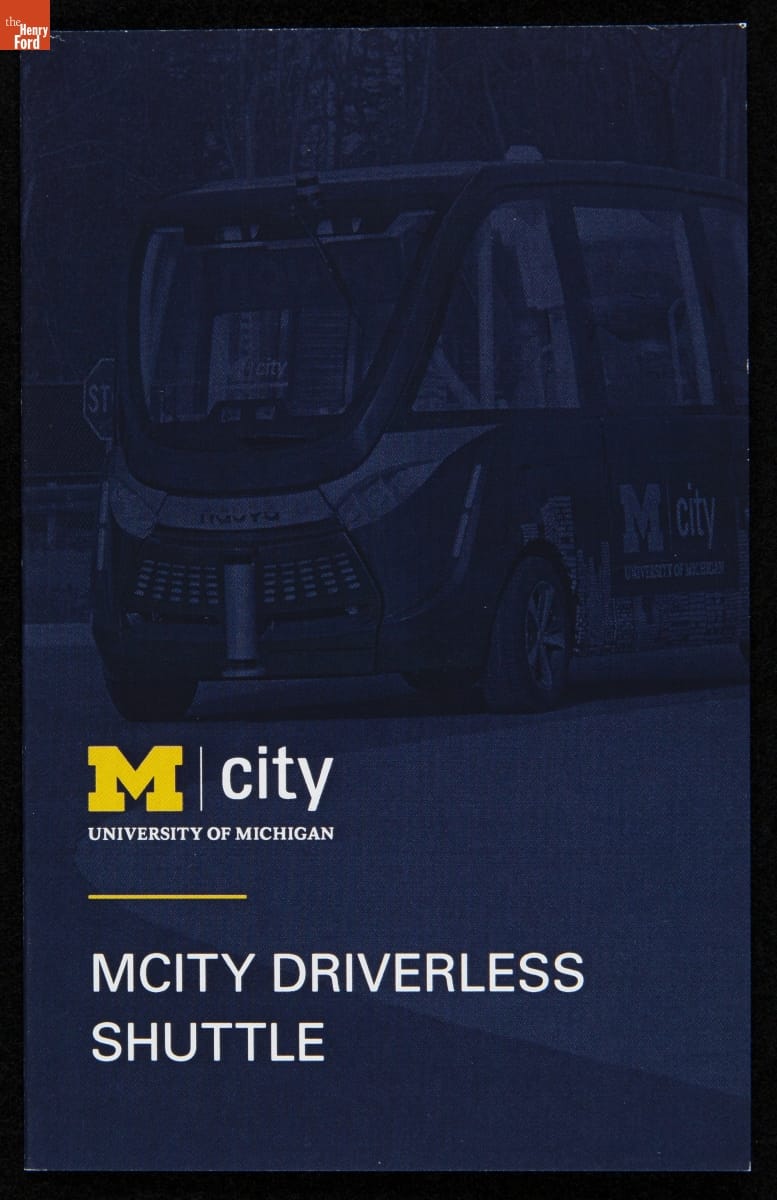
- Mcity Driverless Shuttle, 2018 - Mcity, an advanced mobility research center at the University of Michigan, operated two driverless shuttles on its campus for 18 months in 2018-19. The research project studied public attitudes toward autonomous vehicles. This brochure encouraged passengers to complete an online survey about their experiences riding on the shuttles.
- 2018
- Collections - Artifact
Mcity Driverless Shuttle, 2018
Mcity, an advanced mobility research center at the University of Michigan, operated two driverless shuttles on its campus for 18 months in 2018-19. The research project studied public attitudes toward autonomous vehicles. This brochure encouraged passengers to complete an online survey about their experiences riding on the shuttles.
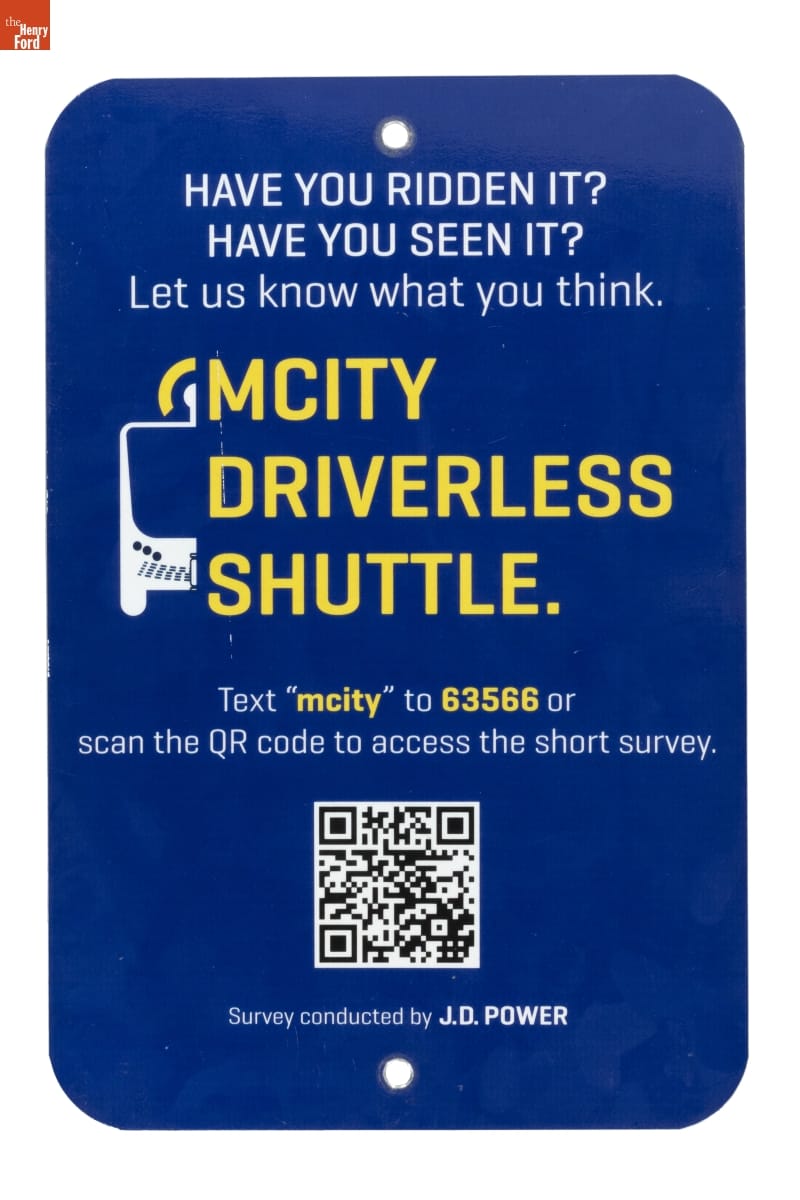
- "Have You Ridden It?" Mcity Shuttle Sign, 2018 - Mcity, an advanced mobility research center at the University of Michigan, operated two driverless shuttles on its campus for 18 months in 2018-19. The research project studied public attitudes toward autonomous vehicles. This sign encouraged people to complete an online survey about their experiences with the shuttles -- whether they rode on them or simply encountered them on the street.
- 2018
- Collections - Artifact
"Have You Ridden It?" Mcity Shuttle Sign, 2018
Mcity, an advanced mobility research center at the University of Michigan, operated two driverless shuttles on its campus for 18 months in 2018-19. The research project studied public attitudes toward autonomous vehicles. This sign encouraged people to complete an online survey about their experiences with the shuttles -- whether they rode on them or simply encountered them on the street.
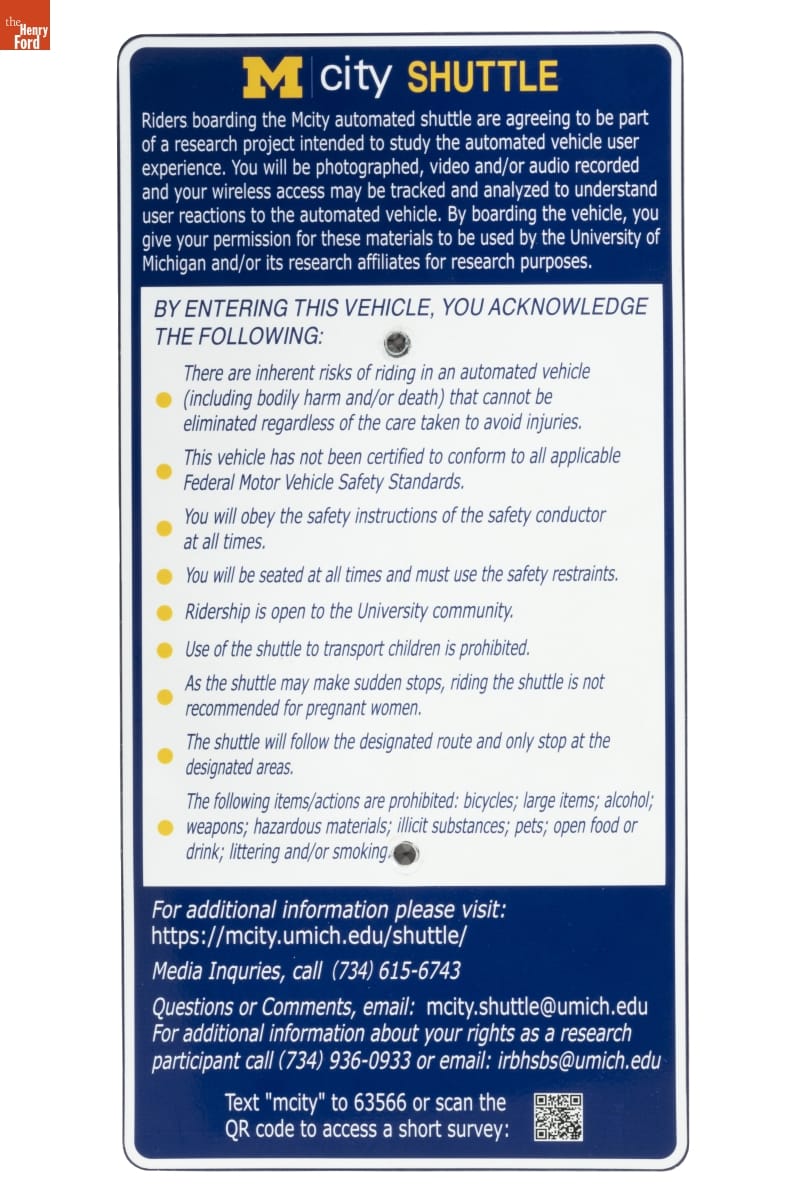
- Mcity Shuttle Rules Sign, 2018 - Mcity, an advanced mobility research center at the University of Michigan, operated two driverless shuttles on its campus for 18 months in 2018-19. The research project studied public attitudes toward autonomous vehicles. This sign informed riders that they would be photographed and recorded as a part of the study. It also listed general policies for the shuttles' operation.
- 2018
- Collections - Artifact
Mcity Shuttle Rules Sign, 2018
Mcity, an advanced mobility research center at the University of Michigan, operated two driverless shuttles on its campus for 18 months in 2018-19. The research project studied public attitudes toward autonomous vehicles. This sign informed riders that they would be photographed and recorded as a part of the study. It also listed general policies for the shuttles' operation.
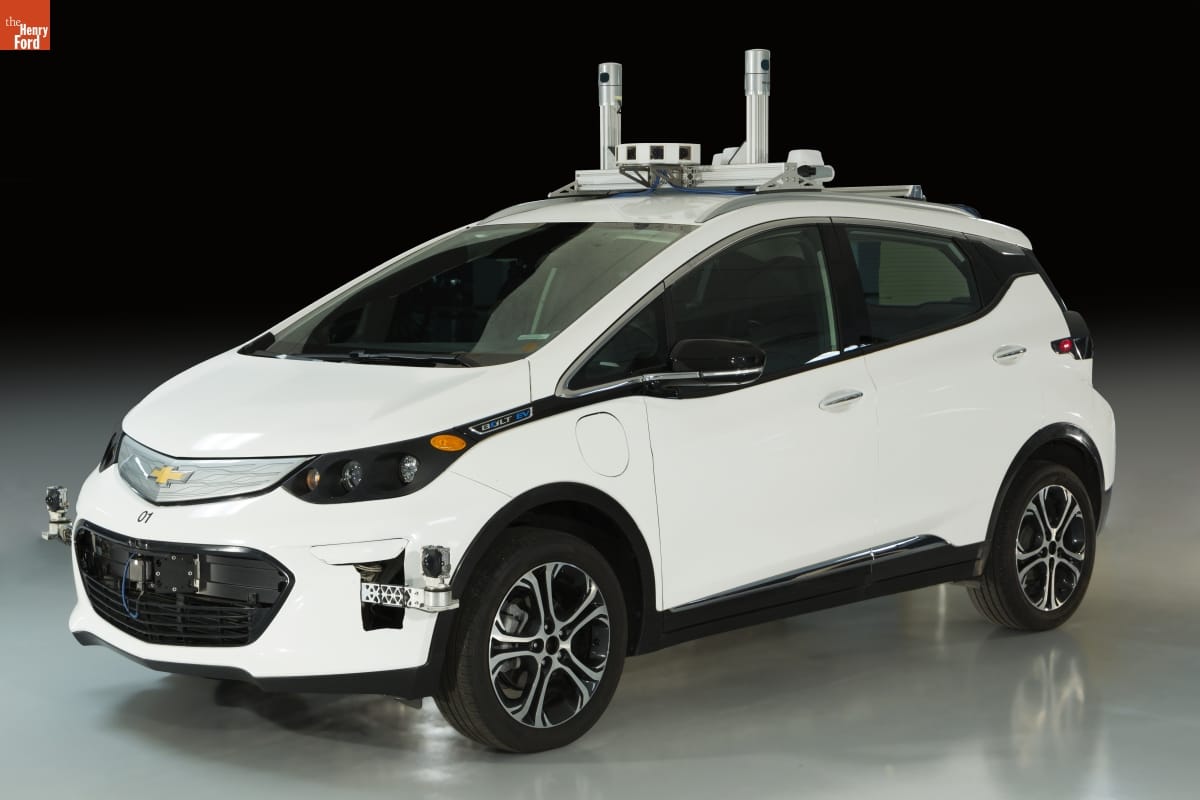
- 2016 General Motors First-Generation Self-Driving Test Vehicle - General Motors tested a series of autonomous vehicles in San Francisco, California, and Scottsdale, Arizona, in 2016. These cars, developed with GM subsidiary Cruise Automation and based on the Chevrolet Bolt electric vehicle, used a combination of cameras, radar and lidar sensors, cellular and GPS antennas, and powerful computers to drive themselves on public streets in both cities.
- 2016
- Collections - Artifact
2016 General Motors First-Generation Self-Driving Test Vehicle
General Motors tested a series of autonomous vehicles in San Francisco, California, and Scottsdale, Arizona, in 2016. These cars, developed with GM subsidiary Cruise Automation and based on the Chevrolet Bolt electric vehicle, used a combination of cameras, radar and lidar sensors, cellular and GPS antennas, and powerful computers to drive themselves on public streets in both cities.