
Search
- Letter from John Trumbull to A. C. de Poggi, August 12, 1788 - American artist John Trumbull met Antonio Cesare Poggi while studying in Europe in the late 1700s. Poggi was an artist, art dealer and print publisher. The two became business associates and friends. In this letter from 1788, Trumbull is happy to hear that Poggi has entered an agreement with an engraver to create printing plates of Trumbull's paintings.
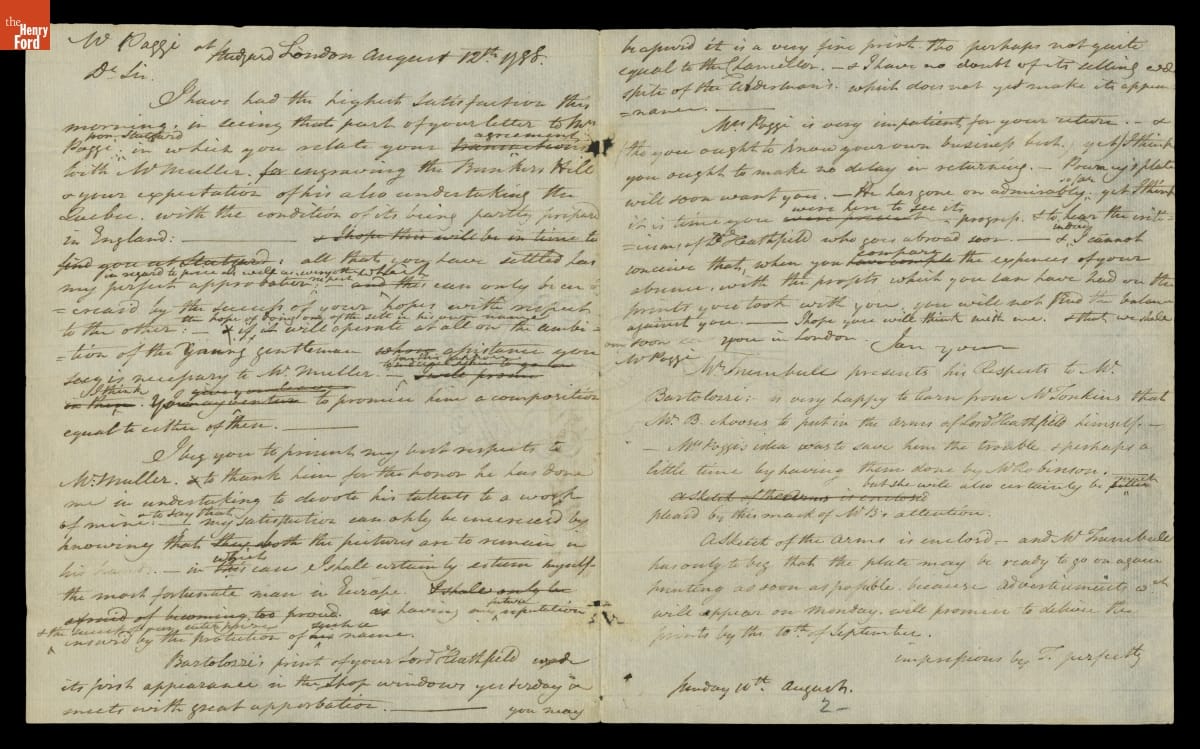
- August 12, 1788
- Collections - Artifact
Letter from John Trumbull to A. C. de Poggi, August 12, 1788
American artist John Trumbull met Antonio Cesare Poggi while studying in Europe in the late 1700s. Poggi was an artist, art dealer and print publisher. The two became business associates and friends. In this letter from 1788, Trumbull is happy to hear that Poggi has entered an agreement with an engraver to create printing plates of Trumbull's paintings.
- Letter from John Trumbull to Samuel M. Hopkins, June 1, 1818 - John Trumbull worked tirelessly on his painting <EM>Declaration of Independence</EM> throughout 1818. The painting was one of four Revolutionary-era scenes commissioned by the U.S. Congress for the Capitol. In this letter to Samuel Hopkins, Trumbull apologized for his inattention to business matters and the failure to visit. Trumbull explained that his drive to complete his "picture of Independence" is "heavy work."
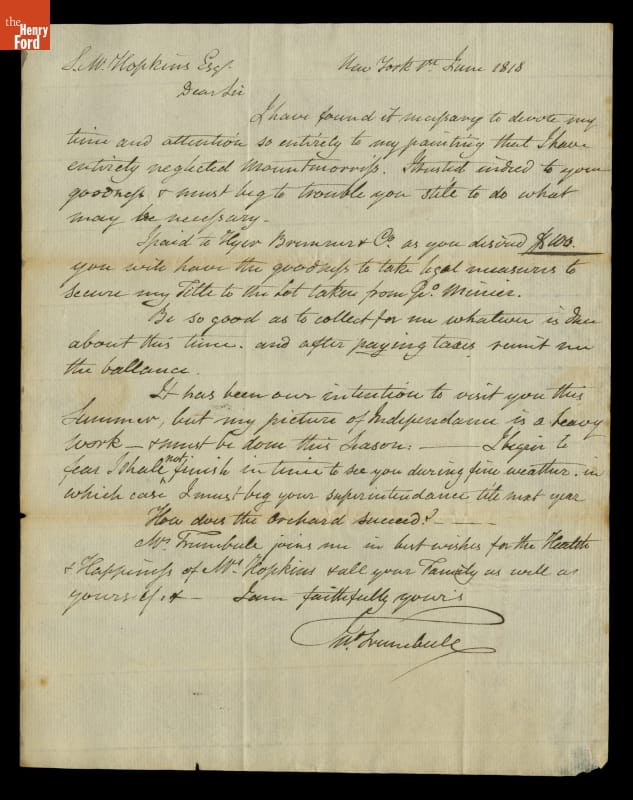
- June 01, 1818
- Collections - Artifact
Letter from John Trumbull to Samuel M. Hopkins, June 1, 1818
John Trumbull worked tirelessly on his painting Declaration of Independence throughout 1818. The painting was one of four Revolutionary-era scenes commissioned by the U.S. Congress for the Capitol. In this letter to Samuel Hopkins, Trumbull apologized for his inattention to business matters and the failure to visit. Trumbull explained that his drive to complete his "picture of Independence" is "heavy work."
- Letter from John Trumbull to Sarah Hope Harvey Trumbull, December 9, 1818 - In 1817, the U.S. Congress commissioned John Trumbull to paint four Revolutionary-era scenes for the Capitol. The first, <EM>Declaration of Independence</EM>, was completed in 1818. Trumbull took the painting on a multi-city tour to give the public a chance to view the work before it returned to the Capitol. Trumbull mentioned the tour's success in this letter to his wife.
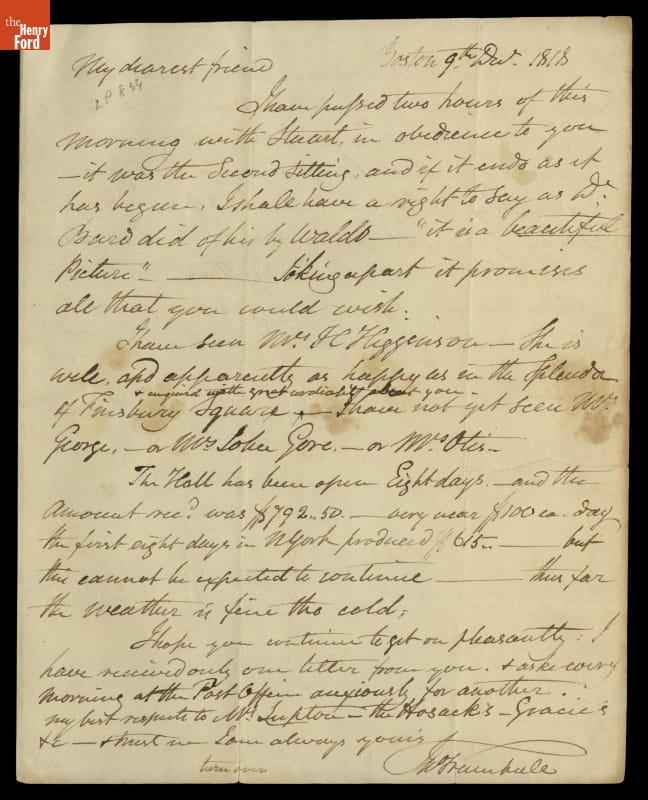
- December 09, 1818
- Collections - Artifact
Letter from John Trumbull to Sarah Hope Harvey Trumbull, December 9, 1818
In 1817, the U.S. Congress commissioned John Trumbull to paint four Revolutionary-era scenes for the Capitol. The first, Declaration of Independence, was completed in 1818. Trumbull took the painting on a multi-city tour to give the public a chance to view the work before it returned to the Capitol. Trumbull mentioned the tour's success in this letter to his wife.
- Letter to John Trumbull from Elkanah Watson, February 15, 1825 - Elkanah Watson subscribed to purchase a print of John Trumbull's painting, <EM>Declaration of Independence</EM>. (The painting was commissioned for the U.S. Capitol and Trumbull authorized engravings to make extra money.) Watson had paid half, but was unable to complete his payment. In this letter, Watson appealed to Trumbull's "liberality" to either reimburse the amount already paid or wait for payment until Watson's "fortune shall be more propitious."
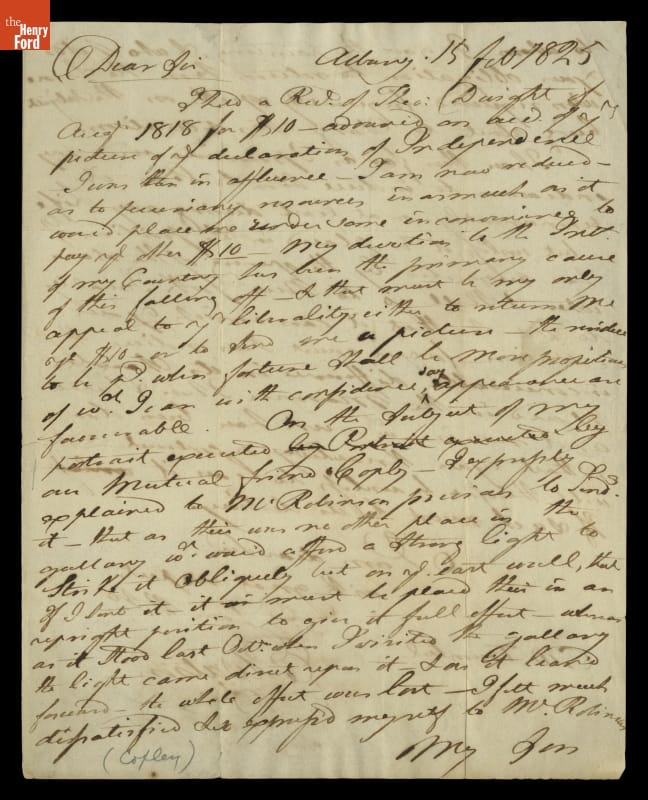
- February 15, 1825
- Collections - Artifact
Letter to John Trumbull from Elkanah Watson, February 15, 1825
Elkanah Watson subscribed to purchase a print of John Trumbull's painting, Declaration of Independence. (The painting was commissioned for the U.S. Capitol and Trumbull authorized engravings to make extra money.) Watson had paid half, but was unable to complete his payment. In this letter, Watson appealed to Trumbull's "liberality" to either reimburse the amount already paid or wait for payment until Watson's "fortune shall be more propitious."
- Letter from John Trumbull to Thomas Claxton, February 3, 1821 - After completing his painting <EM>Declaration of Independence</EM>, John Trumbull authorized engraving plates made to create prints of this work. Trumbull sent an early proof to Thomas Claxton, Doorkeeper of the House of Representatives, who was to place the print in the Capitol Post Office so Congressmen and other officials could view it. Trumbull promised Claxton a commission on any sales of the print.
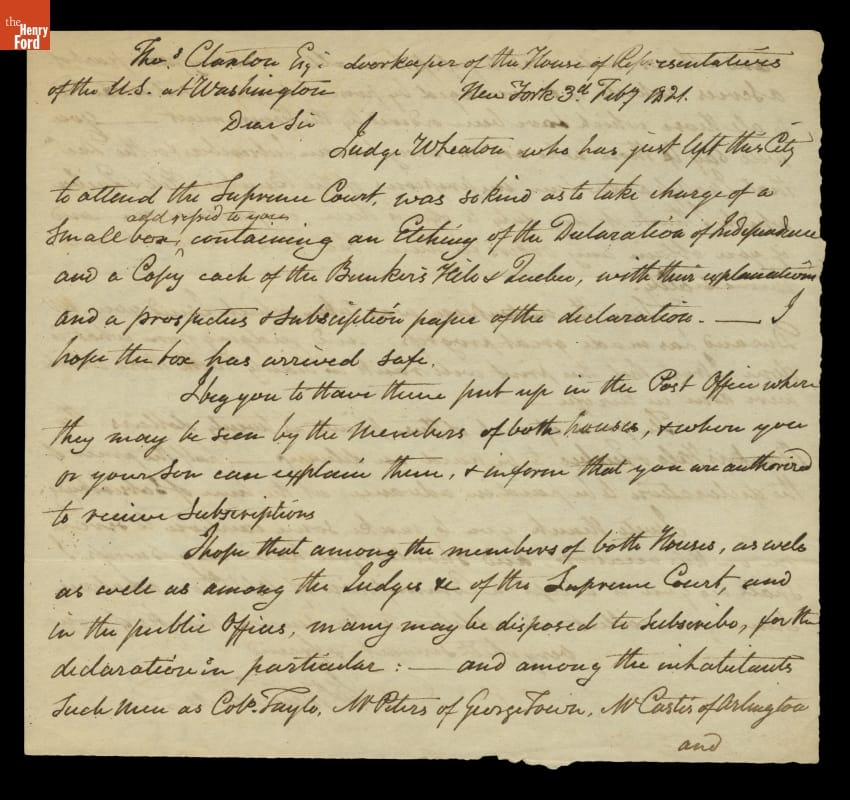
- February 03, 1821
- Collections - Artifact
Letter from John Trumbull to Thomas Claxton, February 3, 1821
After completing his painting Declaration of Independence, John Trumbull authorized engraving plates made to create prints of this work. Trumbull sent an early proof to Thomas Claxton, Doorkeeper of the House of Representatives, who was to place the print in the Capitol Post Office so Congressmen and other officials could view it. Trumbull promised Claxton a commission on any sales of the print.
- Letter from John Trumbull to Ithiel Town, February 13, 1840 - Artist John Trumbull wanted to display a series of his paintings based on Revolutionary-era scenes in some permanent gallery. These eight patriotic works would include smaller versions of his four paintings that hung in the U.S. Capitol. In 1840, the aging Trumbull wrote architect Ithiel Town about the works, their prices and his vision of the project.
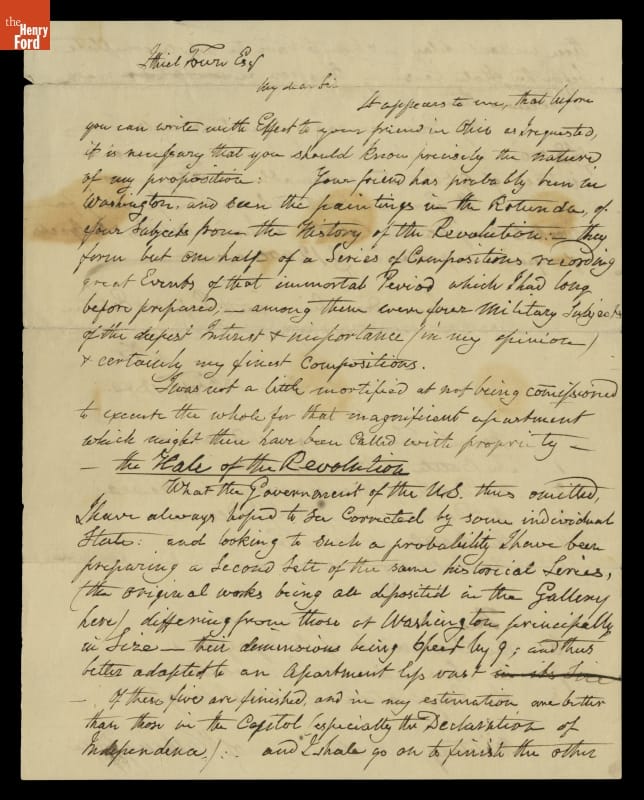
- February 13, 1840
- Collections - Artifact
Letter from John Trumbull to Ithiel Town, February 13, 1840
Artist John Trumbull wanted to display a series of his paintings based on Revolutionary-era scenes in some permanent gallery. These eight patriotic works would include smaller versions of his four paintings that hung in the U.S. Capitol. In 1840, the aging Trumbull wrote architect Ithiel Town about the works, their prices and his vision of the project.
- Complaint Filed by Detroit Merchants regarding the Value of Bank Notes and Specie during Winter 1814-1815 -
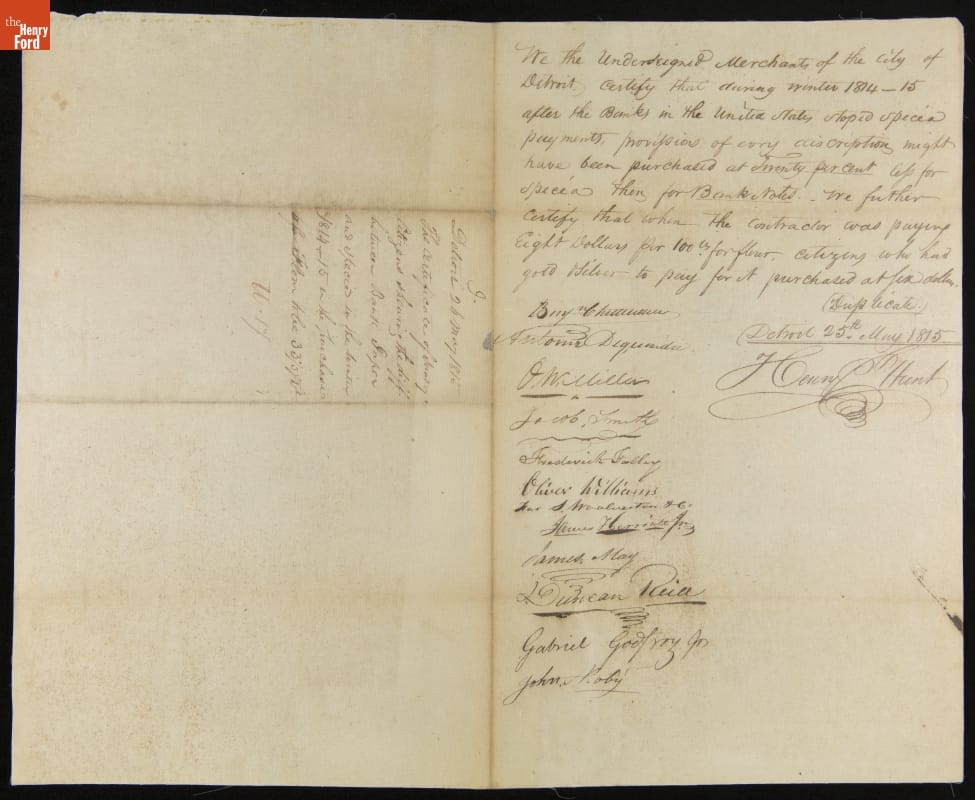
- May 25, 1815
- Collections - Artifact
Complaint Filed by Detroit Merchants regarding the Value of Bank Notes and Specie during Winter 1814-1815
- Letter from John Trumbull to James Irvine, June 27, 1820 - John Trumbull wrote this cordial letter to James Irvine, a painter and art dealer from Rome, Italy. Trumbull regretted that the two did not meet before Irvine headed back to Europe. He also mentions that he has completed <EM>Yorktown</EM>, his second of four works commissioned by the U.S. Congress for the Capitol.
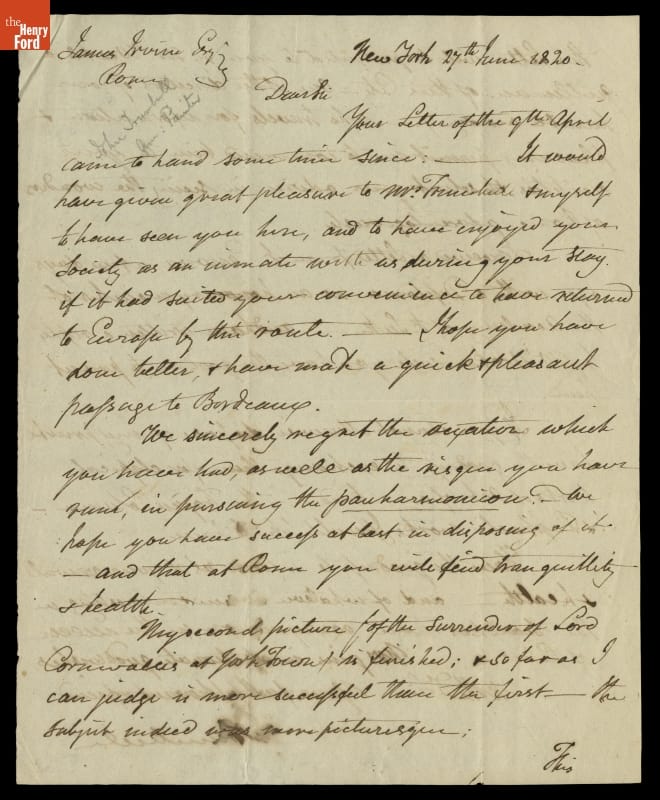
- June 27, 1820
- Collections - Artifact
Letter from John Trumbull to James Irvine, June 27, 1820
John Trumbull wrote this cordial letter to James Irvine, a painter and art dealer from Rome, Italy. Trumbull regretted that the two did not meet before Irvine headed back to Europe. He also mentions that he has completed Yorktown, his second of four works commissioned by the U.S. Congress for the Capitol.
- John Trumbull's Account Book of Subscriptions for the "Declaration of Independence" Print, 1818-1823 - In 1817, the U.S. Congress commissioned John Trumbull to paint four Revolutionary-era scenes for the Capitol. <EM>Declaration of Independence</EM> depicts the presentation of Thomas Jefferson's document to the Continental Congress in 1776. Trumbull began taking subscriptions for an engraving of this painting while he completed it. Among the subscribers listed in Trumbull's account book were several original signers of the Declaration of Independence.
- 1818-1823
- Collections - Artifact
John Trumbull's Account Book of Subscriptions for the "Declaration of Independence" Print, 1818-1823
In 1817, the U.S. Congress commissioned John Trumbull to paint four Revolutionary-era scenes for the Capitol. Declaration of Independence depicts the presentation of Thomas Jefferson's document to the Continental Congress in 1776. Trumbull began taking subscriptions for an engraving of this painting while he completed it. Among the subscribers listed in Trumbull's account book were several original signers of the Declaration of Independence.
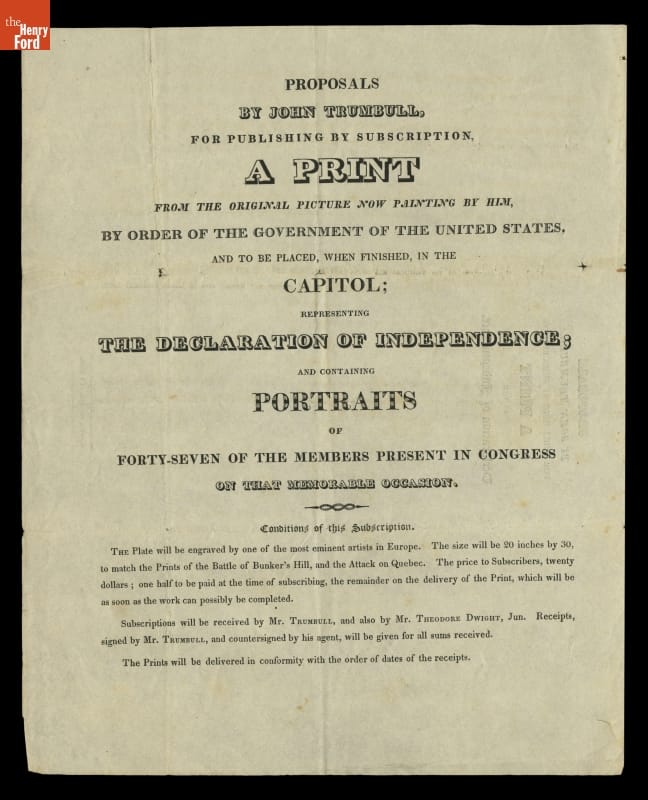
- Proposals by John Trumbull for Publishing by Subscription a Print from His "Declaration of Independence" Painting, 1818-1823 - John Trumbull sold subscriptions to fund the creation of a print based on his painting, <EM>Declaration of Independence</EM>. Subscribers would pay half of the print's price and promise to complete payment upon delivery. Trumbull's list of subscribers would include many prominent Americans, including two Presidents.
- 1818-1823
- Collections - Artifact
Proposals by John Trumbull for Publishing by Subscription a Print from His "Declaration of Independence" Painting, 1818-1823
John Trumbull sold subscriptions to fund the creation of a print based on his painting, Declaration of Independence. Subscribers would pay half of the print's price and promise to complete payment upon delivery. Trumbull's list of subscribers would include many prominent Americans, including two Presidents.