
Search
- A. H. Grebe Presents Radio Operators with Radio Receivers for Use on the Byrd Arctic Expedition, 1926 - Richard E. Byrd led an expedition to the Arctic in 1926, highlighted by a flight toward the North Pole on May 9. Special shortwave radio equipment allowed members of Byrd's team to communicate between their support ship, <em>Chantier</em>, and their Fokker Tri-Motor airplane, <em>Josephine Ford</em>. Though Byrd is generally credited with reaching the pole, controversy remains.
- 1926
- Collections - Artifact
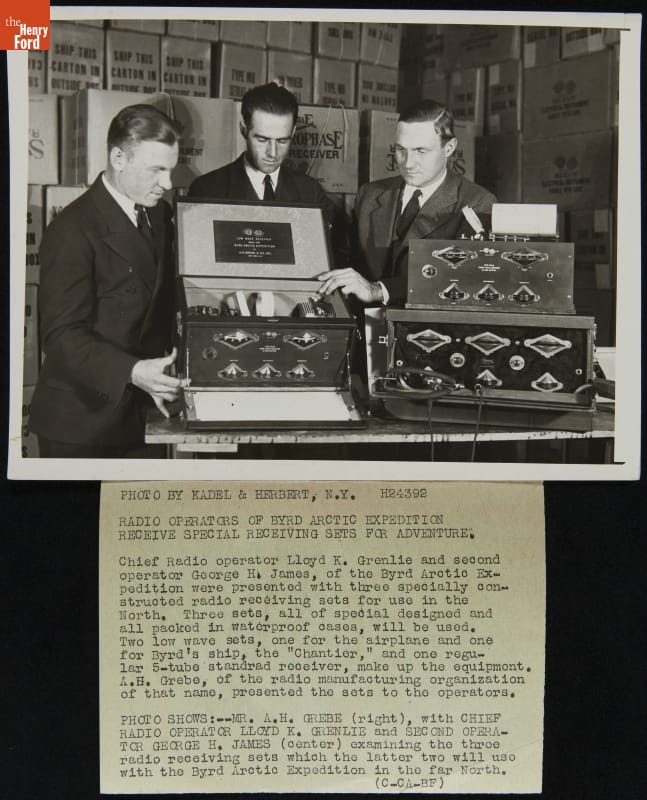
A. H. Grebe Presents Radio Operators with Radio Receivers for Use on the Byrd Arctic Expedition, 1926
Richard E. Byrd led an expedition to the Arctic in 1926, highlighted by a flight toward the North Pole on May 9. Special shortwave radio equipment allowed members of Byrd's team to communicate between their support ship, Chantier, and their Fokker Tri-Motor airplane, Josephine Ford. Though Byrd is generally credited with reaching the pole, controversy remains.
- Special Short Wave Radio Equipment for the Byrd Arctic Expedition, 1926 - Richard E. Byrd led an expedition to the Arctic in 1926, highlighted by a flight toward the North Pole on May 9. Special shortwave radio equipment allowed members of Byrd's team to communicate between their support ship, <em>Chantier</em>, and their Fokker Tri-Motor airplane, <em>Josephine Ford</em>. Though Byrd is generally credited with reaching the pole, controversy remains.
- 1926
- Collections - Artifact
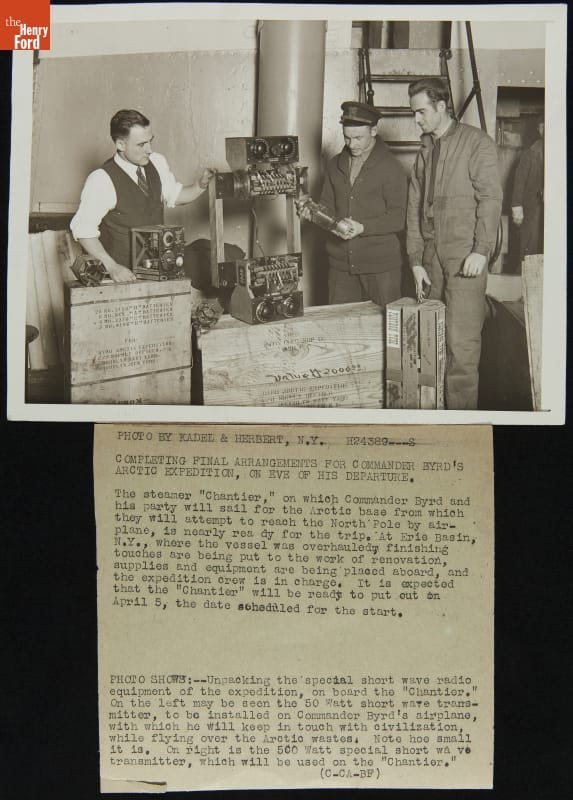
Special Short Wave Radio Equipment for the Byrd Arctic Expedition, 1926
Richard E. Byrd led an expedition to the Arctic in 1926, highlighted by a flight toward the North Pole on May 9. Special shortwave radio equipment allowed members of Byrd's team to communicate between their support ship, Chantier, and their Fokker Tri-Motor airplane, Josephine Ford. Though Byrd is generally credited with reaching the pole, controversy remains.