
Search
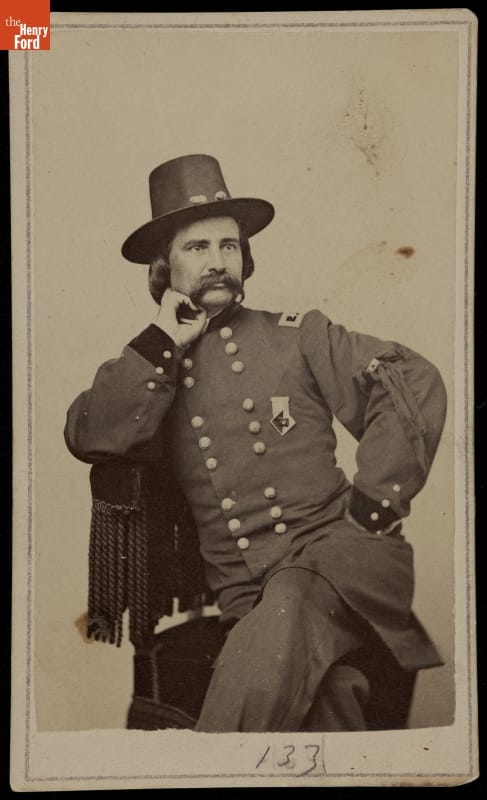
- Portrait of Union Army General John A. Logan, 1863-1865 - Cartes-de-visite, small, professionally made photographs on cardboard stock, remained popular in the United States from the Civil War in the 1860s through the 1880s. Many were given to friends and loved ones, but enterprising photographers also produced images of famous individuals to sell to the collecting-crazed public. Admired politicians or military officers, such as General John A. Logan, were popular subjects.
- 1863-1865
- Collections - Artifact
Portrait of Union Army General John A. Logan, 1863-1865
Cartes-de-visite, small, professionally made photographs on cardboard stock, remained popular in the United States from the Civil War in the 1860s through the 1880s. Many were given to friends and loved ones, but enterprising photographers also produced images of famous individuals to sell to the collecting-crazed public. Admired politicians or military officers, such as General John A. Logan, were popular subjects.
- Portrait of an American Civil War Veteran, circa 1890 -
- circa 1890
- Collections - Artifact
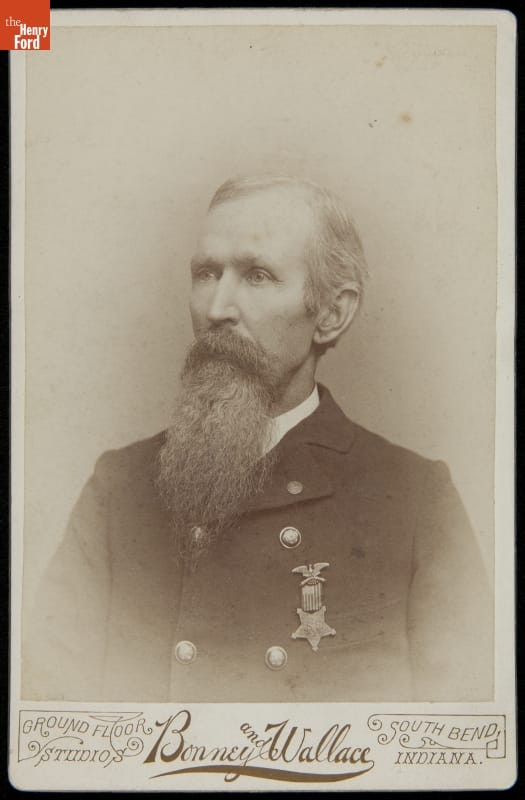
Portrait of an American Civil War Veteran, circa 1890
- Caricature of Abraham Lincoln, "That's What's the Matter," 1863 -
- 1863
- Collections - Artifact
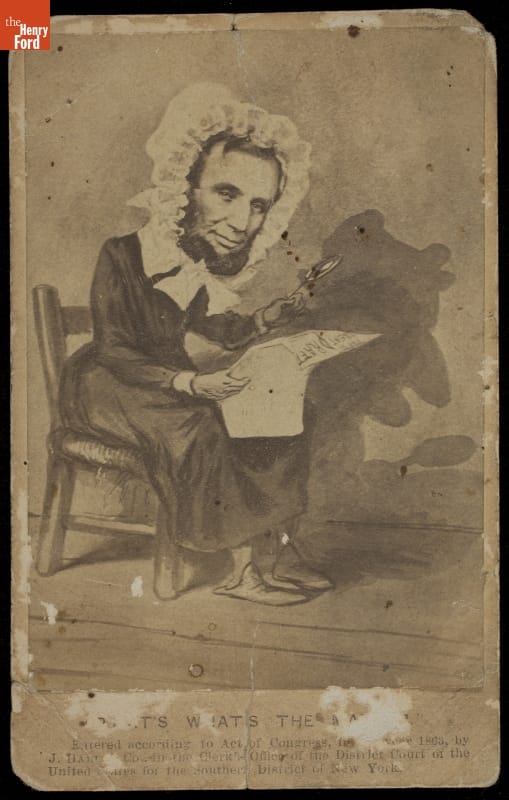
Caricature of Abraham Lincoln, "That's What's the Matter," 1863
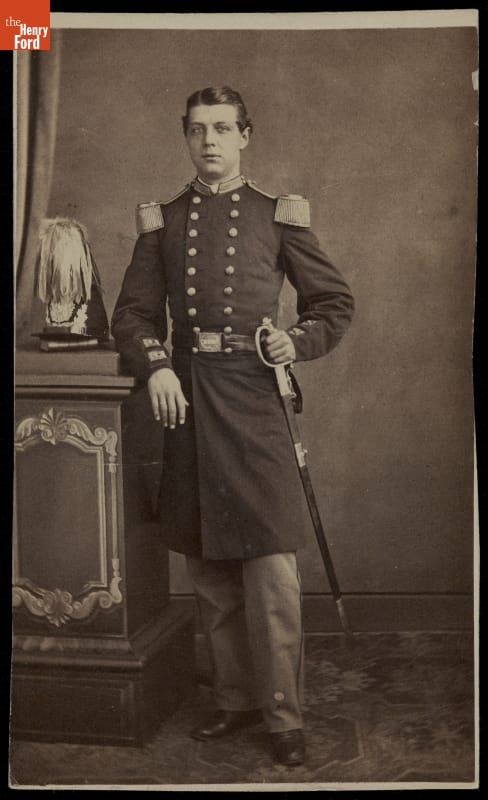
- Portrait of Robert O'Neill Ford, a U. S. Marine Corps 2nd Lieutenant, 1862-1864 - This carte-de-visite portrait shows a Union Marine Officer, Lieutenant Robert O'Neill Ford, who served on the USS <EM>Constellation</EM> in the Mediterranean Sea. Carte-de-visite was a small photographic print on cardboard stock made by professional photographers. Popular in the United States from the Civil War in the 1860s through the 1880s, people exchanged and collected CdVs to help them remember family and celebrities.
- 1862-1864
- Collections - Artifact
Portrait of Robert O'Neill Ford, a U. S. Marine Corps 2nd Lieutenant, 1862-1864
This carte-de-visite portrait shows a Union Marine Officer, Lieutenant Robert O'Neill Ford, who served on the USS Constellation in the Mediterranean Sea. Carte-de-visite was a small photographic print on cardboard stock made by professional photographers. Popular in the United States from the Civil War in the 1860s through the 1880s, people exchanged and collected CdVs to help them remember family and celebrities.
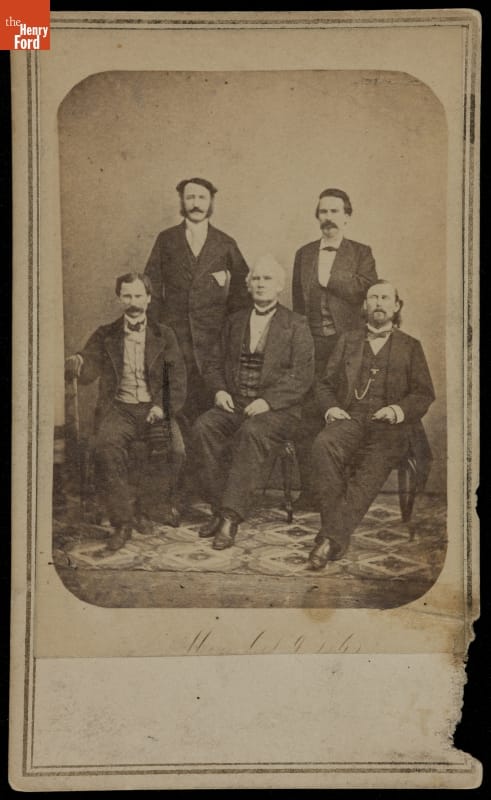
- Five Confederate Generals in Mexico, 1865 -
- October 09, 1865
- Collections - Artifact
Five Confederate Generals in Mexico, 1865
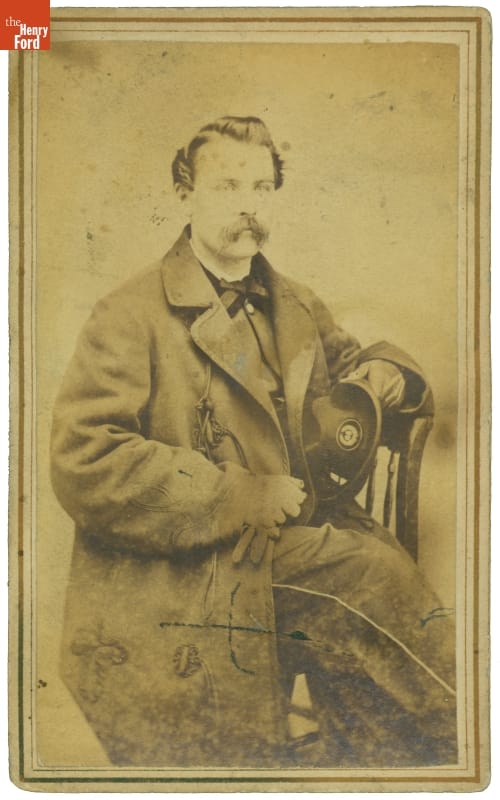
- Portrait of 1st Lieutenant DeLoss C. LeBaron, 18th Michigan Infantry, Company B, 1865 - A.J. Hoag of Tecumseh, Michigan, made this bust portrait of Union Army infantry officer DeLoss C. LeBaron. Professional photographers made cartes-de-visite beginning in the 1860s. Mounted on small cardboard stock, these early photographic prints proved popular in the United States from the Civil War through the 1880s. Americans exchanged and collected CdVs to help them remember family and celebrities.
- 1865
- Collections - Artifact
Portrait of 1st Lieutenant DeLoss C. LeBaron, 18th Michigan Infantry, Company B, 1865
A.J. Hoag of Tecumseh, Michigan, made this bust portrait of Union Army infantry officer DeLoss C. LeBaron. Professional photographers made cartes-de-visite beginning in the 1860s. Mounted on small cardboard stock, these early photographic prints proved popular in the United States from the Civil War through the 1880s. Americans exchanged and collected CdVs to help them remember family and celebrities.
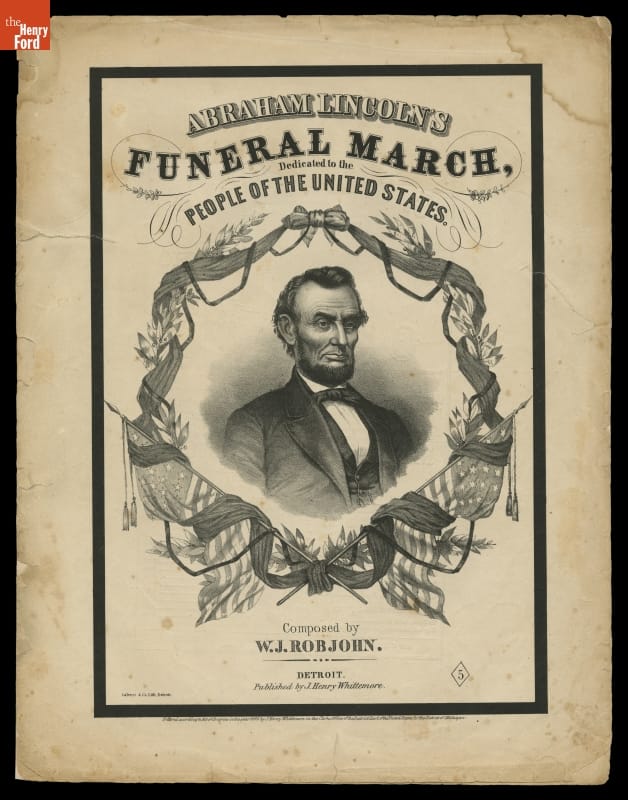
- Music Sheet, "Abraham Lincoln's Funeral March," 1865 - Abraham Lincoln's assassination on April 15, 1865 plunged Americans into deep mourning. This sheet music's somber composition and illustrated cover helped people to understand the tragic event. Printed in Detroit, it may have been used during that city's public mourning ceremony held April 25, 1865. The artist added a border depicting black cloth-draped U.S. flags and laurel leaves in the shape of a wreath around Lincoln's head.
- 1865
- Collections - Artifact
Music Sheet, "Abraham Lincoln's Funeral March," 1865
Abraham Lincoln's assassination on April 15, 1865 plunged Americans into deep mourning. This sheet music's somber composition and illustrated cover helped people to understand the tragic event. Printed in Detroit, it may have been used during that city's public mourning ceremony held April 25, 1865. The artist added a border depicting black cloth-draped U.S. flags and laurel leaves in the shape of a wreath around Lincoln's head.
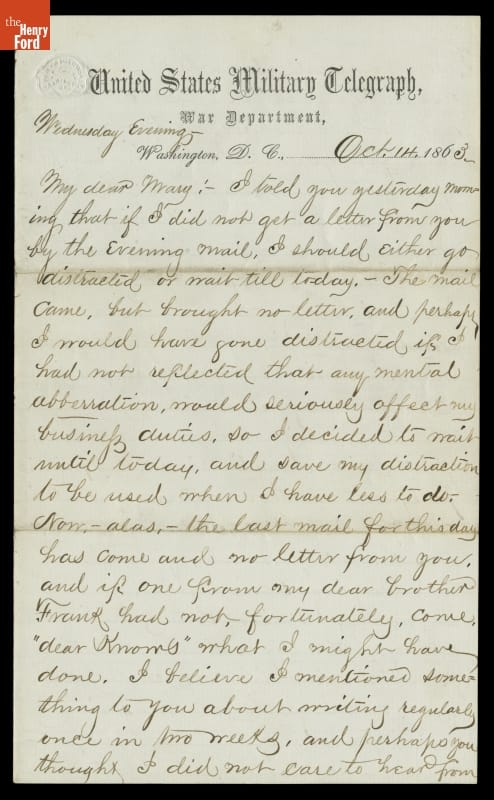
- Letter from Albert B. Chandler to Marilla Stedman, October 14, 1863 - Albert B. Chandler served as a cipher operator at the War Department office in Washington, D.C., during the Civil War. He transmitted coded messages to and decoded messages from Union military field commanders. While at this post, he became acquainted with President Abraham Lincoln. Chandler describes some of his wartime experiences in this letter to Marilla Stedman, his future bride.
- October 14, 1863
- Collections - Artifact
Letter from Albert B. Chandler to Marilla Stedman, October 14, 1863
Albert B. Chandler served as a cipher operator at the War Department office in Washington, D.C., during the Civil War. He transmitted coded messages to and decoded messages from Union military field commanders. While at this post, he became acquainted with President Abraham Lincoln. Chandler describes some of his wartime experiences in this letter to Marilla Stedman, his future bride.
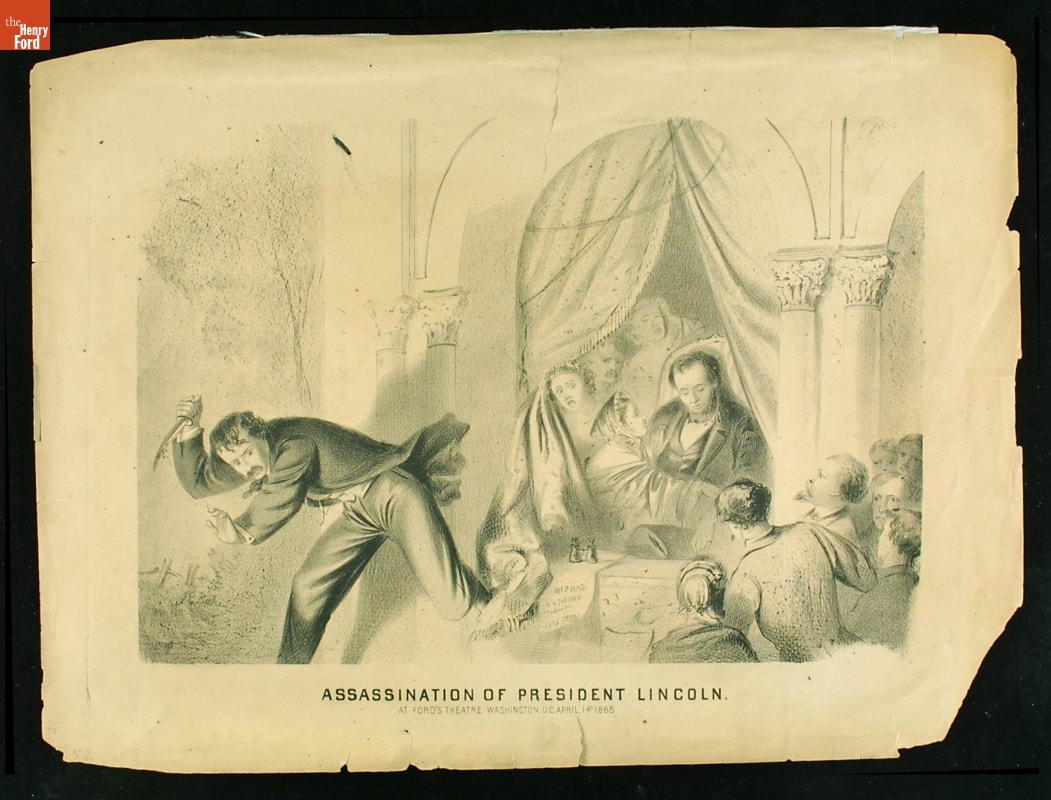
- Print, Assassination of President LIncoln, 1865-1870 - Before the existence of newspaper photos and television, lithographs helped people to understand the tragic event of President Abraham Lincoln's death in April 1865. This shows the assassin escaping after shooting President Lincoln at Ford's Theatre in Washington, D.C., on April 14, 1865. Printmakers produced various versions of this event, based on verbal reports.
- April 14, 1865
- Collections - Artifact
Print, Assassination of President LIncoln, 1865-1870
Before the existence of newspaper photos and television, lithographs helped people to understand the tragic event of President Abraham Lincoln's death in April 1865. This shows the assassin escaping after shooting President Lincoln at Ford's Theatre in Washington, D.C., on April 14, 1865. Printmakers produced various versions of this event, based on verbal reports.
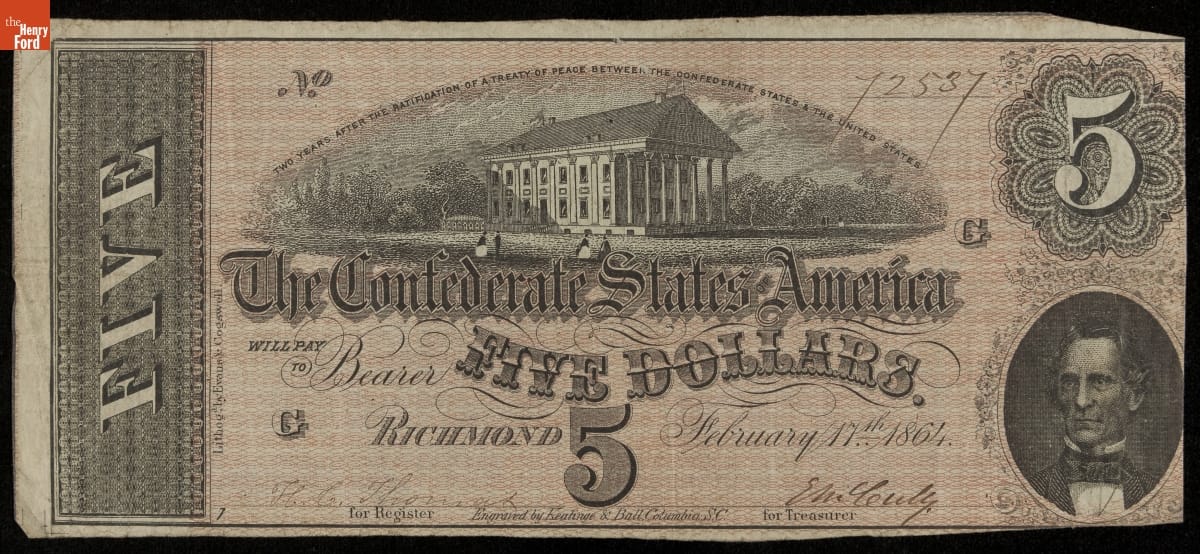
- Confederate Currency, Confederate States of America, Five Dollars, 1864 - When the Civil War broke out, the newly formed Confederate States of America needed to create a monetary system to finance the government and the war effort. The Confederate Treasury printed bank notes in 50-cent, $1, $2, $5, $10, $20, $50, $100, $500 and $1,000 denominations. Some were interest-bearing notes, others not.
- February 17, 1864
- Collections - Artifact
Confederate Currency, Confederate States of America, Five Dollars, 1864
When the Civil War broke out, the newly formed Confederate States of America needed to create a monetary system to finance the government and the war effort. The Confederate Treasury printed bank notes in 50-cent, $1, $2, $5, $10, $20, $50, $100, $500 and $1,000 denominations. Some were interest-bearing notes, others not.