
Search
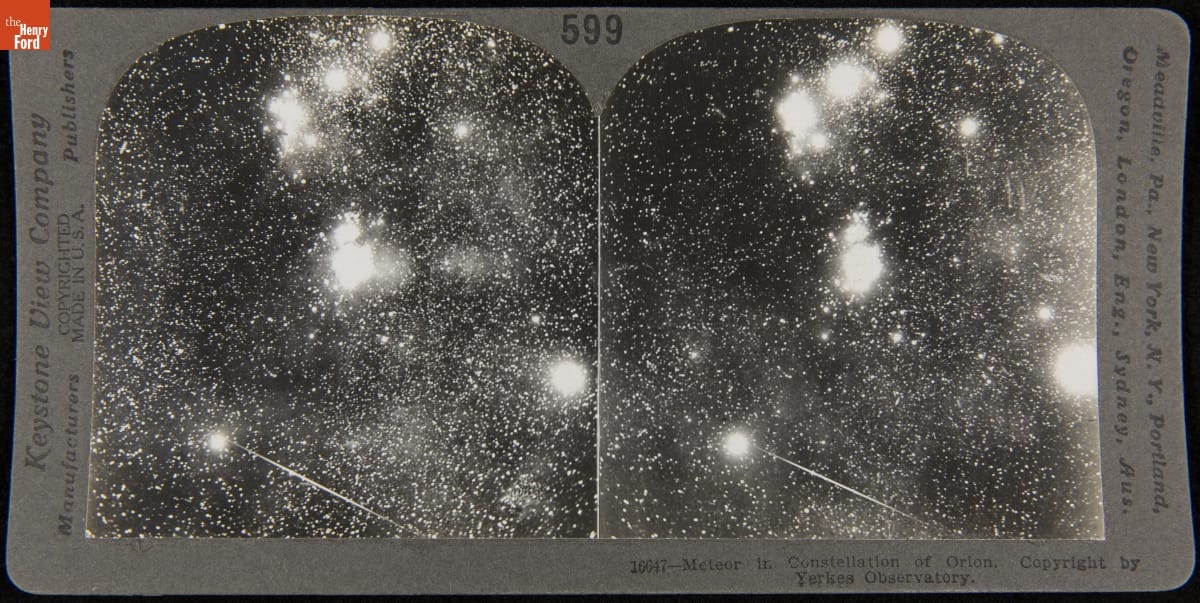
- Stereograph, "Meteor in Constellation of Orion," 1904 - Americans loved stereographs -- millions were made from the mid-1800s through the 1930s. A stereograph consists of two offset photos that appear to have three-dimensional depth when viewed through a stereoscope. These images entertained and educated. Stereographs could transport viewers to distant events, exotic places, and even worlds beyond, like this image of the Orion constellation.
- November 15, 1904
- Collections - Artifact
Stereograph, "Meteor in Constellation of Orion," 1904
Americans loved stereographs -- millions were made from the mid-1800s through the 1930s. A stereograph consists of two offset photos that appear to have three-dimensional depth when viewed through a stereoscope. These images entertained and educated. Stereographs could transport viewers to distant events, exotic places, and even worlds beyond, like this image of the Orion constellation.
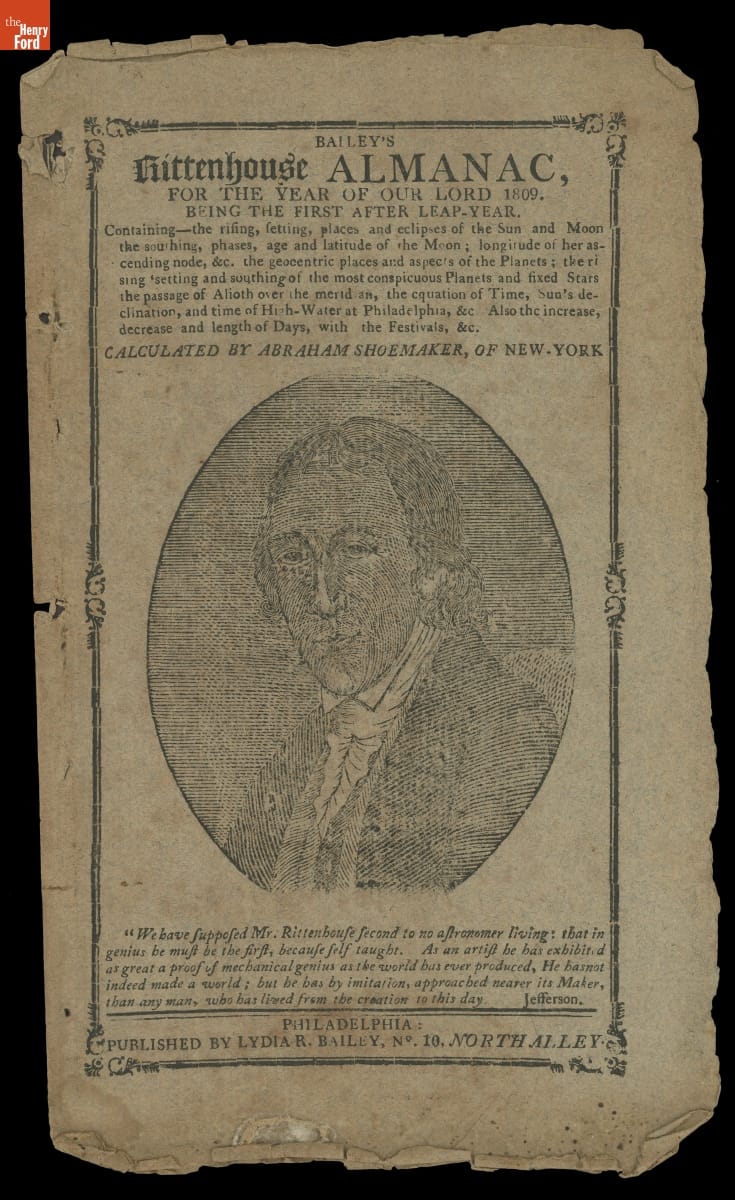
- "Bailey's Rittenhouse Almanac, for the Year of our Lord 1809" - Bailey's Rittenhouse Almanac, named for the noted astronomer David Rittenhouse (1732-1796), was a Philadelphia-focused almanac providing astronomical calculations (times of sunrises and sets, the tides, moon phases, and eclipses, etc.) The almanac also provided remedies, recipes, court schedules, and bits of sage advice among its pages. The almanac's printer, Lydia Bailey, operated one of Philadelphia's largest printing shops.
- 1809
- Collections - Artifact
"Bailey's Rittenhouse Almanac, for the Year of our Lord 1809"
Bailey's Rittenhouse Almanac, named for the noted astronomer David Rittenhouse (1732-1796), was a Philadelphia-focused almanac providing astronomical calculations (times of sunrises and sets, the tides, moon phases, and eclipses, etc.) The almanac also provided remedies, recipes, court schedules, and bits of sage advice among its pages. The almanac's printer, Lydia Bailey, operated one of Philadelphia's largest printing shops.
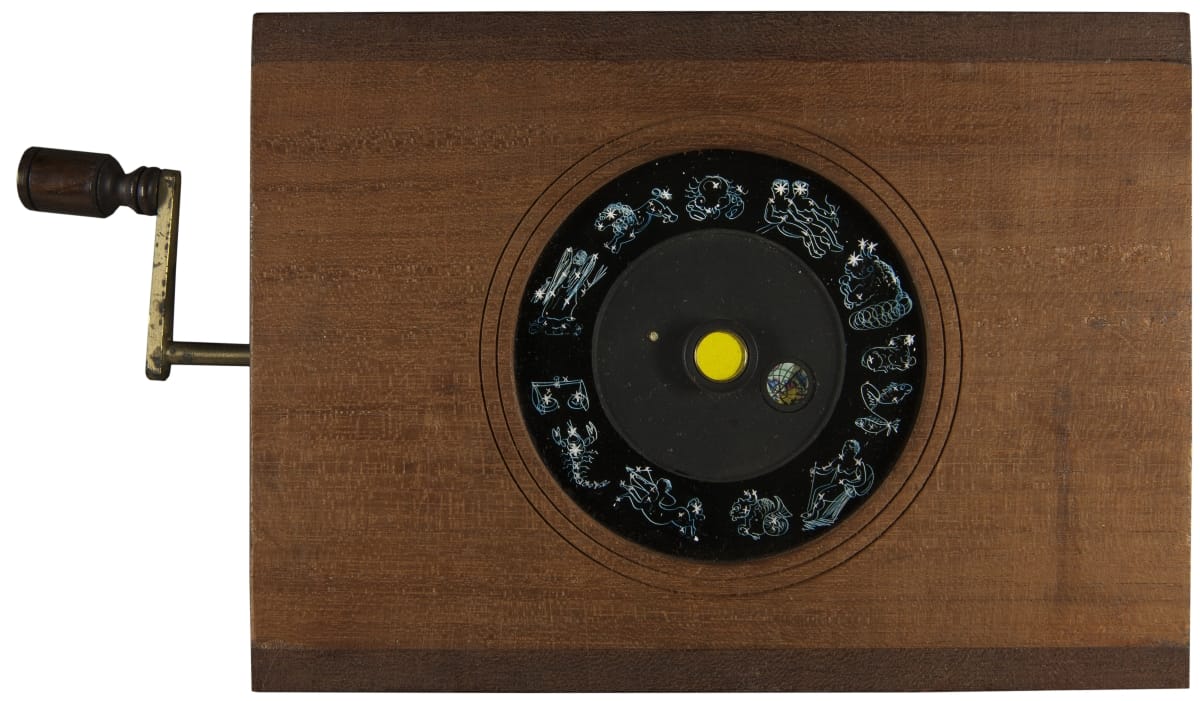
- Mechanical Lantern Slide, Earth's Orbit and Astrological Constellations, 1860-1900 - Magic lanterns use a concave mirror and light source to project images on glass slides with painted or photographic scenes. Developed in the 17th century, magic lanterns predate slide projectors and motion pictures. In the hands of magicians, they became "lanterns of fright," projecting wondrous images and apparitions. Slide themes ranged widely: exotic travel, folklore, advertising, history, science, and art.
- 1860-1900
- Collections - Artifact
Mechanical Lantern Slide, Earth's Orbit and Astrological Constellations, 1860-1900
Magic lanterns use a concave mirror and light source to project images on glass slides with painted or photographic scenes. Developed in the 17th century, magic lanterns predate slide projectors and motion pictures. In the hands of magicians, they became "lanterns of fright," projecting wondrous images and apparitions. Slide themes ranged widely: exotic travel, folklore, advertising, history, science, and art.
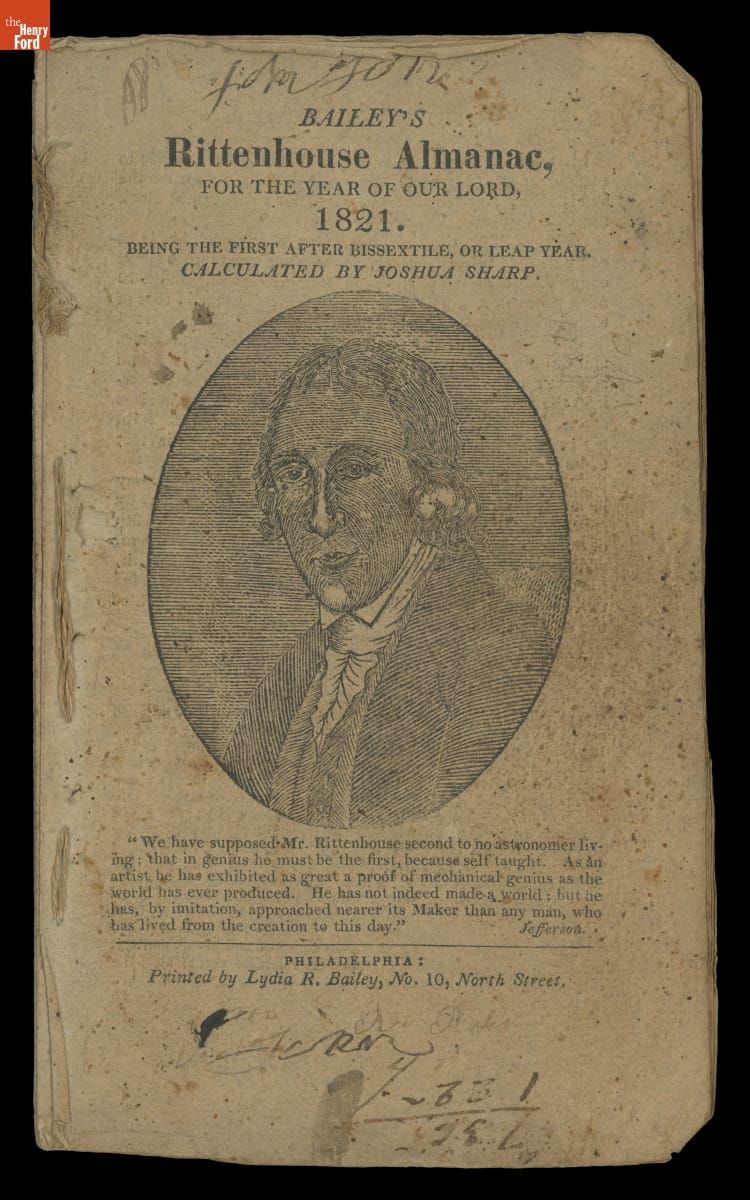
- "Bailey's Rittenhouse Almanac, for the Year of our Lord 1821" - Bailey's Rittenhouse Almanac, named for the noted astronomer David Rittenhouse (1732-1796), was a Philadelphia-focused almanac providing astronomical calculations (times of sunrises and sets, the tides, moon phases, and eclipses, etc.) The almanac also provided remedies, recipes, court schedules, and bits of sage advice among its pages. The almanac's printer, Lydia Bailey, operated one of Philadelphia's largest printing shops.
- 1821
- Collections - Artifact
"Bailey's Rittenhouse Almanac, for the Year of our Lord 1821"
Bailey's Rittenhouse Almanac, named for the noted astronomer David Rittenhouse (1732-1796), was a Philadelphia-focused almanac providing astronomical calculations (times of sunrises and sets, the tides, moon phases, and eclipses, etc.) The almanac also provided remedies, recipes, court schedules, and bits of sage advice among its pages. The almanac's printer, Lydia Bailey, operated one of Philadelphia's largest printing shops.
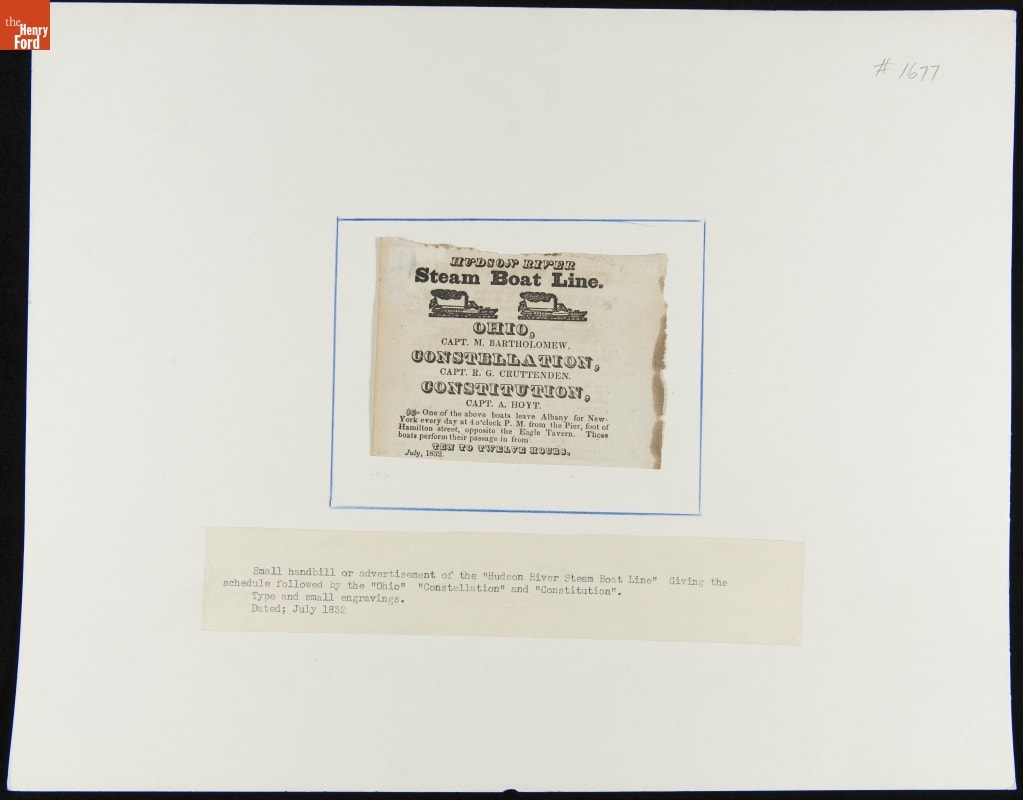
- "Hudson River Steam Boat Line," July 1832 - Robert Fulton operated the world's first commercially successful steamboat, <i>Clermont</i>, on the Hudson River in 1807. The Hudson was broad, deep and straight for many of the 150 miles between New York City and Albany. By the 1860s, steam-powered boats could cover that distance in about nine hours. Spacious, well-equipped steamboats offered a uniquely pleasant way to travel.
- July 01, 1832
- Collections - Artifact
"Hudson River Steam Boat Line," July 1832
Robert Fulton operated the world's first commercially successful steamboat, Clermont, on the Hudson River in 1807. The Hudson was broad, deep and straight for many of the 150 miles between New York City and Albany. By the 1860s, steam-powered boats could cover that distance in about nine hours. Spacious, well-equipped steamboats offered a uniquely pleasant way to travel.
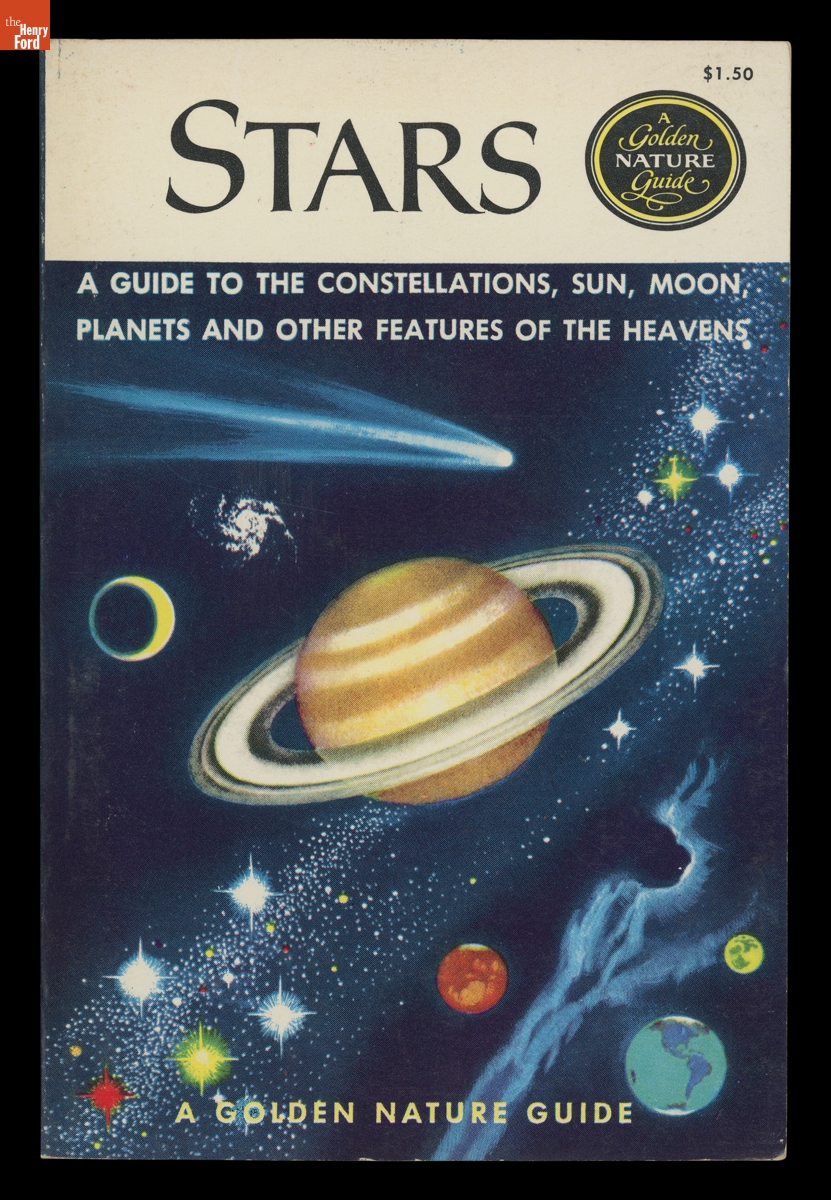
- "A Golden Nature Guide: Stars, A Guide to the Constellations, Sun, Moon, Planets, and Other Features of the Heavens," 1956 -
- 1956
- Collections - Artifact
"A Golden Nature Guide: Stars, A Guide to the Constellations, Sun, Moon, Planets, and Other Features of the Heavens," 1956