
Search
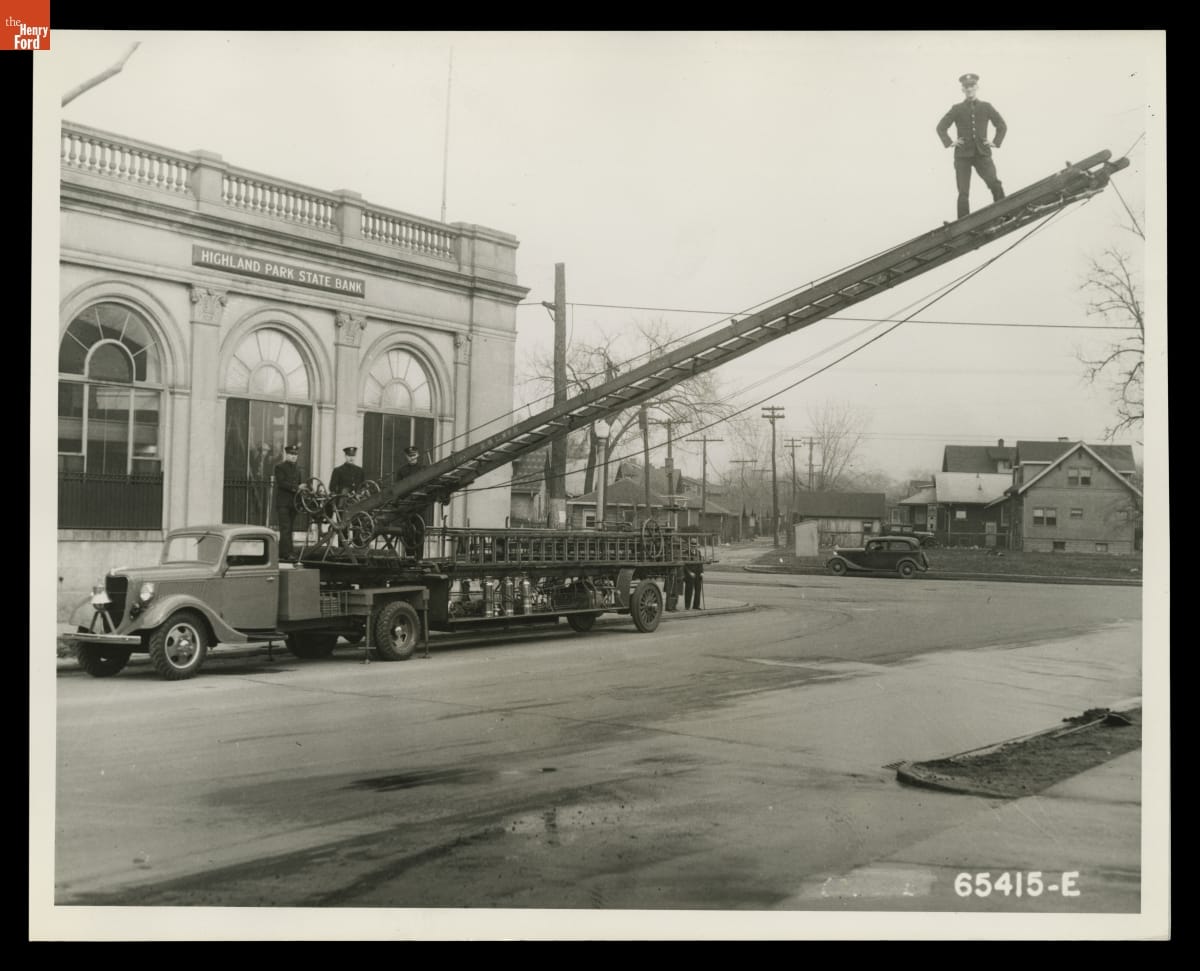
- Ford V-8 Fire Truck Tractor with Hook and Ladder Trailer at the Highland Park State Bank, March 12, 1936 - This 1936 Ford Model 51 truck included a fire bell on its front bumper and a large tank behind its cab. The truck hauled a 75-foot aerial ladder manufactured by American LaFrance. "Hook and ladder" refers to two essential pieces of firefighting equipment: hooks to tear down potential fire fuel, and ladders to reach people trapped on upper floors.
- March 12, 1936
- Collections - Artifact
Ford V-8 Fire Truck Tractor with Hook and Ladder Trailer at the Highland Park State Bank, March 12, 1936
This 1936 Ford Model 51 truck included a fire bell on its front bumper and a large tank behind its cab. The truck hauled a 75-foot aerial ladder manufactured by American LaFrance. "Hook and ladder" refers to two essential pieces of firefighting equipment: hooks to tear down potential fire fuel, and ladders to reach people trapped on upper floors.
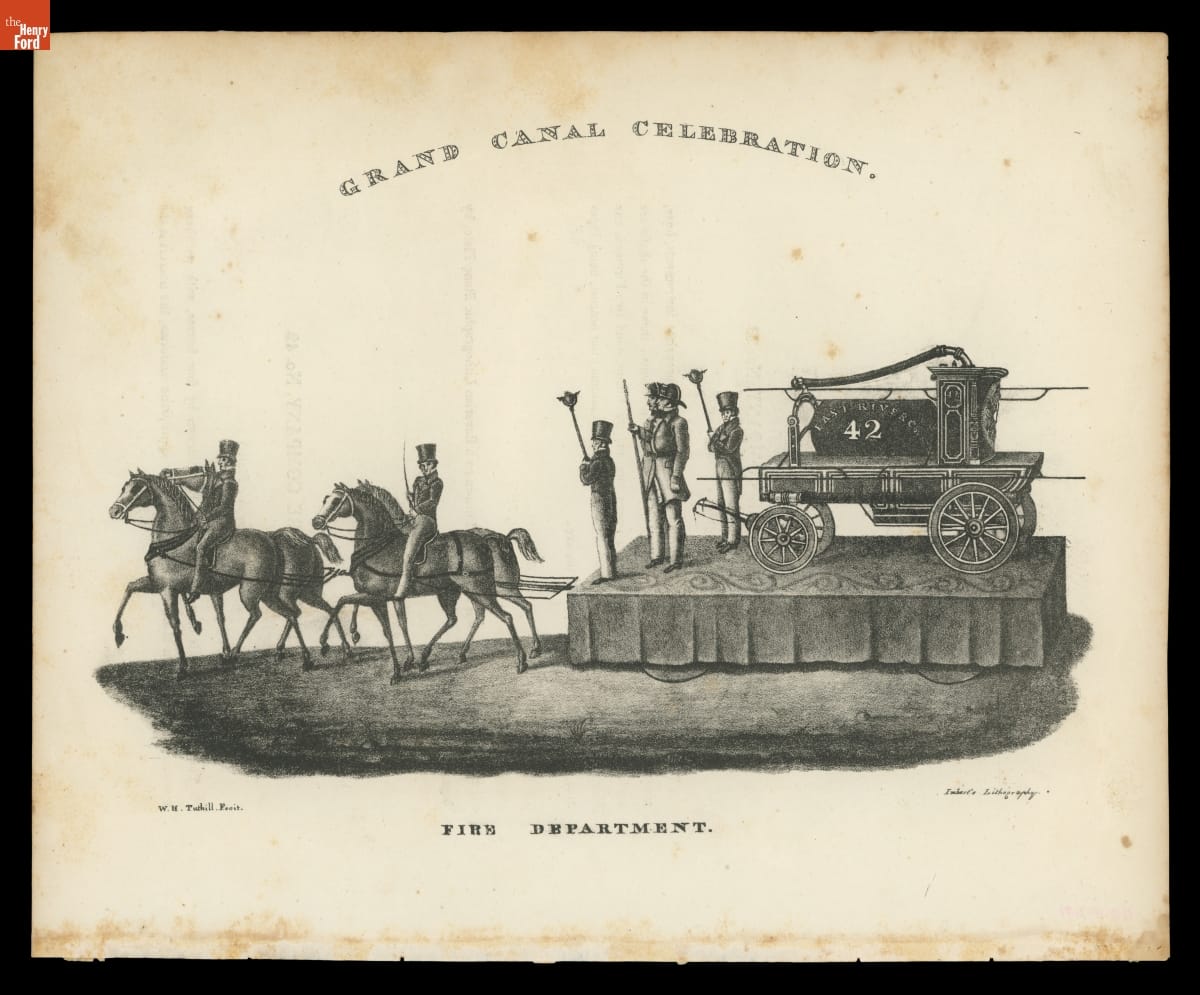
- Lithograph, "Grand Canal Celebration, Fire Department," November 4, 1825 - The Erie Canal connected the Hudson River and New York City with Lake Erie and the Upper Midwest. Its completion in 1825 was cause for grand celebrations up and down the canal's 363-mile length. This lithograph shows a fire department participating in a parade to commemorate the canal's opening.
- November 04, 1825
- Collections - Artifact
Lithograph, "Grand Canal Celebration, Fire Department," November 4, 1825
The Erie Canal connected the Hudson River and New York City with Lake Erie and the Upper Midwest. Its completion in 1825 was cause for grand celebrations up and down the canal's 363-mile length. This lithograph shows a fire department participating in a parade to commemorate the canal's opening.
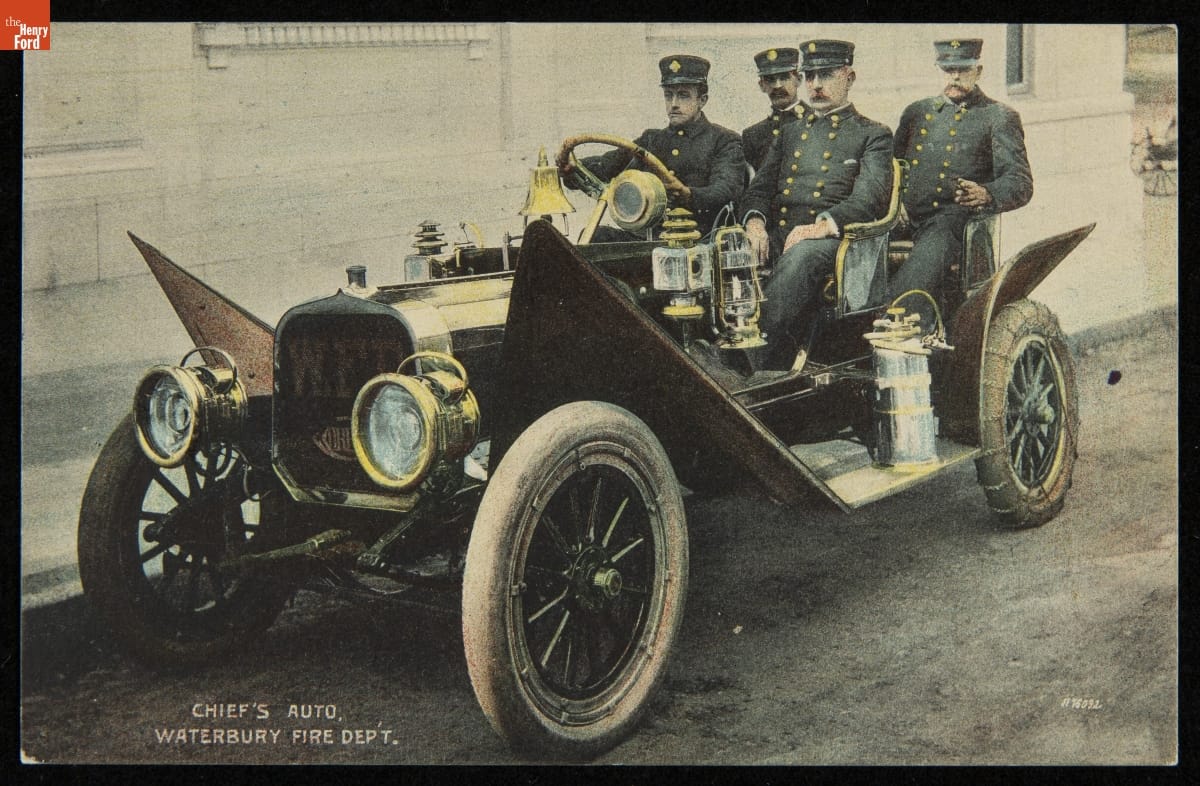
- Postcard, "Chief's Auto, Waterbury Fire Dept.," 1912 - Fire departments, eager to eliminate the costs and complications of horses, were quick to adopt motor vehicles. In addition to motorized pumpers and trucks, many departments purchased automobiles for use by fire chiefs. With a car, a fire chief and staff could travel swiftly to the scene of a fire.
- February 28, 1912
- Collections - Artifact
Postcard, "Chief's Auto, Waterbury Fire Dept.," 1912
Fire departments, eager to eliminate the costs and complications of horses, were quick to adopt motor vehicles. In addition to motorized pumpers and trucks, many departments purchased automobiles for use by fire chiefs. With a car, a fire chief and staff could travel swiftly to the scene of a fire.
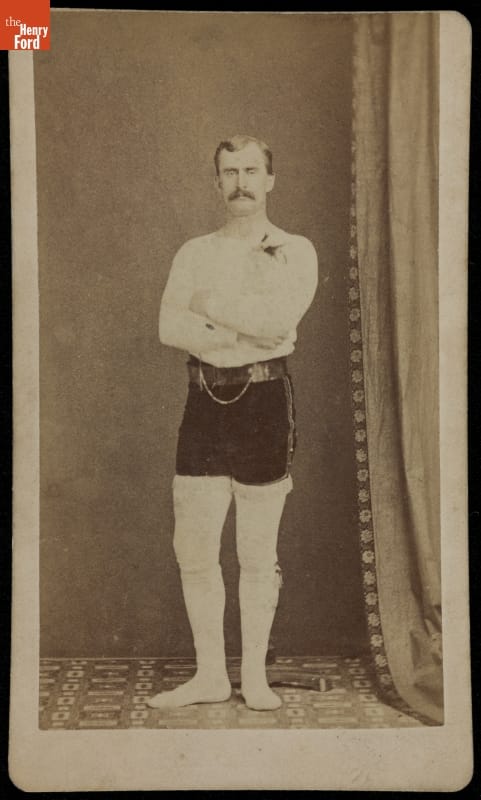
- Thomas Shaw of the Alert Hose Company, Big Rapids, Michigan, 1877 - This man, identified as Thomas Shaw, was a fireman with the Alert Hose Company of Big Rapids, Michigan. To 21st-century eyes his uniform may appear odd, but it was worn during firemen's tournaments and not for fighting fires. These competitions pitted rival firefighting companies against each other in engine and hose races and other tests of firefighting skills needed during fire emergencies.
- 1877
- Collections - Artifact
Thomas Shaw of the Alert Hose Company, Big Rapids, Michigan, 1877
This man, identified as Thomas Shaw, was a fireman with the Alert Hose Company of Big Rapids, Michigan. To 21st-century eyes his uniform may appear odd, but it was worn during firemen's tournaments and not for fighting fires. These competitions pitted rival firefighting companies against each other in engine and hose races and other tests of firefighting skills needed during fire emergencies.
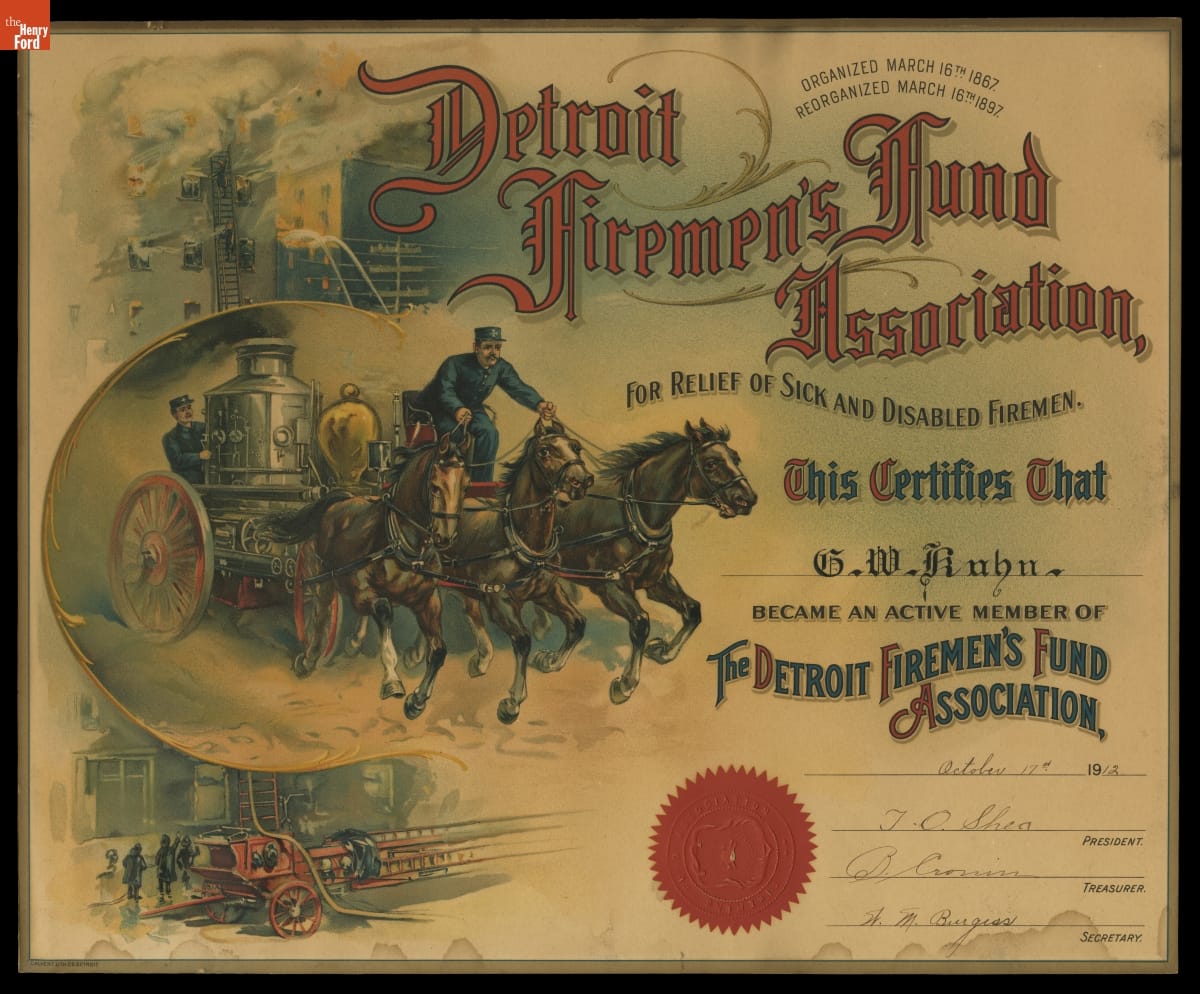
- Lithograph, Detroit Firemen's Fund Association Membership Certificate Issued to G.W. Kahn, October 17, 1912 - The Detroit Firemen's Fund Association was first incorporated in 1867. The association assisted firefighters and their families in the event of injury or death while in the line of duty. Money for the fund came through membership dues, special fundraising activities, and charitable donations.
- October 17, 1912
- Collections - Artifact
Lithograph, Detroit Firemen's Fund Association Membership Certificate Issued to G.W. Kahn, October 17, 1912
The Detroit Firemen's Fund Association was first incorporated in 1867. The association assisted firefighters and their families in the event of injury or death while in the line of duty. Money for the fund came through membership dues, special fundraising activities, and charitable donations.
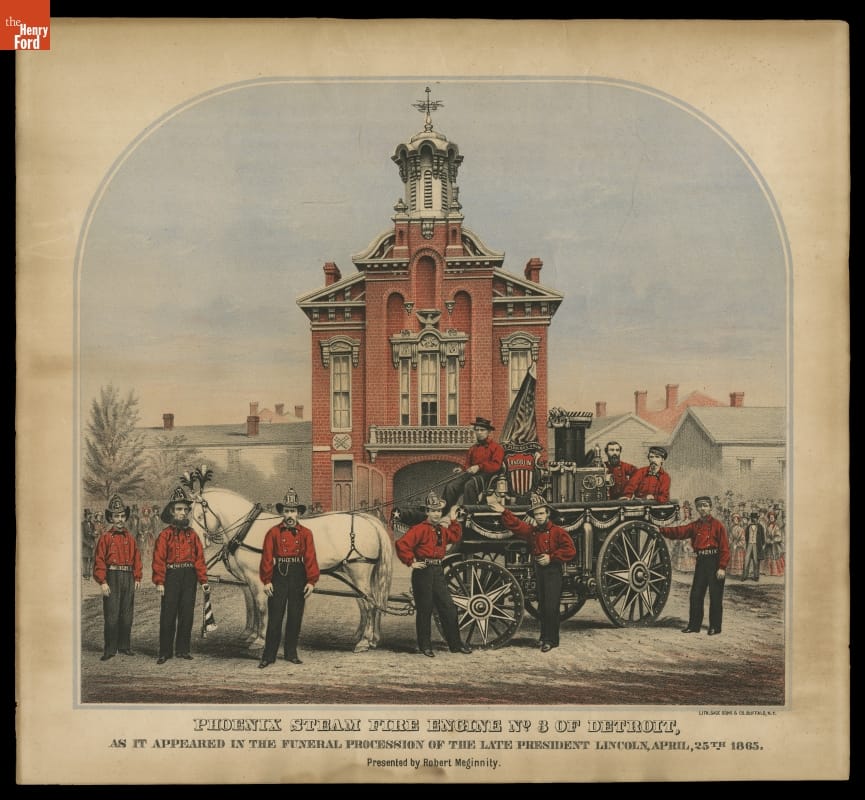
- "Phoenix Fire Engine No. 3 of Detroit as it Appeared in the Funeral Procession of the Late President Lincoln," April 25, 1865 - Abraham Lincoln's assassination in April 1865 plunged Americans into deep mourning. All over the nation, communities joined in public ceremonies honoring the 16th president. This shows Detroit's Phoenix Fire Engine Number 3 decorated for the procession mourning Lincoln's death held on April 25. The <EM>Detroit Free Press</EM> reported that over 30,000 people attended and the three fire engines were "the most beautiful feature of the procession."
- April 25, 1865
- Collections - Artifact
"Phoenix Fire Engine No. 3 of Detroit as it Appeared in the Funeral Procession of the Late President Lincoln," April 25, 1865
Abraham Lincoln's assassination in April 1865 plunged Americans into deep mourning. All over the nation, communities joined in public ceremonies honoring the 16th president. This shows Detroit's Phoenix Fire Engine Number 3 decorated for the procession mourning Lincoln's death held on April 25. The Detroit Free Press reported that over 30,000 people attended and the three fire engines were "the most beautiful feature of the procession."
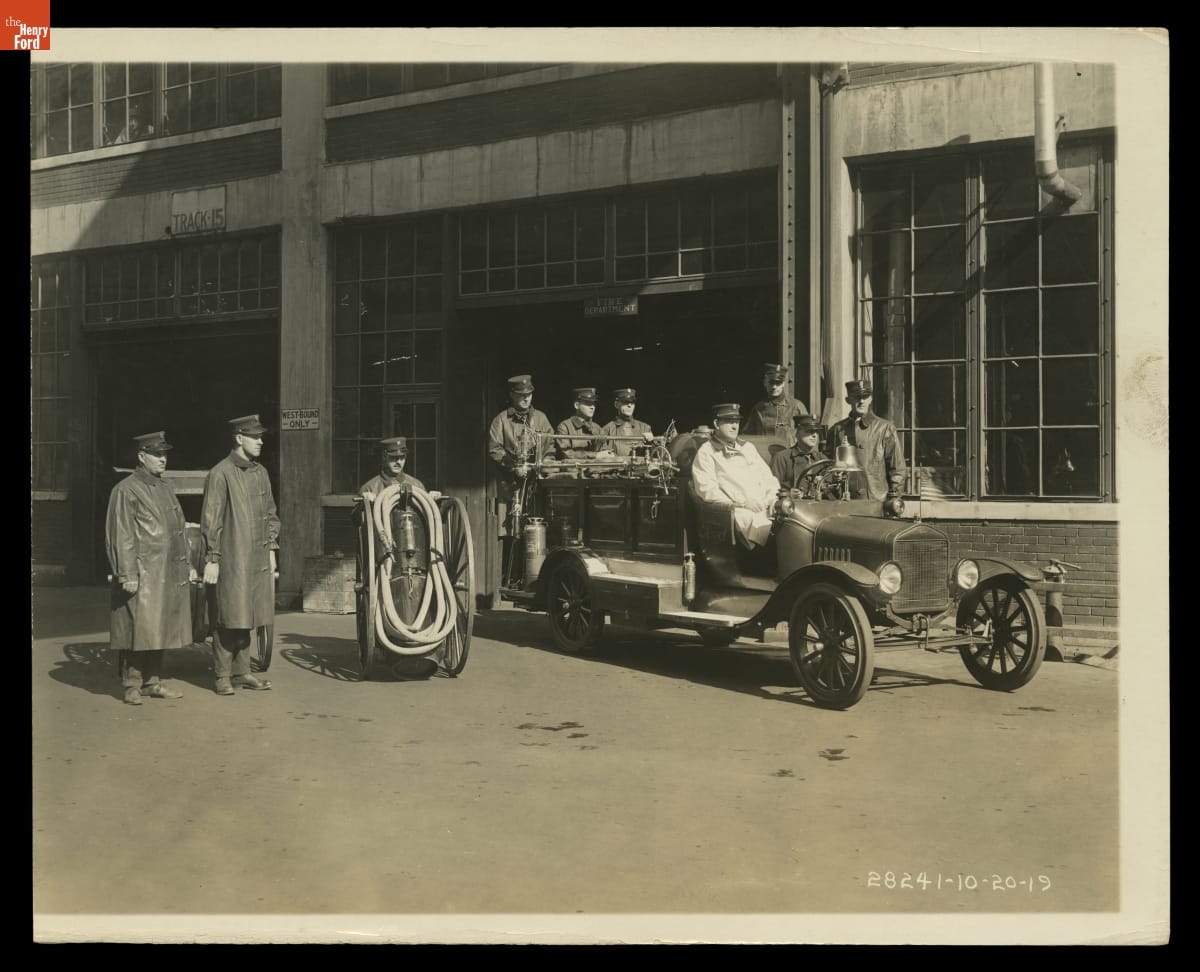
- Ford Highland Park Fire Department, October 20, 1919 - Fire was a constant threat to factories and industrial facilities. Large plants often operated their own fire departments to protect from the danger. Ford Motor Company maintained a fire department at its Highland Park plant near Detroit, Michigan. Naturally, Ford's department used Model T fire trucks.
- October 20, 1919
- Collections - Artifact
Ford Highland Park Fire Department, October 20, 1919
Fire was a constant threat to factories and industrial facilities. Large plants often operated their own fire departments to protect from the danger. Ford Motor Company maintained a fire department at its Highland Park plant near Detroit, Michigan. Naturally, Ford's department used Model T fire trucks.
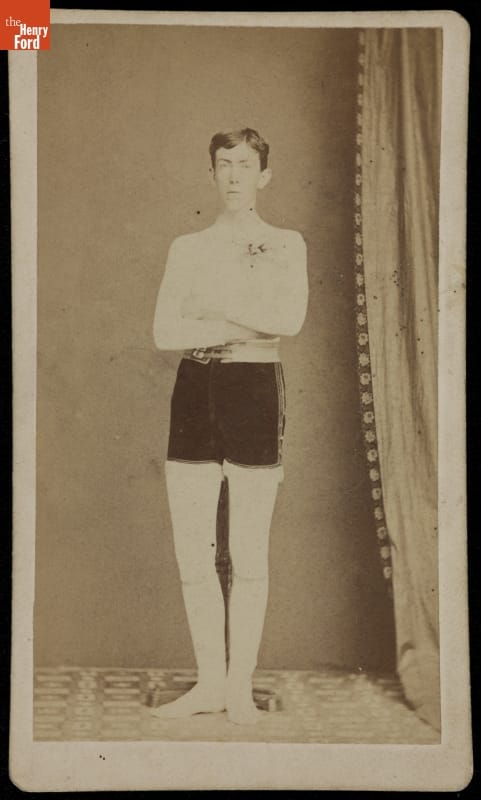
- W. E. Drew of the Alert Hose Company, Big Rapids, Michigan, 1877 - This man, identified as W. E. Drew, was a fireman with the Alert Hose Company of Big Rapids, Michigan. To 21st-century eyes his uniform may appear odd, but it was worn during firemen's tournaments and not for fighting fires. These competitions pitted rival firefighting companies against each other in engine and hose races and other tests of firefighting skills needed during fire emergencies.
- 1877
- Collections - Artifact
W. E. Drew of the Alert Hose Company, Big Rapids, Michigan, 1877
This man, identified as W. E. Drew, was a fireman with the Alert Hose Company of Big Rapids, Michigan. To 21st-century eyes his uniform may appear odd, but it was worn during firemen's tournaments and not for fighting fires. These competitions pitted rival firefighting companies against each other in engine and hose races and other tests of firefighting skills needed during fire emergencies.
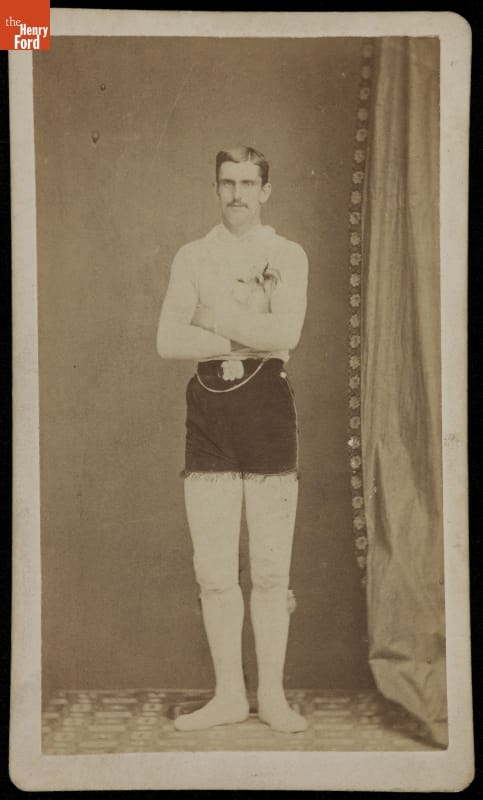
- Henry Shaw of the Alert Hose Company, Big Rapids, Michigan, 1877 - This man, identified as Henry Shaw, was a fireman with the Alert Hose Company of Big Rapids, Michigan. To 21st-century eyes his uniform may appear odd, but it was worn during firemen's tournaments and not for fighting fires. These competitions pitted rival firefighting companies against each other in engine and hose races and other tests of firefighting skills needed during fire emergencies.
- 1877
- Collections - Artifact
Henry Shaw of the Alert Hose Company, Big Rapids, Michigan, 1877
This man, identified as Henry Shaw, was a fireman with the Alert Hose Company of Big Rapids, Michigan. To 21st-century eyes his uniform may appear odd, but it was worn during firemen's tournaments and not for fighting fires. These competitions pitted rival firefighting companies against each other in engine and hose races and other tests of firefighting skills needed during fire emergencies.
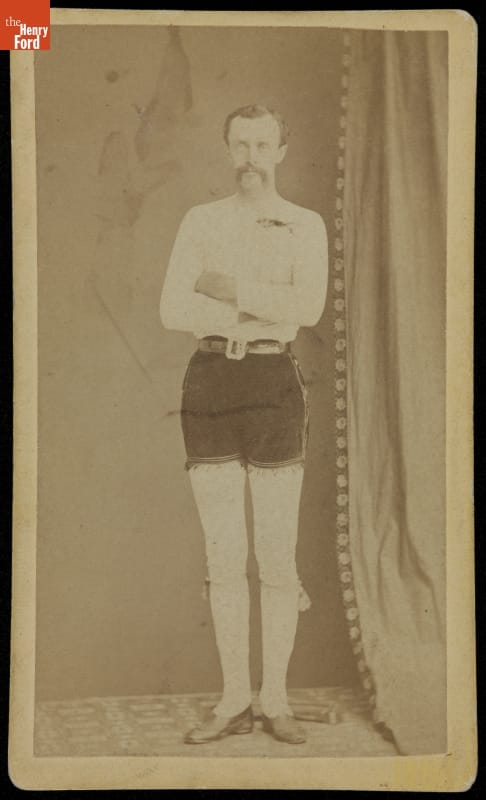
- Zip Hammond of the Alert Hose Company, Big Rapids, Michigan, 1877 - This man, identified as "Zip" Hammond, was a fireman with the Alert Hose Company of Big Rapids, Michigan. To 21st-century eyes his uniform may appear odd, but it was worn during firemen's tournaments and not for fighting fires. These competitions pitted rival firefighting companies against each other in engine and hose races and other tests of firefighting skills needed during fire emergencies.
- 1877
- Collections - Artifact
Zip Hammond of the Alert Hose Company, Big Rapids, Michigan, 1877
This man, identified as "Zip" Hammond, was a fireman with the Alert Hose Company of Big Rapids, Michigan. To 21st-century eyes his uniform may appear odd, but it was worn during firemen's tournaments and not for fighting fires. These competitions pitted rival firefighting companies against each other in engine and hose races and other tests of firefighting skills needed during fire emergencies.