
Search
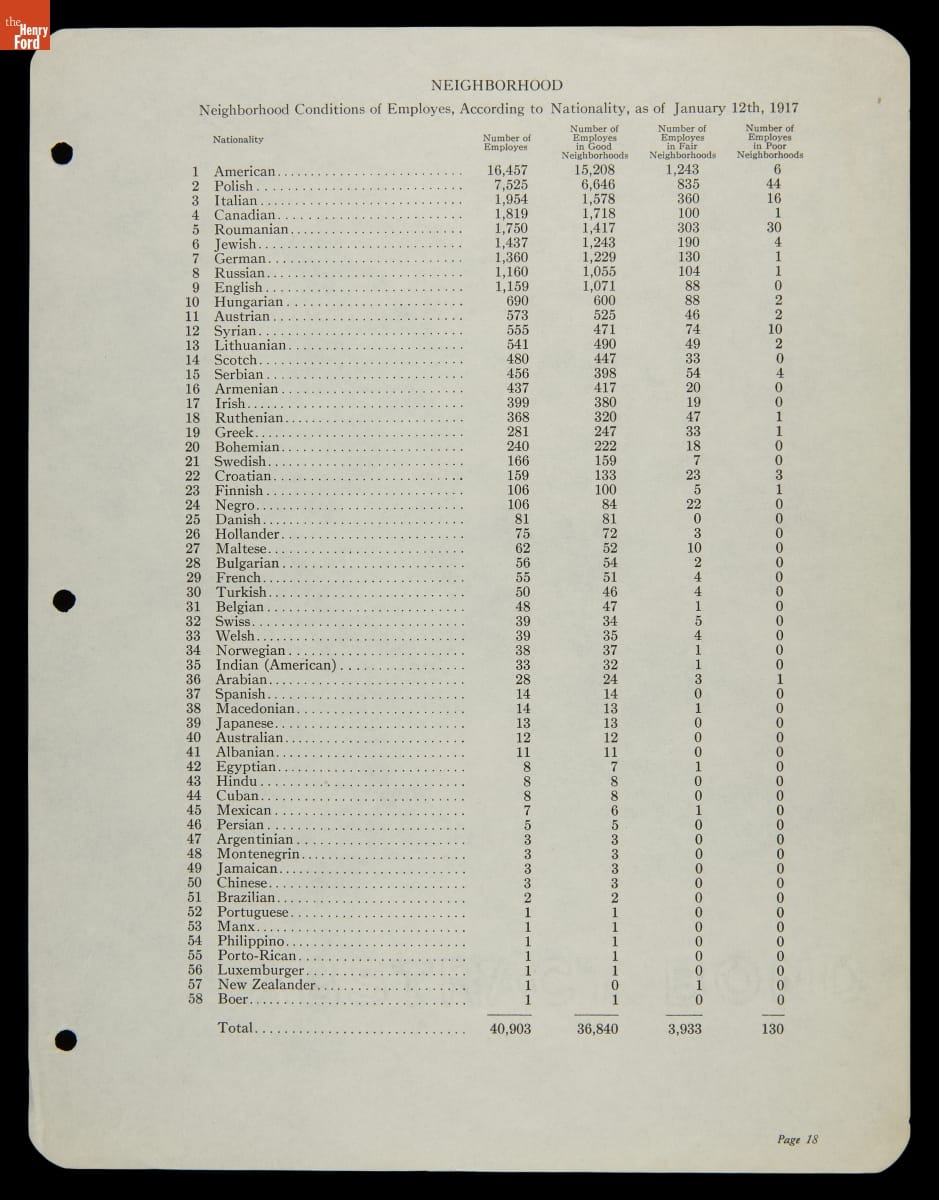
- "Neighborhood Conditions of Employees, According to Nationality, as of January 12th, 1917" - This document is from the publication "Educational Statistics Home Plant, as of January 12th, 1917." It was produced by the Ford Motor Company Sociological (or Educational) Department, and it rates employees' neighborhoods, organized by nationality. The department was created to ensure that employees used their $5 per day wages wisely -- for instance, to escape cheap, ramshackle tenement houses crowded with boarders.
- January 12, 1917
- Collections - Artifact
"Neighborhood Conditions of Employees, According to Nationality, as of January 12th, 1917"
This document is from the publication "Educational Statistics Home Plant, as of January 12th, 1917." It was produced by the Ford Motor Company Sociological (or Educational) Department, and it rates employees' neighborhoods, organized by nationality. The department was created to ensure that employees used their $5 per day wages wisely -- for instance, to escape cheap, ramshackle tenement houses crowded with boarders.
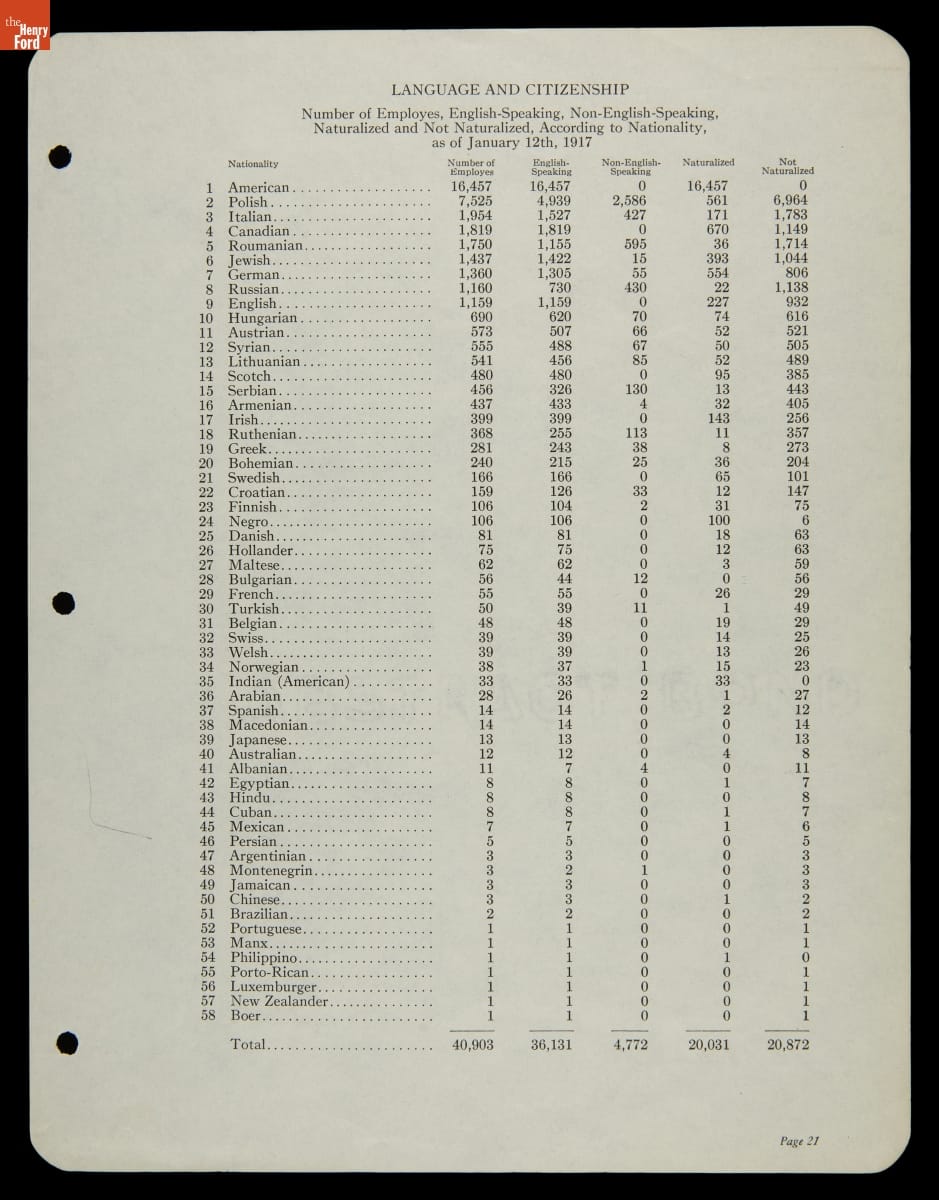
- Language and Citizenship of Ford Motor Company Employees, According to Nationality, as of January 12th, 1917 - This document is from the publication "Educational Statistics Home Plant, as of January 12th, 1917." It classifies employees by nationality as English speakers and American citizens. The document was produced by the Ford Sociological (or Educational) Department, which ensured that employees were responsible with their pay. Ford required workers to learn English in order to earn the $5 per day wage.
- January 12, 1917
- Collections - Artifact
Language and Citizenship of Ford Motor Company Employees, According to Nationality, as of January 12th, 1917
This document is from the publication "Educational Statistics Home Plant, as of January 12th, 1917." It classifies employees by nationality as English speakers and American citizens. The document was produced by the Ford Sociological (or Educational) Department, which ensured that employees were responsible with their pay. Ford required workers to learn English in order to earn the $5 per day wage.
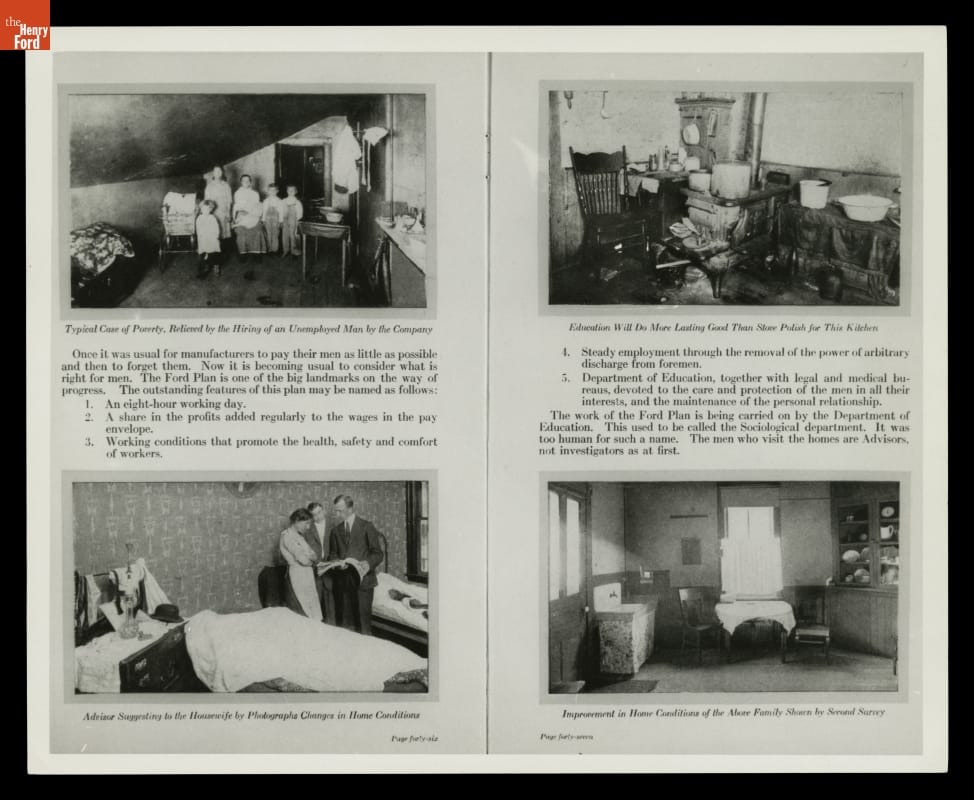
- Checking on Ford Employees Home Conditions, Views from "Factory Facts From Ford," 1917 - Beyond revolutionizing America's industrial production, Henry Ford and other managers at Ford Motor Company instituted a wide-reaching corporate welfare program that opened up the most intimate and personal details of employee's personal, family, and financial life to investigators from the Sociological Department. After the announcement of the $5 per day profit sharing plan in January 1914, Henry Ford wanted to ensure that employees, many of whom were non-English speaking immigrants, did not squander the funds. To this end, the Ford Sociological Department was created to investigate and monitor the personal and work lives of employees to the extent that investigators (later called Advisors) conducted home visits, checked bank deposits, and monitored children's school attendance as well as divorce filings. In addition, the Sociological Department advisors provided hygiene instruction, financial and legal advice, and worked with the English School to teach Ford's immigrant workers English.
- 1917
- Collections - Artifact
Checking on Ford Employees Home Conditions, Views from "Factory Facts From Ford," 1917
Beyond revolutionizing America's industrial production, Henry Ford and other managers at Ford Motor Company instituted a wide-reaching corporate welfare program that opened up the most intimate and personal details of employee's personal, family, and financial life to investigators from the Sociological Department. After the announcement of the $5 per day profit sharing plan in January 1914, Henry Ford wanted to ensure that employees, many of whom were non-English speaking immigrants, did not squander the funds. To this end, the Ford Sociological Department was created to investigate and monitor the personal and work lives of employees to the extent that investigators (later called Advisors) conducted home visits, checked bank deposits, and monitored children's school attendance as well as divorce filings. In addition, the Sociological Department advisors provided hygiene instruction, financial and legal advice, and worked with the English School to teach Ford's immigrant workers English.
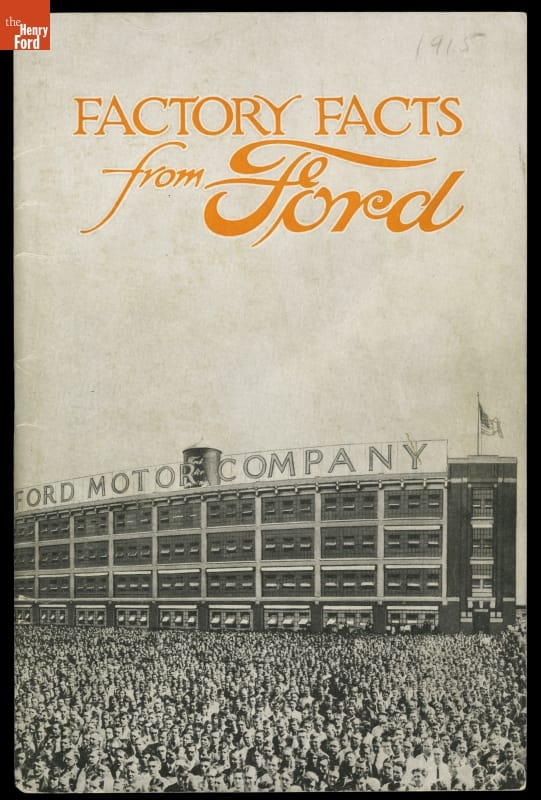
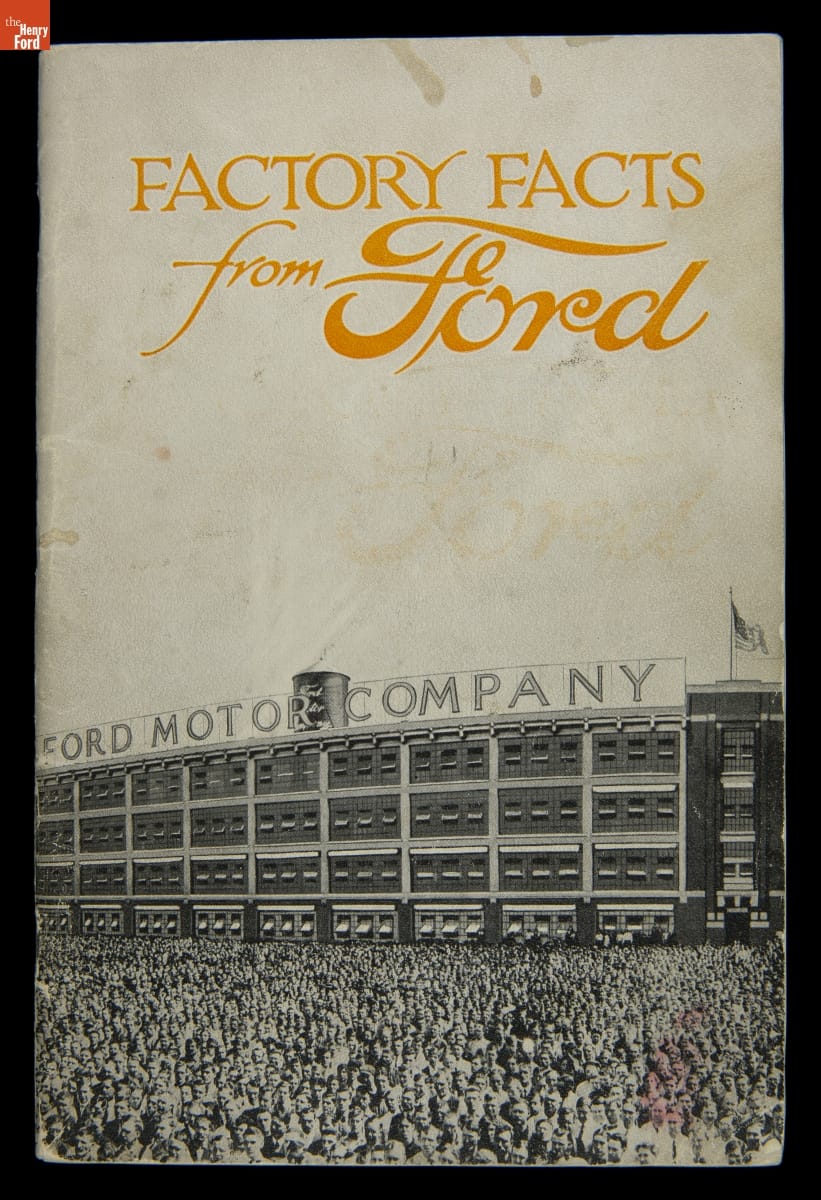
- "Factory Facts from Ford," 1915 - This pamphlet covers topics about Ford Motor Company and highlights the Ford Sociological Department. The department was created to ensure that employees, many of whom were non-English-speaking immigrants, did not squander their $5 per day wages. Investigators monitored the personal and work lives of employees. In addition, the department provided hygiene instruction, financial and legal advice, and an English-language school.
- 1915
- Collections - Artifact
"Factory Facts from Ford," 1915
This pamphlet covers topics about Ford Motor Company and highlights the Ford Sociological Department. The department was created to ensure that employees, many of whom were non-English-speaking immigrants, did not squander their $5 per day wages. Investigators monitored the personal and work lives of employees. In addition, the department provided hygiene instruction, financial and legal advice, and an English-language school.
- "Factory Facts from Ford," 1917 - Beyond revolutionizing America's industrial production, Henry Ford and other managers at Ford Motor Company instituted a wide-reaching corporate welfare program that opened up the most intimate and personal details of employee's personal, family, and financial life to investigators from the Sociological Department. After the announcement of the $5 per day profit sharing plan in January 1914, Henry Ford wanted to ensure that employees, many of whom were non-English speaking immigrants, did not squander the funds. To this end, the Ford Sociological Department was created to investigate and monitor the personal and work lives of employees to the extent that investigators (later called Advisors) conducted home visits, checked bank deposits, and monitored children's school attendance as well as divorce filings. In addition, the Sociological Department advisors provided hygiene instruction, financial and legal advice, and worked with the English School to teach Ford's immigrant workers English.
- July 15, 1917
- Collections - Artifact
"Factory Facts from Ford," 1917
Beyond revolutionizing America's industrial production, Henry Ford and other managers at Ford Motor Company instituted a wide-reaching corporate welfare program that opened up the most intimate and personal details of employee's personal, family, and financial life to investigators from the Sociological Department. After the announcement of the $5 per day profit sharing plan in January 1914, Henry Ford wanted to ensure that employees, many of whom were non-English speaking immigrants, did not squander the funds. To this end, the Ford Sociological Department was created to investigate and monitor the personal and work lives of employees to the extent that investigators (later called Advisors) conducted home visits, checked bank deposits, and monitored children's school attendance as well as divorce filings. In addition, the Sociological Department advisors provided hygiene instruction, financial and legal advice, and worked with the English School to teach Ford's immigrant workers English.
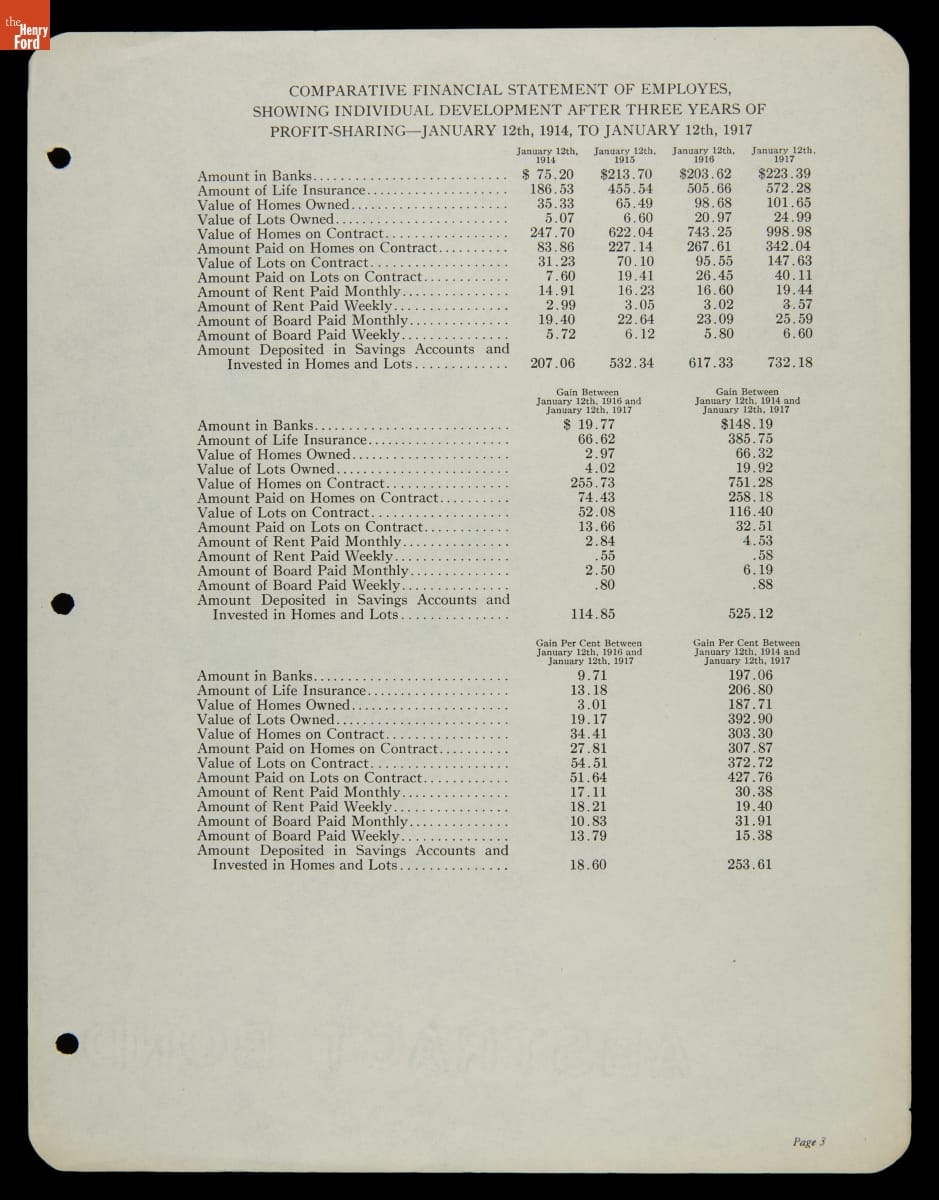
- "Comparative Financial Statement of Employees...After Three Years of Profit-Sharing - January 12th, 1914 to January 12th, 1917" -
- January 12, 1917
- Collections - Artifact
"Comparative Financial Statement of Employees...After Three Years of Profit-Sharing - January 12th, 1914 to January 12th, 1917"
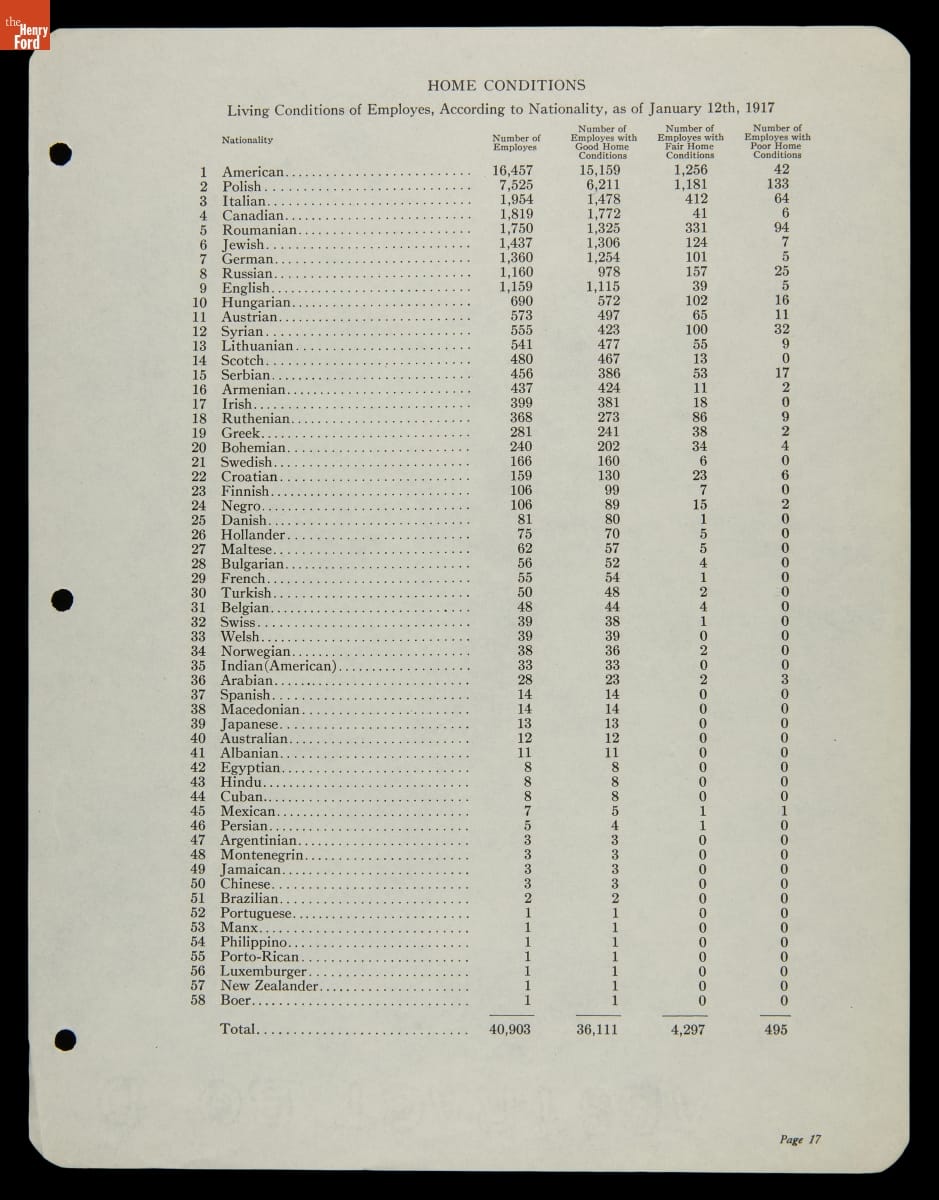
- Document Noting Living Conditions of Ford Motor Company Employees, According to Nationality, as of January 12th, 1917 - Ford Motor Company's Sociological Department, established in 1914, sent investigators to make unannounced visits to evaluate the cleanliness and safety of an employee's household. Investigators that entered workers' homes took notes, filled out forms, and compiled statistics based on their findings. This document organized living conditions by employee nationality and gave ratings of "Good," "Fair" and "Poor" conditions.
- January 12, 1917
- Collections - Artifact
Document Noting Living Conditions of Ford Motor Company Employees, According to Nationality, as of January 12th, 1917
Ford Motor Company's Sociological Department, established in 1914, sent investigators to make unannounced visits to evaluate the cleanliness and safety of an employee's household. Investigators that entered workers' homes took notes, filled out forms, and compiled statistics based on their findings. This document organized living conditions by employee nationality and gave ratings of "Good," "Fair" and "Poor" conditions.
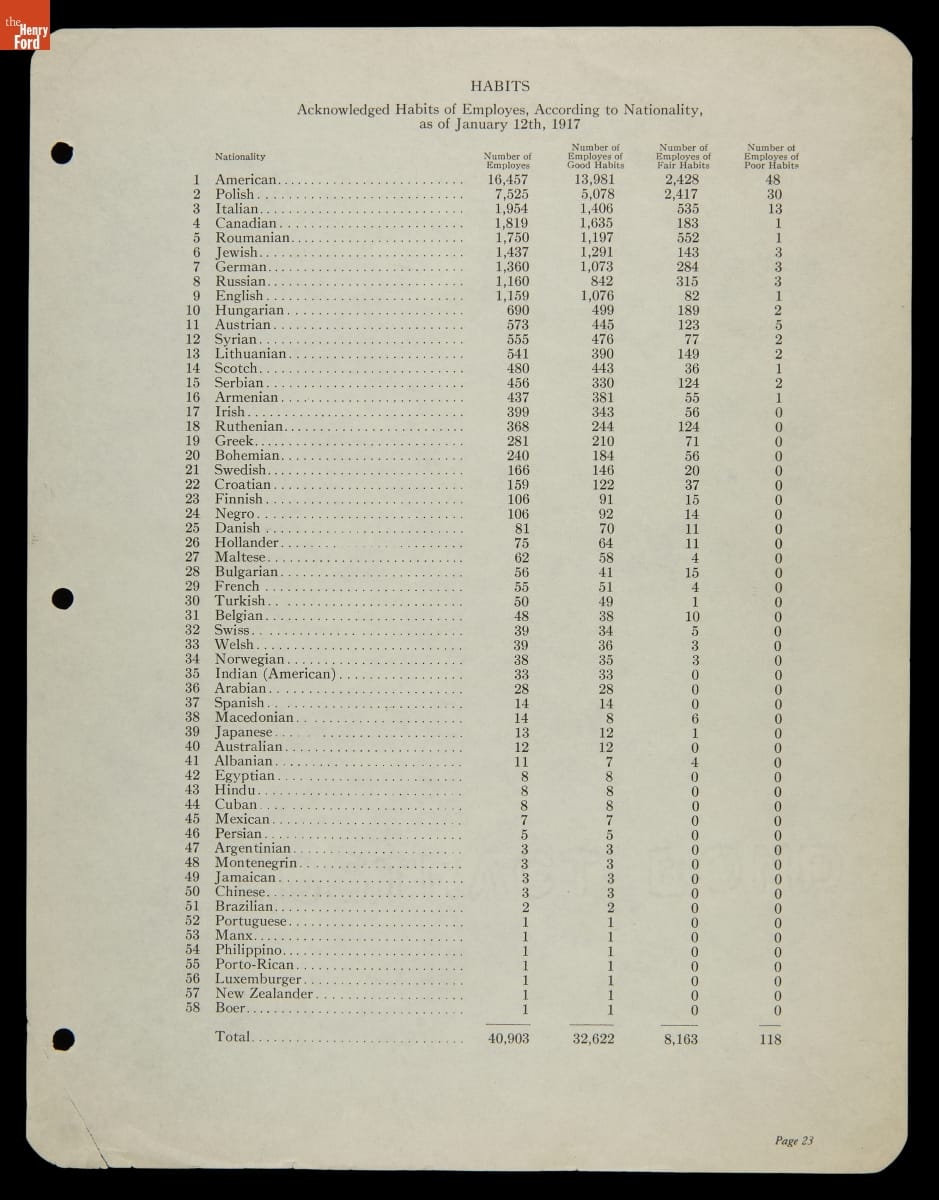
- The Quality of Habits of Ford Motor Company Employees, According to Nationality, as of January 12th, 1917 - After the announcement of the $5 day in January 1914, Ford wanted to ensure that employees did not squander their money. To this end, the Ford Sociological (or Educational) Department was created to investigate and monitor employees' personal and work lives. In order to be considered a good employee, workers needed to be sober, thrifty, and maintain a positive attitude.
- January 12, 1917
- Collections - Artifact
The Quality of Habits of Ford Motor Company Employees, According to Nationality, as of January 12th, 1917
After the announcement of the $5 day in January 1914, Ford wanted to ensure that employees did not squander their money. To this end, the Ford Sociological (or Educational) Department was created to investigate and monitor employees' personal and work lives. In order to be considered a good employee, workers needed to be sober, thrifty, and maintain a positive attitude.