
Search
- Letter from UAW-CIO to Ford Motor Company regarding Collective Bargaining with Long Beach Assembly Plant Employees, December 30, 1940 - Starting in the early 1910s, Ford Motor Company established domestic assembly plants throughout the United States. Ford opened its Long Beach, California, assembly plant in 1930. This letter to company president Edsel Ford concerned relations with the local chapter of the United Auto Workers. Edsel Ford had a far more progressive and collaborative attitude toward unions than his father, Henry Ford.
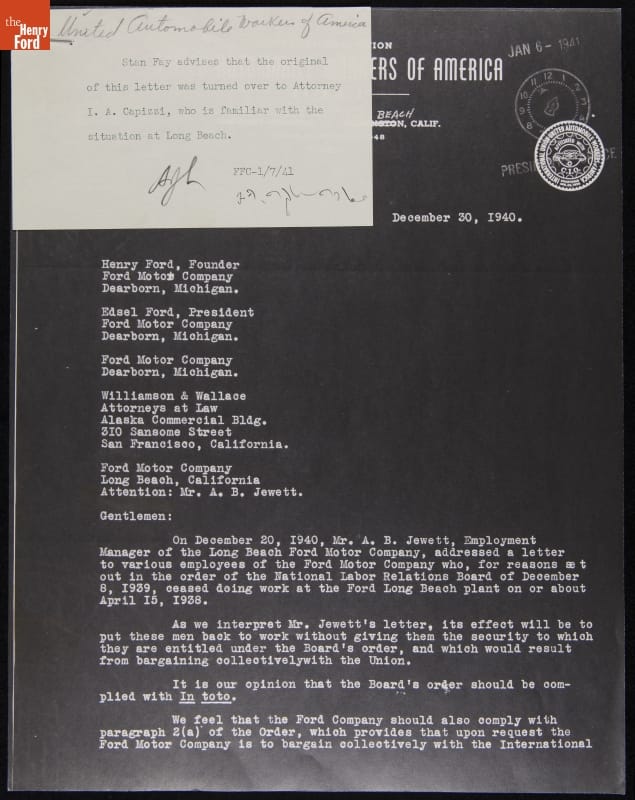
- December 30, 1940
- Collections - Artifact
Letter from UAW-CIO to Ford Motor Company regarding Collective Bargaining with Long Beach Assembly Plant Employees, December 30, 1940
Starting in the early 1910s, Ford Motor Company established domestic assembly plants throughout the United States. Ford opened its Long Beach, California, assembly plant in 1930. This letter to company president Edsel Ford concerned relations with the local chapter of the United Auto Workers. Edsel Ford had a far more progressive and collaborative attitude toward unions than his father, Henry Ford.
- Letter from UAW-CIO to Edsel Ford Protesting Turning the Long Beach Assembly Plant into an Army Warehouse, January 19, 1942 - Starting in the 1910s, Ford Motor Company opened domestic assembly plants throughout the United States. Ford opened its Long Beach, California, assembly plant in 1930. Civilian production was suspended during World War II, and the facility became a temporary supply base for U.S. Army Air Corps. Automobile production resumed at Long Beach in late 1945 until the plant closed in 1959.
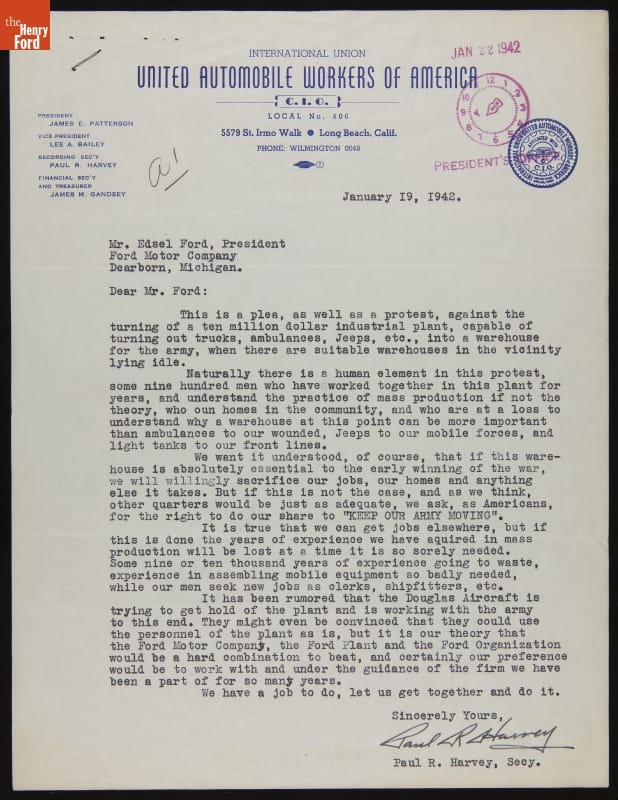
- January 19, 1942
- Collections - Artifact
Letter from UAW-CIO to Edsel Ford Protesting Turning the Long Beach Assembly Plant into an Army Warehouse, January 19, 1942
Starting in the 1910s, Ford Motor Company opened domestic assembly plants throughout the United States. Ford opened its Long Beach, California, assembly plant in 1930. Civilian production was suspended during World War II, and the facility became a temporary supply base for U.S. Army Air Corps. Automobile production resumed at Long Beach in late 1945 until the plant closed in 1959.
- Letter from UAW #406 to Edsel Ford regarding Ending the Ford Long Beach Assembly Plant Strike, September 28, 1938 - Starting in the early 1910s, Ford Motor Company established domestic assembly plants throughout the United States. Ford opened its Long Beach, California, assembly plant in 1930. This letter to company president Edsel Ford concerned relations with the local chapter of the United Auto Workers. Edsel Ford had a far more progressive and collaborative attitude toward unions than his father, Henry Ford.
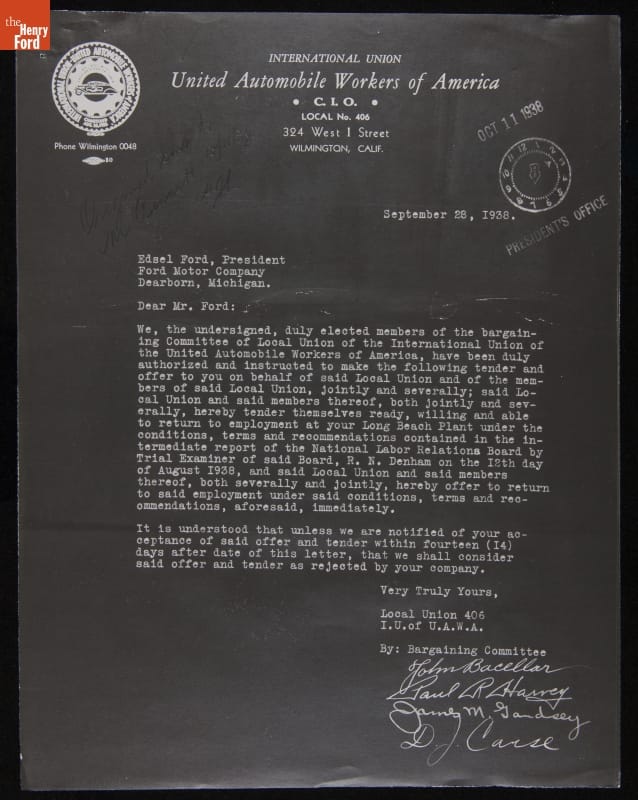
- September 28, 1938
- Collections - Artifact
Letter from UAW #406 to Edsel Ford regarding Ending the Ford Long Beach Assembly Plant Strike, September 28, 1938
Starting in the early 1910s, Ford Motor Company established domestic assembly plants throughout the United States. Ford opened its Long Beach, California, assembly plant in 1930. This letter to company president Edsel Ford concerned relations with the local chapter of the United Auto Workers. Edsel Ford had a far more progressive and collaborative attitude toward unions than his father, Henry Ford.
- Letter from UAW #406 to Edsel Ford to Request Collective Bargaining, September 16, 1938 - Starting in the early 1910s, Ford Motor Company established domestic assembly plants throughout the United States. Ford opened its Long Beach, California, assembly plant in 1930. This letter to company president Edsel Ford concerned relations with the local chapter of the United Auto Workers. Edsel Ford had a far more progressive and collaborative attitude toward unions than his father, Henry Ford.
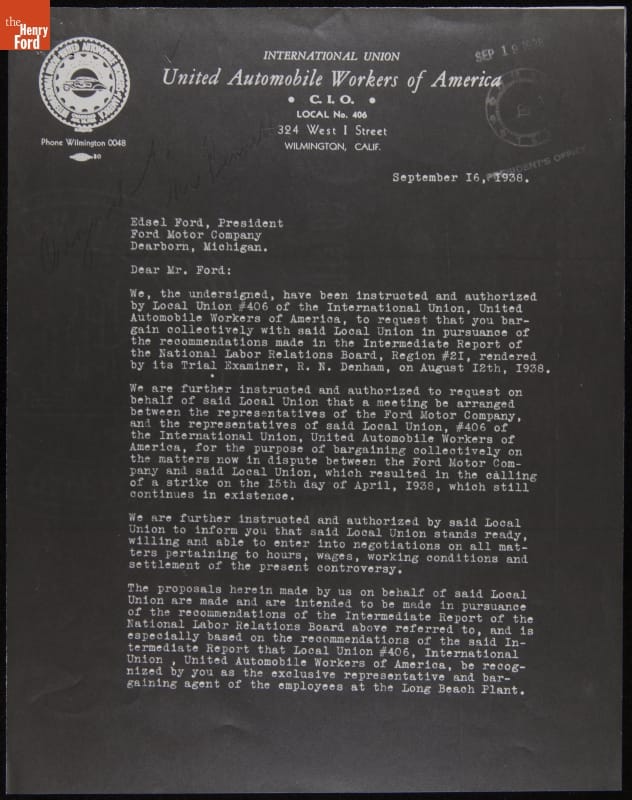
- September 16, 1938
- Collections - Artifact
Letter from UAW #406 to Edsel Ford to Request Collective Bargaining, September 16, 1938
Starting in the early 1910s, Ford Motor Company established domestic assembly plants throughout the United States. Ford opened its Long Beach, California, assembly plant in 1930. This letter to company president Edsel Ford concerned relations with the local chapter of the United Auto Workers. Edsel Ford had a far more progressive and collaborative attitude toward unions than his father, Henry Ford.
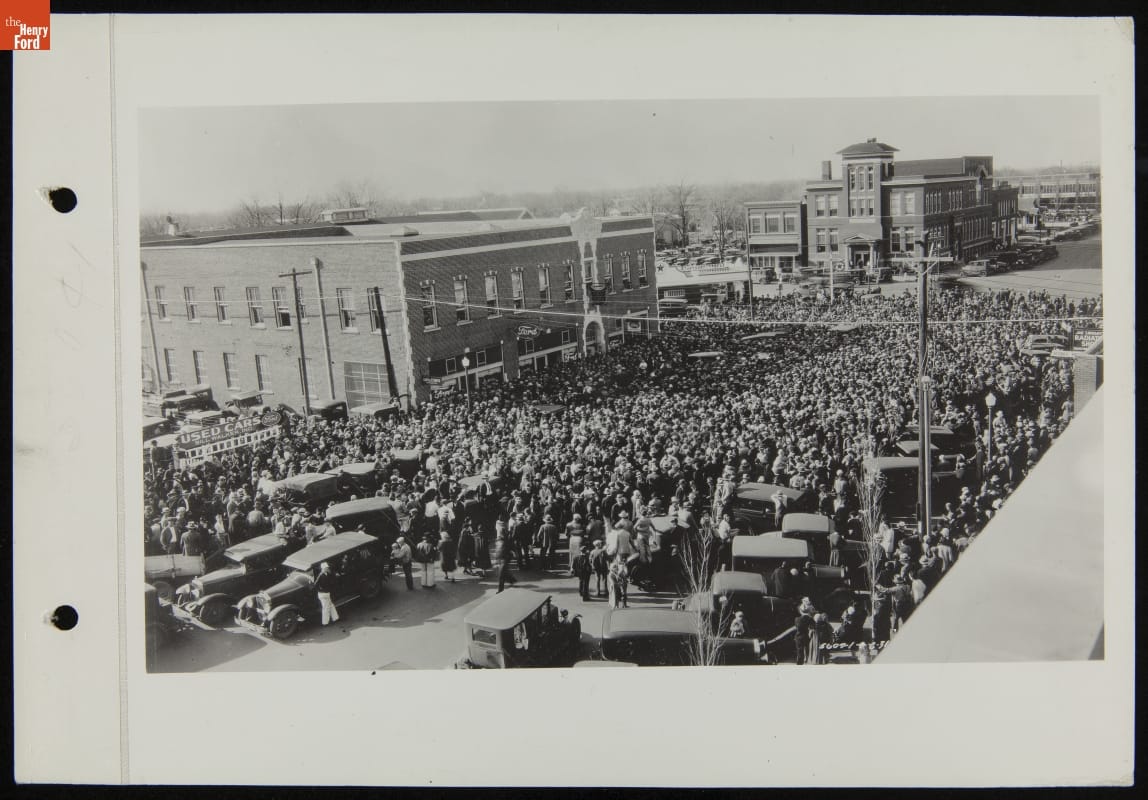
- Ford Motor Company Long Beach Assembly Plant Pressed Steel Building, 1931 - Starting in the early 1910s, Ford Motor Company opened domestic assembly plants throughout the United States. These plants allowed the company to better serve its customers, with facilities located near major American cities. Ford opened its Long Beach, California, assembly plant in 1930. Employees at the factory built various Ford, Lincoln and Mercury vehicles until the facility closed in 1959.
- April 29, 1931
- Collections - Artifact
Ford Motor Company Long Beach Assembly Plant Pressed Steel Building, 1931
Starting in the early 1910s, Ford Motor Company opened domestic assembly plants throughout the United States. These plants allowed the company to better serve its customers, with facilities located near major American cities. Ford opened its Long Beach, California, assembly plant in 1930. Employees at the factory built various Ford, Lincoln and Mercury vehicles until the facility closed in 1959.
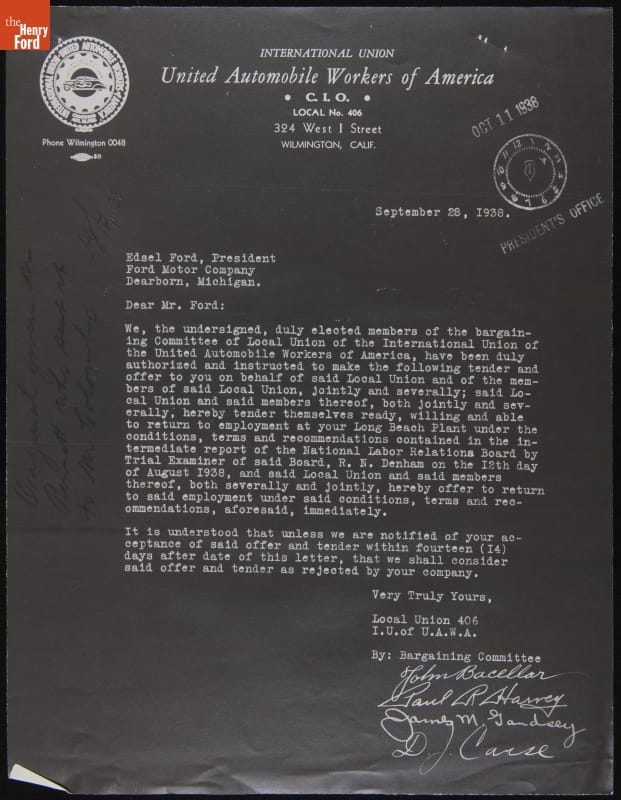
- Letter from UAW #406 to Edsel Ford regarding Ending the Ford Long Beach Assembly Plant Strike, September 28, 1938 - Starting in the early 1910s, Ford Motor Company established domestic assembly plants throughout the United States. Ford opened its Long Beach, California, assembly plant in 1930. This letter to company president Edsel Ford concerned relations with the local chapter of the United Auto Workers. Edsel Ford had a far more progressive and collaborative attitude toward unions than his father, Henry Ford.
- September 28, 1938
- Collections - Artifact
Letter from UAW #406 to Edsel Ford regarding Ending the Ford Long Beach Assembly Plant Strike, September 28, 1938
Starting in the early 1910s, Ford Motor Company established domestic assembly plants throughout the United States. Ford opened its Long Beach, California, assembly plant in 1930. This letter to company president Edsel Ford concerned relations with the local chapter of the United Auto Workers. Edsel Ford had a far more progressive and collaborative attitude toward unions than his father, Henry Ford.