
Search
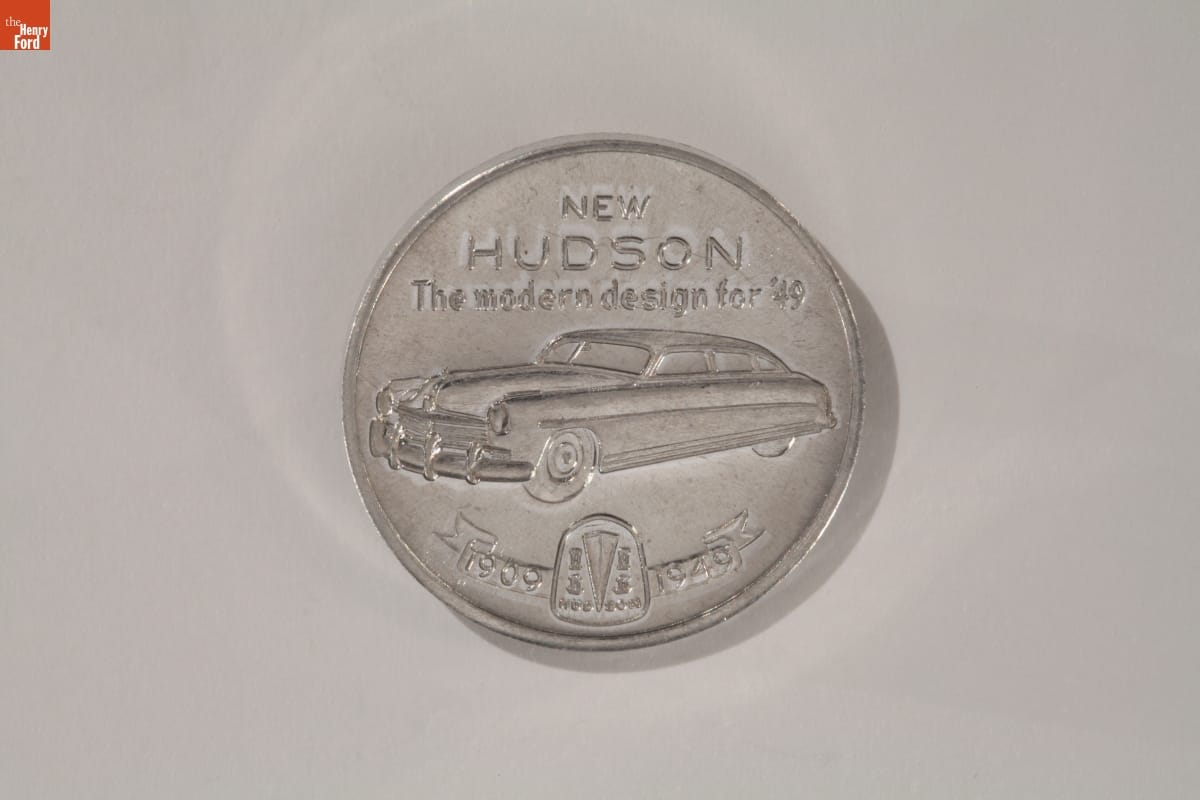
- Hudson Commemorative Medallion, 1949 - Hudson's 1949 cars continued to reflect the unit-body construction and "step-down" design introduced by the company a year earlier. Customers could choose from the Super Six or Super Eight, or the more deluxe Commodore Custom. Body styles ranged from four-door sedans, to two-door coupes, to the elegant Convertible Brougham. Hudson sold more than 159,000 cars for the model year.
- 1949
- Collections - Artifact
Hudson Commemorative Medallion, 1949
Hudson's 1949 cars continued to reflect the unit-body construction and "step-down" design introduced by the company a year earlier. Customers could choose from the Super Six or Super Eight, or the more deluxe Commodore Custom. Body styles ranged from four-door sedans, to two-door coupes, to the elegant Convertible Brougham. Hudson sold more than 159,000 cars for the model year.
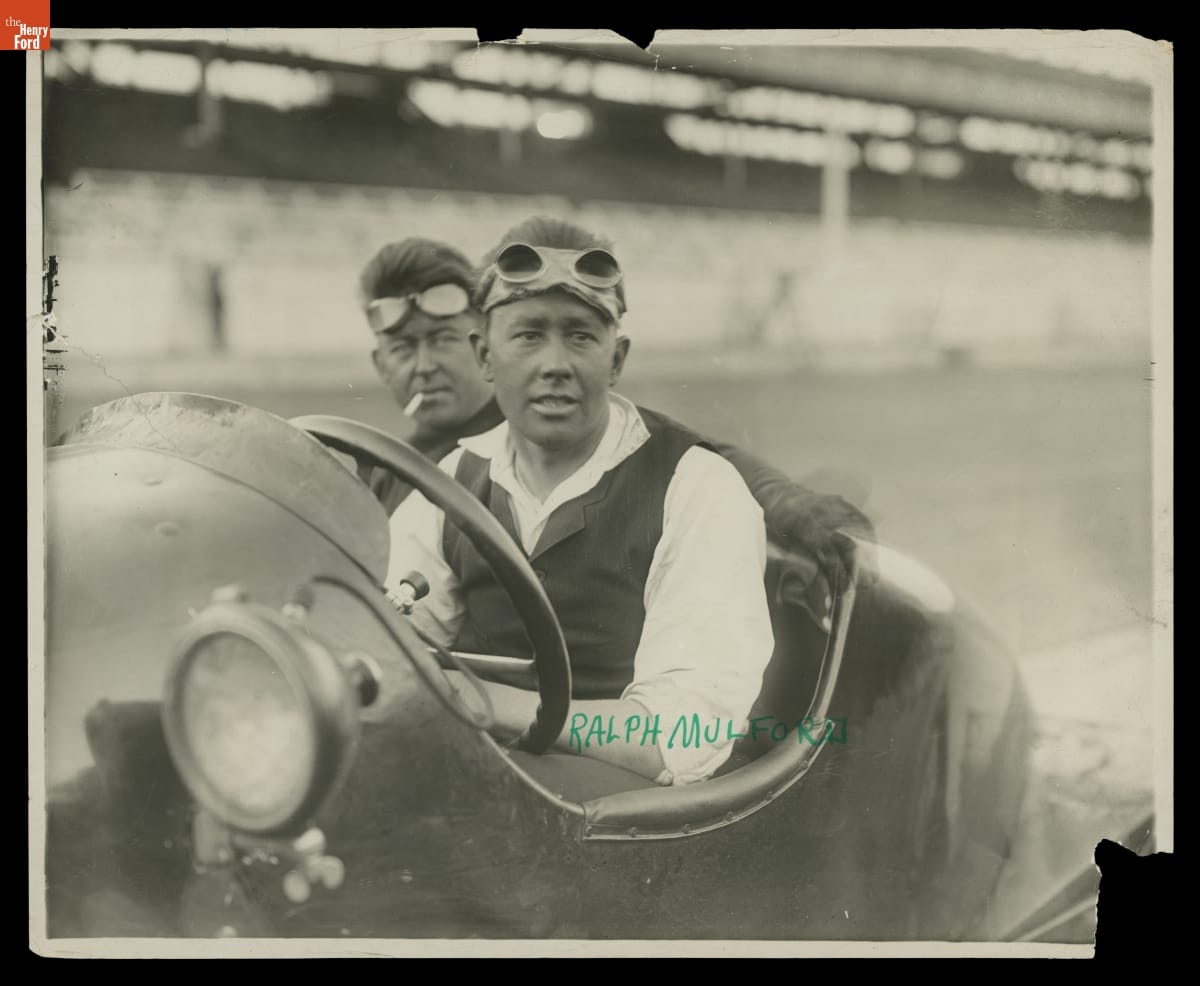
- Race Car Driver Ralph Mulford in Hudson Super Six, circa 1916 - Ralph Mulford competed in the first Indianapolis 500 in 1911, and he returned to race there nine more times through 1922. Mulford's second-place finish in 1911 was his personal best at Indy. By the time of his death at age 88 in 1973, Mulford was the last surviving driver from the inaugural Indianapolis 500.
- circa 1916
- Collections - Artifact
Race Car Driver Ralph Mulford in Hudson Super Six, circa 1916
Ralph Mulford competed in the first Indianapolis 500 in 1911, and he returned to race there nine more times through 1922. Mulford's second-place finish in 1911 was his personal best at Indy. By the time of his death at age 88 in 1973, Mulford was the last surviving driver from the inaugural Indianapolis 500.
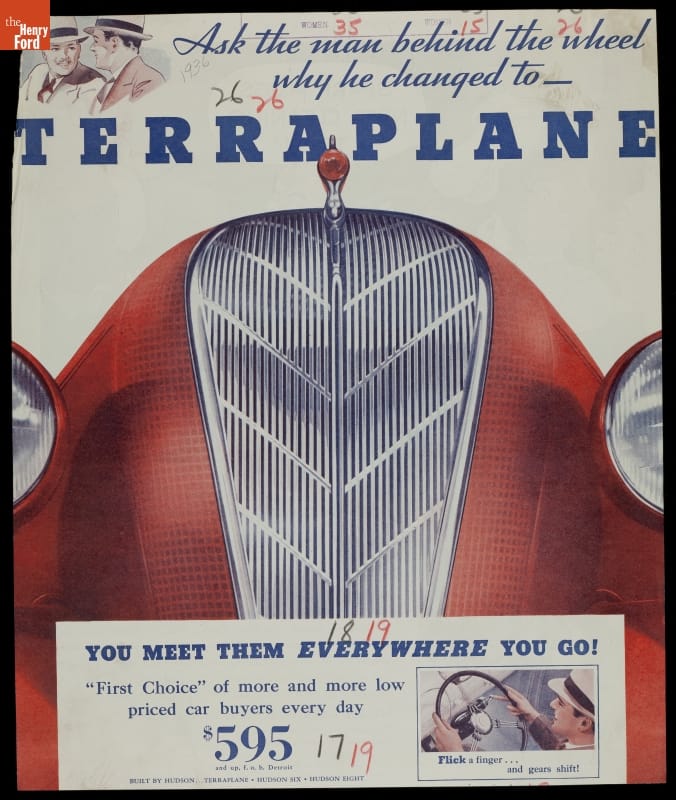
- 1936 Hudson Advertisement, "Ask the Man Behind the Wheel Why He Changed to Terraplane!" - The automobile is a paradox -- a practical tool that plays host to both human needs and fantasies. Like car consumers, automotive ads seem to land somewhere between fantasy and reality, emotions and rationality. Many ads incorporate apparent opposites: fantasy can sell practicality, and vice versa. Sometimes the car has disappeared completely -- an emotional appeal prompts us to complete the ad.
- 1936
- Collections - Artifact
1936 Hudson Advertisement, "Ask the Man Behind the Wheel Why He Changed to Terraplane!"
The automobile is a paradox -- a practical tool that plays host to both human needs and fantasies. Like car consumers, automotive ads seem to land somewhere between fantasy and reality, emotions and rationality. Many ads incorporate apparent opposites: fantasy can sell practicality, and vice versa. Sometimes the car has disappeared completely -- an emotional appeal prompts us to complete the ad.
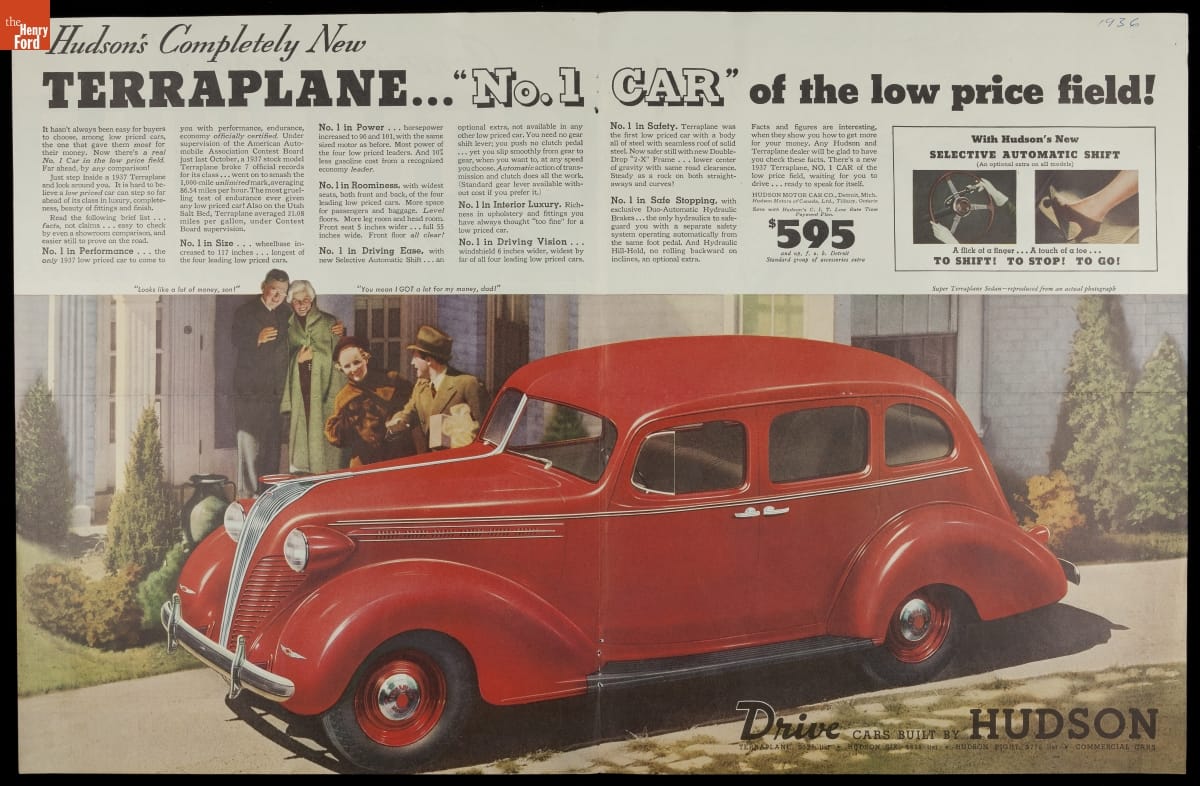
- "Completely New Terraplane...No. 1 Car of the Low-Price Field," 1937 - During the Great Depression, the Hudson Automobile Company introduced the budget-priced Terraplane in 1932. The car was capable of 80 miles per hour and set several racing records, making it worthy of its aviation-inspired name. Advertisements like this, though, emphasized value over speed. With the Depression easing in 1939, Hudson dropped the Terraplane line and refocused on its up-market cars.
- December 19, 1936
- Collections - Artifact
"Completely New Terraplane...No. 1 Car of the Low-Price Field," 1937
During the Great Depression, the Hudson Automobile Company introduced the budget-priced Terraplane in 1932. The car was capable of 80 miles per hour and set several racing records, making it worthy of its aviation-inspired name. Advertisements like this, though, emphasized value over speed. With the Depression easing in 1939, Hudson dropped the Terraplane line and refocused on its up-market cars.
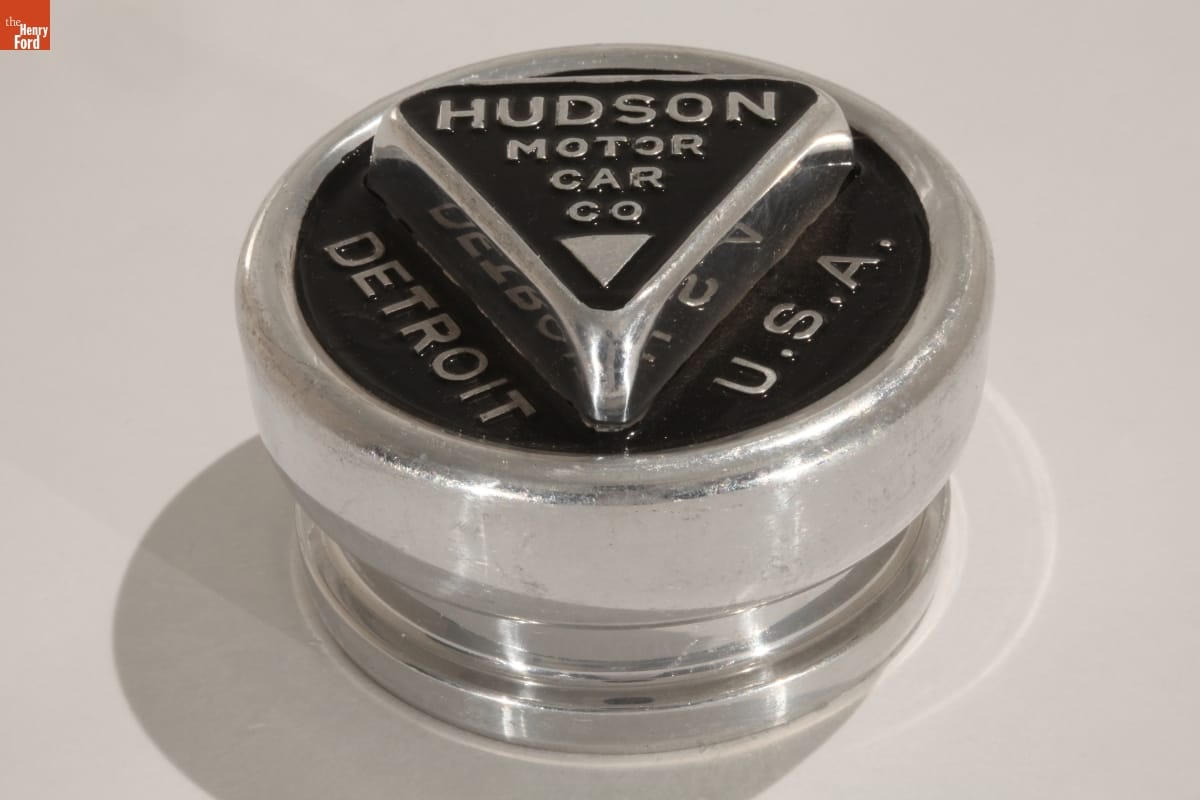
- Hudson Hubcap, circa 1925 - Early automobile wheels had a central hub with a greased wheel bearing. Hub caps kept grease in and dust out. As wheels evolved and hubcaps became functionally unnecessary, they remained important to both manufacturers -- who branded wheel covers with maker names or logos -- and consumers -- who identified with hubcaps as statements about their cars and themselves.
- circa 1925
- Collections - Artifact
Hudson Hubcap, circa 1925
Early automobile wheels had a central hub with a greased wheel bearing. Hub caps kept grease in and dust out. As wheels evolved and hubcaps became functionally unnecessary, they remained important to both manufacturers -- who branded wheel covers with maker names or logos -- and consumers -- who identified with hubcaps as statements about their cars and themselves.
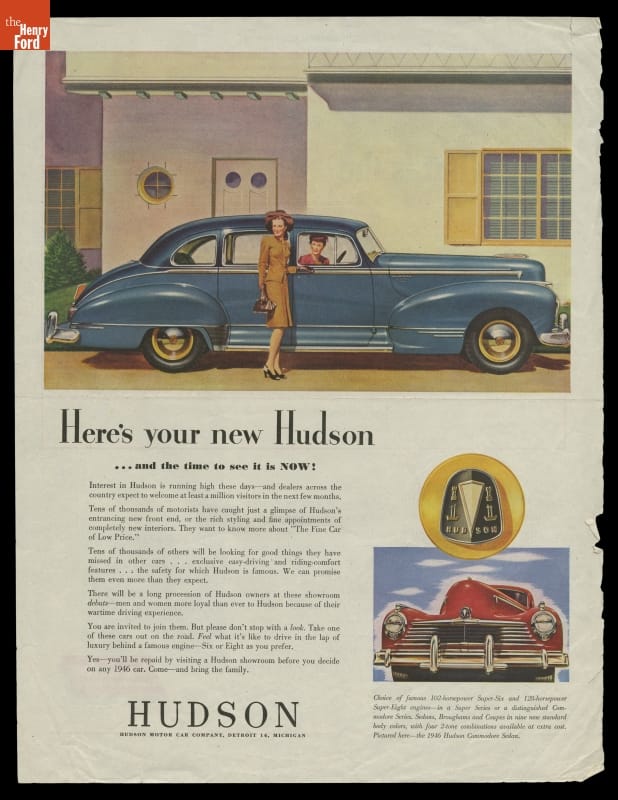
- 1946 Hudson Advertisement, "Here's Your New Hudson...and the Time to See it is Now! - Like other American automakers, Hudson devoted its employees and facilities exclusively to military production during World War II. For its postwar 1946 models, Hudson freshened its prewar body with a new grille capped by a prominent Hudson badge. Buyers could choose from the Hudson Super or the fancier Hudson Commodore. Hudson's model-year sales totaled about 95,000 cars.
- 1946
- Collections - Artifact
1946 Hudson Advertisement, "Here's Your New Hudson...and the Time to See it is Now!
Like other American automakers, Hudson devoted its employees and facilities exclusively to military production during World War II. For its postwar 1946 models, Hudson freshened its prewar body with a new grille capped by a prominent Hudson badge. Buyers could choose from the Hudson Super or the fancier Hudson Commodore. Hudson's model-year sales totaled about 95,000 cars.
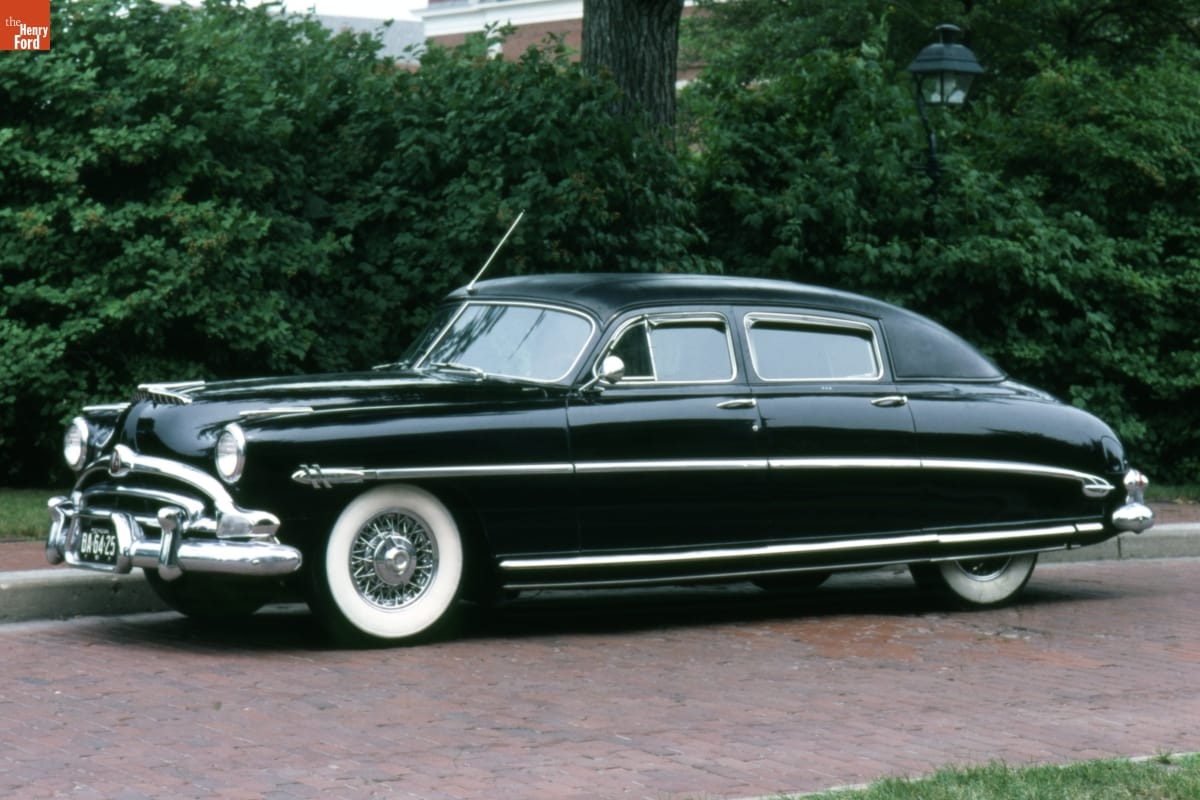
- 1951 Hudson Limousine - The Hudson Motor Car Company was founded in 1909 with significant financial support from Detroit department store magnate J.L. Hudson, for whom the company was named. This 1951 limousine, with a custom body by Derham, was a personal car of A. Edward Barit, Hudson president from 1936-1954. Barit updated the limo with Hudson's 1953 front-end treatment.
- 1951
- Collections - Artifact
1951 Hudson Limousine
The Hudson Motor Car Company was founded in 1909 with significant financial support from Detroit department store magnate J.L. Hudson, for whom the company was named. This 1951 limousine, with a custom body by Derham, was a personal car of A. Edward Barit, Hudson president from 1936-1954. Barit updated the limo with Hudson's 1953 front-end treatment.
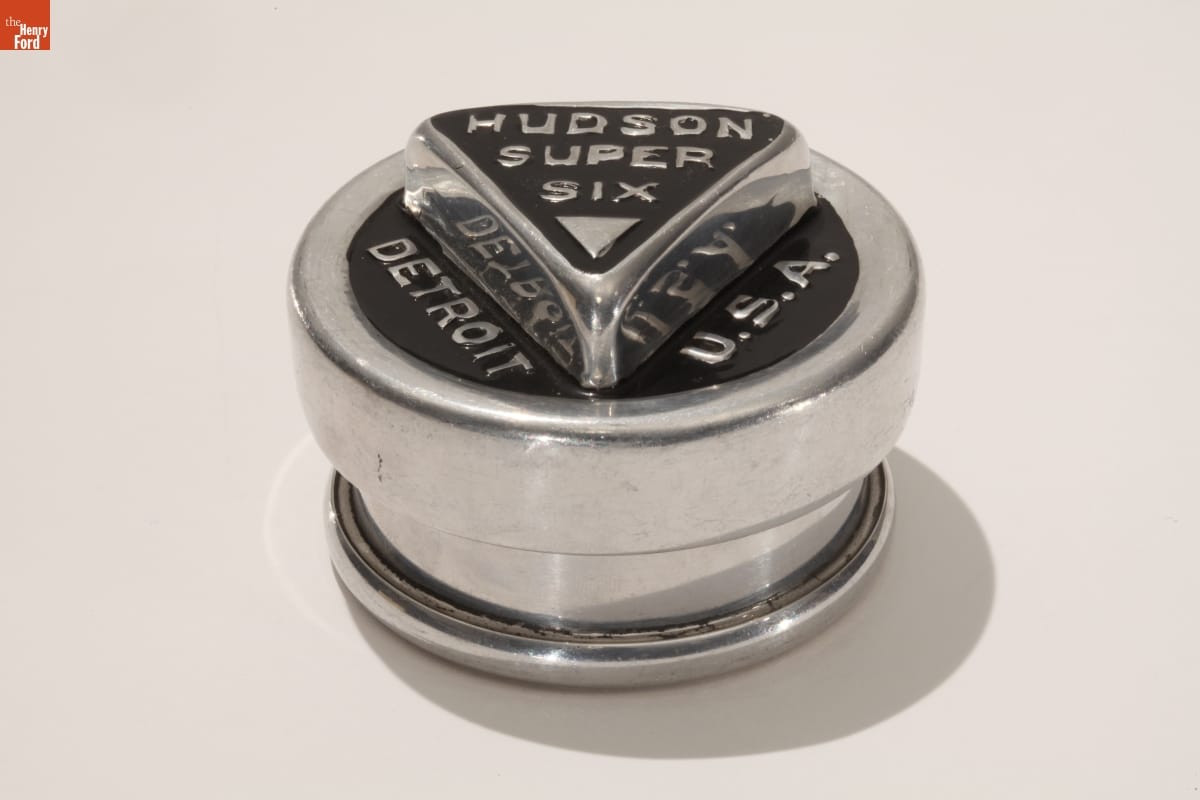
- Hudson Super Six Hubcap, 1916-1926 - An automobile manufacturer's badge is fundamental to the company's brand identity -- just as the maker's name is often important to <EM>our</EM> identity as consumers and drivers. Early automobile badges tended to be small and often discreetly located; today they have evolved into enlarged, prominently placed, and frequently symmetrical logos -- easy to recognize, even at a glance in a rear-view mirror.
- 1916-1926
- Collections - Artifact
Hudson Super Six Hubcap, 1916-1926
An automobile manufacturer's badge is fundamental to the company's brand identity -- just as the maker's name is often important to our identity as consumers and drivers. Early automobile badges tended to be small and often discreetly located; today they have evolved into enlarged, prominently placed, and frequently symmetrical logos -- easy to recognize, even at a glance in a rear-view mirror.
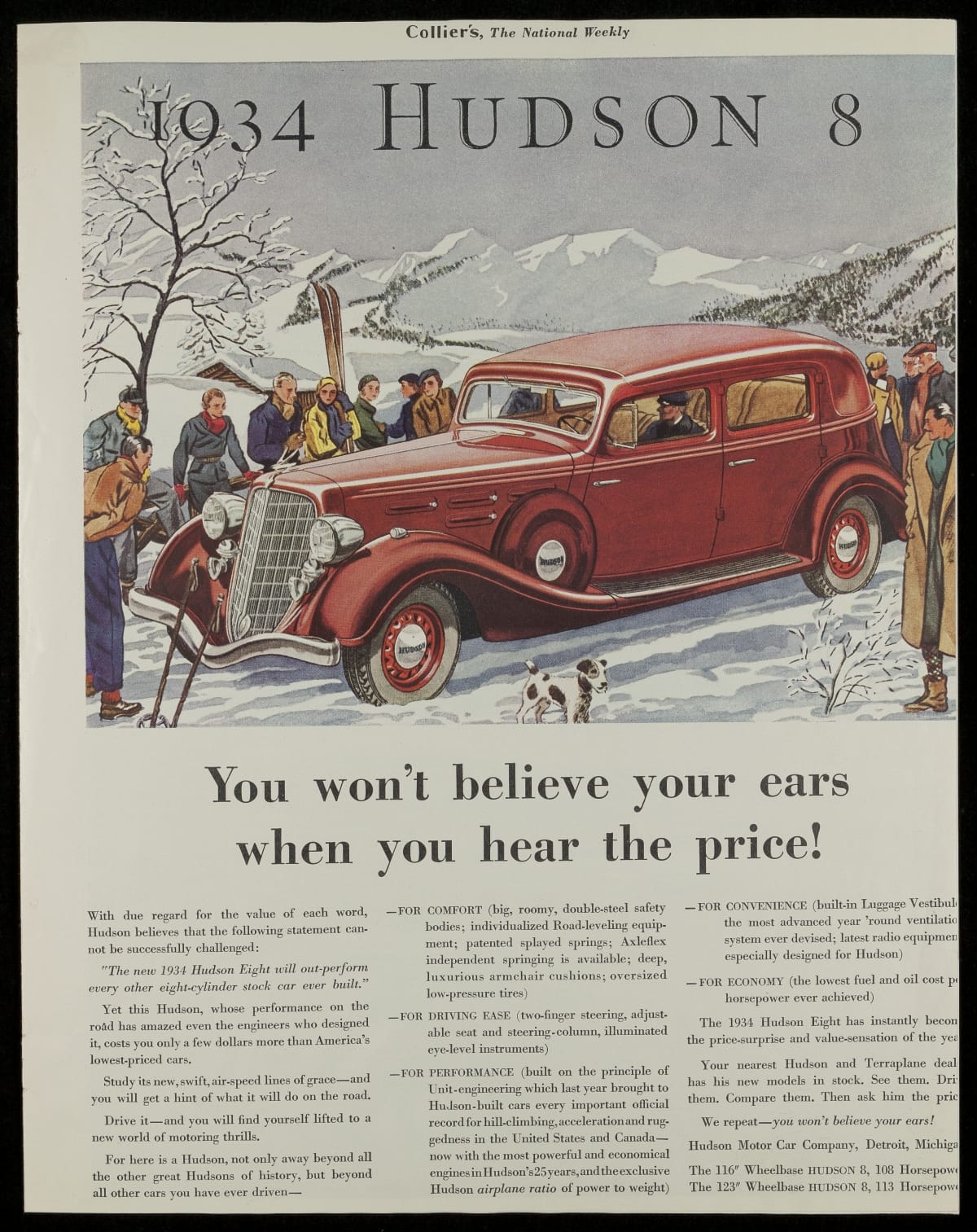
- 1934 Hudson 8 "You Won't Believe Your Ears When You Hear The Price!" - Hudson's 1934 models featured new styling accented by wide fenders, long hoods, and -- on sedan and coach models -- space inside the body to store the spare tire. Hudson that year offered eight-cylinder cars, in standard and deluxe trims, on 116-inch and 123-inch wheelbases. The company's total production in 1934 was somewhere around 27,000 cars.
- 1934
- Collections - Artifact
1934 Hudson 8 "You Won't Believe Your Ears When You Hear The Price!"
Hudson's 1934 models featured new styling accented by wide fenders, long hoods, and -- on sedan and coach models -- space inside the body to store the spare tire. Hudson that year offered eight-cylinder cars, in standard and deluxe trims, on 116-inch and 123-inch wheelbases. The company's total production in 1934 was somewhere around 27,000 cars.
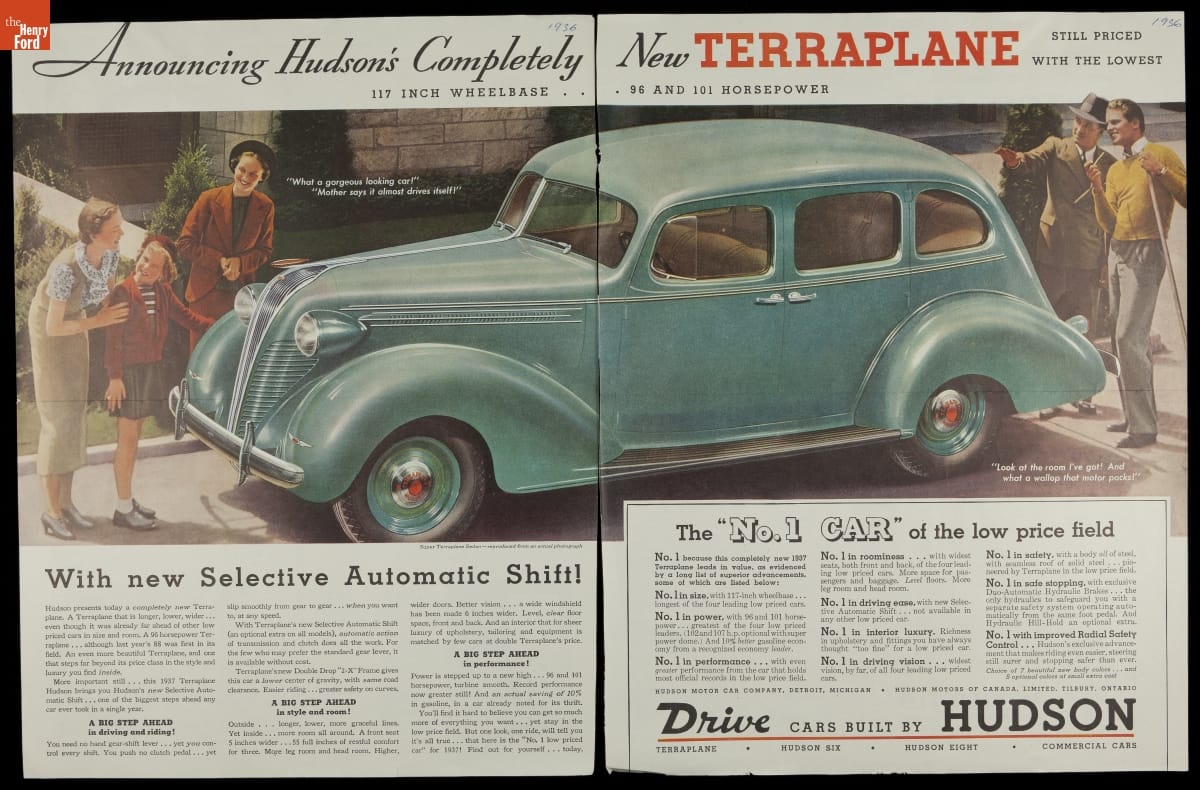
- "Announcing Hudson's Completely New Terraplane," 1937 - During the Great Depression, the Hudson Automobile Company introduced the budget-priced Terraplane in 1932. The car was capable of 80 miles per hour and set several racing records, making it worthy of its aviation-inspired name. Advertisements like this, though, emphasized value over speed. With the Depression easing in 1939, Hudson dropped the Terraplane line and refocused on its up-market cars.
- November 07, 1936
- Collections - Artifact
"Announcing Hudson's Completely New Terraplane," 1937
During the Great Depression, the Hudson Automobile Company introduced the budget-priced Terraplane in 1932. The car was capable of 80 miles per hour and set several racing records, making it worthy of its aviation-inspired name. Advertisements like this, though, emphasized value over speed. With the Depression easing in 1939, Hudson dropped the Terraplane line and refocused on its up-market cars.