
Search
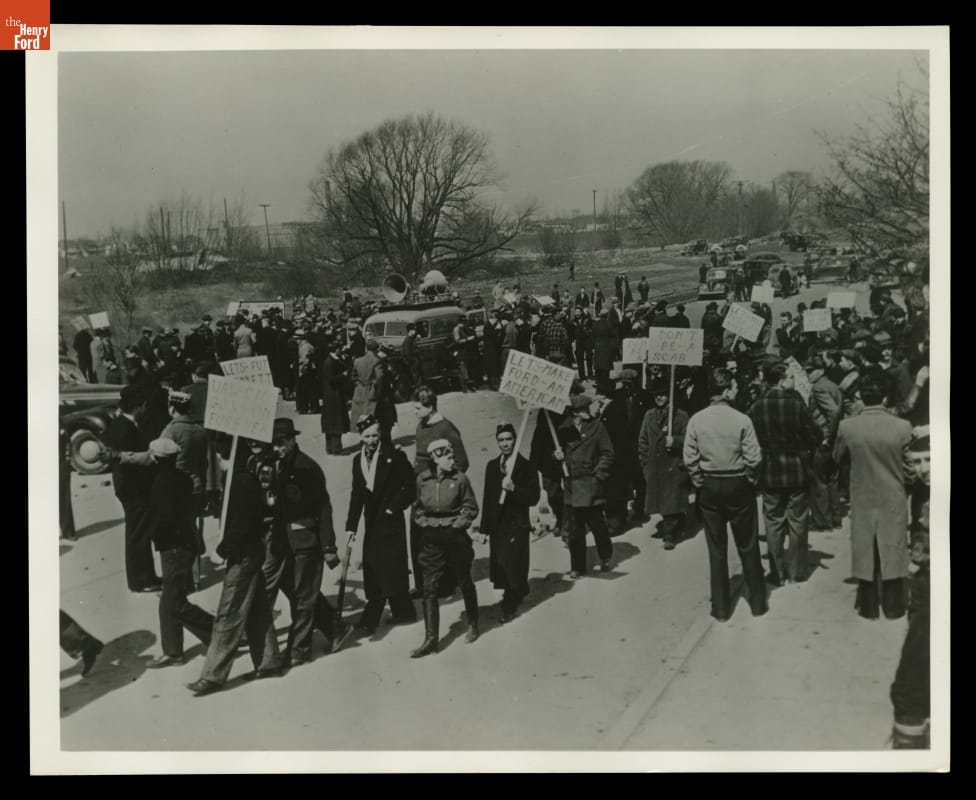
- Union Picket Line at the Ford Rouge Plant, April 1941 - In 1937, the United Auto Workers (UAW) began efforts to unionize Ford Motor Company workers. The long and--at times--violent struggle culminated in a turbulent ten-day strike in April 1941. Here, demonstrators carry placards and wear caps with union buttons outside Ford's Rouge Plant gates. By June 1941 Ford became the last major automotive manufacturer to recognize the UAW and agree to a union contract.
- April 04, 1941
- Collections - Artifact
Union Picket Line at the Ford Rouge Plant, April 1941
In 1937, the United Auto Workers (UAW) began efforts to unionize Ford Motor Company workers. The long and--at times--violent struggle culminated in a turbulent ten-day strike in April 1941. Here, demonstrators carry placards and wear caps with union buttons outside Ford's Rouge Plant gates. By June 1941 Ford became the last major automotive manufacturer to recognize the UAW and agree to a union contract.
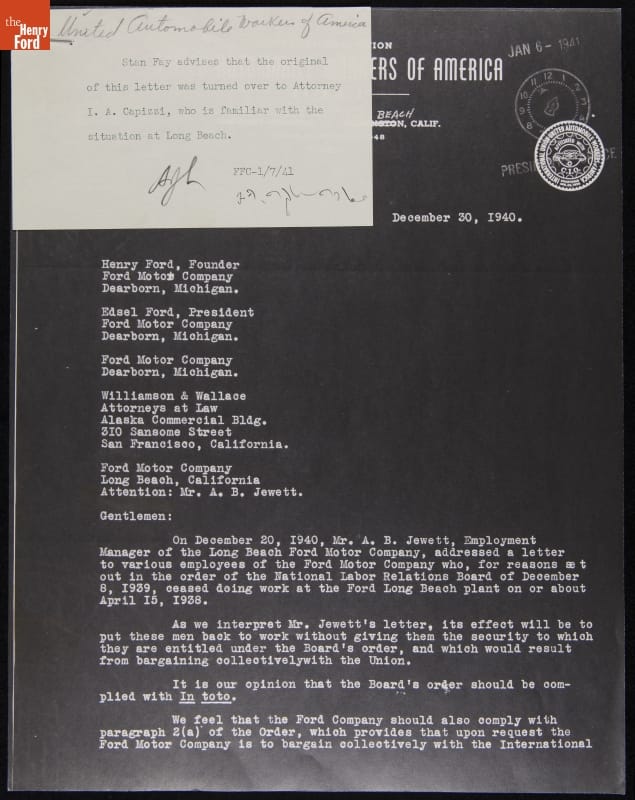
- Letter from UAW-CIO to Ford Motor Company regarding Collective Bargaining with Long Beach Assembly Plant Employees, December 30, 1940 - Starting in the early 1910s, Ford Motor Company established domestic assembly plants throughout the United States. Ford opened its Long Beach, California, assembly plant in 1930. This letter to company president Edsel Ford concerned relations with the local chapter of the United Auto Workers. Edsel Ford had a far more progressive and collaborative attitude toward unions than his father, Henry Ford.
- December 30, 1940
- Collections - Artifact
Letter from UAW-CIO to Ford Motor Company regarding Collective Bargaining with Long Beach Assembly Plant Employees, December 30, 1940
Starting in the early 1910s, Ford Motor Company established domestic assembly plants throughout the United States. Ford opened its Long Beach, California, assembly plant in 1930. This letter to company president Edsel Ford concerned relations with the local chapter of the United Auto Workers. Edsel Ford had a far more progressive and collaborative attitude toward unions than his father, Henry Ford.
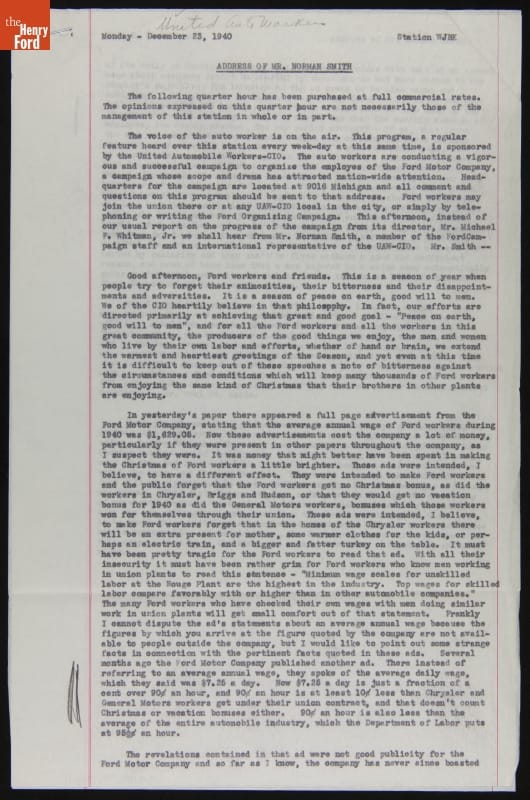
- Address of Mr. Norman Smith on WJBK Radio, Ypsilanti, Michigan, December 23, 1940 -
- December 23, 1940
- Collections - Artifact
Address of Mr. Norman Smith on WJBK Radio, Ypsilanti, Michigan, December 23, 1940
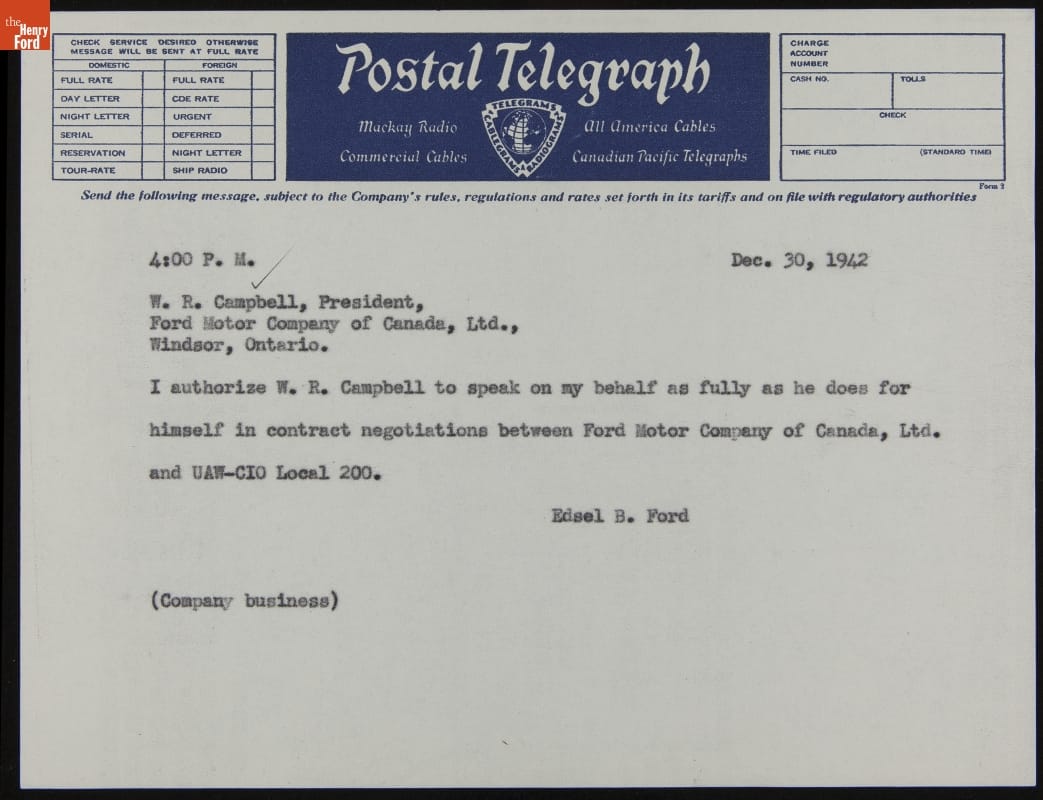
- Telegram from Edsel Ford Authorizing W. R. Campbell to Negotiate with UAW-CIO in Canada, December 30, 1942 -
- December 30, 1942
- Collections - Artifact
Telegram from Edsel Ford Authorizing W. R. Campbell to Negotiate with UAW-CIO in Canada, December 30, 1942
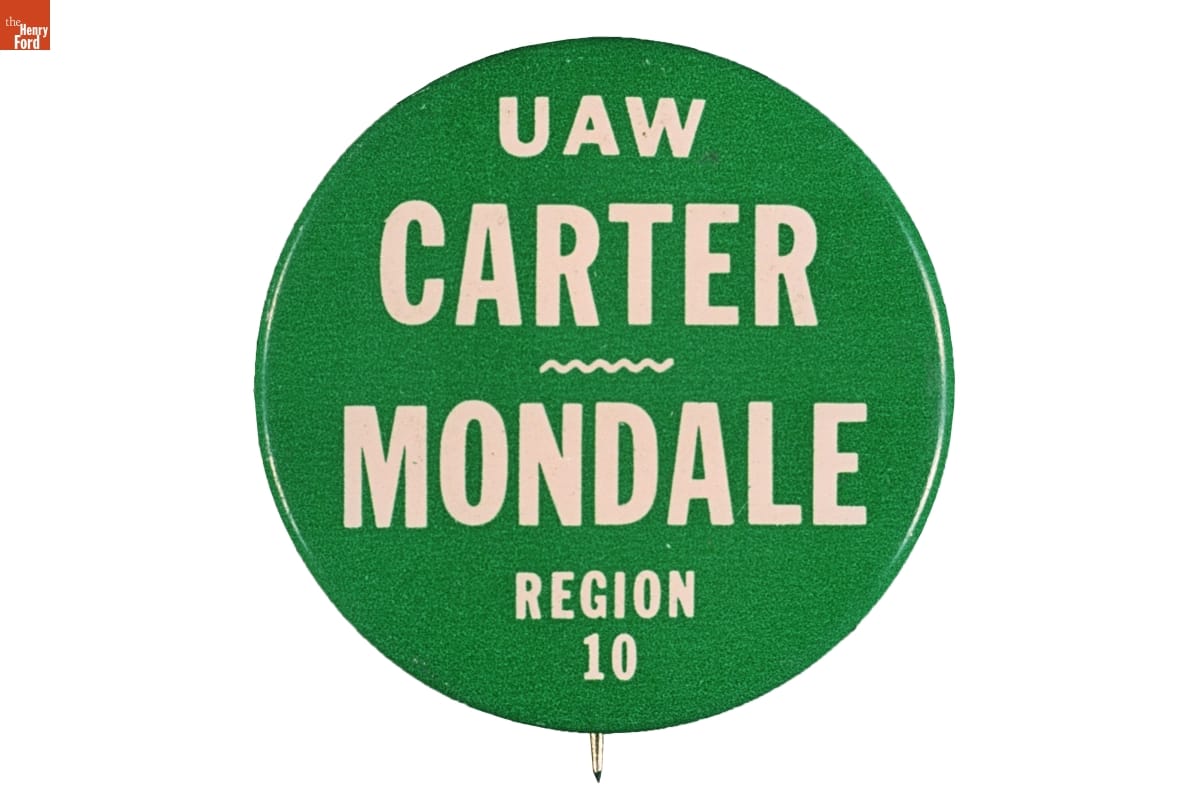
- UAW Carter Mondale Region 10 Button, 1976-1980 - In 1976, organized labor leaders worried about supporting Georgia governor and Democratic presidential candidate Jimmy Carter--many Southern politicians were not friendly to union activities. Carter allayed those fears by choosing Walter Mondale, the liberal pro-union Minnesota senator, as his running mate. Four years later, though labor wanted a change, it eventually backed the incumbent--preferring Carter over Republican candidate, Ronald Reagan.
- 1976-1980
- Collections - Artifact
UAW Carter Mondale Region 10 Button, 1976-1980
In 1976, organized labor leaders worried about supporting Georgia governor and Democratic presidential candidate Jimmy Carter--many Southern politicians were not friendly to union activities. Carter allayed those fears by choosing Walter Mondale, the liberal pro-union Minnesota senator, as his running mate. Four years later, though labor wanted a change, it eventually backed the incumbent--preferring Carter over Republican candidate, Ronald Reagan.
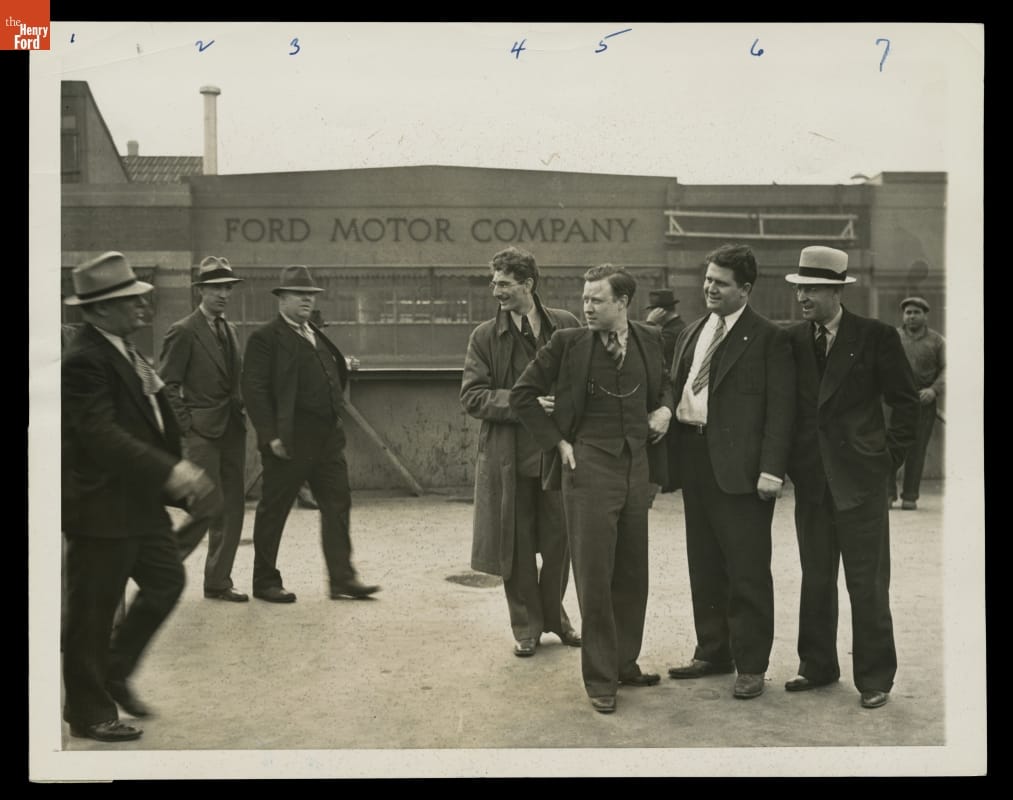
- Ford Service Department Men Confront UAW Organizers during the Battle of the Overpass, May 26, 1937 - Ford Motor Company refused to recognize the United Auto Workers (UAW) labor union. On May 26, 1937, men from Ford's Service Department (left) attacked labor organizers (right) Robert Kanter, Walter Reuther, Richard Frankensteen, and J.J. Kennedy on a pedestrian overpass at Ford's Rouge Plant. This "Battle of the Overpass" came to symbolize the struggle to unionize Ford. The UAW ultimately succeeded in 1941.
- May 26, 1937
- Collections - Artifact
Ford Service Department Men Confront UAW Organizers during the Battle of the Overpass, May 26, 1937
Ford Motor Company refused to recognize the United Auto Workers (UAW) labor union. On May 26, 1937, men from Ford's Service Department (left) attacked labor organizers (right) Robert Kanter, Walter Reuther, Richard Frankensteen, and J.J. Kennedy on a pedestrian overpass at Ford's Rouge Plant. This "Battle of the Overpass" came to symbolize the struggle to unionize Ford. The UAW ultimately succeeded in 1941.
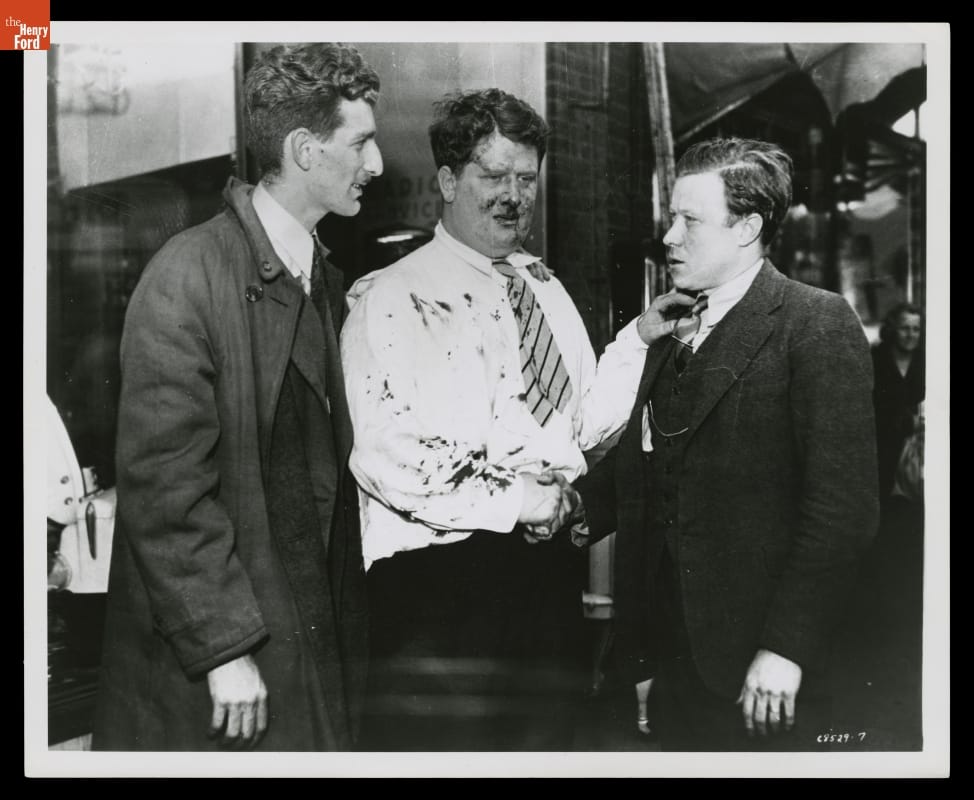
- Robert Kanter, Richard Frankensteen and Walter Reuther after the Battle of the Overpass, May 26, 1937 - Ford Motor Company refused to recognize the United Auto Workers labor union and hired guards to resist unionization among Ford employees. In May 1937, men from Ford's Service Department attacked labor organizers (including Kanter, Frankensteen and Reuther) on a pedestrian overpass at Ford's Rouge Plant. This bloody "Battle of the Overpass" became a lasting symbol of the American labor struggle.
- May 26, 1937
- Collections - Artifact
Robert Kanter, Richard Frankensteen and Walter Reuther after the Battle of the Overpass, May 26, 1937
Ford Motor Company refused to recognize the United Auto Workers labor union and hired guards to resist unionization among Ford employees. In May 1937, men from Ford's Service Department attacked labor organizers (including Kanter, Frankensteen and Reuther) on a pedestrian overpass at Ford's Rouge Plant. This bloody "Battle of the Overpass" became a lasting symbol of the American labor struggle.
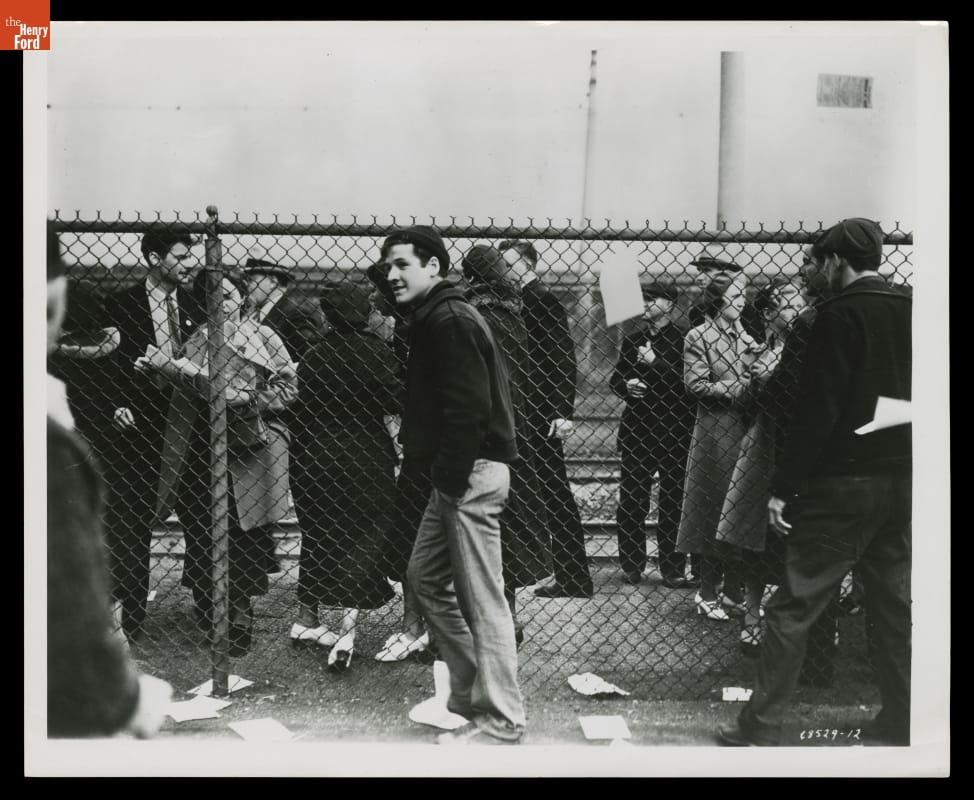
- UAW Organizers Forced Back from the Ford Rouge Plant during the Battle of the Overpass, May 26, 1937 - Ford Motor Company refused to recognize the United Auto Workers labor union and hired guards to resist unionization among Ford employees. In May 1937, men from Ford's Service Department attacked labor organizers on a pedestrian overpass at Ford's Rouge Plant, beating several men and women. This bloody "Battle of the Overpass" became a lasting symbol of the American labor struggle.
- May 26, 1937
- Collections - Artifact
UAW Organizers Forced Back from the Ford Rouge Plant during the Battle of the Overpass, May 26, 1937
Ford Motor Company refused to recognize the United Auto Workers labor union and hired guards to resist unionization among Ford employees. In May 1937, men from Ford's Service Department attacked labor organizers on a pedestrian overpass at Ford's Rouge Plant, beating several men and women. This bloody "Battle of the Overpass" became a lasting symbol of the American labor struggle.
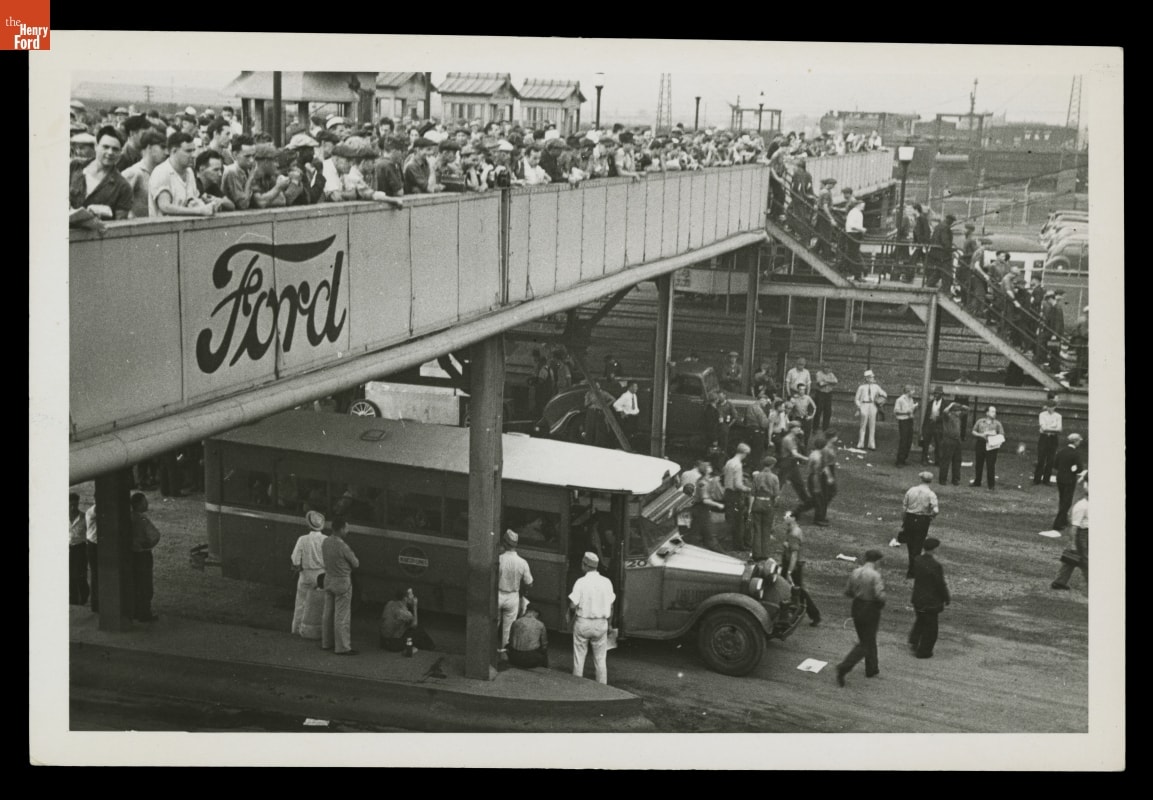
- Distributing Labor Union Literature to Workers at the Ford Rouge Plant, 1937 - The struggle to unionize Ford Motor Company workers was long and--at times--violent. This photograph shows United Auto Workers (UAW) labor organizers demonstrating outside Ford's Rouge Plant pedestrian overpass during 1937. Four years later, following a turbulent ten-day strike in April 1941, Ford became the last major automotive manufacturer to recognize the UAW and agree to a union contract.
- 1937
- Collections - Artifact
Distributing Labor Union Literature to Workers at the Ford Rouge Plant, 1937
The struggle to unionize Ford Motor Company workers was long and--at times--violent. This photograph shows United Auto Workers (UAW) labor organizers demonstrating outside Ford's Rouge Plant pedestrian overpass during 1937. Four years later, following a turbulent ten-day strike in April 1941, Ford became the last major automotive manufacturer to recognize the UAW and agree to a union contract.
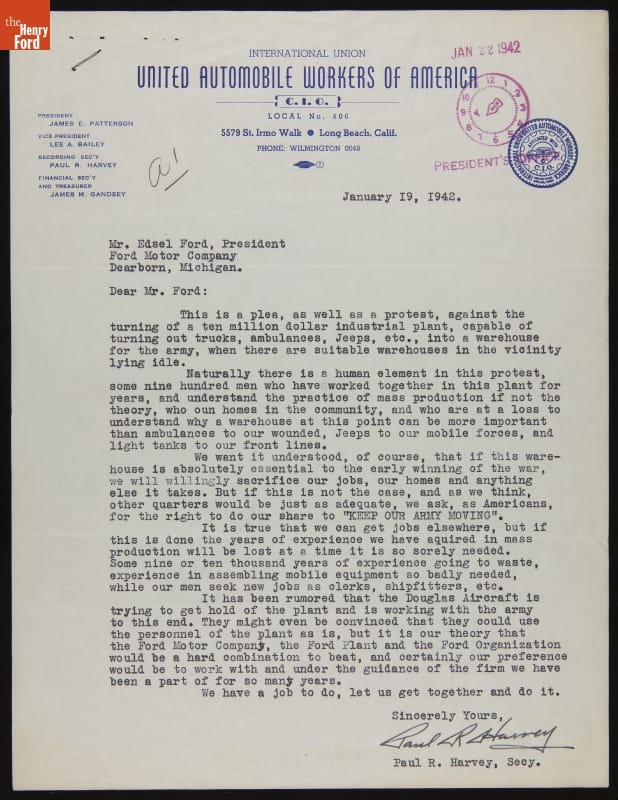
- Letter from UAW-CIO to Edsel Ford Protesting Turning the Long Beach Assembly Plant into an Army Warehouse, January 19, 1942 - Starting in the 1910s, Ford Motor Company opened domestic assembly plants throughout the United States. Ford opened its Long Beach, California, assembly plant in 1930. Civilian production was suspended during World War II, and the facility became a temporary supply base for U.S. Army Air Corps. Automobile production resumed at Long Beach in late 1945 until the plant closed in 1959.
- January 19, 1942
- Collections - Artifact
Letter from UAW-CIO to Edsel Ford Protesting Turning the Long Beach Assembly Plant into an Army Warehouse, January 19, 1942
Starting in the 1910s, Ford Motor Company opened domestic assembly plants throughout the United States. Ford opened its Long Beach, California, assembly plant in 1930. Civilian production was suspended during World War II, and the facility became a temporary supply base for U.S. Army Air Corps. Automobile production resumed at Long Beach in late 1945 until the plant closed in 1959.