
Search
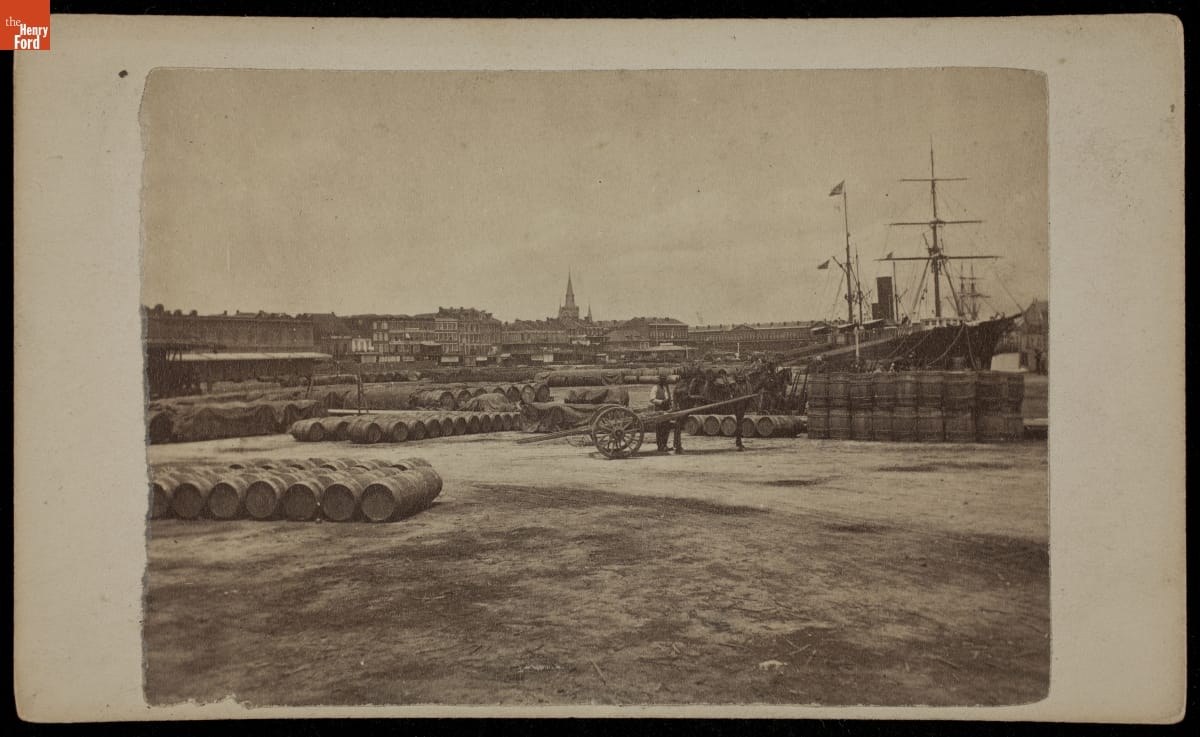
- Steamboat and Cargo at a Landing, New Orleans, Louisiana, 1866-1890 -
- 1866-1890
- Collections - Artifact
Steamboat and Cargo at a Landing, New Orleans, Louisiana, 1866-1890
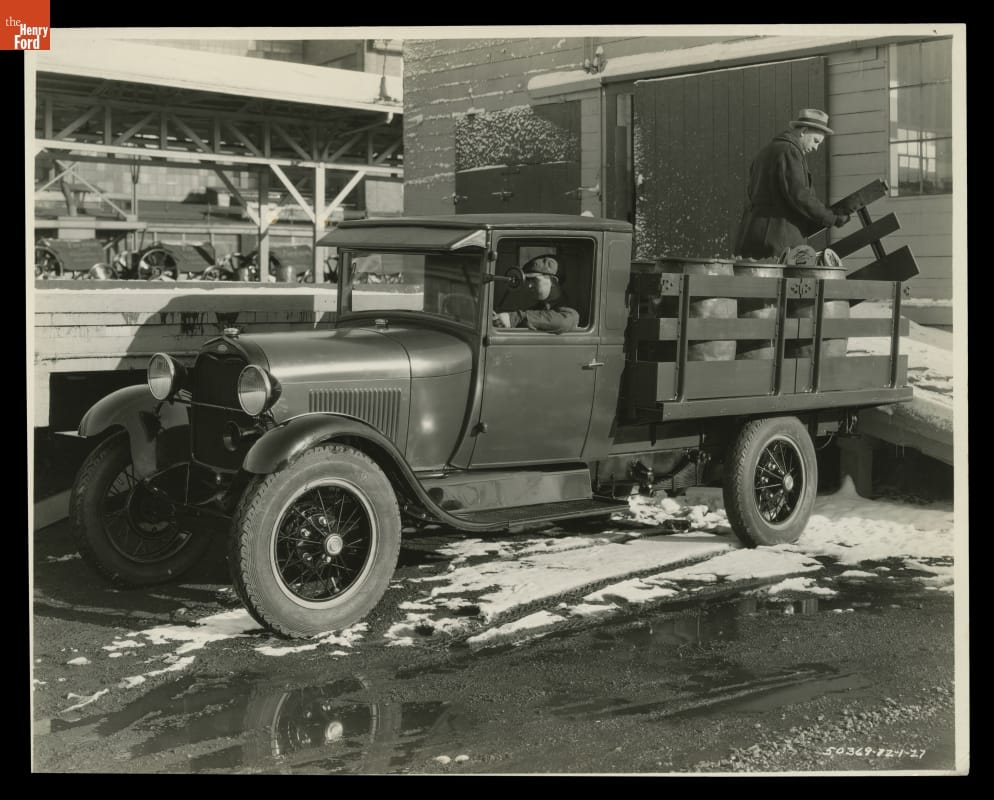
- 1928 Ford Model AA Stake Truck Parked at Loading Dock, December 1927 - Ford Motor Company's Model AA truck was based on its Model A automobile platform, but with a longer wheelbase, a stronger frame, and generally sturdier chassis components. The Model AA was available in several body styles to permit its use as a panel truck, an express delivery truck, a garbage truck, a bus, or an ambulance, among other options.
- December 01, 1927
- Collections - Artifact
1928 Ford Model AA Stake Truck Parked at Loading Dock, December 1927
Ford Motor Company's Model AA truck was based on its Model A automobile platform, but with a longer wheelbase, a stronger frame, and generally sturdier chassis components. The Model AA was available in several body styles to permit its use as a panel truck, an express delivery truck, a garbage truck, a bus, or an ambulance, among other options.
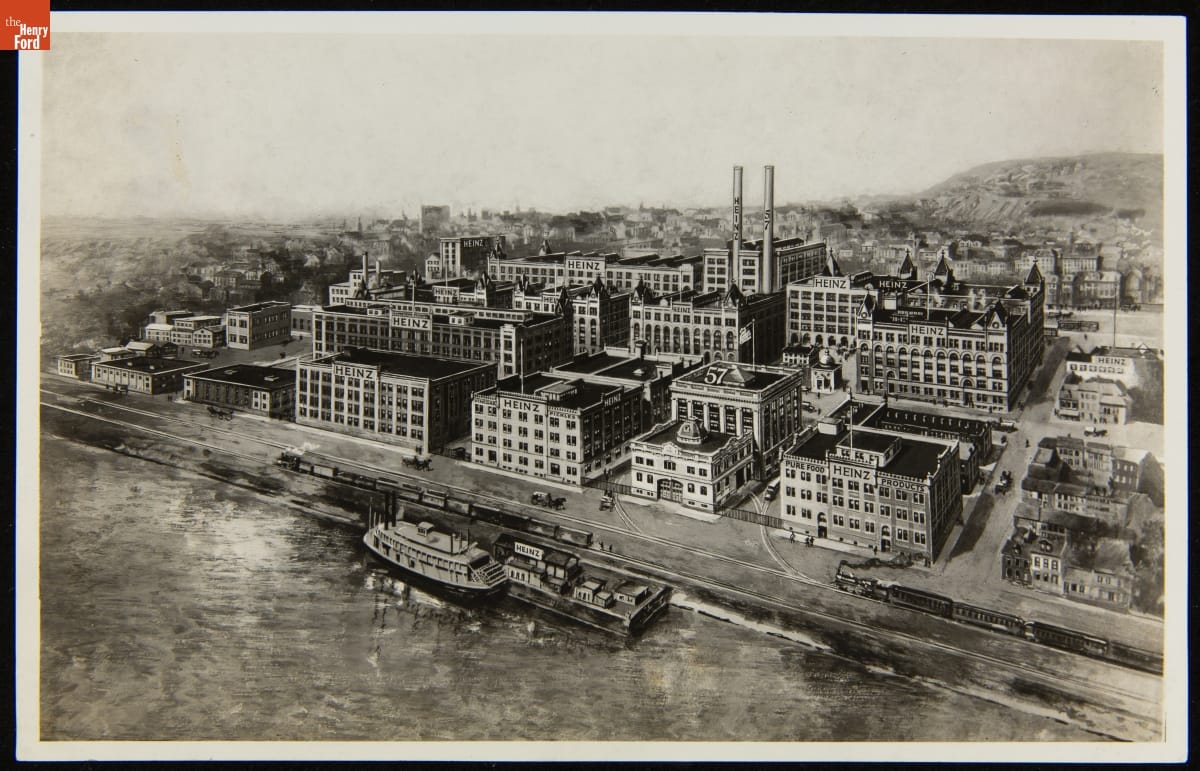
- H. J. Heinz Company Main Plant, Pittsburgh, Pennsylvania, circa 1910 - The H.J. Heinz Company had humble beginnings in 1869 when its founder began selling horseradish out his parents' home in Sharpsburg, Pennsylvania. With a rapidly expanding product line and extensive marketing, the Heinz brand became a household name by the turn of the century. Its main plant in Pittsburgh, Pennsylvania (seen here), was known as the "Home of the 57" and offered tours for visitors.
- circa 1910
- Collections - Artifact
H. J. Heinz Company Main Plant, Pittsburgh, Pennsylvania, circa 1910
The H.J. Heinz Company had humble beginnings in 1869 when its founder began selling horseradish out his parents' home in Sharpsburg, Pennsylvania. With a rapidly expanding product line and extensive marketing, the Heinz brand became a household name by the turn of the century. Its main plant in Pittsburgh, Pennsylvania (seen here), was known as the "Home of the 57" and offered tours for visitors.
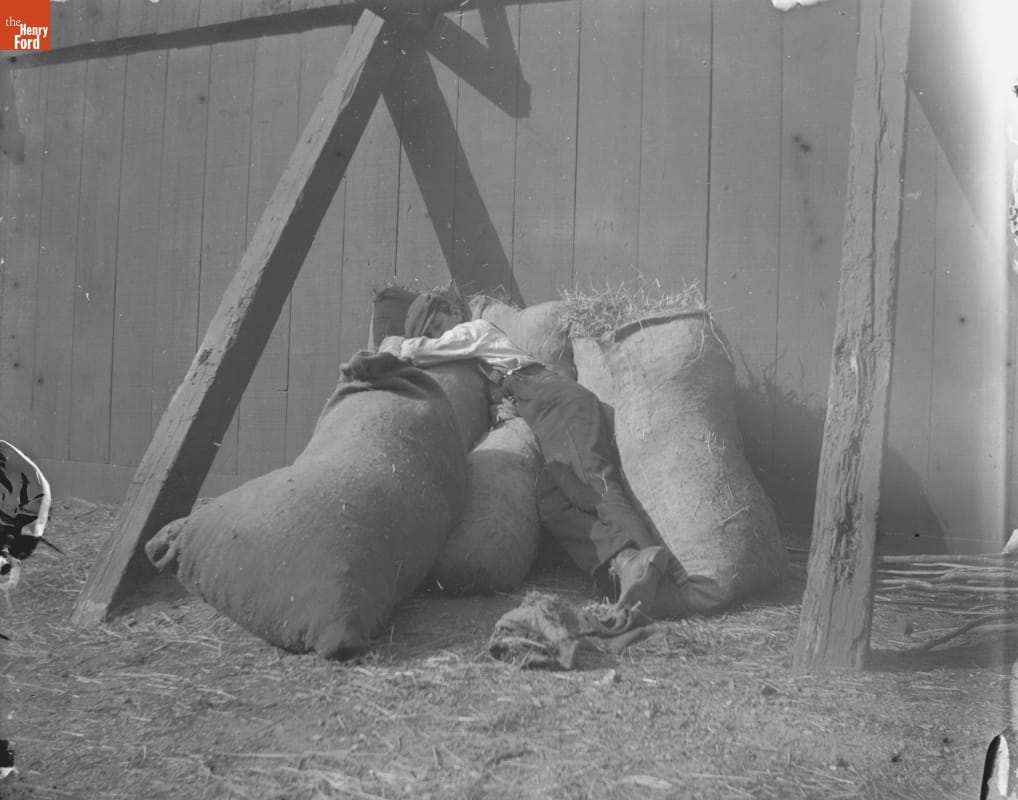
- Boy on Palmer's Dock, Brooklyn, New York, 1890-1915 - In 1890, Jenny Young Chandler, 25 years old and recently widowed, began working for the <EM>New York Herald</EM>. As a photojournalist and feature writer, Chandler captured life in Brooklyn, New York, and vicinity. By 1922, the time of her death, she had produced over 800 glass plate negatives. Her sensitive, insightful photographs depict people from all walks of life and the world in which they lived.
- 1890-1915
- Collections - Artifact
Boy on Palmer's Dock, Brooklyn, New York, 1890-1915
In 1890, Jenny Young Chandler, 25 years old and recently widowed, began working for the New York Herald. As a photojournalist and feature writer, Chandler captured life in Brooklyn, New York, and vicinity. By 1922, the time of her death, she had produced over 800 glass plate negatives. Her sensitive, insightful photographs depict people from all walks of life and the world in which they lived.
- Unloading Bananas from Steamer, New Orleans, Louisiana, 1900-1910 - Bananas arrived on grocery store shelves via a transportation system controlled by competing fruit companies and their government allies. Refrigerated railcars moved the crop from Central American plantations to ships bound for U.S. ports in the Gulf of Mexico. This photograph shows dockworkers in New Orleans, Louisiana, transferring bunches of bananas -- each weighing around 86 pounds -- to a refrigerated railcar for transport to market.
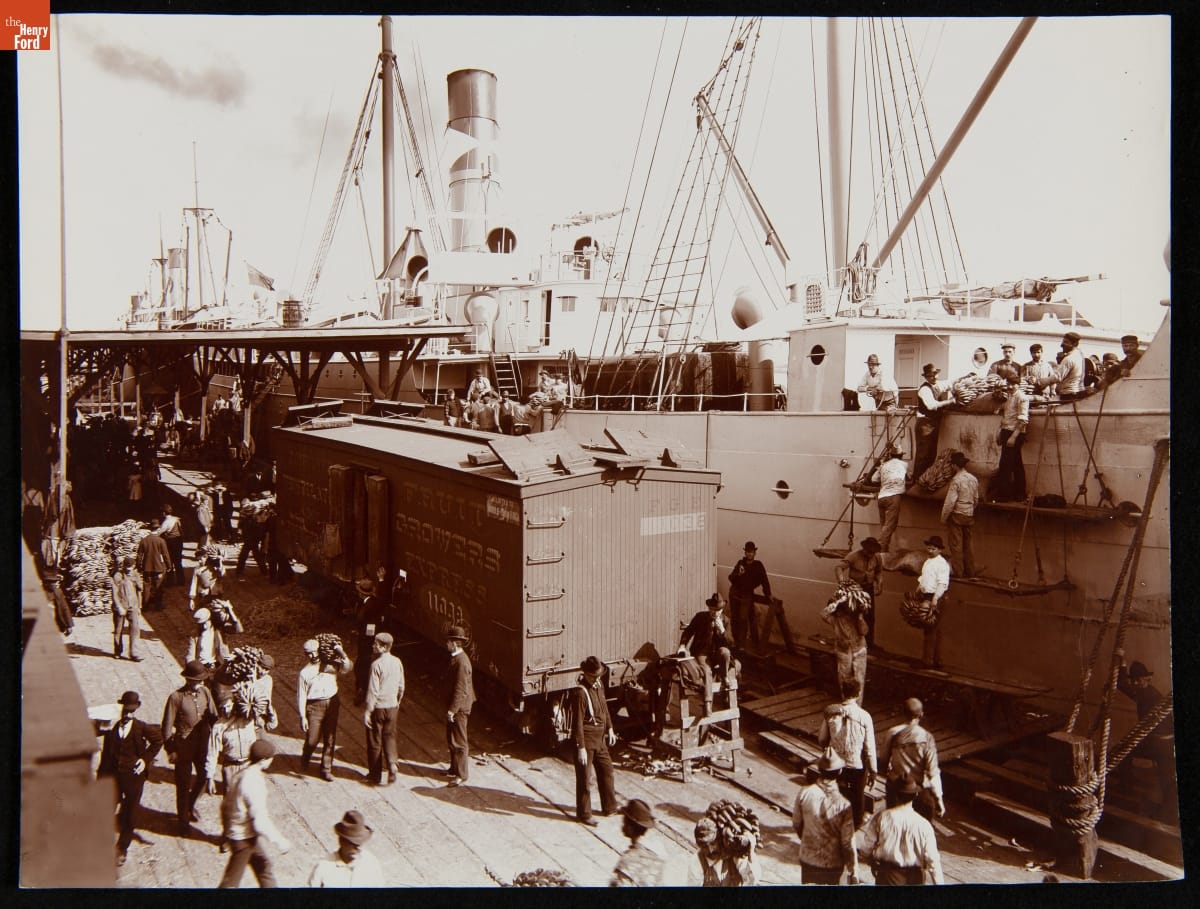
- 1900-1910
- Collections - Artifact
Unloading Bananas from Steamer, New Orleans, Louisiana, 1900-1910
Bananas arrived on grocery store shelves via a transportation system controlled by competing fruit companies and their government allies. Refrigerated railcars moved the crop from Central American plantations to ships bound for U.S. ports in the Gulf of Mexico. This photograph shows dockworkers in New Orleans, Louisiana, transferring bunches of bananas -- each weighing around 86 pounds -- to a refrigerated railcar for transport to market.
- Jerry O'Mahony Dining Car Construction and Transportation, 1920-1948 -
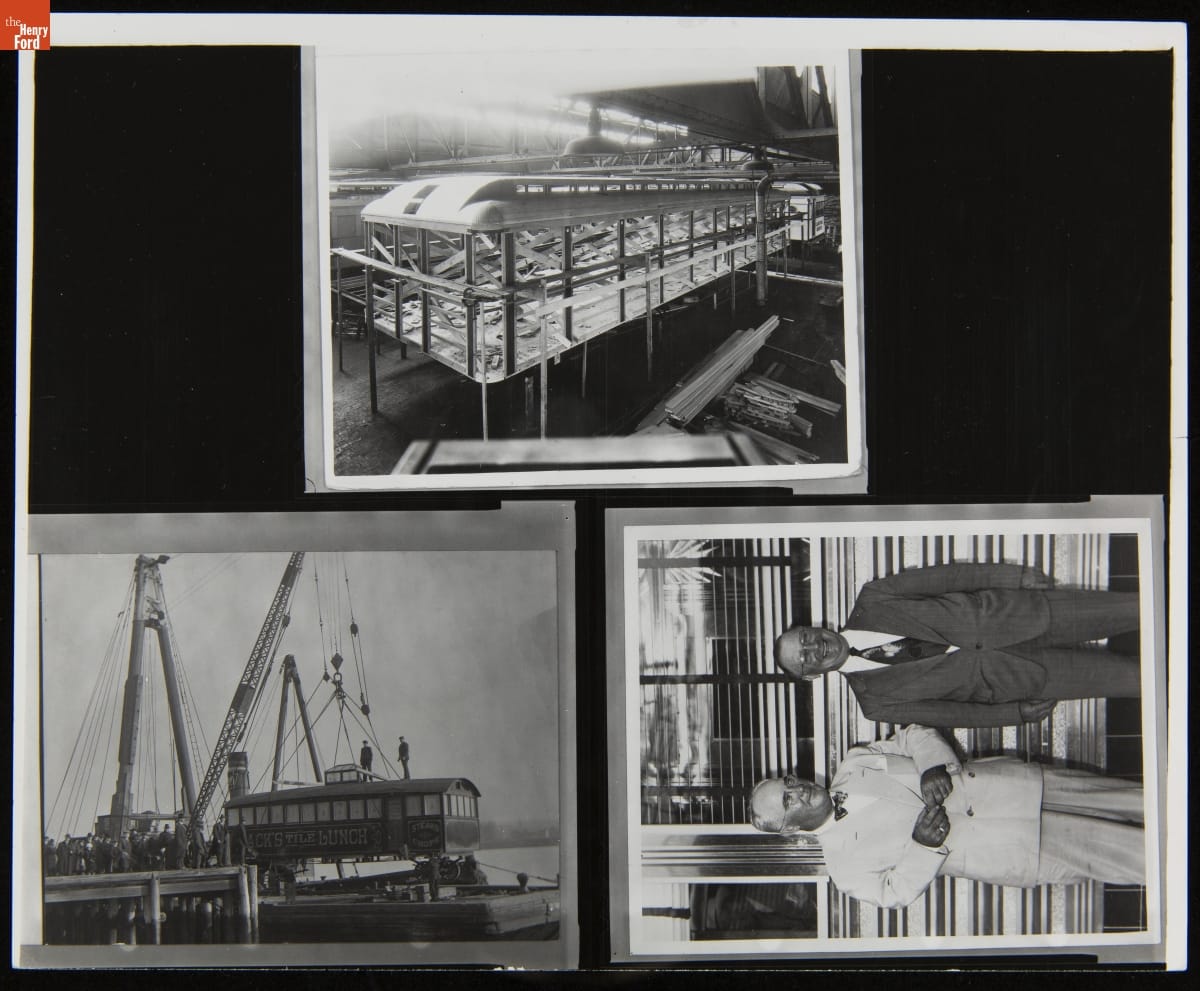
- 1920-1948
- Collections - Artifact
Jerry O'Mahony Dining Car Construction and Transportation, 1920-1948
- The Basin, Baltimore, Maryland, 1900-1910 -
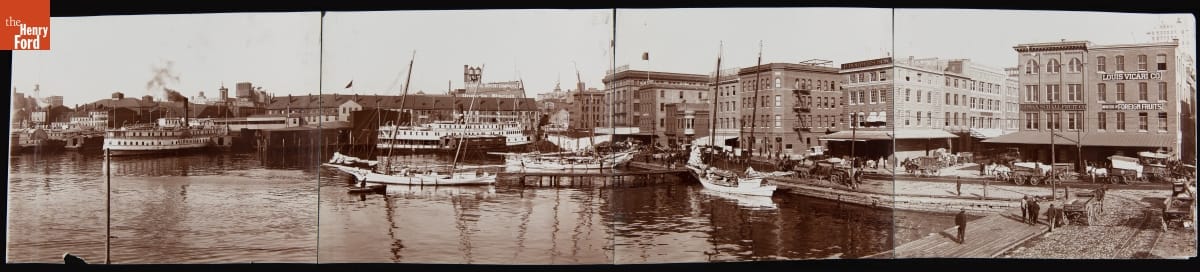
- 1900-1910
- Collections - Artifact
The Basin, Baltimore, Maryland, 1900-1910
- Men Loading Fruit Boxes onto Horse-Drawn Wagons, circa 1905 - California farmers grew a lot of fruit. Beginning in the 1890s, the Earl Fruit Company's refrigerated railroad cars transported the produce to hungry consumers back east. But first the fruit needed to be packed for shipping at plants like this one in Redlands, a citrus town in southern California. Workers are loading boxes of oranges onto a horse-drawn wagon.
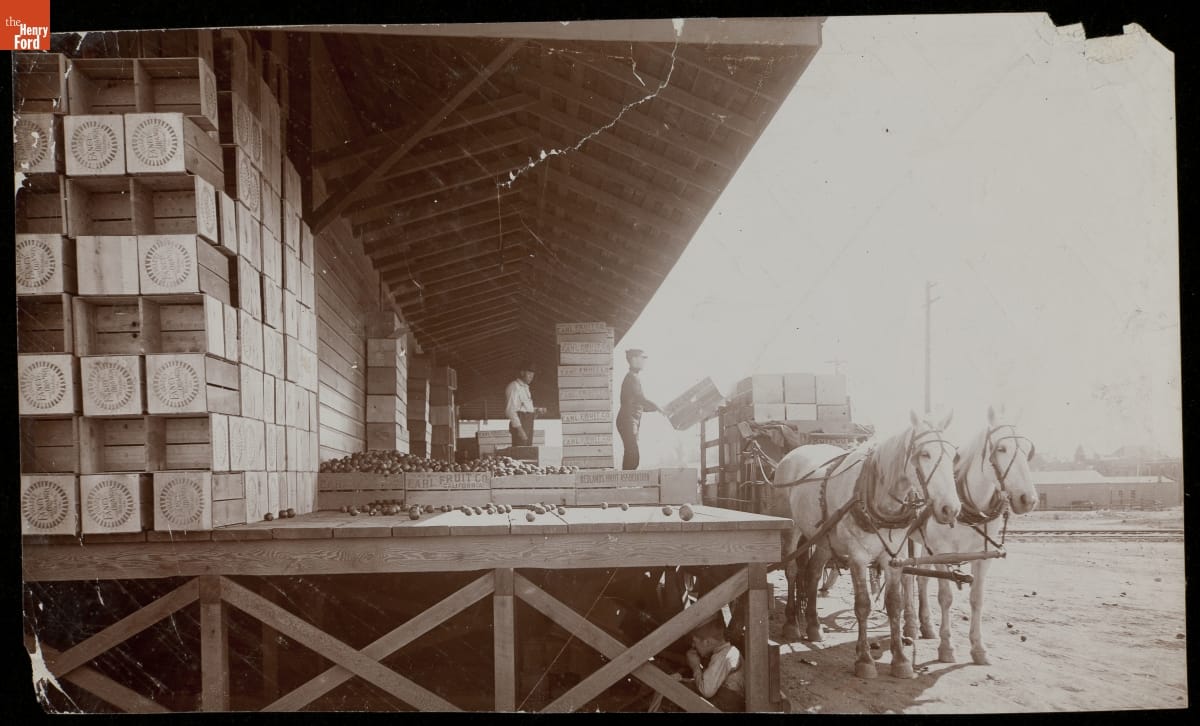
- circa 1905
- Collections - Artifact
Men Loading Fruit Boxes onto Horse-Drawn Wagons, circa 1905
California farmers grew a lot of fruit. Beginning in the 1890s, the Earl Fruit Company's refrigerated railroad cars transported the produce to hungry consumers back east. But first the fruit needed to be packed for shipping at plants like this one in Redlands, a citrus town in southern California. Workers are loading boxes of oranges onto a horse-drawn wagon.
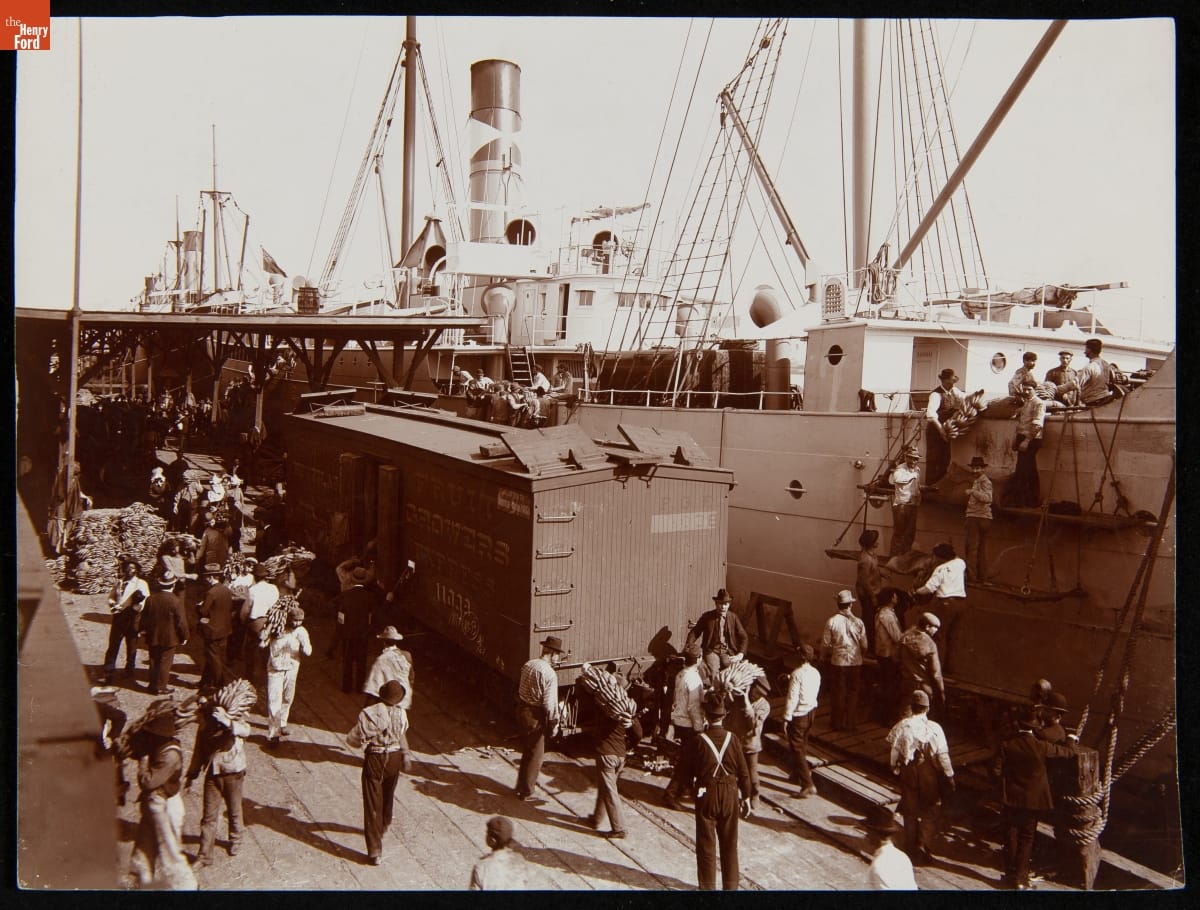
- Unloading Bananas from Steamer, New Orleans, Louisiana, 1900-1910 - Bananas arrived on grocery store shelves via a transportation system controlled by competing fruit companies and their government allies. Refrigerated railcars moved the crop from Central American plantations to ships bound for U.S. ports in the Gulf of Mexico. This photograph shows dockworkers in New Orleans, Louisiana, transferring bunches of bananas -- each weighing around 86 pounds -- to a refrigerated railcar for transport to market.
- 1900-1910
- Collections - Artifact
Unloading Bananas from Steamer, New Orleans, Louisiana, 1900-1910
Bananas arrived on grocery store shelves via a transportation system controlled by competing fruit companies and their government allies. Refrigerated railcars moved the crop from Central American plantations to ships bound for U.S. ports in the Gulf of Mexico. This photograph shows dockworkers in New Orleans, Louisiana, transferring bunches of bananas -- each weighing around 86 pounds -- to a refrigerated railcar for transport to market.
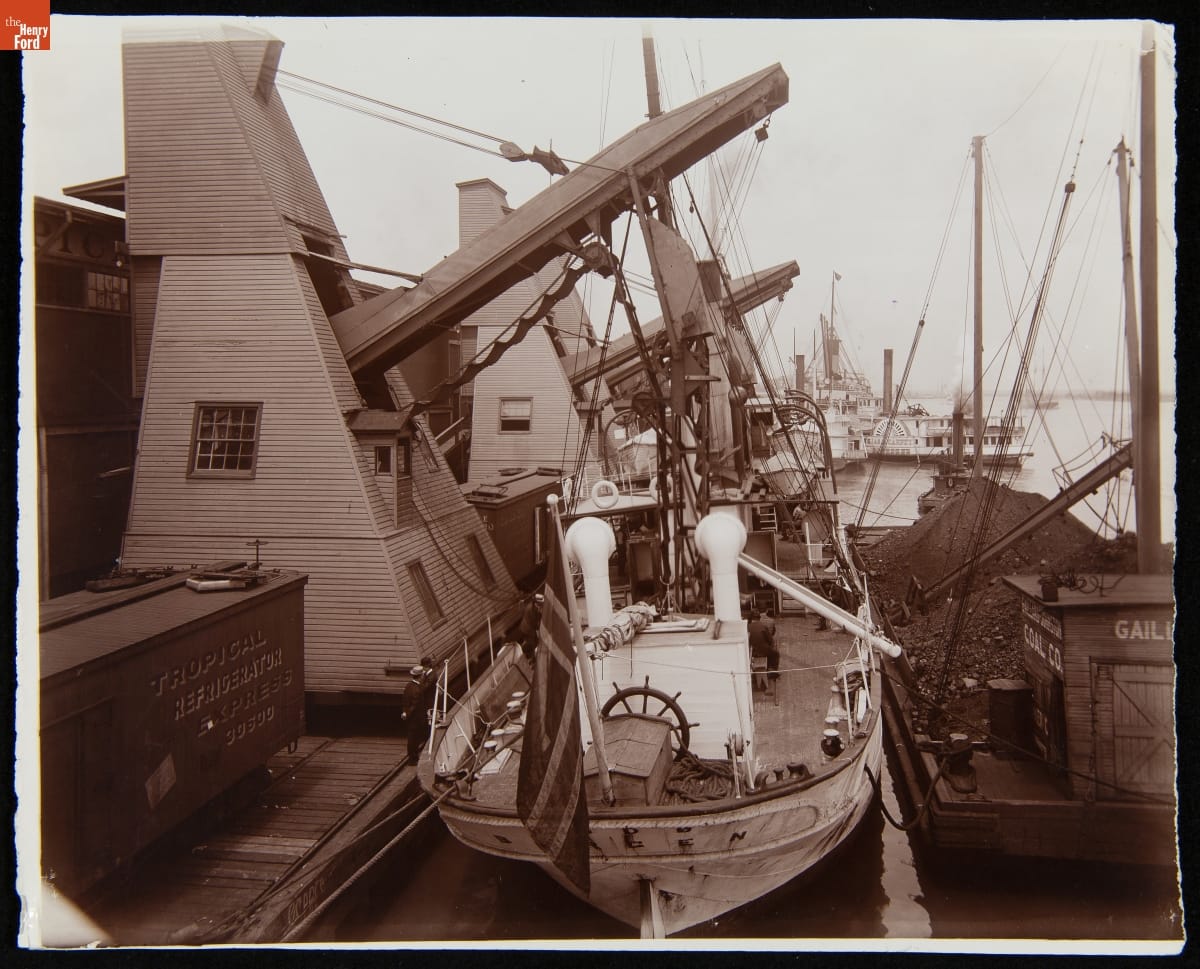
- Unloading a Banana Steamer by Machinery, Mobile, Alabama, 1900-1910 - Bananas raised on Central American plantations traveled to North American grocery stores via a transportation system controlled by competing fruit companies and their government allies. Ships hauled the commodity to U.S. ports in the Gulf of Mexico, including Mobile, Alabama. Conveyor belts moved stalks of bananas, each weighing around 86 pounds, from the ship's hold into refrigerated railcars, visible next to the ship.
- 1900-1910
- Collections - Artifact
Unloading a Banana Steamer by Machinery, Mobile, Alabama, 1900-1910
Bananas raised on Central American plantations traveled to North American grocery stores via a transportation system controlled by competing fruit companies and their government allies. Ships hauled the commodity to U.S. ports in the Gulf of Mexico, including Mobile, Alabama. Conveyor belts moved stalks of bananas, each weighing around 86 pounds, from the ship's hold into refrigerated railcars, visible next to the ship.