
Search
- Henry Ford's Private Railroad Car "Fair Lane," 1921 - By 1920, Henry and Clara Ford found it increasingly difficult to travel with any degree of privacy. They purchased a private railcar and named it <EM>Fair Lane</EM>. The car had four private rooms, an observation lounge, a dining room, and a fully equipped kitchen. It could accommodate eight passengers. The couple made over 400 trips using <EM>Fair Lane</EM> before selling the passenger car in 1942.

- June 23, 1921
- Collections - Artifact
Henry Ford's Private Railroad Car "Fair Lane," 1921
By 1920, Henry and Clara Ford found it increasingly difficult to travel with any degree of privacy. They purchased a private railcar and named it Fair Lane. The car had four private rooms, an observation lounge, a dining room, and a fully equipped kitchen. It could accommodate eight passengers. The couple made over 400 trips using Fair Lane before selling the passenger car in 1942.
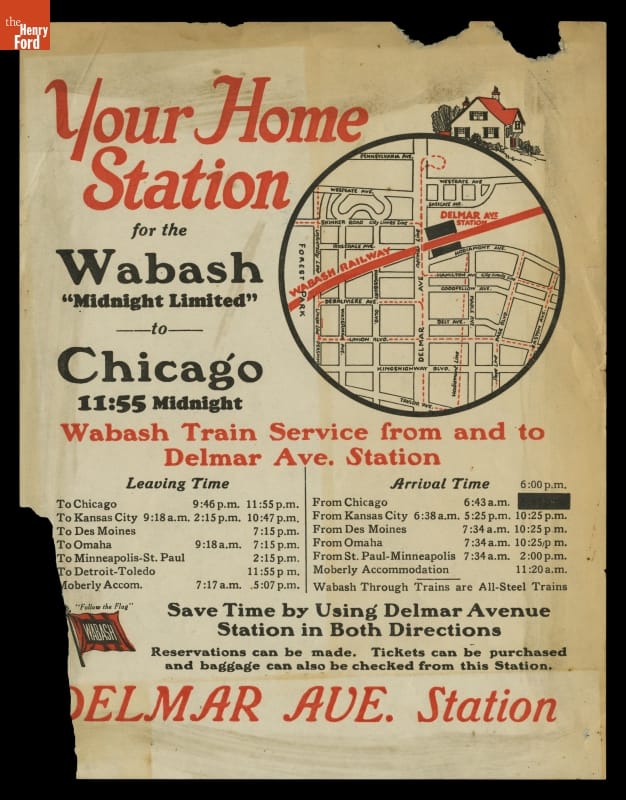
- Handbill and Timetable for Wabash Railway's "Midnight Limited," Leaving from Delmar Avenue Station, St. Louis, Missouri, 1929 - The Wabash Railway, with origins dating back to 1838, was a strong Midwestern carrier until Amtrak took over the national passenger railroad system in 1971. In 1928, the Wabash Railway erected the Delmar Avenue Station, providing west-end and suburban St. Louis residents -- particularly businessmen -- convenient access to their railroad system without having to go all the way downtown.
- 1929
- Collections - Artifact
Handbill and Timetable for Wabash Railway's "Midnight Limited," Leaving from Delmar Avenue Station, St. Louis, Missouri, 1929
The Wabash Railway, with origins dating back to 1838, was a strong Midwestern carrier until Amtrak took over the national passenger railroad system in 1971. In 1928, the Wabash Railway erected the Delmar Avenue Station, providing west-end and suburban St. Louis residents -- particularly businessmen -- convenient access to their railroad system without having to go all the way downtown.
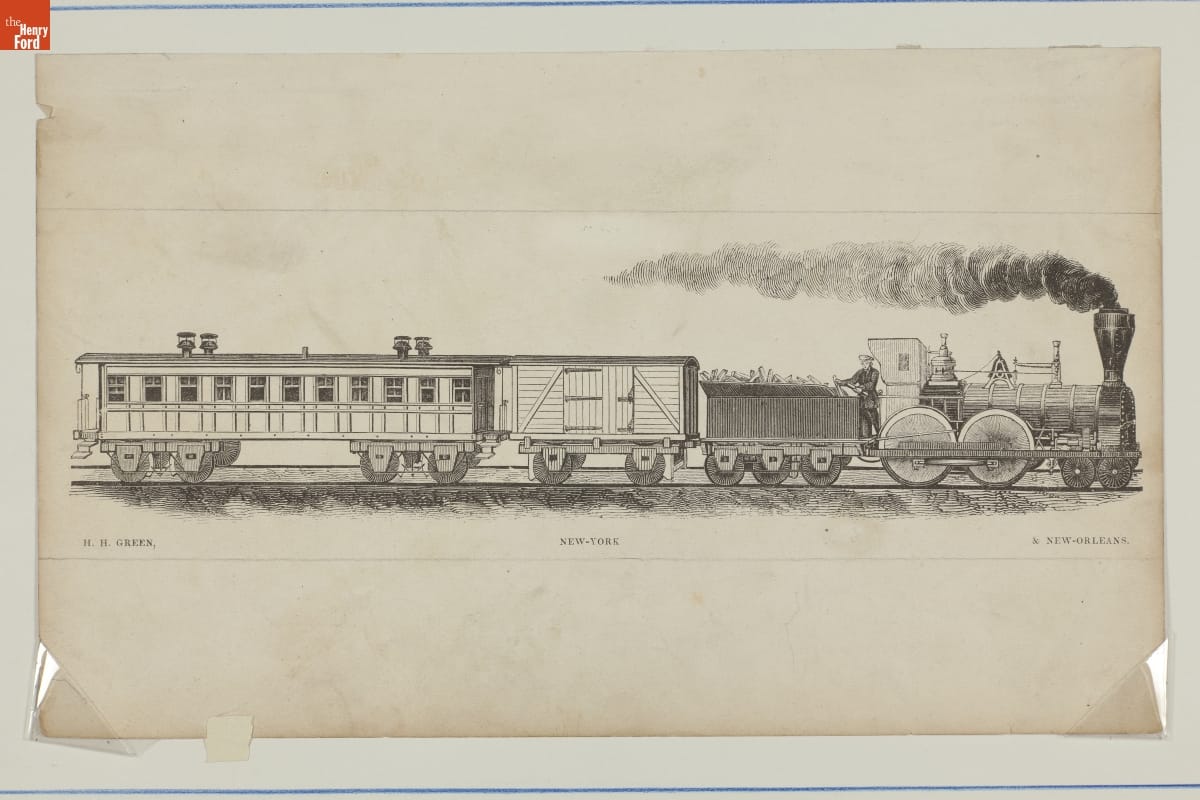
- Train with Steam Locomotive, Passenger and Freight Cars, circa 1856 - Locomotive boilers had to stay hot to produce steam. Lagging -- insulation around the boiler -- was crucial. This American-type locomotive of the 1850s had narrow wooden strips mounted around its boiler for insulation. But the wood deteriorated quickly when exposed to weather and sparks. Improved designs placed a protective sheet metal jacket over the wood.
- circa 1856
- Collections - Artifact
Train with Steam Locomotive, Passenger and Freight Cars, circa 1856
Locomotive boilers had to stay hot to produce steam. Lagging -- insulation around the boiler -- was crucial. This American-type locomotive of the 1850s had narrow wooden strips mounted around its boiler for insulation. But the wood deteriorated quickly when exposed to weather and sparks. Improved designs placed a protective sheet metal jacket over the wood.
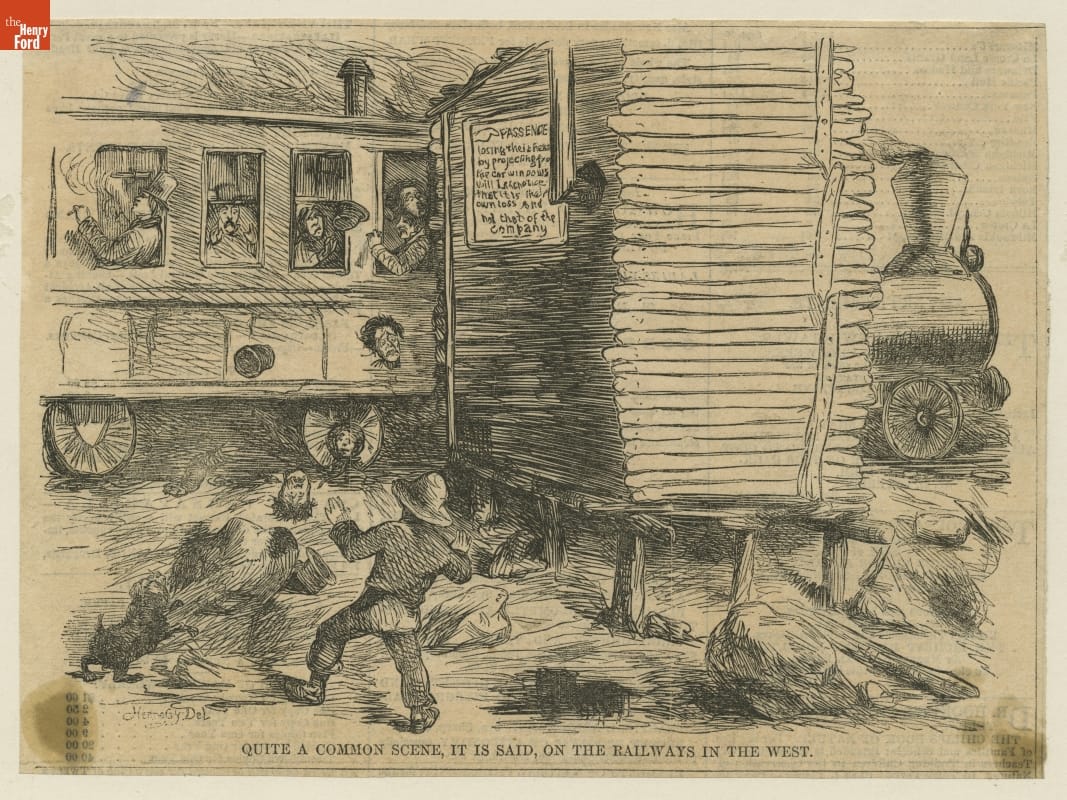
- Wood Engraving, "Quite a Common Scene, it is Said, on the Railways in the West," 1858 - While close clearances -- tight spaces between railroad cars and trackside structures -- did exist, this 1858 illustration from <em>Harper's Weekly</em> exaggerated the dangers faced by passengers who stuck their heads through windows. More likely threats from an open window included sparks, cinders and smoke from the steam locomotive pulling the train -- all of which could irritate eyes and damage clothing.
- 1858
- Collections - Artifact
Wood Engraving, "Quite a Common Scene, it is Said, on the Railways in the West," 1858
While close clearances -- tight spaces between railroad cars and trackside structures -- did exist, this 1858 illustration from Harper's Weekly exaggerated the dangers faced by passengers who stuck their heads through windows. More likely threats from an open window included sparks, cinders and smoke from the steam locomotive pulling the train -- all of which could irritate eyes and damage clothing.
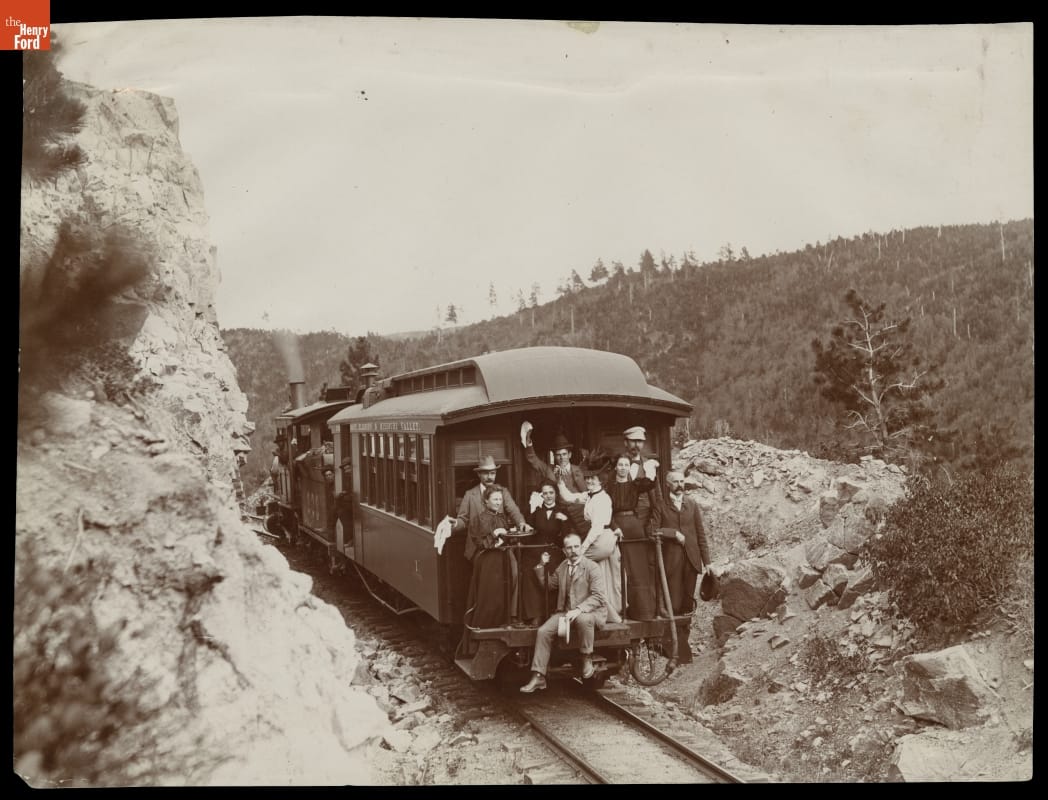
- Passengers on the Fremont, Elkhorn and Missouri Valley Railroad, South Dakota, circa 1895 - Passengers gathered for a photograph when the Fremont, Elkhorn, and Missouri Valley train stopped in a South Dakota mountain pass. The photograph, taken about 1907, shows the happy group on the back platform while the engineer and others peer out from the side.
- circa 1895
- Collections - Artifact
Passengers on the Fremont, Elkhorn and Missouri Valley Railroad, South Dakota, circa 1895
Passengers gathered for a photograph when the Fremont, Elkhorn, and Missouri Valley train stopped in a South Dakota mountain pass. The photograph, taken about 1907, shows the happy group on the back platform while the engineer and others peer out from the side.
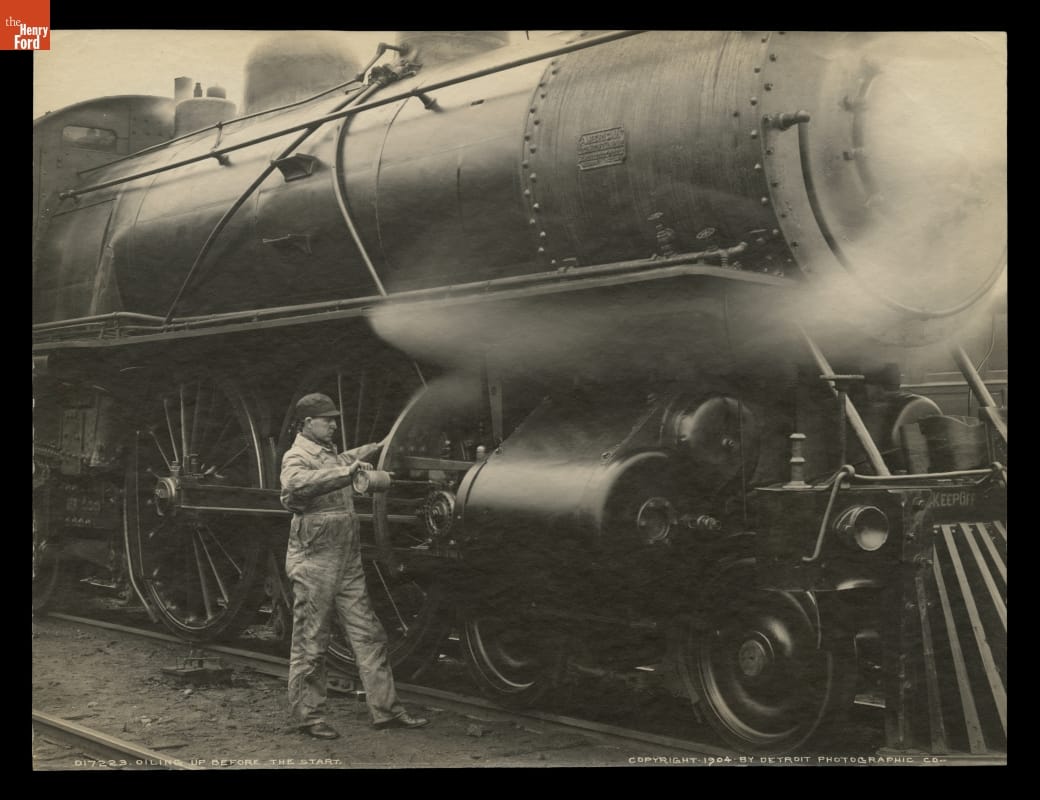
- "Oiling Up Before the Start," Engineer Working on Michigan Central Railroad K-Class Locomotive, 1904 - An engineman is seen oiling the side rods on a Michigan Central Railroad locomotive about 1905. The 4-4-2 Atlantic-type locomotive, with its tall driving wheels, was built to pull fast passenger trains on the Michigan Central's Detroit-Chicago mainline. But speed was relative. Even the fastest regularly scheduled trains might have averaged only 40 miles per hour in 1905.
- 1904
- Collections - Artifact
"Oiling Up Before the Start," Engineer Working on Michigan Central Railroad K-Class Locomotive, 1904
An engineman is seen oiling the side rods on a Michigan Central Railroad locomotive about 1905. The 4-4-2 Atlantic-type locomotive, with its tall driving wheels, was built to pull fast passenger trains on the Michigan Central's Detroit-Chicago mainline. But speed was relative. Even the fastest regularly scheduled trains might have averaged only 40 miles per hour in 1905.
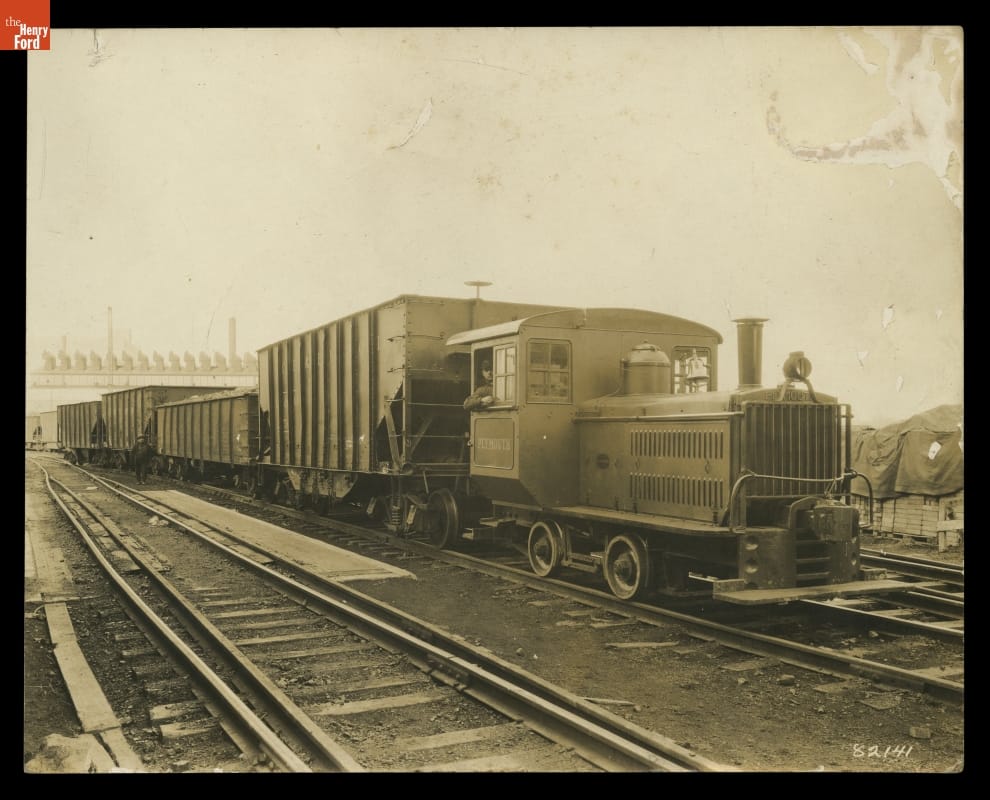
- Engineer Charles Vaughn in Plymouth Locomotive at Mistersky Power Plant, West Jefferson Avenue, Detroit, Michigan, circa 1930 - Engineer Charles Vaughn shuttles carloads of coal at Detroit's Mistersky Power Plant around 1930. The gasoline-powered Plymouth locomotive did not require the coal and water used by steam engines, and it could be operated by one person. The locomotive's light weight and simple operation made it ideal for small industrial railroads. This engine joined The Henry Ford's collection in 1979.
- circa 1930
- Collections - Artifact
Engineer Charles Vaughn in Plymouth Locomotive at Mistersky Power Plant, West Jefferson Avenue, Detroit, Michigan, circa 1930
Engineer Charles Vaughn shuttles carloads of coal at Detroit's Mistersky Power Plant around 1930. The gasoline-powered Plymouth locomotive did not require the coal and water used by steam engines, and it could be operated by one person. The locomotive's light weight and simple operation made it ideal for small industrial railroads. This engine joined The Henry Ford's collection in 1979.
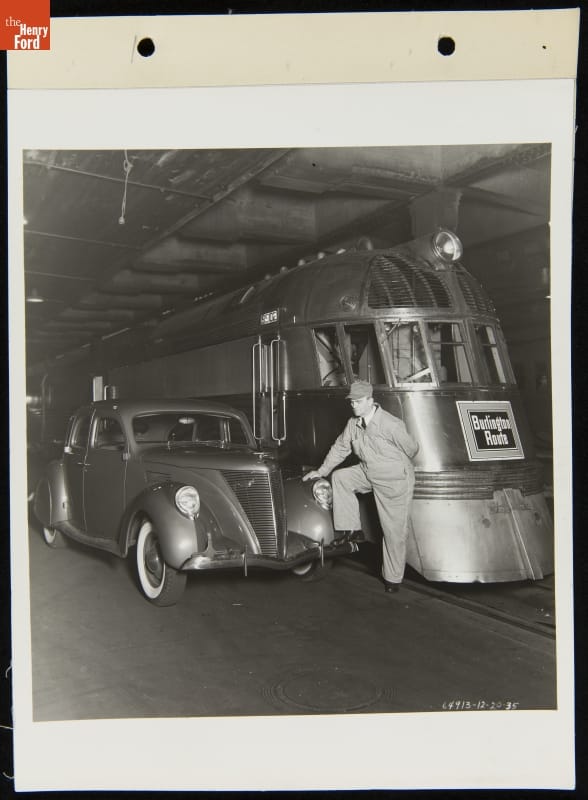
- Lincoln Zephyr Automobile with the Diesel-Powered "Burlington Zephyr" Streamlined Train, December 1935 - This publicity photo posed a Lincoln Zephyr automobile beside the Chicago, Burlington & Quincy Railroad's <em>Pioneer Zephyr</em>. In 1934 the streamlined train made a widely publicized run from Denver to Chicago in just over 13 hours, maintaining an average speed of 77 miles per hour. It's no coincidence that Lincoln gave its streamlined car, introduced in 1935, a similar name.
- December 20, 1935
- Collections - Artifact
Lincoln Zephyr Automobile with the Diesel-Powered "Burlington Zephyr" Streamlined Train, December 1935
This publicity photo posed a Lincoln Zephyr automobile beside the Chicago, Burlington & Quincy Railroad's Pioneer Zephyr. In 1934 the streamlined train made a widely publicized run from Denver to Chicago in just over 13 hours, maintaining an average speed of 77 miles per hour. It's no coincidence that Lincoln gave its streamlined car, introduced in 1935, a similar name.
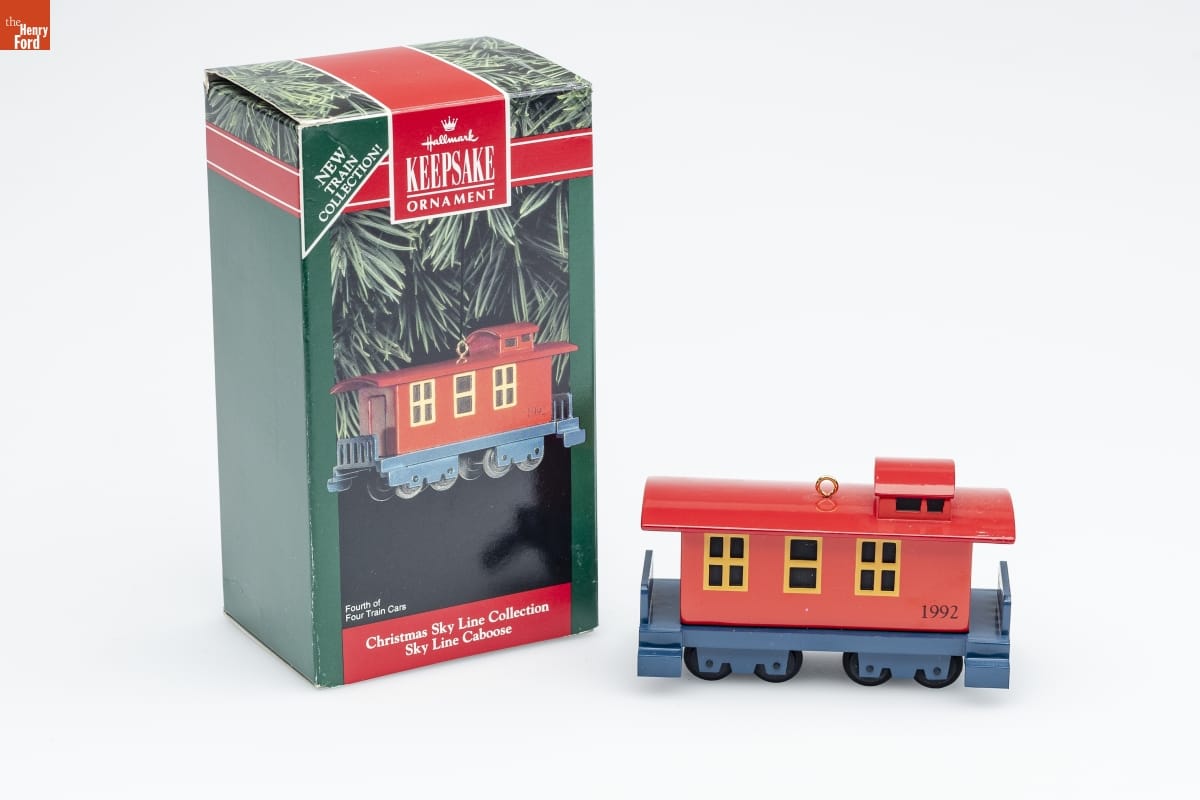
- Hallmark "Christmas Sky Line Collection: Sky Line Caboose" Christmas Ornament, 1992 - Already known for greeting cards, Hallmark introduced a line of Christmas ornaments in 1973. The company's annual release of an increasing array of ornaments revolutionized Christmas decorating, appealing to customers' interest in marking memories and milestones as well as expressing one's personality and unique tastes.
- 1992
- Collections - Artifact
Hallmark "Christmas Sky Line Collection: Sky Line Caboose" Christmas Ornament, 1992
Already known for greeting cards, Hallmark introduced a line of Christmas ornaments in 1973. The company's annual release of an increasing array of ornaments revolutionized Christmas decorating, appealing to customers' interest in marking memories and milestones as well as expressing one's personality and unique tastes.
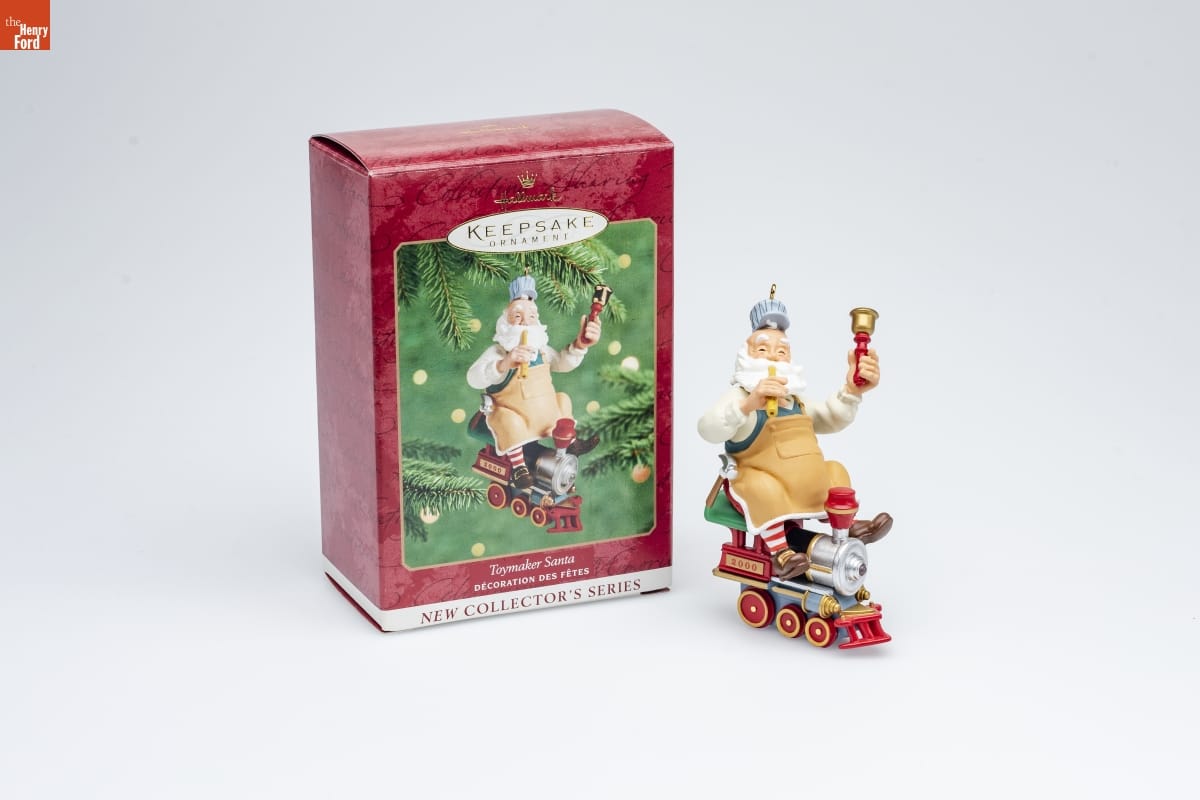
- Hallmark "Toymaker Santa Series" Christmas Ornament, 2000 - Already known for greeting cards, Hallmark introduced a line of Christmas ornaments in 1973. The company's annual release of an increasing array of ornaments revolutionized Christmas decorating, appealing to customers' interest in marking memories and milestones as well as expressing one's personality and unique tastes.
- 2000
- Collections - Artifact
Hallmark "Toymaker Santa Series" Christmas Ornament, 2000
Already known for greeting cards, Hallmark introduced a line of Christmas ornaments in 1973. The company's annual release of an increasing array of ornaments revolutionized Christmas decorating, appealing to customers' interest in marking memories and milestones as well as expressing one's personality and unique tastes.