
Search
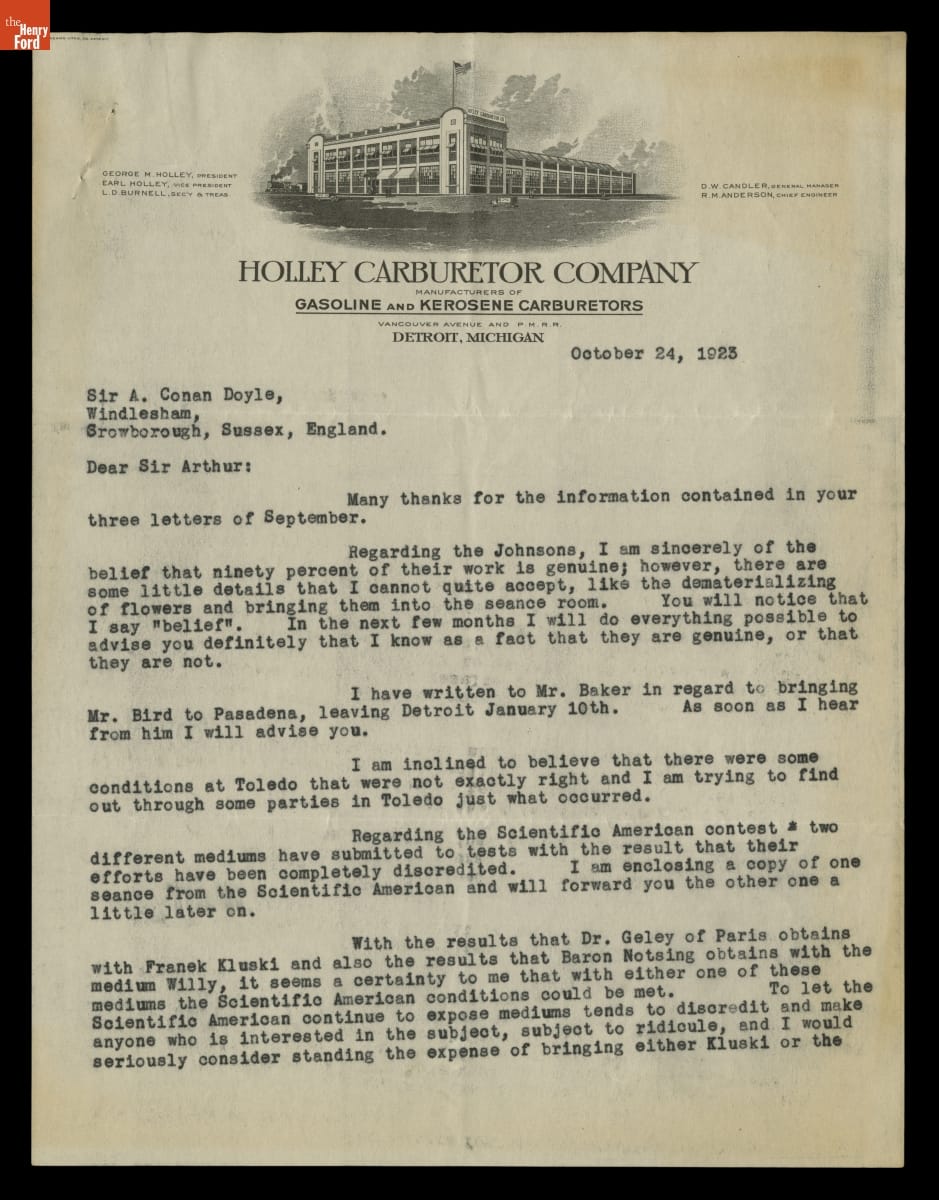
- Letter from George M. Holley to Arthur Conan Doyle, October 24, 1923 - George Holley, founder of Holley Motor Company, and Sir Arthur Conan Doyle, famed author, became acquainted after Holley attended one of Doyle's lectures in Detroit. From 1923 to 1929, the two maintained a robust correspondence. Spiritualism was a frequent topic as they traded recommendations of mediums, bemoaned skeptics like Harry Houdini, and discussed the state of belief on both sides of the Atlantic.
- October 24, 1923
- Collections - Artifact
Letter from George M. Holley to Arthur Conan Doyle, October 24, 1923
George Holley, founder of Holley Motor Company, and Sir Arthur Conan Doyle, famed author, became acquainted after Holley attended one of Doyle's lectures in Detroit. From 1923 to 1929, the two maintained a robust correspondence. Spiritualism was a frequent topic as they traded recommendations of mediums, bemoaned skeptics like Harry Houdini, and discussed the state of belief on both sides of the Atlantic.
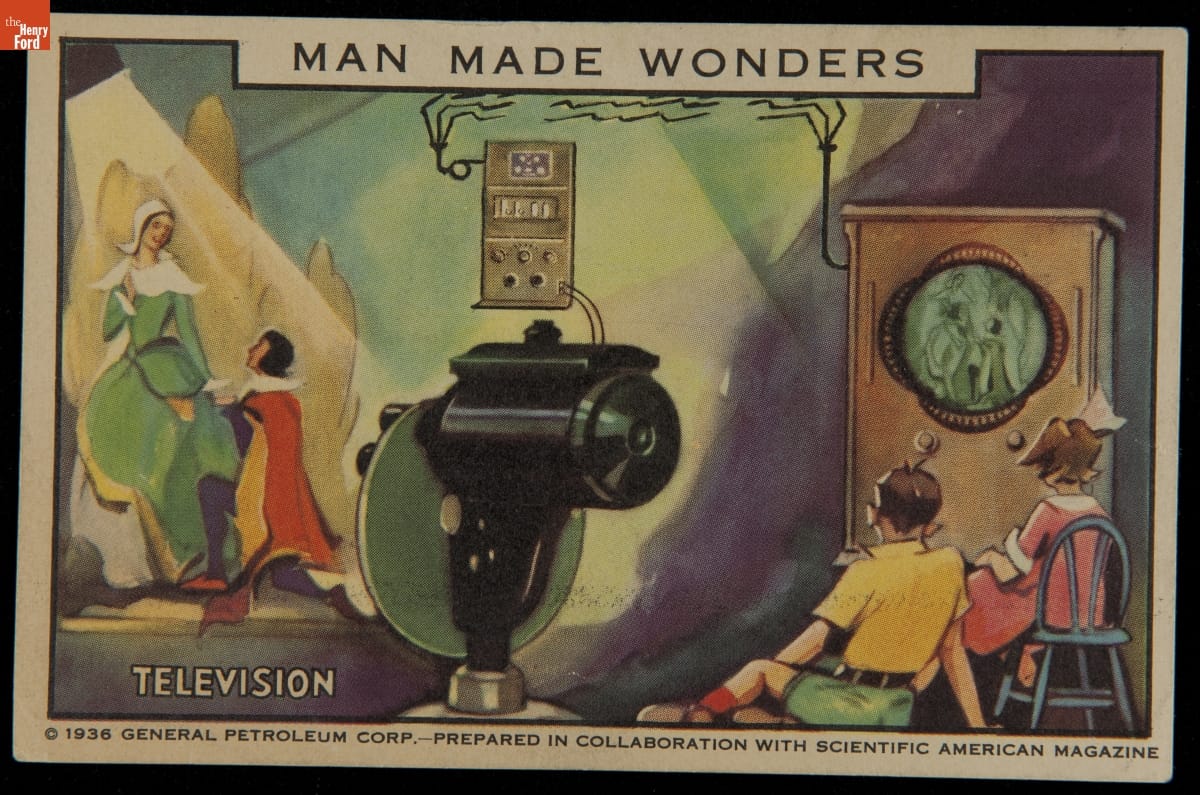
- Trade Card, "Man Made Wonders: Television," 1936 - In the last third of the nineteenth century, American consumers could choose from an unprecedented variety of goods and services. Seeking to distinguish certain products and businesses from the competition, advertisers began to print and distribute trade cards. Though the popularity of these cards diminished after 1900, some companies employed the informative, often vibrant little advertisements well into the twentieth century.
- 1936
- Collections - Artifact
Trade Card, "Man Made Wonders: Television," 1936
In the last third of the nineteenth century, American consumers could choose from an unprecedented variety of goods and services. Seeking to distinguish certain products and businesses from the competition, advertisers began to print and distribute trade cards. Though the popularity of these cards diminished after 1900, some companies employed the informative, often vibrant little advertisements well into the twentieth century.
- Scientific American, Bound Volume for July-December 1864, Vol. 11 - Massachusetts machinist Sylvester Roper patented a hot air engine that produced motion by harnessing the expansion and contraction of warming and cooling air. The December 3, 1864, issue of <em>Scientific American</em> described his engine. Roper also built at least seven steam-powered carriages and two steam-powered motorcycles years before automobiles -- as we know them -- appeared.

- 02 July 1864 - 24 December 1864
- Collections - Artifact
Scientific American, Bound Volume for July-December 1864, Vol. 11
Massachusetts machinist Sylvester Roper patented a hot air engine that produced motion by harnessing the expansion and contraction of warming and cooling air. The December 3, 1864, issue of Scientific American described his engine. Roper also built at least seven steam-powered carriages and two steam-powered motorcycles years before automobiles -- as we know them -- appeared.
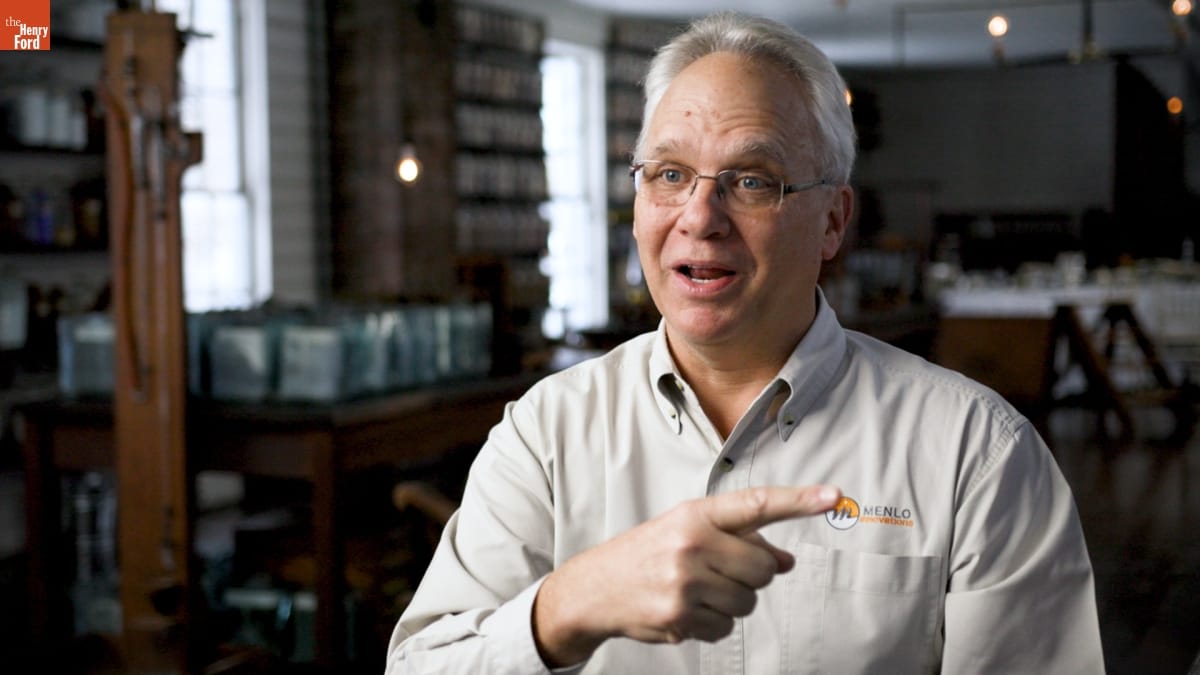
- "Finding Your Passion" Clip from Interview with Richard Sheridan, November 13, 2019 - Richard Sheridan, CEO and co-founder of Menlo Innovations, was the Fall 2019 Entrepreneur-in-Residence at The Henry Ford, funded by the William Davidson Foundation Initiative for Entrepreneurship. During his interview, Sheridan describes how his career experiences influenced the founding of his software company, where he embraces a unique approach to the office environment, emphasizing teamwork and encouraging joy in the workplace.
- November 13, 2019
- Collections - Artifact
"Finding Your Passion" Clip from Interview with Richard Sheridan, November 13, 2019
Richard Sheridan, CEO and co-founder of Menlo Innovations, was the Fall 2019 Entrepreneur-in-Residence at The Henry Ford, funded by the William Davidson Foundation Initiative for Entrepreneurship. During his interview, Sheridan describes how his career experiences influenced the founding of his software company, where he embraces a unique approach to the office environment, emphasizing teamwork and encouraging joy in the workplace.