
Search
- Montgomery Bus Boycott Scrapbook, November 1955 - April 1957 (Part 5 of 6) - These newspaper articles come from a scrapbook of newspaper clippings saved by Charles "Homer" Cummings, a Montgomery City bus lines manager. Together, these articles recount the story of the 381-day Montgomery bus boycott that was inspired by the arrest of Rosa Parks, who refused to give up her bus seat to a white man despite existing segregation laws.
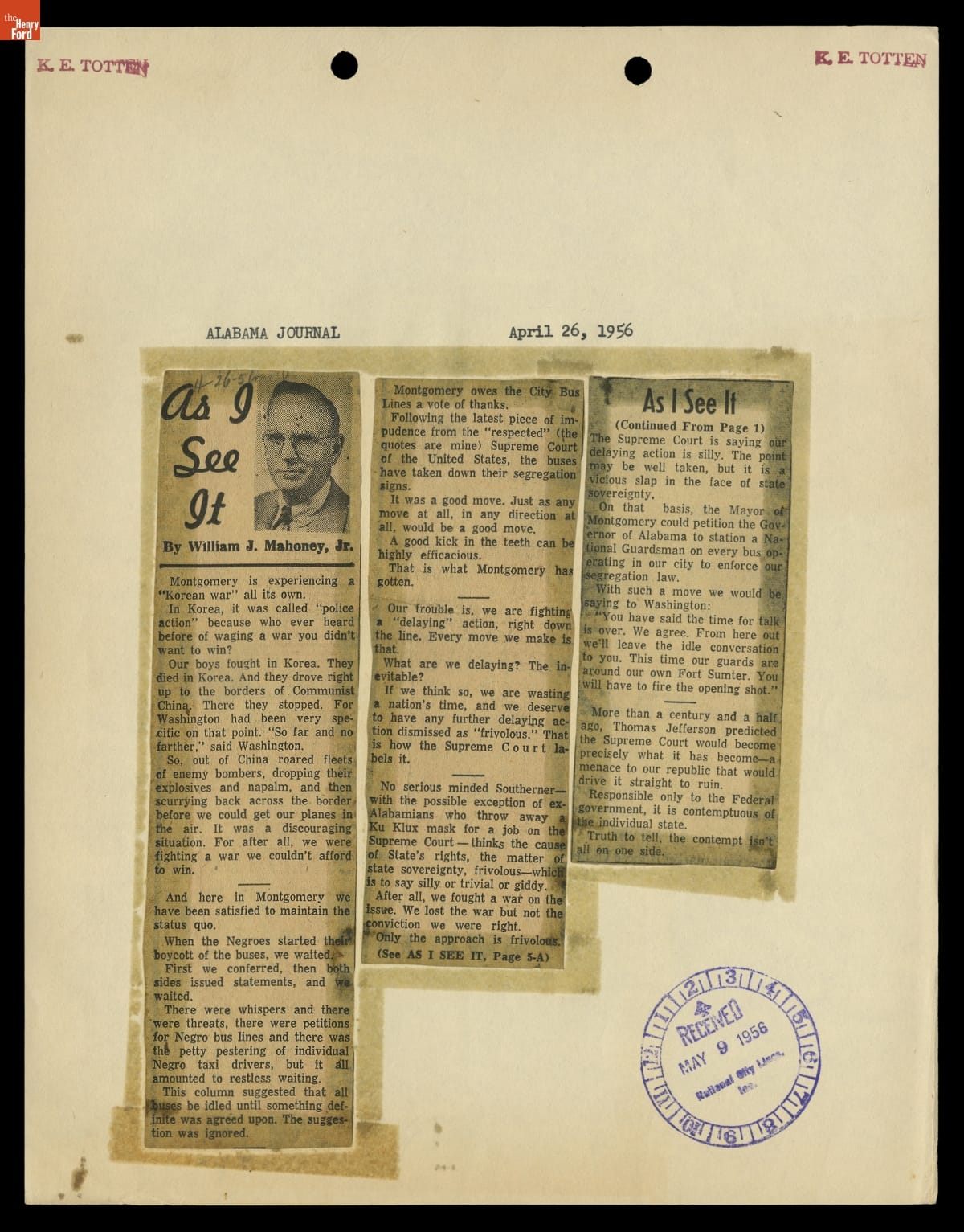
- June 1956-August 1956
- Collections - Artifact
Montgomery Bus Boycott Scrapbook, November 1955 - April 1957 (Part 5 of 6)
These newspaper articles come from a scrapbook of newspaper clippings saved by Charles "Homer" Cummings, a Montgomery City bus lines manager. Together, these articles recount the story of the 381-day Montgomery bus boycott that was inspired by the arrest of Rosa Parks, who refused to give up her bus seat to a white man despite existing segregation laws.
- Montgomery Bus Boycott Scrapbook, November 1955 - April 1957 (Part 6 of 6) - These newspaper articles come from a scrapbook of newspaper clippings saved by Charles "Homer" Cummings, a Montgomery City bus lines manager. Together, these articles recount the story of the 381-day Montgomery bus boycott that was inspired by the arrest of Rosa Parks, who refused to give up her bus seat to a white man despite existing segregation laws.
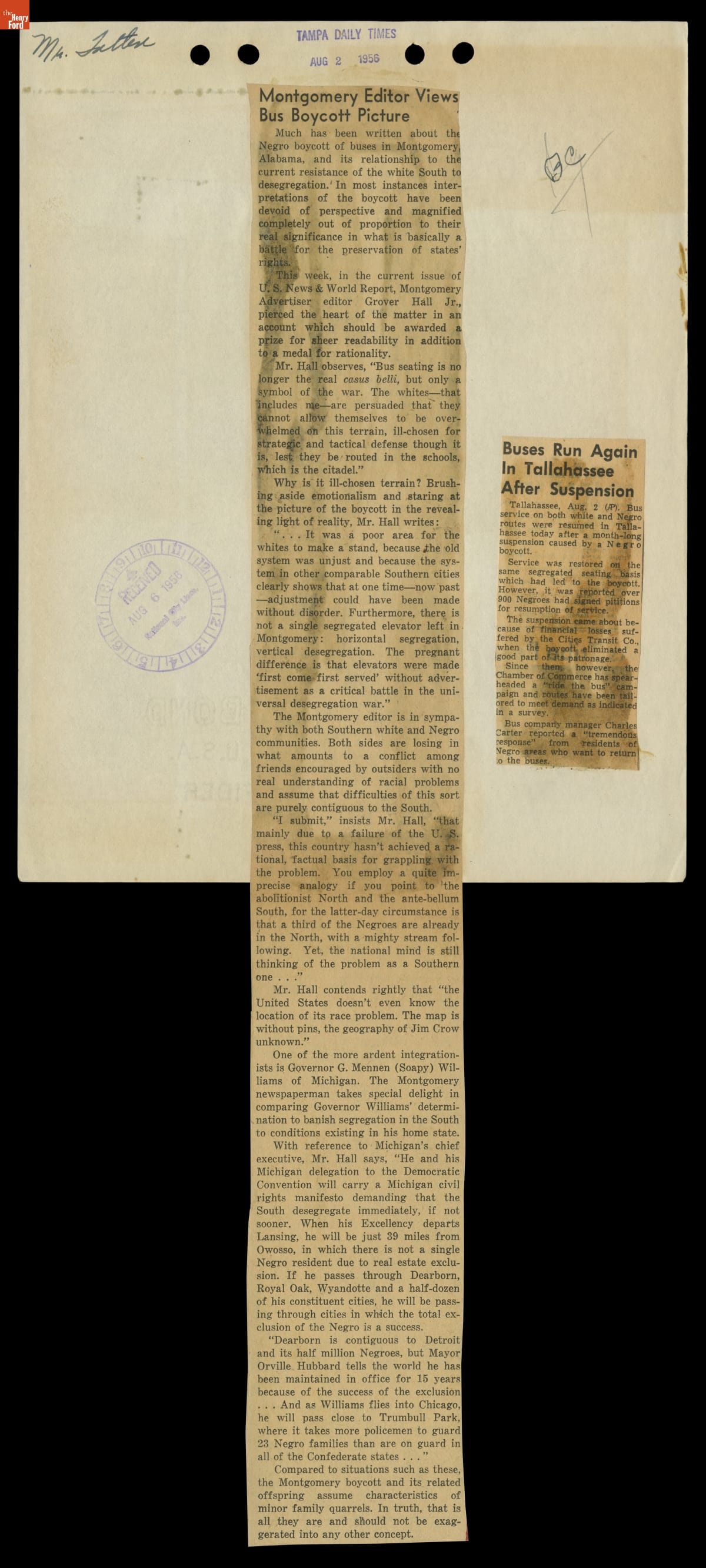
- October 1956-April 1957
- Collections - Artifact
Montgomery Bus Boycott Scrapbook, November 1955 - April 1957 (Part 6 of 6)
These newspaper articles come from a scrapbook of newspaper clippings saved by Charles "Homer" Cummings, a Montgomery City bus lines manager. Together, these articles recount the story of the 381-day Montgomery bus boycott that was inspired by the arrest of Rosa Parks, who refused to give up her bus seat to a white man despite existing segregation laws.
- "Jim Crow Guide to the U.S.A.," 1959 - Activist, folklorist and author Stetson Kennedy exposed American racism in his book <EM>Jim Crow Guide to the U.S.A.</EM> First published in France in 1956 -- he could find no American publisher to take on the project -- this mock guidebook uncovered the reach of Jim Crow inequality. Kennedy examined a number of areas including where one could live, work, travel, eat, sleep or study.
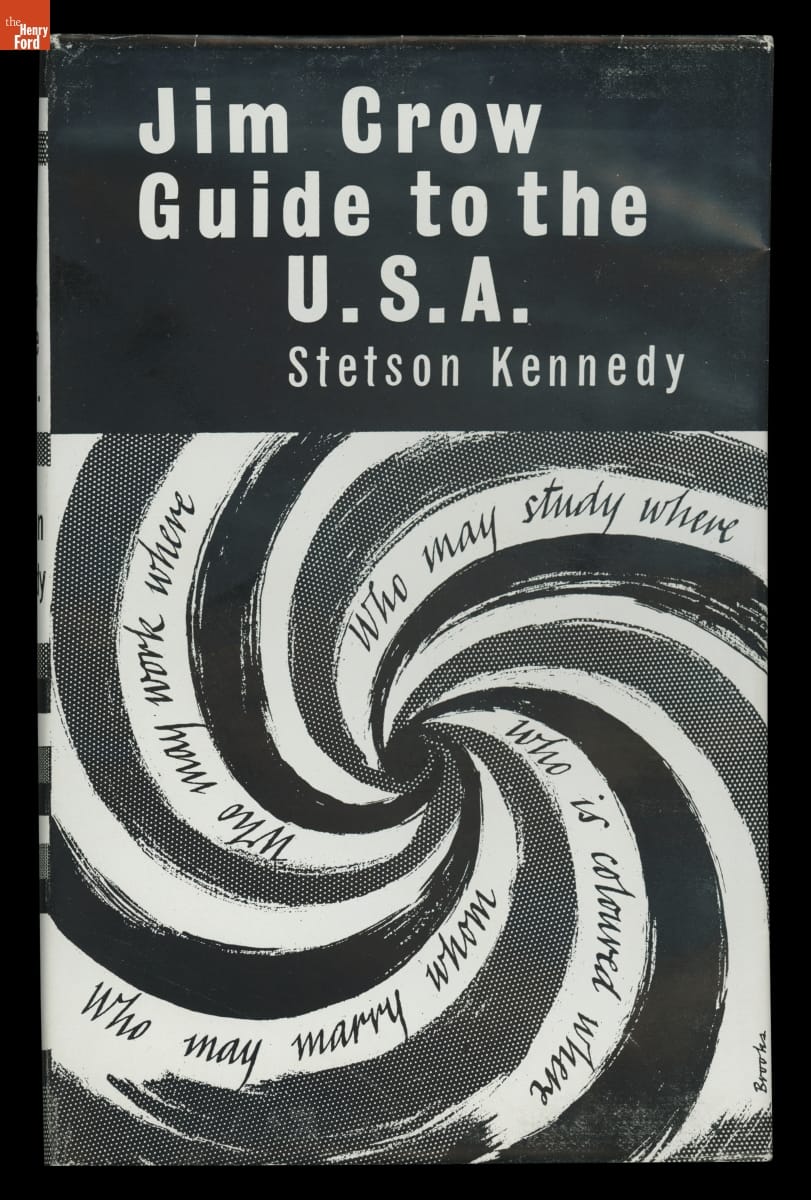
- 1959
- Collections - Artifact
"Jim Crow Guide to the U.S.A.," 1959
Activist, folklorist and author Stetson Kennedy exposed American racism in his book Jim Crow Guide to the U.S.A. First published in France in 1956 -- he could find no American publisher to take on the project -- this mock guidebook uncovered the reach of Jim Crow inequality. Kennedy examined a number of areas including where one could live, work, travel, eat, sleep or study.
- "I sat DOWN 2 STAND Up for courage" Mug, 2013 -

- December 01, 1955
- Collections - Artifact
"I sat DOWN 2 STAND Up for courage" Mug, 2013
- The Souls of Black Folk, 1996 - <body>William Edward Burghardt "W.E.B." Du Bois (1868-1963) was a writer, historian, sociologist, and activist. He explored the challenges Black Americans faced during the early 20th century in his 1903 book, <i>The</i> <i>Souls of Black Folk</i>. Du Bois's advocacy of social change through suffrage and civil rights contrasted with other thought leaders like Booker T. Washington. </body>
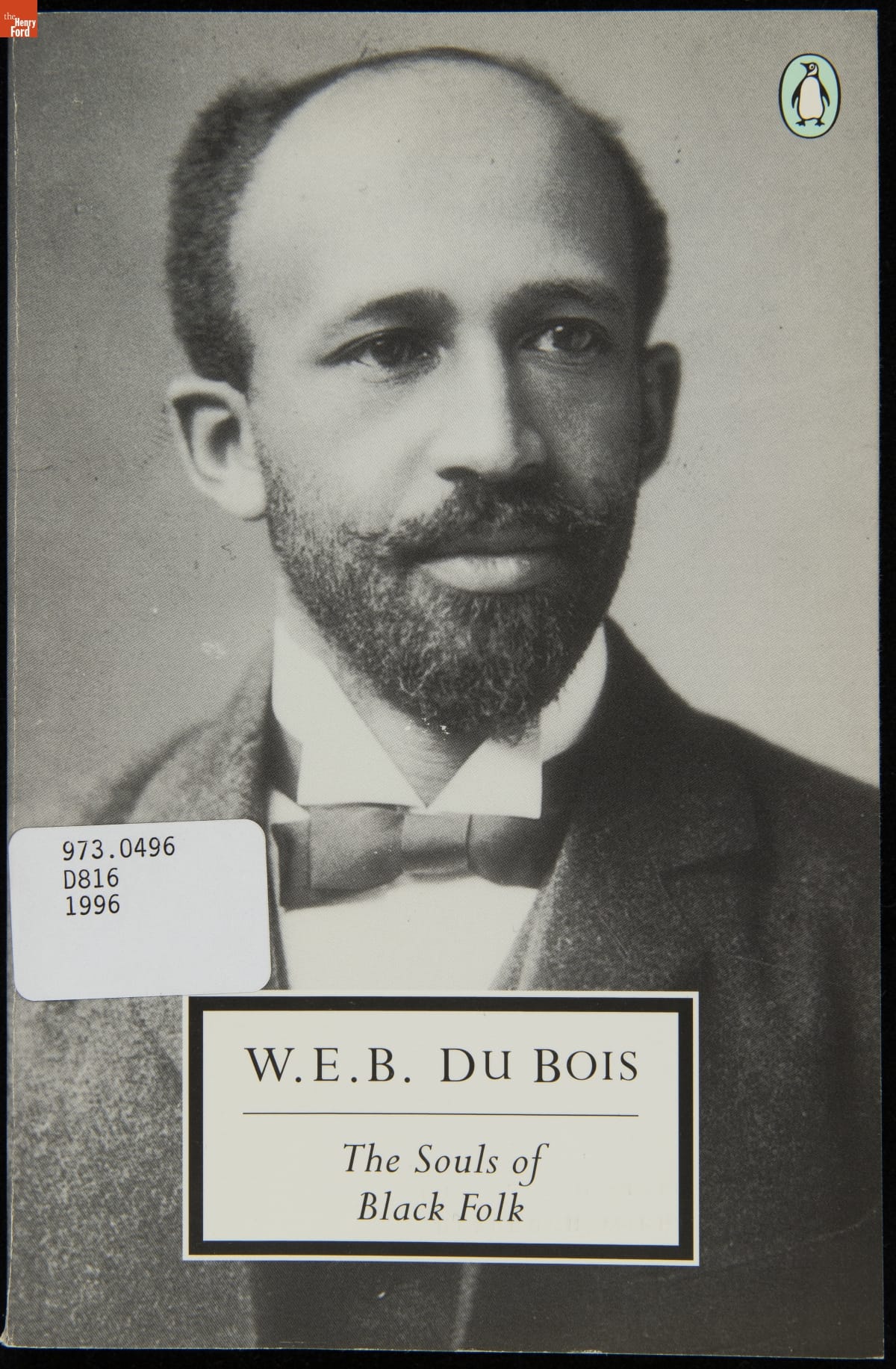
- 1996
- Collections - Artifact
The Souls of Black Folk, 1996
William Edward Burghardt "W.E.B." Du Bois (1868-1963) was a writer, historian, sociologist, and activist. He explored the challenges Black Americans faced during the early 20th century in his 1903 book, The Souls of Black Folk. Du Bois's advocacy of social change through suffrage and civil rights contrasted with other thought leaders like Booker T. Washington. - Montgomery Bus Boycott Scrapbook, November 1955 - April 1957 (Part 2 of 6) - These newspaper articles come from a scrapbook of newspaper clippings saved by Charles "Homer" Cummings, a Montgomery City bus lines manager. Together, these articles recount the story of the 381-day Montgomery bus boycott that was inspired by the arrest of Rosa Parks, who refused to give up her bus seat to a white man despite existing segregation laws.
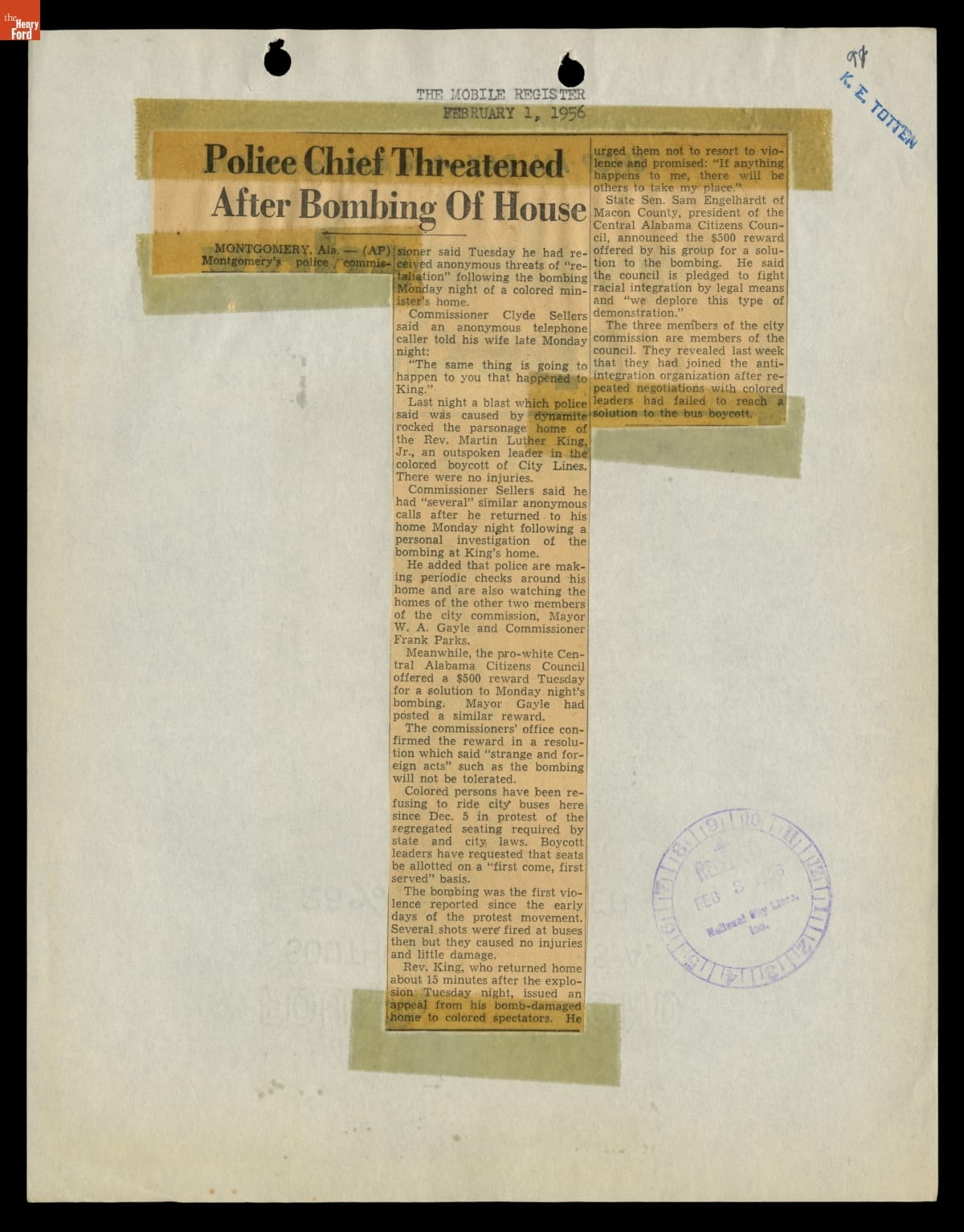
- February 01, 1956
- Collections - Artifact
Montgomery Bus Boycott Scrapbook, November 1955 - April 1957 (Part 2 of 6)
These newspaper articles come from a scrapbook of newspaper clippings saved by Charles "Homer" Cummings, a Montgomery City bus lines manager. Together, these articles recount the story of the 381-day Montgomery bus boycott that was inspired by the arrest of Rosa Parks, who refused to give up her bus seat to a white man despite existing segregation laws.
- Montgomery Bus Boycott Scrapbook, November 1955 - April 1957 (Part 3 of 6) - These newspaper articles come from a scrapbook of newspaper clippings saved by Charles "Homer" Cummings, a Montgomery City bus lines manager. Together, these articles recount the story of the 381-day Montgomery bus boycott that was inspired by the arrest of Rosa Parks, who refused to give up her bus seat to a white man despite existing segregation laws.
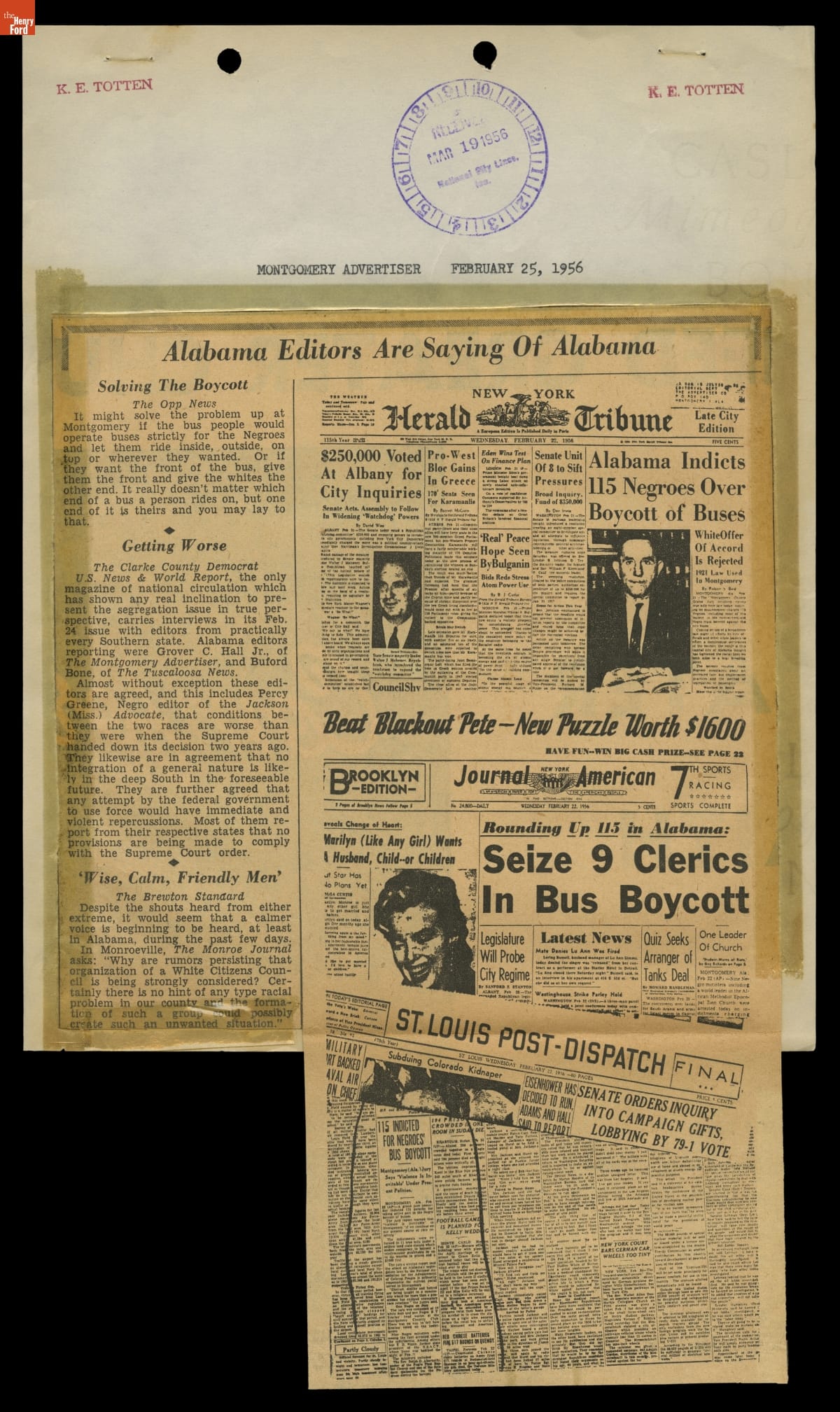
- March 01, 1956
- Collections - Artifact
Montgomery Bus Boycott Scrapbook, November 1955 - April 1957 (Part 3 of 6)
These newspaper articles come from a scrapbook of newspaper clippings saved by Charles "Homer" Cummings, a Montgomery City bus lines manager. Together, these articles recount the story of the 381-day Montgomery bus boycott that was inspired by the arrest of Rosa Parks, who refused to give up her bus seat to a white man despite existing segregation laws.
- Magazine, "Our Sports, The Negro's Own Sports Magazine," May 1953 - This magazine, billed as the "Negro's Own Sports Magazine," ran for five issues in 1953. Jackie Robinson, the first African American to play major league baseball, was ostensibly the editor. At this time, African-American athletes were becoming involved in every major spectator sport. The cover features Larry Doby, who, in 1947, became the first African-American player to integrate baseball's American League.
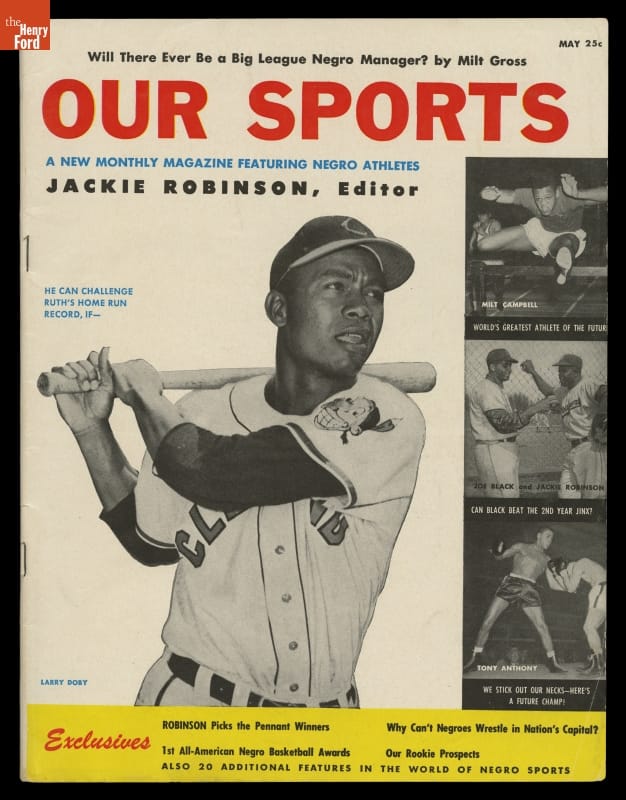
- May 01, 1953
- Collections - Artifact
Magazine, "Our Sports, The Negro's Own Sports Magazine," May 1953
This magazine, billed as the "Negro's Own Sports Magazine," ran for five issues in 1953. Jackie Robinson, the first African American to play major league baseball, was ostensibly the editor. At this time, African-American athletes were becoming involved in every major spectator sport. The cover features Larry Doby, who, in 1947, became the first African-American player to integrate baseball's American League.
- Congress of Racial Equality Handbill, "Don't Buy at Woolworth," 1960 - In 1960, four African-American students sat down at a Woolworth lunch counter in Greensboro, North Carolina, and were refused service. This poster, produced by the Congress on Racial Equality (CORE), urged Americans to boycott the national five-and-dime chain. It was hoped that the loss of customer dollars would spur company officials to end the segregationist policies found in its southern stores.

- 1960
- Collections - Artifact
Congress of Racial Equality Handbill, "Don't Buy at Woolworth," 1960
In 1960, four African-American students sat down at a Woolworth lunch counter in Greensboro, North Carolina, and were refused service. This poster, produced by the Congress on Racial Equality (CORE), urged Americans to boycott the national five-and-dime chain. It was hoped that the loss of customer dollars would spur company officials to end the segregationist policies found in its southern stores.
- Press Release on the Birmingham Campaign, May 10, 1963 -
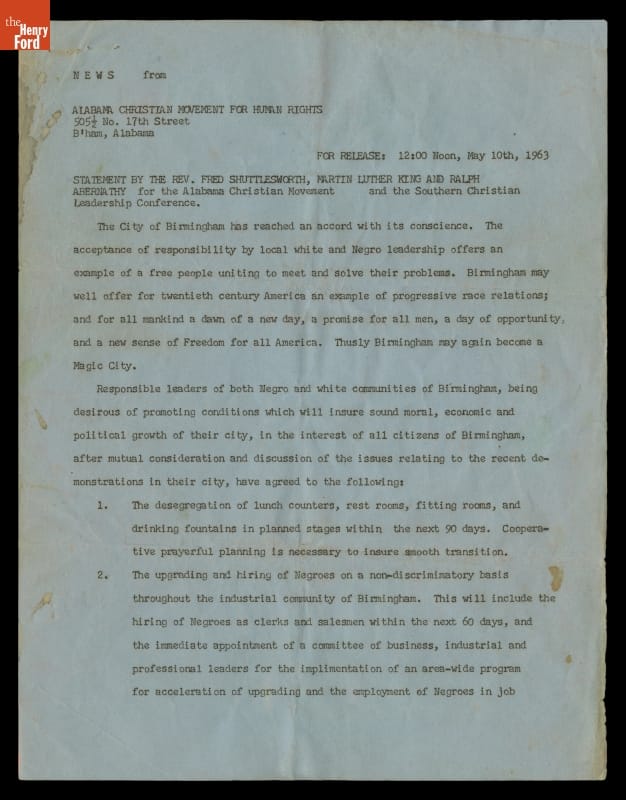
- May 10, 1963
- Collections - Artifact
Press Release on the Birmingham Campaign, May 10, 1963