
Search
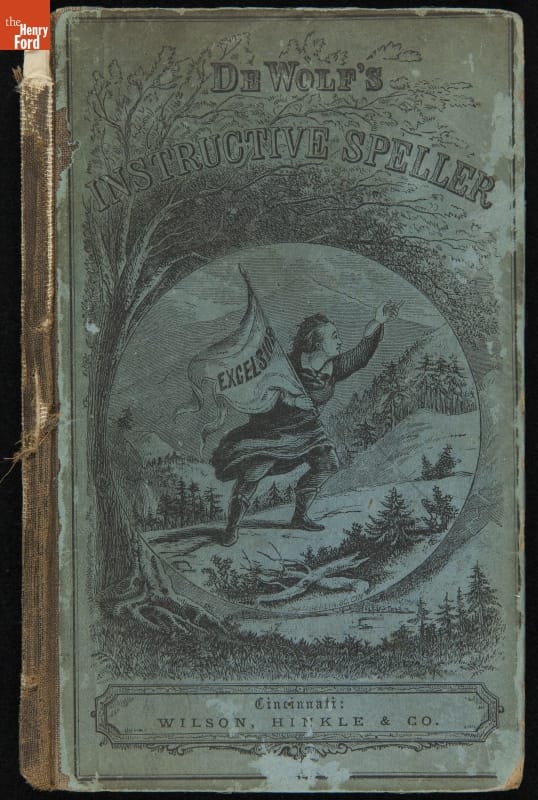
- Book Used by Wilbur Wright, "DeWolf's Instructive Speller" - Milton and Susan Wright encouraged an interest in learning in their children Reuchlin, Lorin, Wilbur, Orville, and Katharine -- though not necessarily in formal education. Katharine was the only Wright child to finish college, graduating from Oberlin in 1898. Neither Wilbur nor Orville finished high school, but they learned much from their father's extensive home library.
- 1862
- Collections - Artifact
Book Used by Wilbur Wright, "DeWolf's Instructive Speller"
Milton and Susan Wright encouraged an interest in learning in their children Reuchlin, Lorin, Wilbur, Orville, and Katharine -- though not necessarily in formal education. Katharine was the only Wright child to finish college, graduating from Oberlin in 1898. Neither Wilbur nor Orville finished high school, but they learned much from their father's extensive home library.
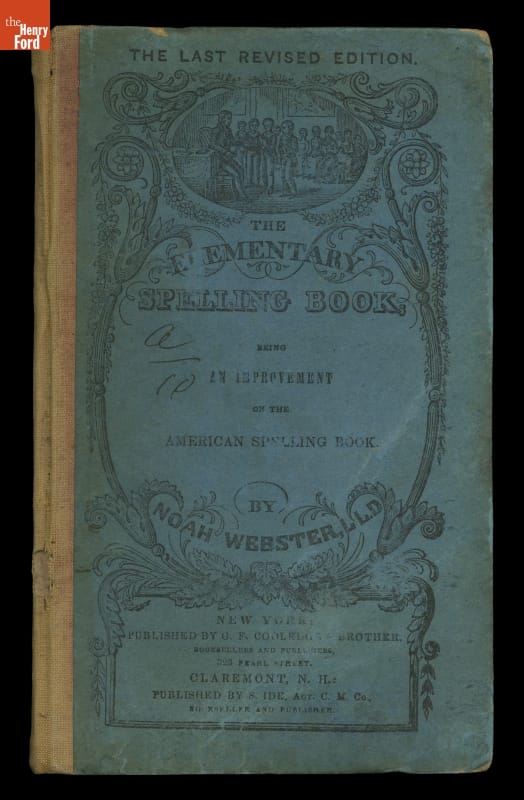
- "The Elementary Spelling Book; Being an Improvement on the American Spelling Book by Noah Webster," circa 1848 - Noah Webster's speller offered simple guidelines for spelling and pronouncing American English words. Age-appropriate lessons taught schoolchildren to read and write, helping to define and unify American language. Known by its colored cover, Webster's "blue-backed speller" remained popular for more than 100 years. It sold so well that Webster was able to construct his New Haven, Connecticut, home using the proceeds.
- circa 1848
- Collections - Artifact
"The Elementary Spelling Book; Being an Improvement on the American Spelling Book by Noah Webster," circa 1848
Noah Webster's speller offered simple guidelines for spelling and pronouncing American English words. Age-appropriate lessons taught schoolchildren to read and write, helping to define and unify American language. Known by its colored cover, Webster's "blue-backed speller" remained popular for more than 100 years. It sold so well that Webster was able to construct his New Haven, Connecticut, home using the proceeds.
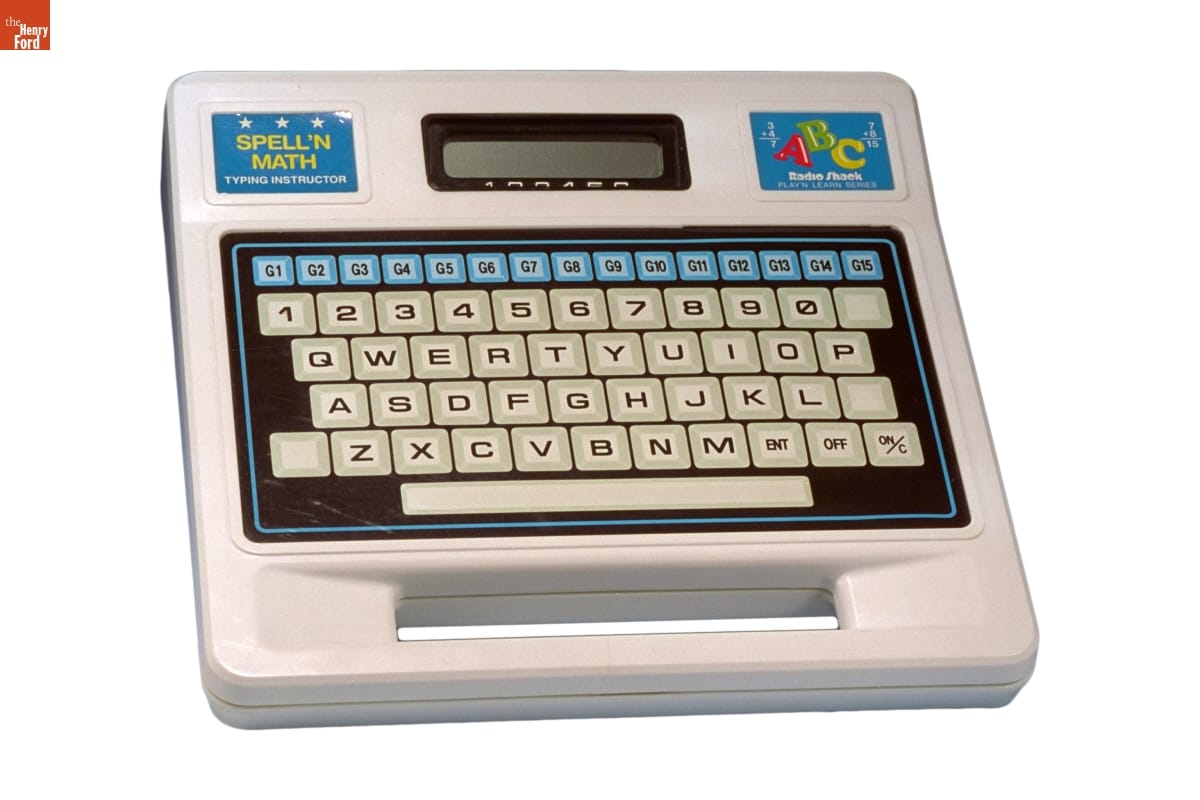
- Radio Shack Spell 'N Math, circa 1978 - This Spell 'N Math toy -- from Radio Shack's "Play'n Learn" line of portable electronic games -- quizzes children on spelling and math through different pre-programmed games. The keyboard helps familiarize them with the QWERTY layout that is standard on English-language typewriters and computers.
- circa 1978
- Collections - Artifact
Radio Shack Spell 'N Math, circa 1978
This Spell 'N Math toy -- from Radio Shack's "Play'n Learn" line of portable electronic games -- quizzes children on spelling and math through different pre-programmed games. The keyboard helps familiarize them with the QWERTY layout that is standard on English-language typewriters and computers.
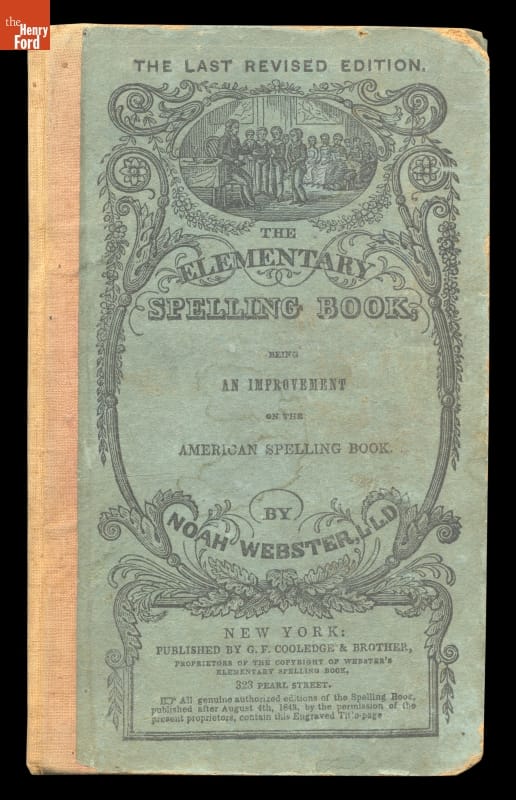
- The Elementary Spelling Book by Noah Webster, circa 1845 - Noah Webster's speller offered simple guidelines for spelling and pronouncing American English words. Age-appropriate lessons taught schoolchildren to read and write, helping to define and unify American language. Known by its colored cover, Webster's "blue-backed speller" remained popular for more than 100 years. It sold so well that Webster was able to construct his New Haven, Connecticut, home using the proceeds.
- circa 1845
- Collections - Artifact
The Elementary Spelling Book by Noah Webster, circa 1845
Noah Webster's speller offered simple guidelines for spelling and pronouncing American English words. Age-appropriate lessons taught schoolchildren to read and write, helping to define and unify American language. Known by its colored cover, Webster's "blue-backed speller" remained popular for more than 100 years. It sold so well that Webster was able to construct his New Haven, Connecticut, home using the proceeds.
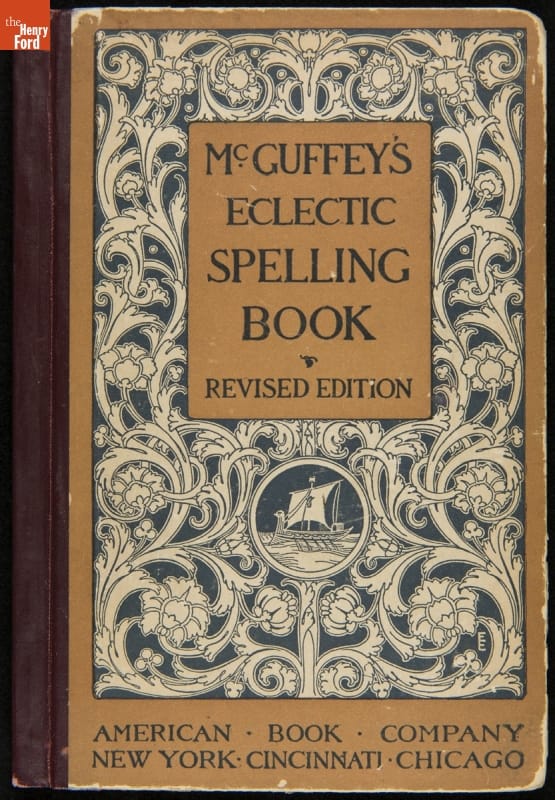
- "McGuffey's Eclectic Spelling Book," Revised Edition, 1907 -
- 1907
- Collections - Artifact
"McGuffey's Eclectic Spelling Book," Revised Edition, 1907
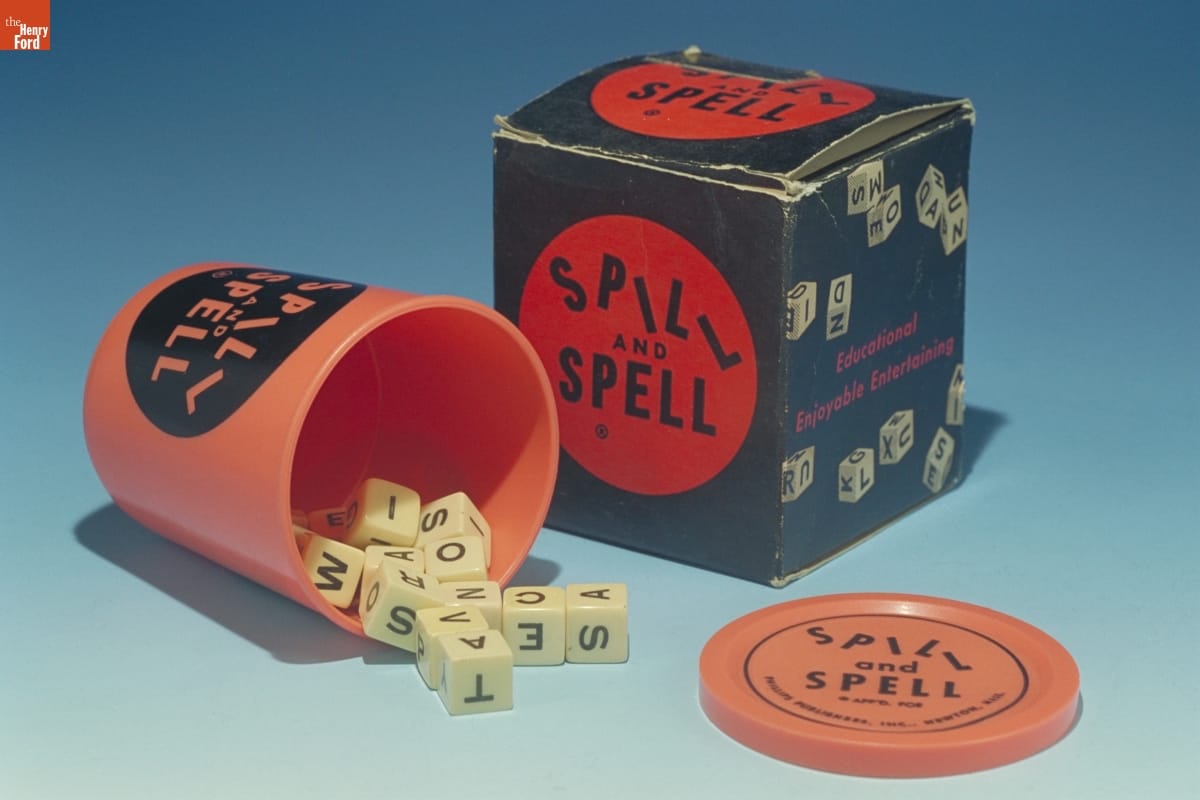
- Spill and Spell Dice Game, 1957 - Spill and Spell is competitive. Players take turns spilling fifteen lettered cubes and spelling out words from the upturned letters. Complex scoring requires addition and multiplication skills. The longer the word, the more points, and words that intersect like a crossword puzzle double the score. The first player to earn 300 points wins!
- 1957
- Collections - Artifact
Spill and Spell Dice Game, 1957
Spill and Spell is competitive. Players take turns spilling fifteen lettered cubes and spelling out words from the upturned letters. Complex scoring requires addition and multiplication skills. The longer the word, the more points, and words that intersect like a crossword puzzle double the score. The first player to earn 300 points wins!
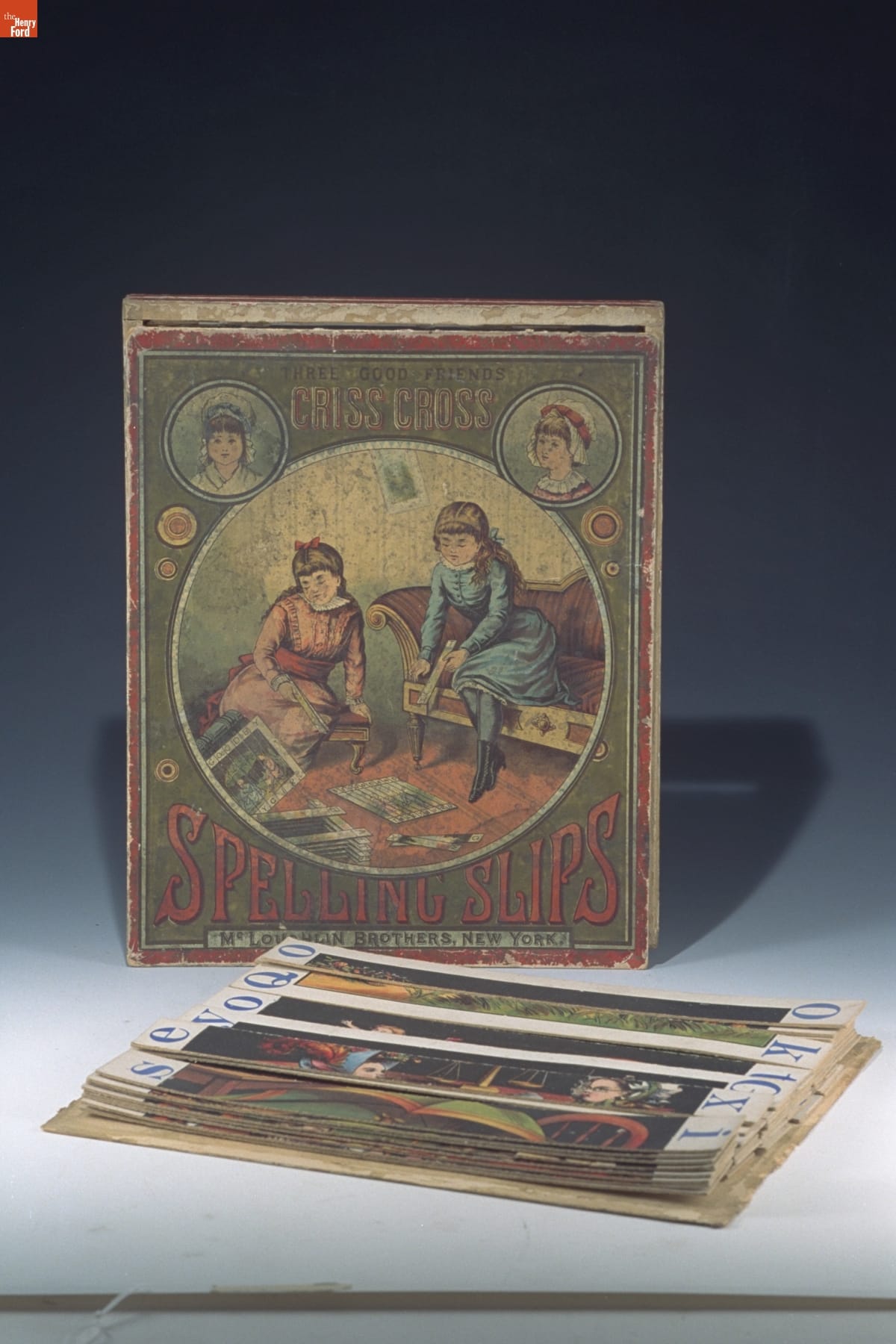
- Puzzle, "Criss Cross Spelling Slips," 1880-1890 - Using pioneering color printing technology, McLoughlin Brothers became a leading publisher of children's books by about 1870. The company also produced blocks, alphabet cards, games, and puzzles. Children playing "Criss Cross Spelling Strips" used slips to assemble picture puzzles. When complete, letters on the end spelled out phrases related to the scene. As well as spelling puzzle pieces, the strips doubled as stackable building toys.
- 1880-1890
- Collections - Artifact
Puzzle, "Criss Cross Spelling Slips," 1880-1890
Using pioneering color printing technology, McLoughlin Brothers became a leading publisher of children's books by about 1870. The company also produced blocks, alphabet cards, games, and puzzles. Children playing "Criss Cross Spelling Strips" used slips to assemble picture puzzles. When complete, letters on the end spelled out phrases related to the scene. As well as spelling puzzle pieces, the strips doubled as stackable building toys.
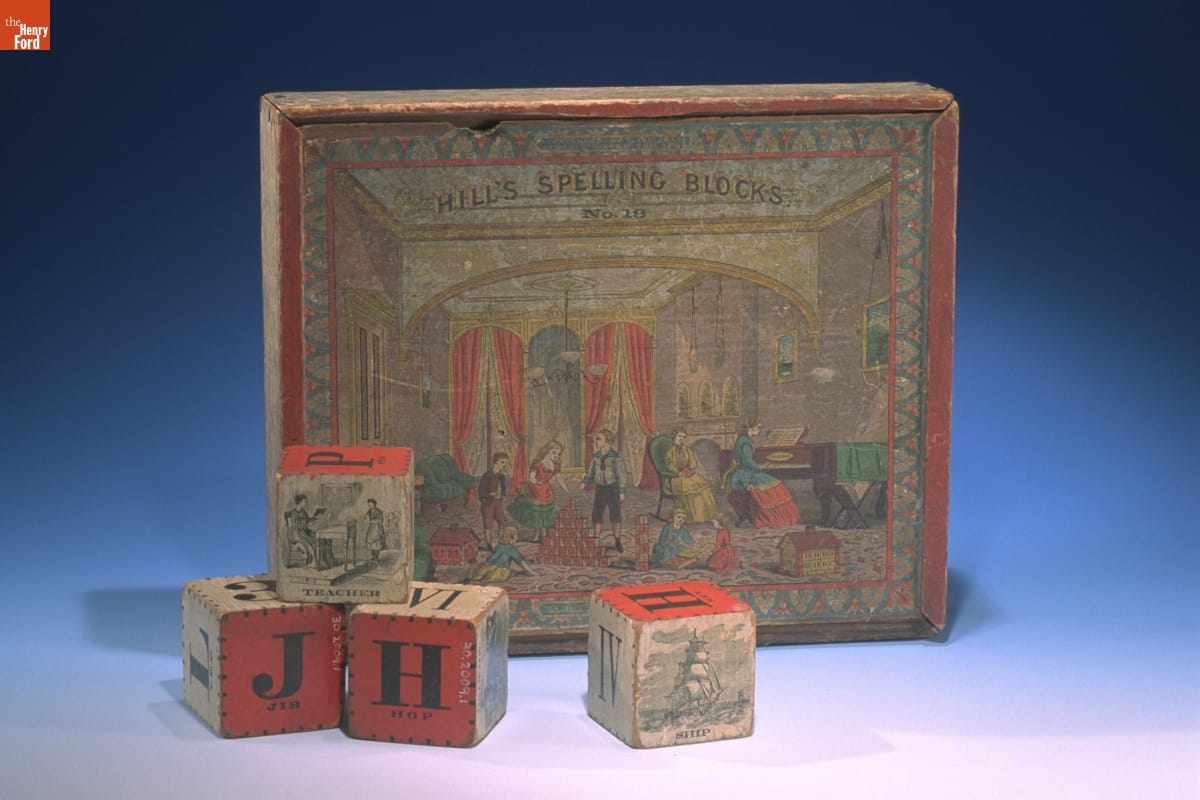
- Hill's Spelling Blocks, 1867-1880 - There have always been toys intended to have an "instructive" purpose. Educational toys for young children taught concepts like learning letters and numbers as well as telling time. S.L. Hill was the first manufacturer in the United States to produce blocks in great quantity. The blocks in this set contain numbers, letters, and pictures.
- 1867-1880
- Collections - Artifact
Hill's Spelling Blocks, 1867-1880
There have always been toys intended to have an "instructive" purpose. Educational toys for young children taught concepts like learning letters and numbers as well as telling time. S.L. Hill was the first manufacturer in the United States to produce blocks in great quantity. The blocks in this set contain numbers, letters, and pictures.
- Junior Spelling and Number Board, 1940-1950 - The Junior Spelling and Number Board challenged users to locate letters, numerals, or symbols on a track, then slide them along to complete phrases in the center. On the other side, users could add, subtract, multiply, and divide with single- and multi-digit numerals. Playful images and words around the outside reinforced learning.

- 1940-1950
- Collections - Artifact
Junior Spelling and Number Board, 1940-1950
The Junior Spelling and Number Board challenged users to locate letters, numerals, or symbols on a track, then slide them along to complete phrases in the center. On the other side, users could add, subtract, multiply, and divide with single- and multi-digit numerals. Playful images and words around the outside reinforced learning.
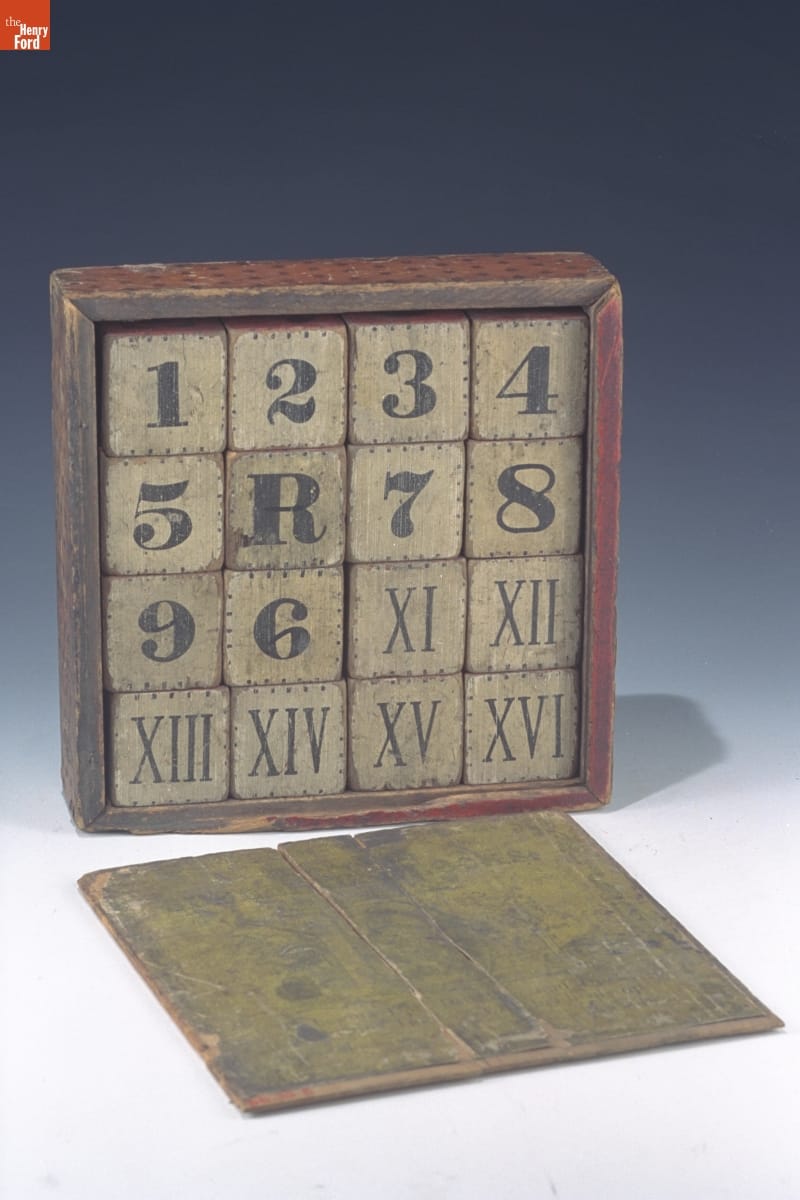
- Alphabet Blocks, 1867-1875 - Mid-nineteenth-century companies drew on new technologies to produce and distribute inexpensive toys. In 1858, New York firm S. L. Hill patented "a new and Improved Spelling-Block" with imagery applied directly to the wood. Hill became the first American manufacturer to mass produce toy alphabet blocks. These popular toys helped children learn letters and numbers and practice spelling. They also served as stackable building blocks.
- 1867-1875
- Collections - Artifact
Alphabet Blocks, 1867-1875
Mid-nineteenth-century companies drew on new technologies to produce and distribute inexpensive toys. In 1858, New York firm S. L. Hill patented "a new and Improved Spelling-Block" with imagery applied directly to the wood. Hill became the first American manufacturer to mass produce toy alphabet blocks. These popular toys helped children learn letters and numbers and practice spelling. They also served as stackable building blocks.