
Search
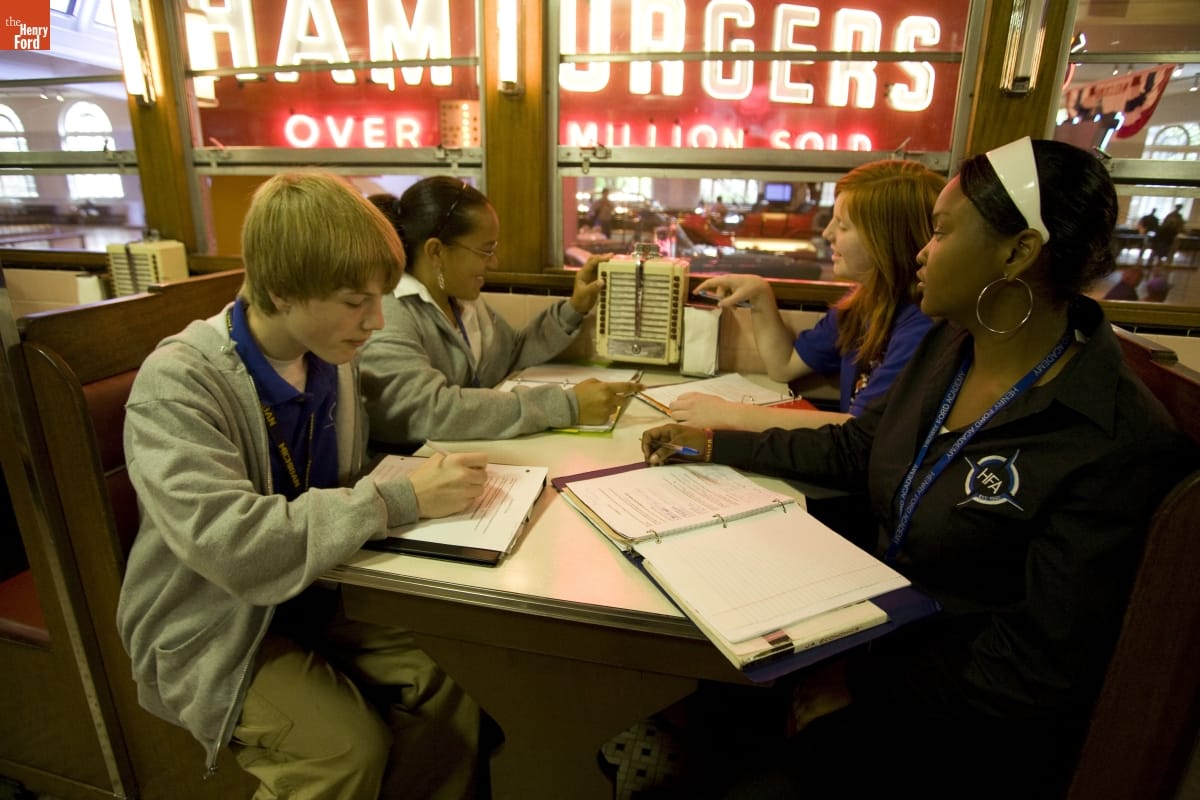
- Henry Ford Academy Students in Lamy's Diner in Henry Ford Museum, October 2007 - Henry Ford Academy, a charter high school on the campus of The Henry Ford, opened in 1997. These students were photographed having a lesson in Lamy's Diner, inside Henry Ford Museum, in October 2007.
- October 01, 2007
- Collections - Artifact
Henry Ford Academy Students in Lamy's Diner in Henry Ford Museum, October 2007
Henry Ford Academy, a charter high school on the campus of The Henry Ford, opened in 1997. These students were photographed having a lesson in Lamy's Diner, inside Henry Ford Museum, in October 2007.
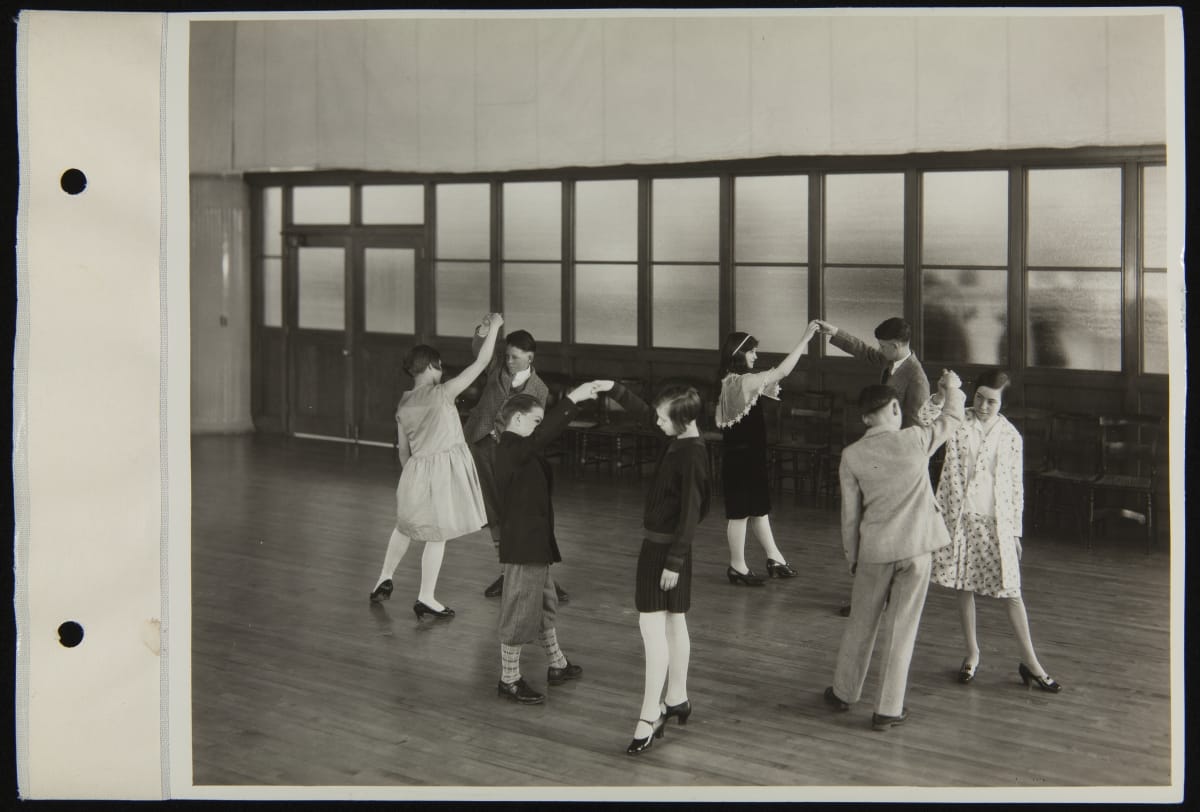
- Edison Institute School Students in the Dance Room of Ford Engineering Laboratory, May 1929 - Henry Ford created a room for dancing at Ford Motor Company's Engineering Lab, where his office and the company's engineering activities were located. These students are learning the traditional American dances of Henry Ford's youth -- along with dance etiquette. Later, Ford built Lovett Hall, an elegant ballroom named for his dancing master.
- May 11, 1929
- Collections - Artifact
Edison Institute School Students in the Dance Room of Ford Engineering Laboratory, May 1929
Henry Ford created a room for dancing at Ford Motor Company's Engineering Lab, where his office and the company's engineering activities were located. These students are learning the traditional American dances of Henry Ford's youth -- along with dance etiquette. Later, Ford built Lovett Hall, an elegant ballroom named for his dancing master.
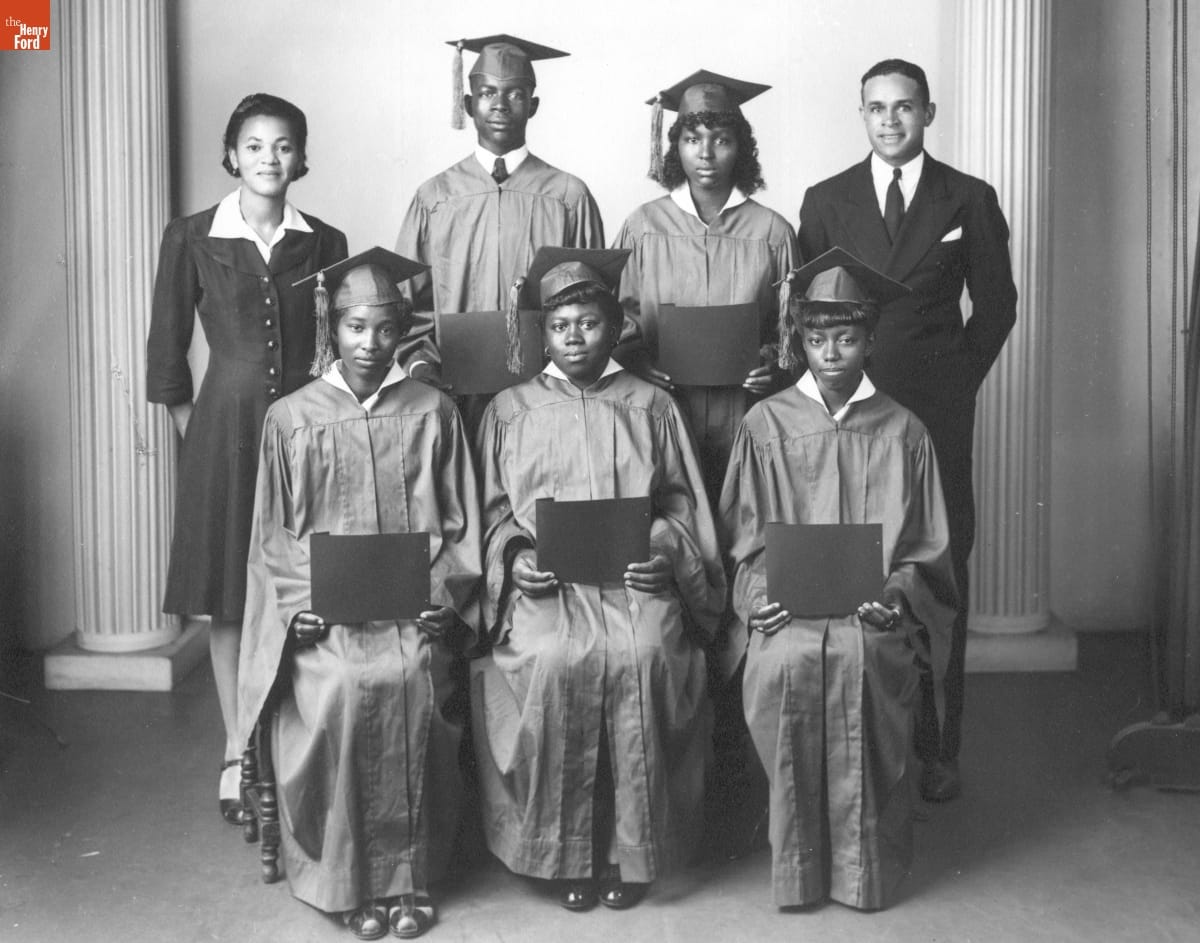
- Graduating Students and Teachers at George Washington Carver School, Richmond Hill, Georgia, 1945 - Henry Ford purchased vast amounts of land around present-day Richmond Hill, Georgia, beginning in the 1920s. After acquiring the property, Ford became interested in the economic and civic improvement of the area. He built schools, churches, and community centers. In 1939, Ford founded the George Washington Carver School. This image shows the 1945 graduating class and their teachers.
- June 01, 1945
- Collections - Artifact
Graduating Students and Teachers at George Washington Carver School, Richmond Hill, Georgia, 1945
Henry Ford purchased vast amounts of land around present-day Richmond Hill, Georgia, beginning in the 1920s. After acquiring the property, Ford became interested in the economic and civic improvement of the area. He built schools, churches, and community centers. In 1939, Ford founded the George Washington Carver School. This image shows the 1945 graduating class and their teachers.
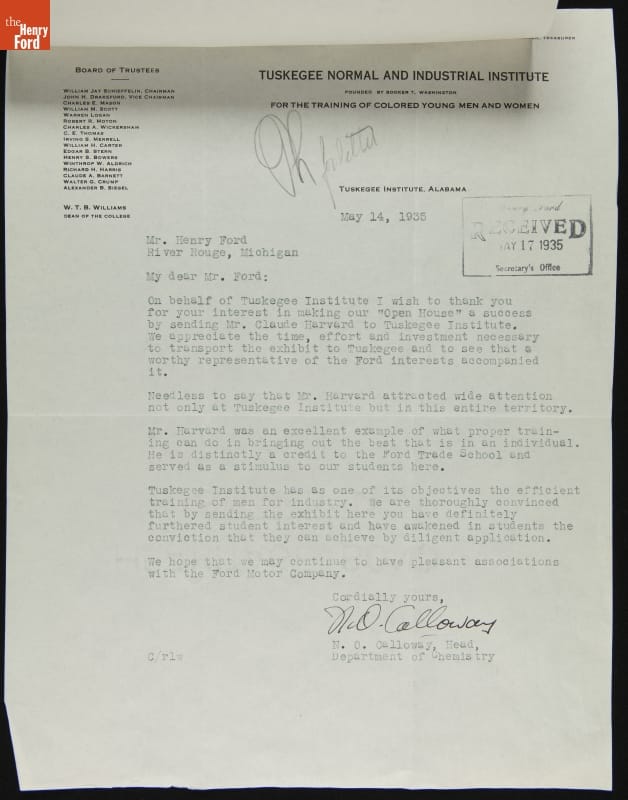
- Correspondence between Frank Campsall (for Henry Ford) and N. O. Calloway regarding Claude Harvard's Visit to Tuskegee Institute, May 1935 -
- 14 May 1935-27 May 1935
- Collections - Artifact
Correspondence between Frank Campsall (for Henry Ford) and N. O. Calloway regarding Claude Harvard's Visit to Tuskegee Institute, May 1935
- Jennifer O'Hare in Her Prom Dress, May 13, 2006 - Proms are a much-anticipated milestone for many teenagers. High school students dress up in their most glamorous formal clothing to enjoy the prom. And for teen girls, choosing the perfect dress is key to the experience -- even when a compromise is required. Jennifer O'Hare preferred a backless dress but chose one acceptable to her mother, who helped pay for the gown.

- May 13, 2006
- Collections - Artifact
Jennifer O'Hare in Her Prom Dress, May 13, 2006
Proms are a much-anticipated milestone for many teenagers. High school students dress up in their most glamorous formal clothing to enjoy the prom. And for teen girls, choosing the perfect dress is key to the experience -- even when a compromise is required. Jennifer O'Hare preferred a backless dress but chose one acceptable to her mother, who helped pay for the gown.
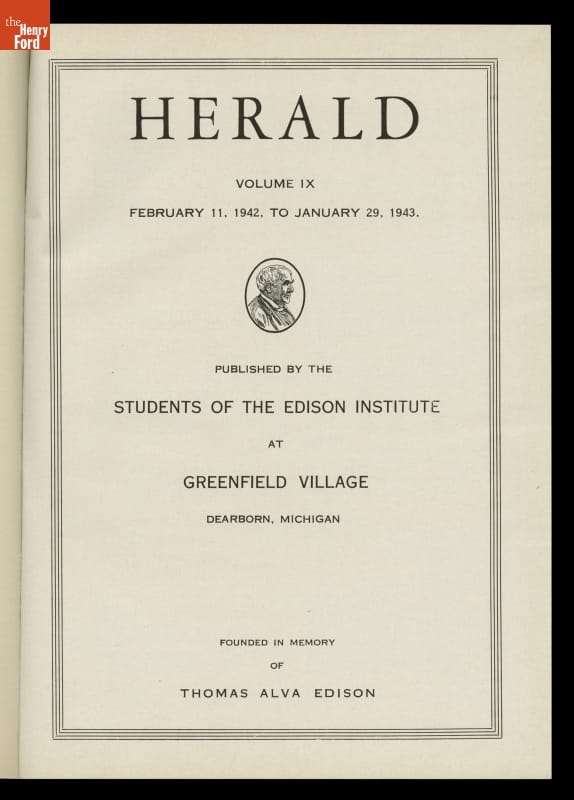
- "Herald" Magazine, Bound Volume IX for February 1942 - January 1943 - The students of the Greenfield Village and Associated Schools of the Edison Institute began publishing the <em>Herald</em> in 1934. They took the name from a weekly newspaper printed and sold by Thomas Alva Edison when he worked for the Grand Trunk Railroad in 1862-63. The students' version included articles on academic, social, and recreational activities. The publication continued until 1952.
- 11 February 1942 - 29 January 1943
- Collections - Artifact
"Herald" Magazine, Bound Volume IX for February 1942 - January 1943
The students of the Greenfield Village and Associated Schools of the Edison Institute began publishing the Herald in 1934. They took the name from a weekly newspaper printed and sold by Thomas Alva Edison when he worked for the Grand Trunk Railroad in 1862-63. The students' version included articles on academic, social, and recreational activities. The publication continued until 1952.
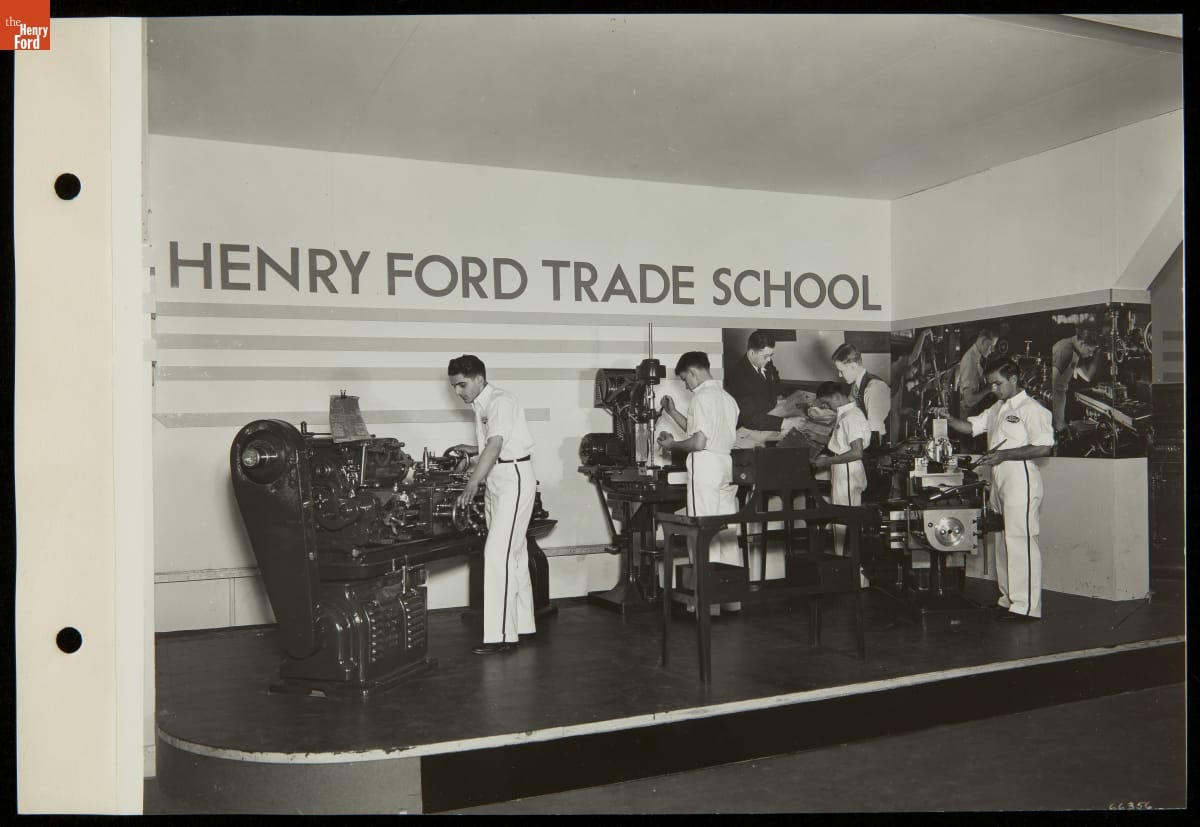
- Henry Ford Trade School Students at Great Lakes Exposition, Cleveland, Ohio, 1936-1937 - Cleveland celebrated its centennial with the Great Lakes Exposition. For two summers during 1936 and 1937, over seven million visitors came through the gates. Fair officials consigned Ford and the other automobile companies to the Automotive Building -- no separate corporate buildings were constructed. Ford supplemented its vehicle displays with other exhibitions, including demonstrations by students from the Henry Ford Trade School.
- June 29, 1936
- Collections - Artifact
Henry Ford Trade School Students at Great Lakes Exposition, Cleveland, Ohio, 1936-1937
Cleveland celebrated its centennial with the Great Lakes Exposition. For two summers during 1936 and 1937, over seven million visitors came through the gates. Fair officials consigned Ford and the other automobile companies to the Automotive Building -- no separate corporate buildings were constructed. Ford supplemented its vehicle displays with other exhibitions, including demonstrations by students from the Henry Ford Trade School.
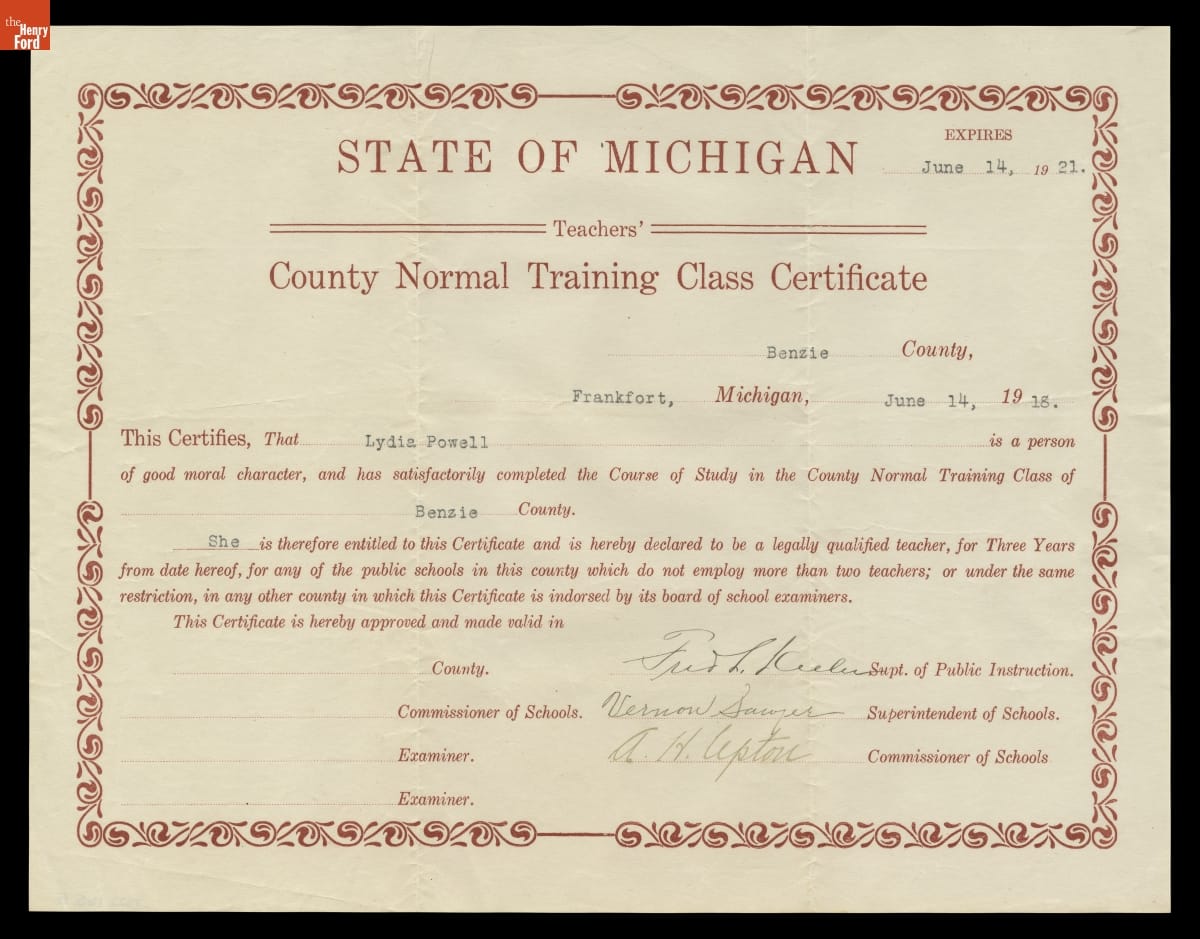
- State of Michigan Teachers' County Normal Training Class Certificate Awarded to Lydia Powell, June 14, 1918 - Lydia Powell (1898-1991) graduated from high school in 1917. By the following year, all states had made school attendance compulsory for 8- to 14-year-olds. In 1925, mandatory attendance expanded to include children 16 years and under. After her high school graduation, Powell, a woman of limited means, completed courses and received degrees from several Michigan colleges, making teaching her passion and a lifelong career.
- June 14, 1918
- Collections - Artifact
State of Michigan Teachers' County Normal Training Class Certificate Awarded to Lydia Powell, June 14, 1918
Lydia Powell (1898-1991) graduated from high school in 1917. By the following year, all states had made school attendance compulsory for 8- to 14-year-olds. In 1925, mandatory attendance expanded to include children 16 years and under. After her high school graduation, Powell, a woman of limited means, completed courses and received degrees from several Michigan colleges, making teaching her passion and a lifelong career.
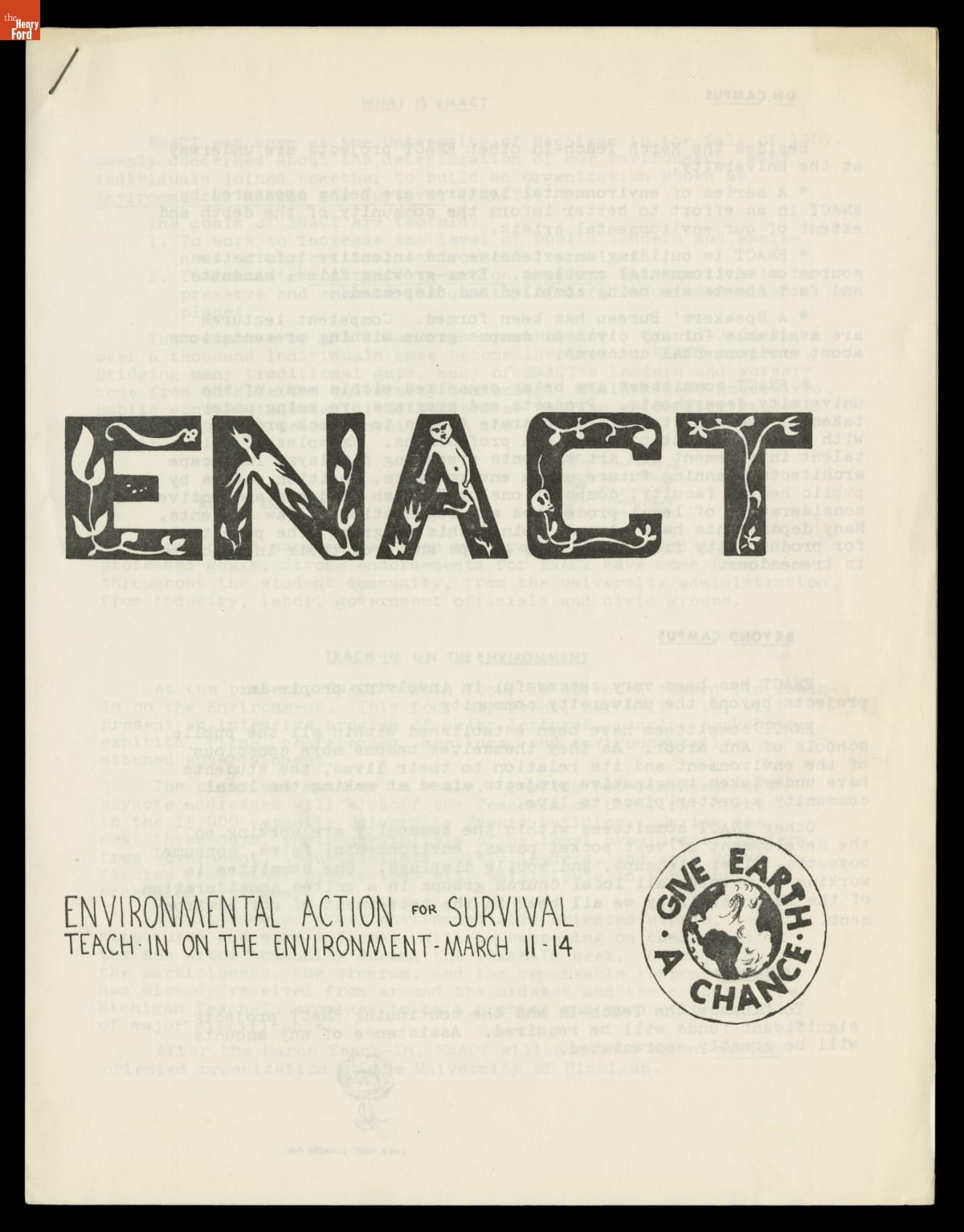
- ENACT Environmental Action for Survival Teach-In on the Environment, March 11-14, 1970 - University of Michigan students formed Environmental Action for Survival (ENACT) in 1969. They promoted their 4-day "Teach-in on the Environment," on March 11-14, 1970, as a prototype for the national environmental teach-in planned for April 22, 1970, later known as Earth Day. The leaflet called for community and youth engagement and information sharing "to preserve and enhance the quality of life on our despoiled planet."
- March 01, 1970
- Collections - Artifact
ENACT Environmental Action for Survival Teach-In on the Environment, March 11-14, 1970
University of Michigan students formed Environmental Action for Survival (ENACT) in 1969. They promoted their 4-day "Teach-in on the Environment," on March 11-14, 1970, as a prototype for the national environmental teach-in planned for April 22, 1970, later known as Earth Day. The leaflet called for community and youth engagement and information sharing "to preserve and enhance the quality of life on our despoiled planet."
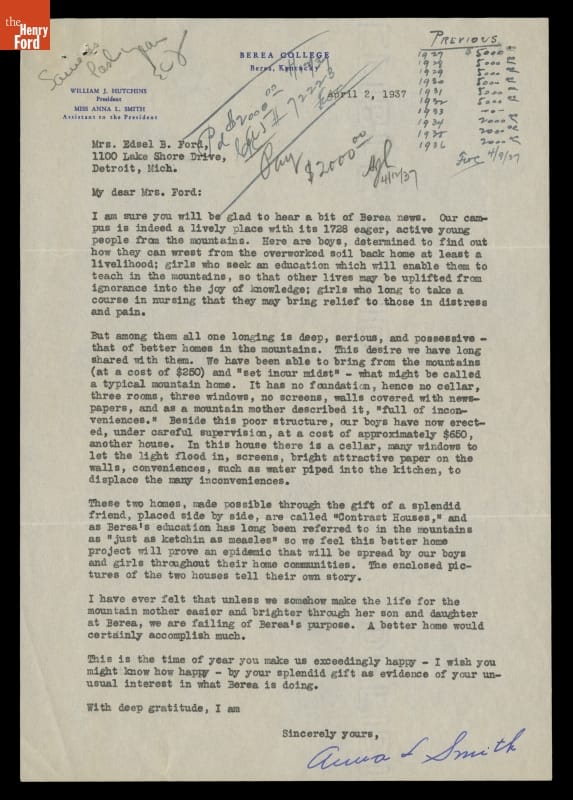
- Fundraising Letter from Anna L. Smith, Berea College, to Eleanor Ford, April 2, 1937 -
- April 02, 1937
- Collections - Artifact
Fundraising Letter from Anna L. Smith, Berea College, to Eleanor Ford, April 2, 1937