
Search
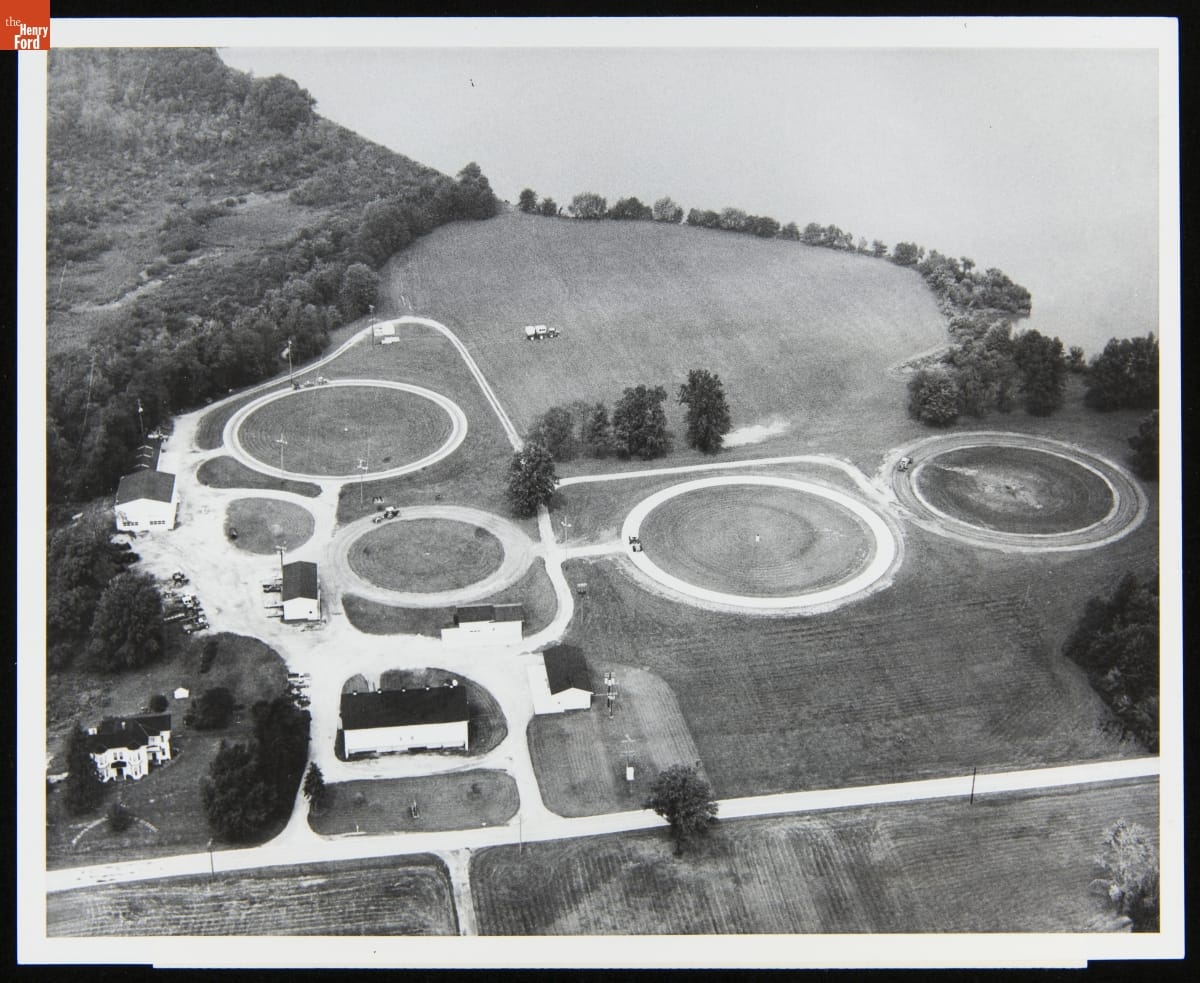
- Firestone Test Center near Columbiana County, Ohio, circa 1975 -
- circa 1975
- Collections - Artifact
Firestone Test Center near Columbiana County, Ohio, circa 1975
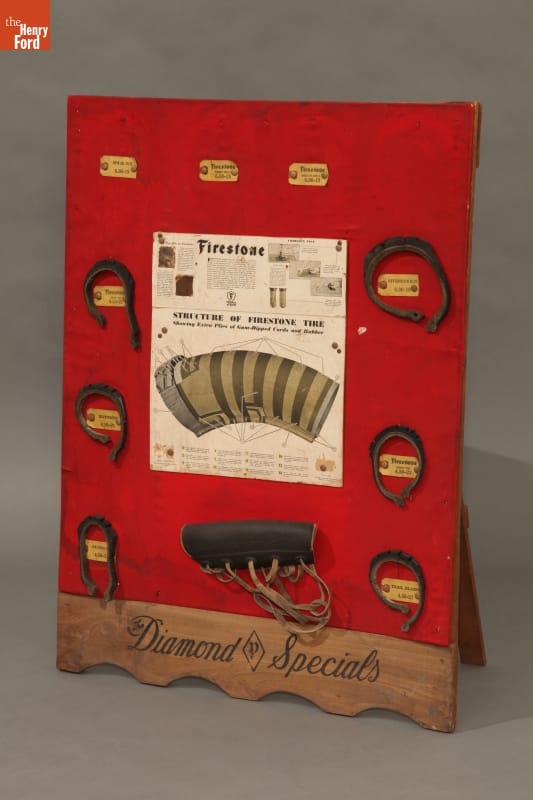
- Firestone "The Diamond Specials" Display, circa 1927 - By 1927, Firestone was an established market leader in the United States, manufacturing about 25 percent of all tires used here. This promotional display for the company's Diamond Special tires emphasized its gum-dipping process. Tires are supported by a cord body underneath the rubber surface. Firestone dipped the cotton cords in liquid rubber to help extend tire life.
- circa 1927
- Collections - Artifact
Firestone "The Diamond Specials" Display, circa 1927
By 1927, Firestone was an established market leader in the United States, manufacturing about 25 percent of all tires used here. This promotional display for the company's Diamond Special tires emphasized its gum-dipping process. Tires are supported by a cord body underneath the rubber surface. Firestone dipped the cotton cords in liquid rubber to help extend tire life.
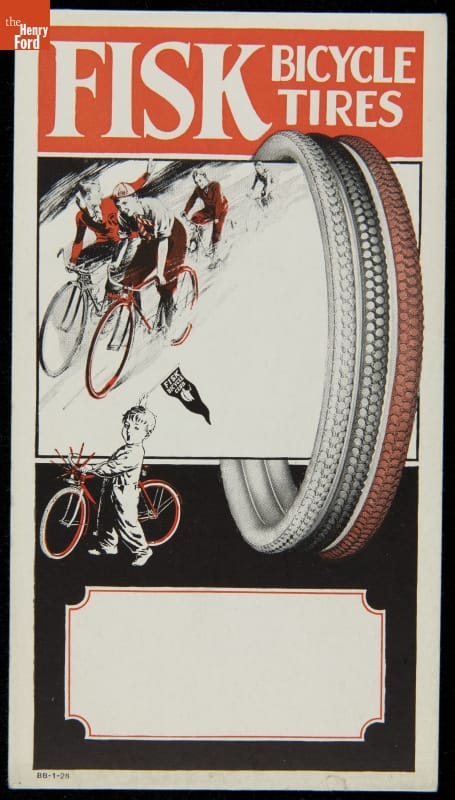
- Trade Card for Fisk Bicycle Tires, circa 1938 - In the last third of the nineteenth century, American consumers could choose from an unprecedented variety of goods and services. Seeking to distinguish certain products and businesses from the competition, advertisers began to print and distribute trade cards. Though the popularity of these cards diminished after 1900, some companies employed the informative, often vibrant little advertisements well into the twentieth century.
- circa 1938
- Collections - Artifact
Trade Card for Fisk Bicycle Tires, circa 1938
In the last third of the nineteenth century, American consumers could choose from an unprecedented variety of goods and services. Seeking to distinguish certain products and businesses from the competition, advertisers began to print and distribute trade cards. Though the popularity of these cards diminished after 1900, some companies employed the informative, often vibrant little advertisements well into the twentieth century.
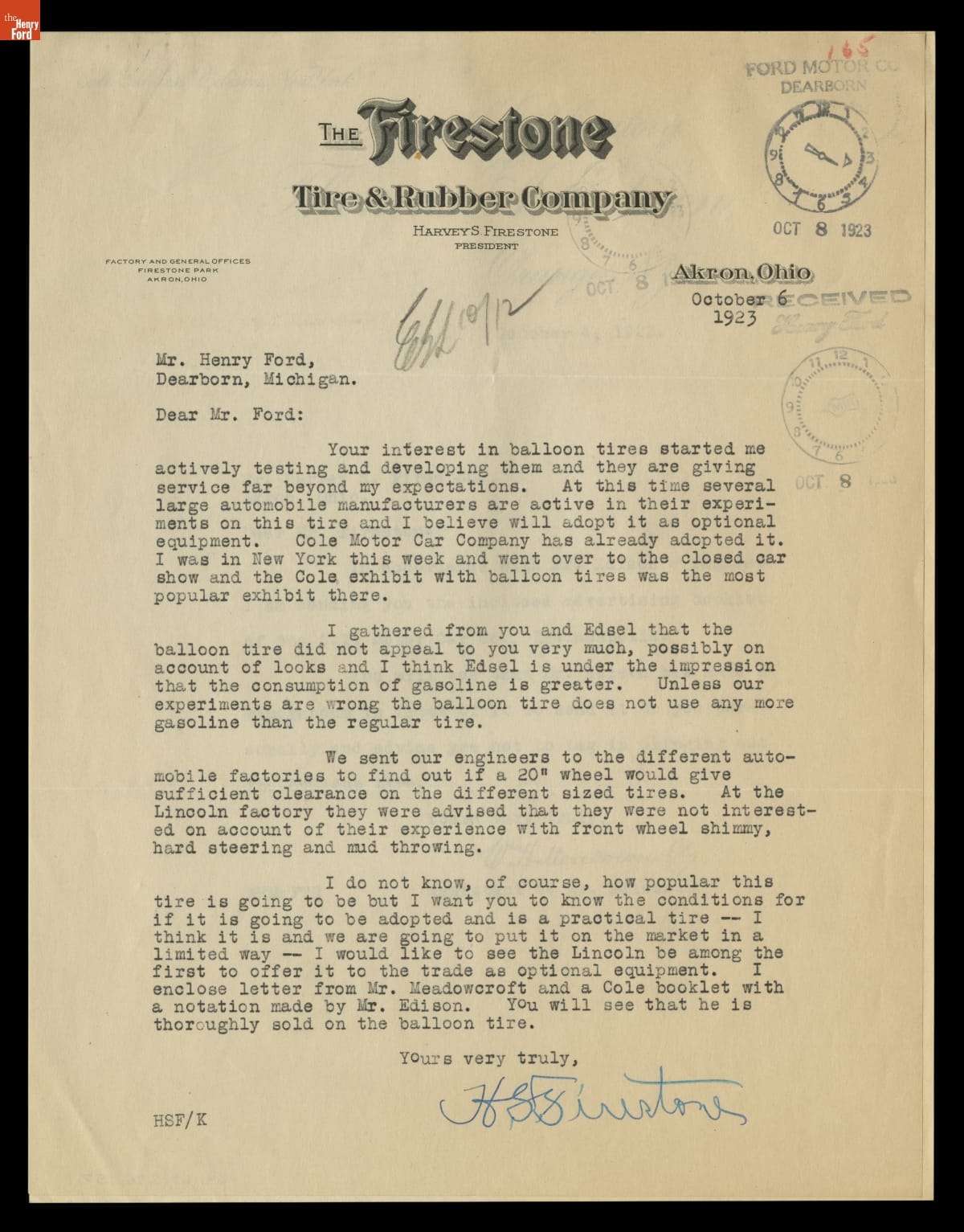
- Correspondence between Harvey Firestone, Henry Ford, and Thomas Edison regarding Cole Balloon Tires, October 1923 -
- 04 October 1923-06 October 1923
- Collections - Artifact
Correspondence between Harvey Firestone, Henry Ford, and Thomas Edison regarding Cole Balloon Tires, October 1923
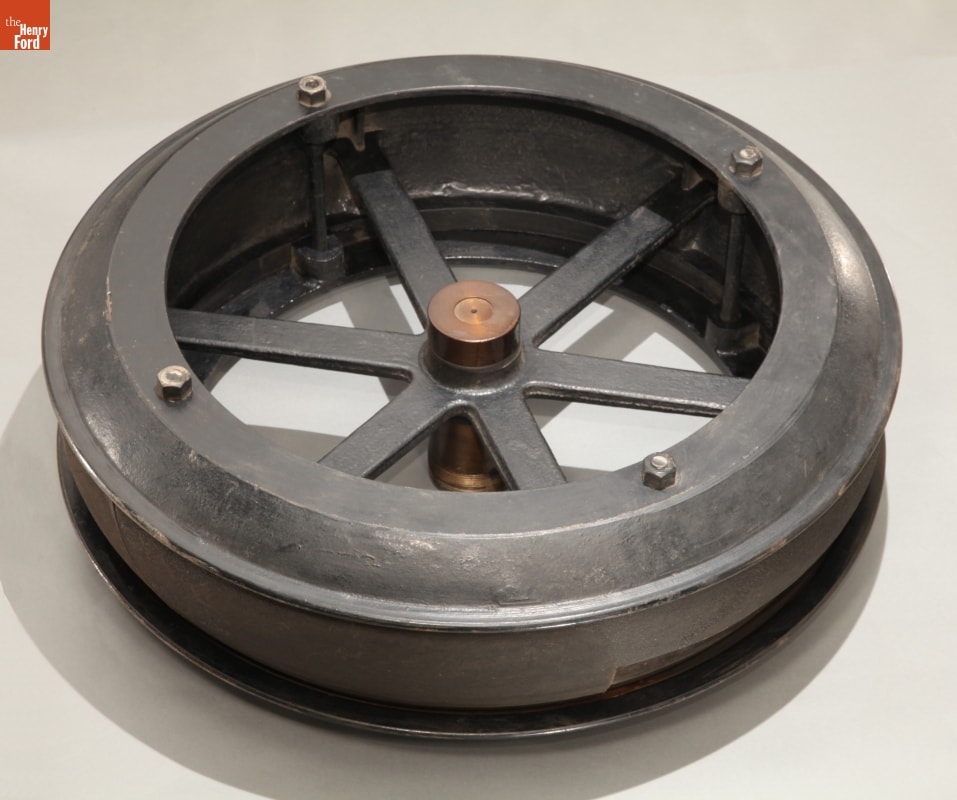
- Tire Drum, 1895 - Tires were built on cylindrical drums. Plies were layered on the drum one at a time, and beads were added to the sides, to create what was called a carcass. Tread stock was then wrapped around the carcass and pressed firmly into place with rollers. The carcass was then removed from the drum and formed into shape in a tire mold.
- 1895
- Collections - Artifact
Tire Drum, 1895
Tires were built on cylindrical drums. Plies were layered on the drum one at a time, and beads were added to the sides, to create what was called a carcass. Tread stock was then wrapped around the carcass and pressed firmly into place with rollers. The carcass was then removed from the drum and formed into shape in a tire mold.
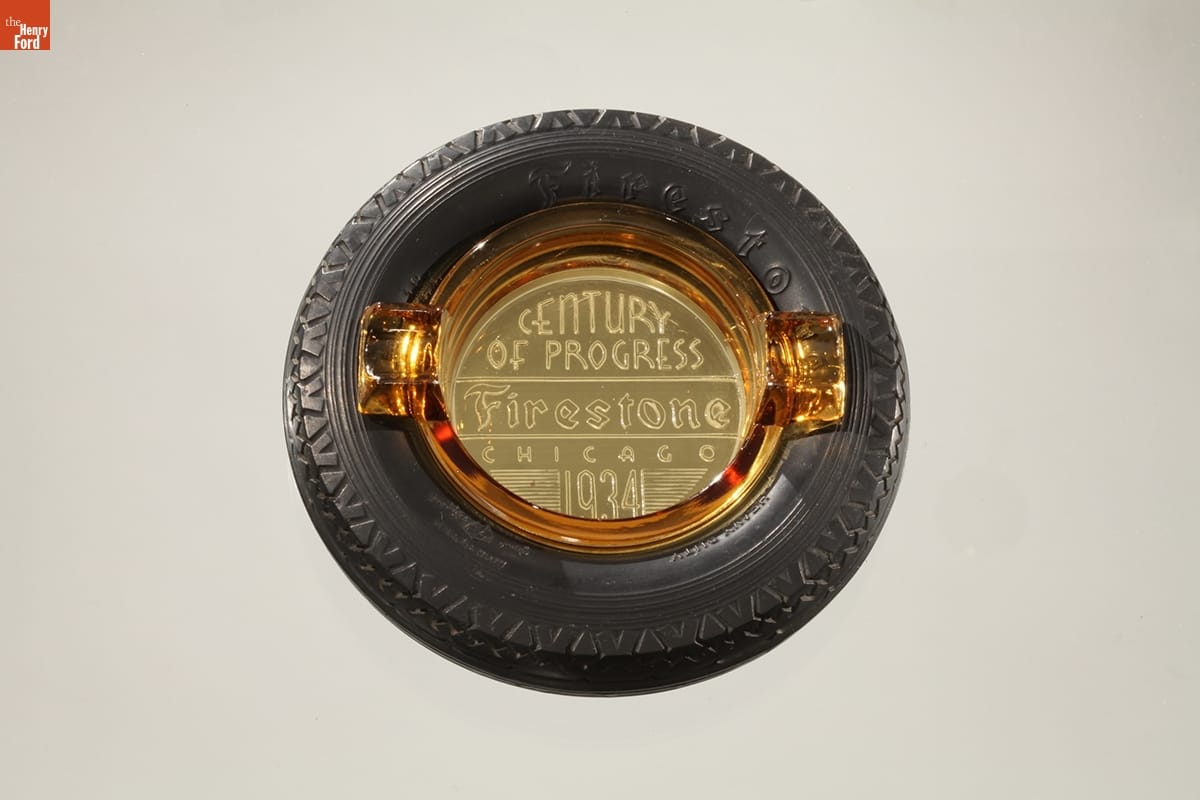
- Firestone Souvenir Ashtray From Century of Progress, 1933 - Chicago's 1933-34 Century of Progress Exposition used the theme of progress to buoy national optimism during the Depression's darkest years. The fair also provided the opportunity for companies to show off their achievements to millions of people. This souvenir ashtray embodied Firestone's featured product at the fair: rubber tires.
- 1933
- Collections - Artifact
Firestone Souvenir Ashtray From Century of Progress, 1933
Chicago's 1933-34 Century of Progress Exposition used the theme of progress to buoy national optimism during the Depression's darkest years. The fair also provided the opportunity for companies to show off their achievements to millions of people. This souvenir ashtray embodied Firestone's featured product at the fair: rubber tires.
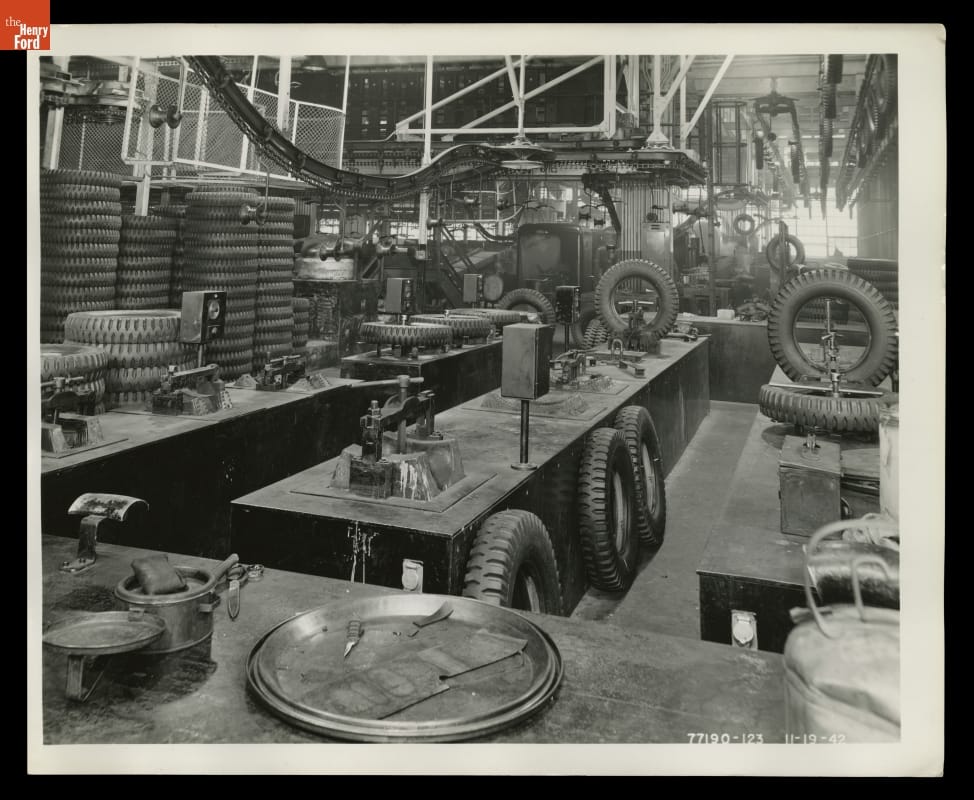
- Ford Rouge Plant Tire Building Equipment, November 1942 - Henry Ford hoped to control virtually every item that went into Ford Motor Company vehicles, from raw materials to finished components. Construction on a tire plant at the Rouge started in 1937. By 1939 it was turning out up to 16,000 tires each day. Nearly eight million "Ford" branded tires were made before World War II ended production in 1942.
- November 19, 1942
- Collections - Artifact
Ford Rouge Plant Tire Building Equipment, November 1942
Henry Ford hoped to control virtually every item that went into Ford Motor Company vehicles, from raw materials to finished components. Construction on a tire plant at the Rouge started in 1937. By 1939 it was turning out up to 16,000 tires each day. Nearly eight million "Ford" branded tires were made before World War II ended production in 1942.
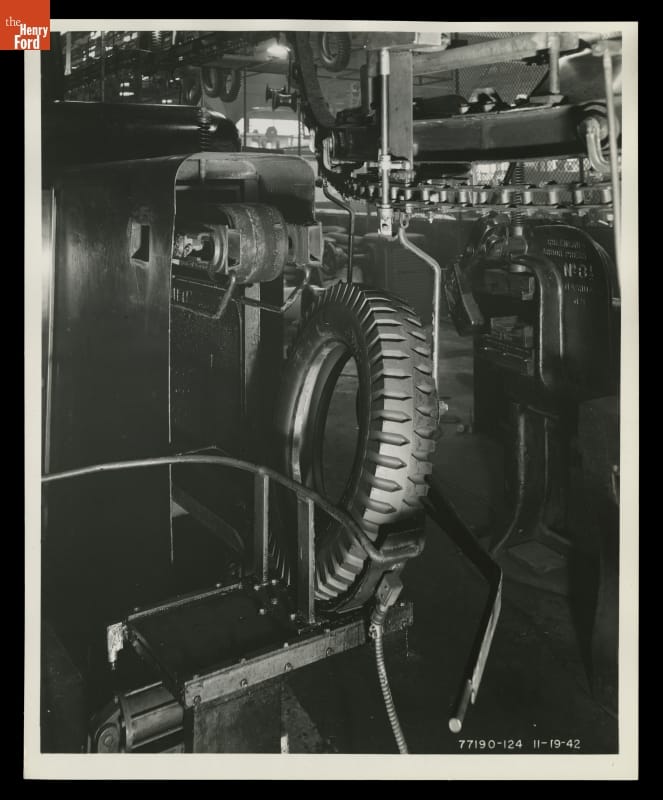
- Ford Rouge Plant Tire Building Equipment, November 1942 - Henry Ford hoped to control virtually every item that went into Ford Motor Company vehicles, from raw materials to finished components. Construction on a tire plant at the Rouge started in 1937. By 1939 it was turning out up to 16,000 tires each day. Nearly eight million "Ford" branded tires were made before World War II ended production in 1942.
- November 19, 1942
- Collections - Artifact
Ford Rouge Plant Tire Building Equipment, November 1942
Henry Ford hoped to control virtually every item that went into Ford Motor Company vehicles, from raw materials to finished components. Construction on a tire plant at the Rouge started in 1937. By 1939 it was turning out up to 16,000 tires each day. Nearly eight million "Ford" branded tires were made before World War II ended production in 1942.
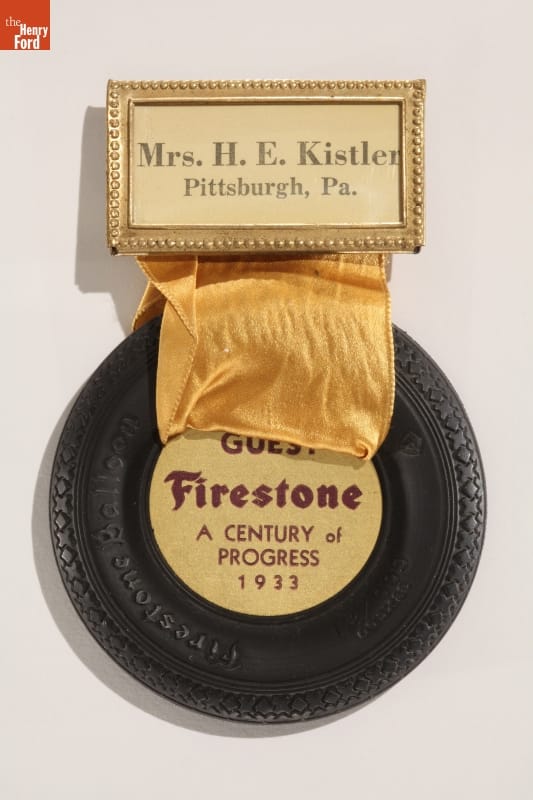
- Century of Progress Exposition, Guest of Firestone Tire and Rubber Company Badge, 1933 - Chicago's 1933-34 Century of Progress Exposition used the theme of progress to encourage optimism during the Depression. Many manufacturers, including the Firestone Tire and Rubber Company, mounted exhibitions in Chicago to capitalize on the fair's popularity. This identification badge worn by the wife of a visiting salesman from Pittsburgh embodied Firestone's featured product at the fair -- rubber tires.
- 1933
- Collections - Artifact
Century of Progress Exposition, Guest of Firestone Tire and Rubber Company Badge, 1933
Chicago's 1933-34 Century of Progress Exposition used the theme of progress to encourage optimism during the Depression. Many manufacturers, including the Firestone Tire and Rubber Company, mounted exhibitions in Chicago to capitalize on the fair's popularity. This identification badge worn by the wife of a visiting salesman from Pittsburgh embodied Firestone's featured product at the fair -- rubber tires.
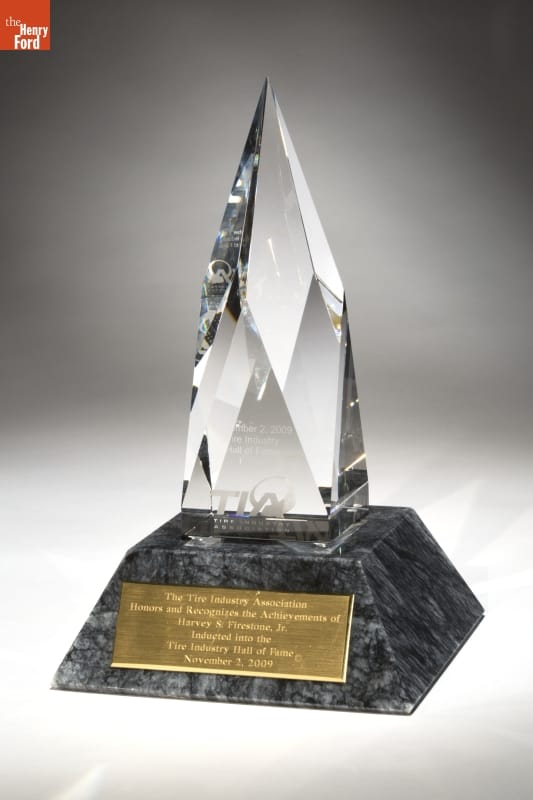
- Tire Industry Hall of Fame Award Recognizing the Achievements of Harvey Firestone, Jr., 2009. - Harvey Firestone, Jr., joined Firestone Tire and Rubber -- the company founded by his father, Harvey, Sr. -- in 1920. He headed Firestone's rubber-growing operations in the 1930s, and he became the company's chief executive officer in 1946. Harvey Firestone, Jr., expanded Firestone's global operations, and he led the development of Firestone auto supply and service stores.
- 2009
- Collections - Artifact
Tire Industry Hall of Fame Award Recognizing the Achievements of Harvey Firestone, Jr., 2009.
Harvey Firestone, Jr., joined Firestone Tire and Rubber -- the company founded by his father, Harvey, Sr. -- in 1920. He headed Firestone's rubber-growing operations in the 1930s, and he became the company's chief executive officer in 1946. Harvey Firestone, Jr., expanded Firestone's global operations, and he led the development of Firestone auto supply and service stores.