
Search
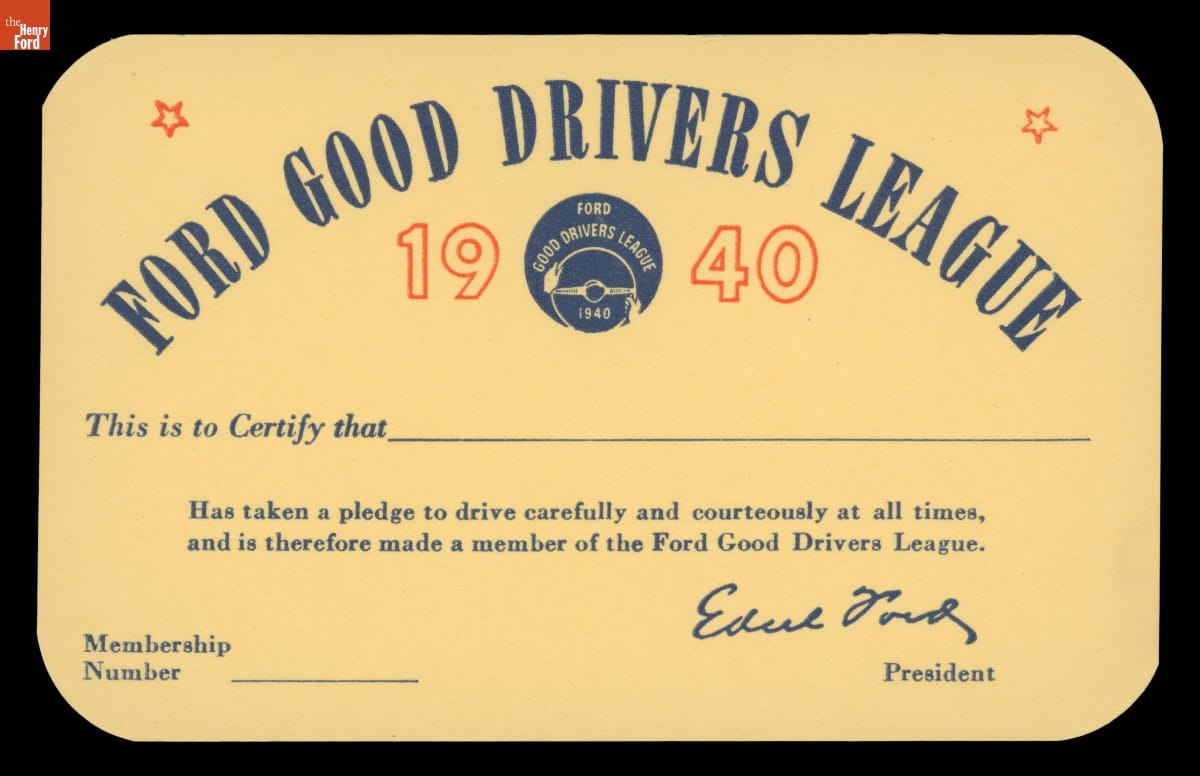
- Ford Good Drivers League Membership Card, 1940 - Ford Motor Company created the Good Drivers League in 1940. Headed by Edsel Ford, the League promoted safe driving habits among high school students. The League initially invited boys to compete in state and national championships--girls would join in 1941. Contestants wrote essays and participated in driving tests. National champions won trophies and scholarships. America's entry into World War II ended the program.
- 1940
- Collections - Artifact
Ford Good Drivers League Membership Card, 1940
Ford Motor Company created the Good Drivers League in 1940. Headed by Edsel Ford, the League promoted safe driving habits among high school students. The League initially invited boys to compete in state and national championships--girls would join in 1941. Contestants wrote essays and participated in driving tests. National champions won trophies and scholarships. America's entry into World War II ended the program.
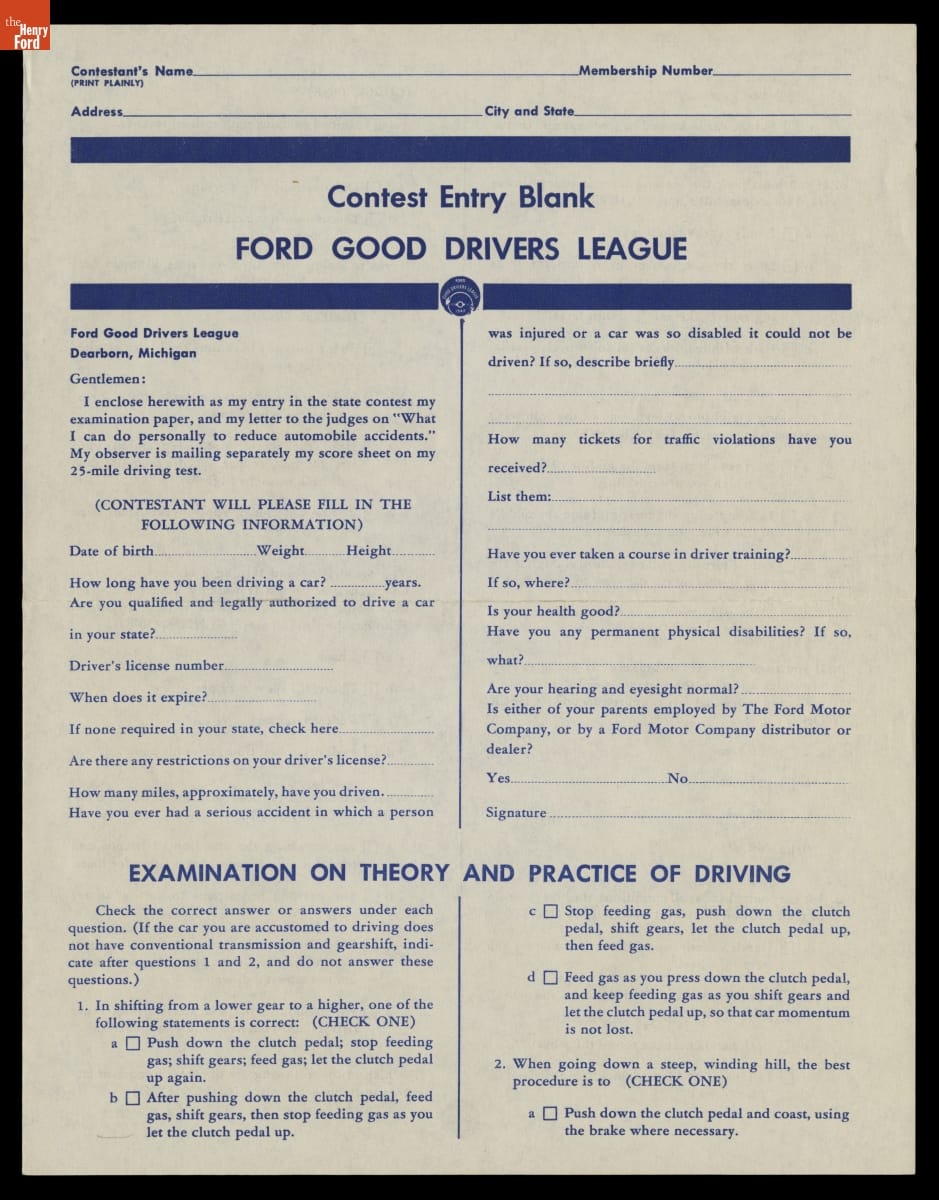
- Ford Good Drivers League Contest Entry Blank, April 1940 - Ford Motor Company created the Good Drivers League in 1940. Headed by Edsel Ford, the League promoted safe driving habits among high school students. The League initially invited boys to compete in state and national championships--girls would join in 1941. Contestants wrote essays and participated in driving tests. National champions won trophies and scholarships. America's entry into World War II ended the program.
- April 01, 1940
- Collections - Artifact
Ford Good Drivers League Contest Entry Blank, April 1940
Ford Motor Company created the Good Drivers League in 1940. Headed by Edsel Ford, the League promoted safe driving habits among high school students. The League initially invited boys to compete in state and national championships--girls would join in 1941. Contestants wrote essays and participated in driving tests. National champions won trophies and scholarships. America's entry into World War II ended the program.
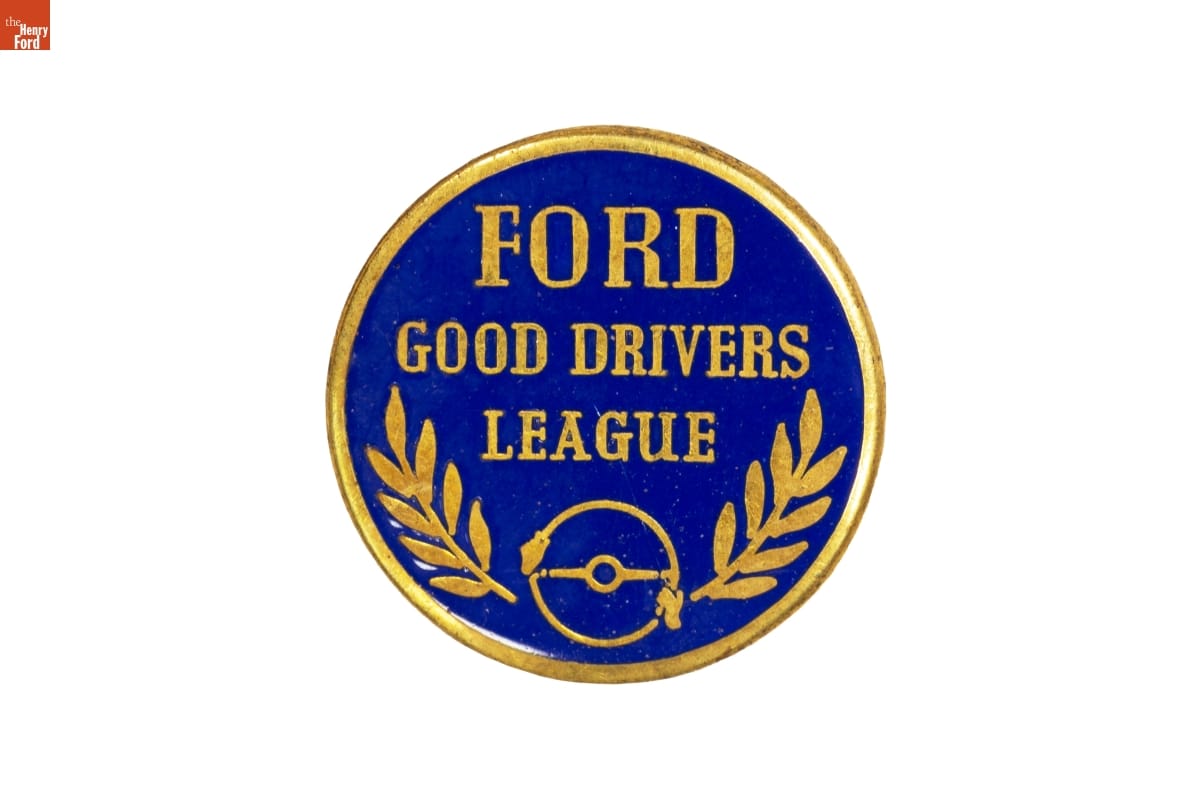
- "Ford Good Drivers League" Pin, 1940-1942 - Ford Motor Company created the Good Drivers League in 1940. Headed by Edsel Ford, the League promoted safe driving habits among high school students. The League initially invited boys to compete in state and national championships--girls would join in 1941. Contestants wrote essays and participated in driving tests. National champions won trophies and scholarships. America's entry into World War II ended the program.
- 1940-1942
- Collections - Artifact
"Ford Good Drivers League" Pin, 1940-1942
Ford Motor Company created the Good Drivers League in 1940. Headed by Edsel Ford, the League promoted safe driving habits among high school students. The League initially invited boys to compete in state and national championships--girls would join in 1941. Contestants wrote essays and participated in driving tests. National champions won trophies and scholarships. America's entry into World War II ended the program.
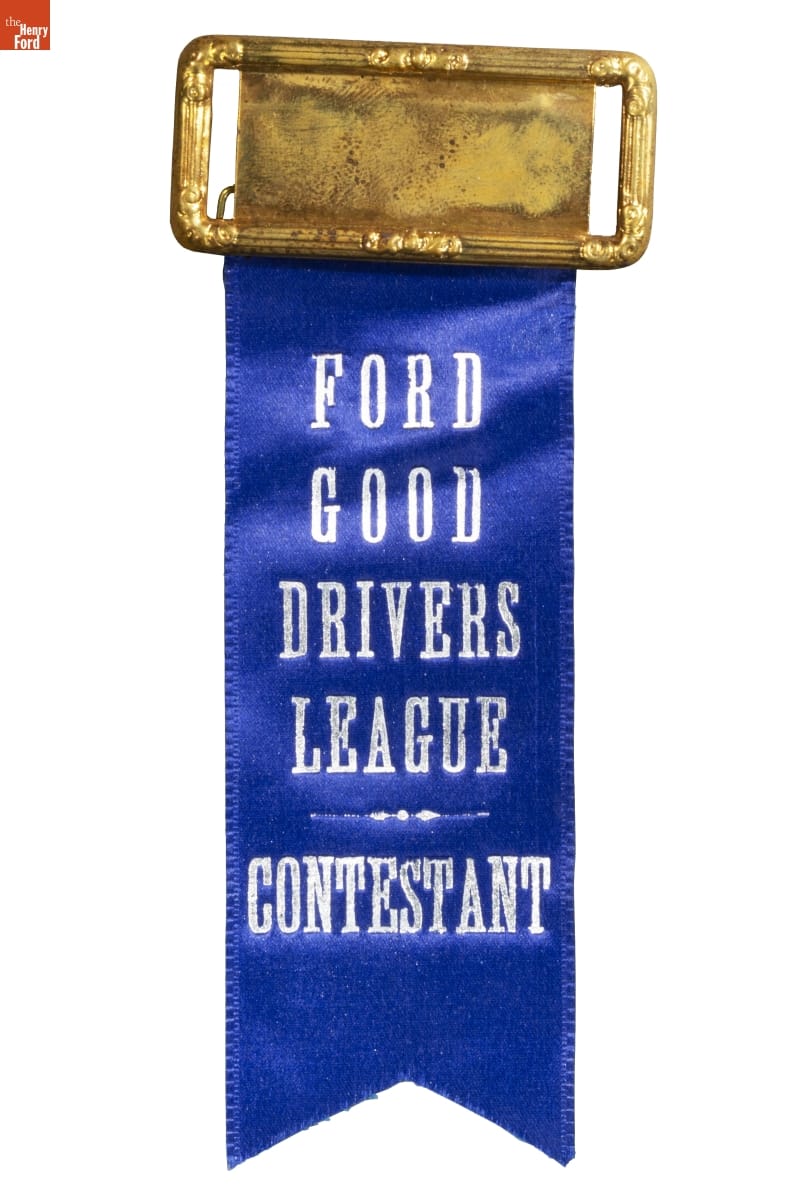
- Ford Good Drivers League "Contestant" Badge, 1940-1942 - Ford Motor Company created the Good Drivers League in 1940. Headed by Edsel Ford, the League promoted safe driving habits among high school students. The League initially invited boys to compete in state and national championships--girls would join in 1941. Contestants wrote essays and participated in driving tests. National champions won trophies and scholarships. America's entry into World War II ended the program.
- 1940-1942
- Collections - Artifact
Ford Good Drivers League "Contestant" Badge, 1940-1942
Ford Motor Company created the Good Drivers League in 1940. Headed by Edsel Ford, the League promoted safe driving habits among high school students. The League initially invited boys to compete in state and national championships--girls would join in 1941. Contestants wrote essays and participated in driving tests. National champions won trophies and scholarships. America's entry into World War II ended the program.
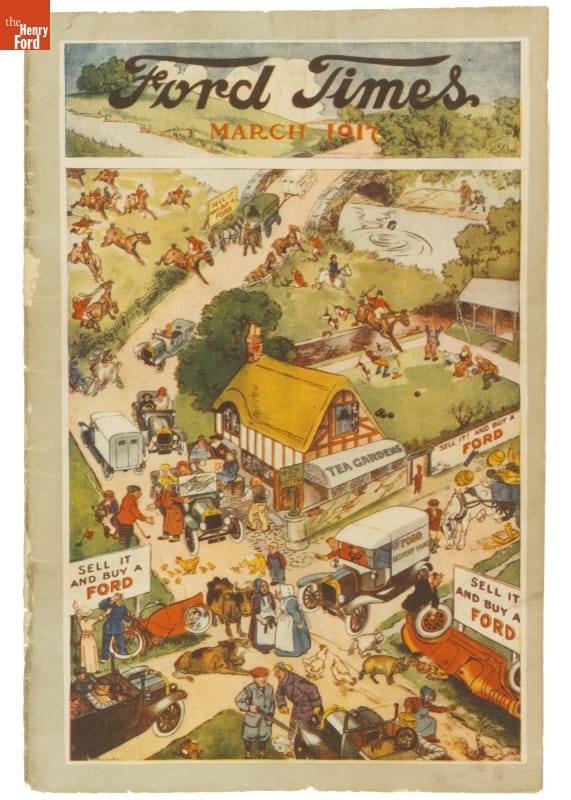
- Ford Times Cover, March 1917 - Norval Hawkins, the sales manager for Ford Motor Company, developed the idea for a company magazine, <EM>Ford Times</EM>. Hawkins filled the magazine with information ranging from production methods and testimonials to Ford race victories. Always lively and well illustrated, <EM>Ford Times</EM> boosted morale at the agencies and branches while serving as another advertising medium.
- March 01, 1917
- Collections - Artifact
Ford Times Cover, March 1917
Norval Hawkins, the sales manager for Ford Motor Company, developed the idea for a company magazine, Ford Times. Hawkins filled the magazine with information ranging from production methods and testimonials to Ford race victories. Always lively and well illustrated, Ford Times boosted morale at the agencies and branches while serving as another advertising medium.
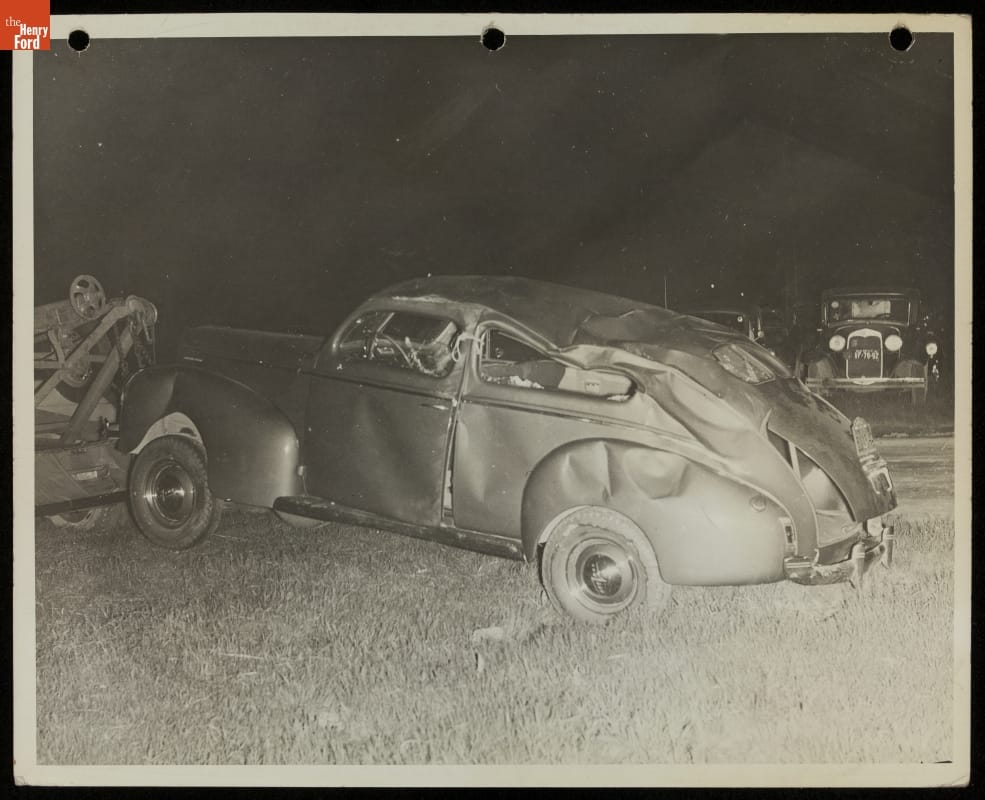
- Damaged Car Hooked up to a Tow Truck, 1939 - Automobiles are fast, powerful, and potentially dangerous. Damage to wrecked vehicles -- which was sometimes beyond repair -- became more commonplace as automotive speeds and the number of drivers on American roads rapidly increased in the 20th century. Eventually, manufacturers, governments, and drivers themselves were compelled to improve automotive safety.
- 1939
- Collections - Artifact
Damaged Car Hooked up to a Tow Truck, 1939
Automobiles are fast, powerful, and potentially dangerous. Damage to wrecked vehicles -- which was sometimes beyond repair -- became more commonplace as automotive speeds and the number of drivers on American roads rapidly increased in the 20th century. Eventually, manufacturers, governments, and drivers themselves were compelled to improve automotive safety.
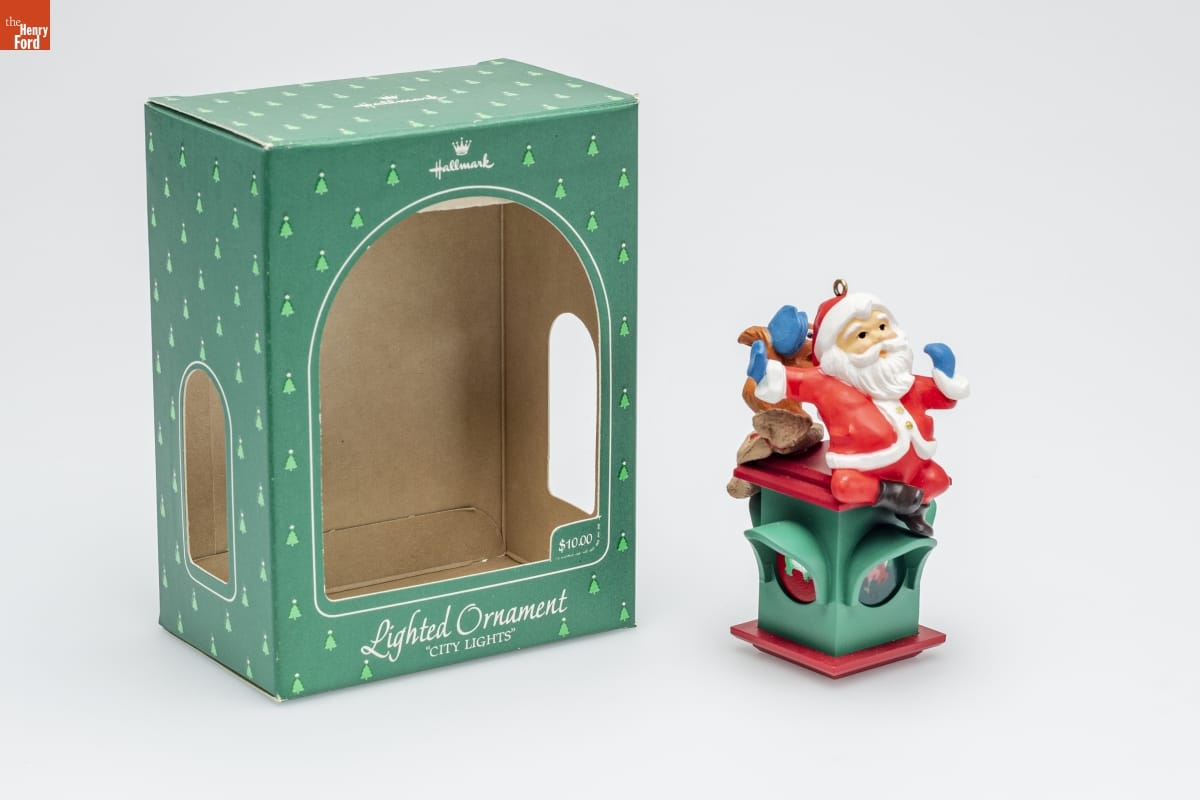
- Hallmark "City Lights" Christmas Ornament, 1984 - Already known for greeting cards, Hallmark introduced a line of Christmas ornaments in 1973. The company's annual release of an increasing array of ornaments revolutionized Christmas decorating, appealing to customers' interest in marking memories and milestones as well as expressing one's personality and unique tastes.
- 1984
- Collections - Artifact
Hallmark "City Lights" Christmas Ornament, 1984
Already known for greeting cards, Hallmark introduced a line of Christmas ornaments in 1973. The company's annual release of an increasing array of ornaments revolutionized Christmas decorating, appealing to customers' interest in marking memories and milestones as well as expressing one's personality and unique tastes.
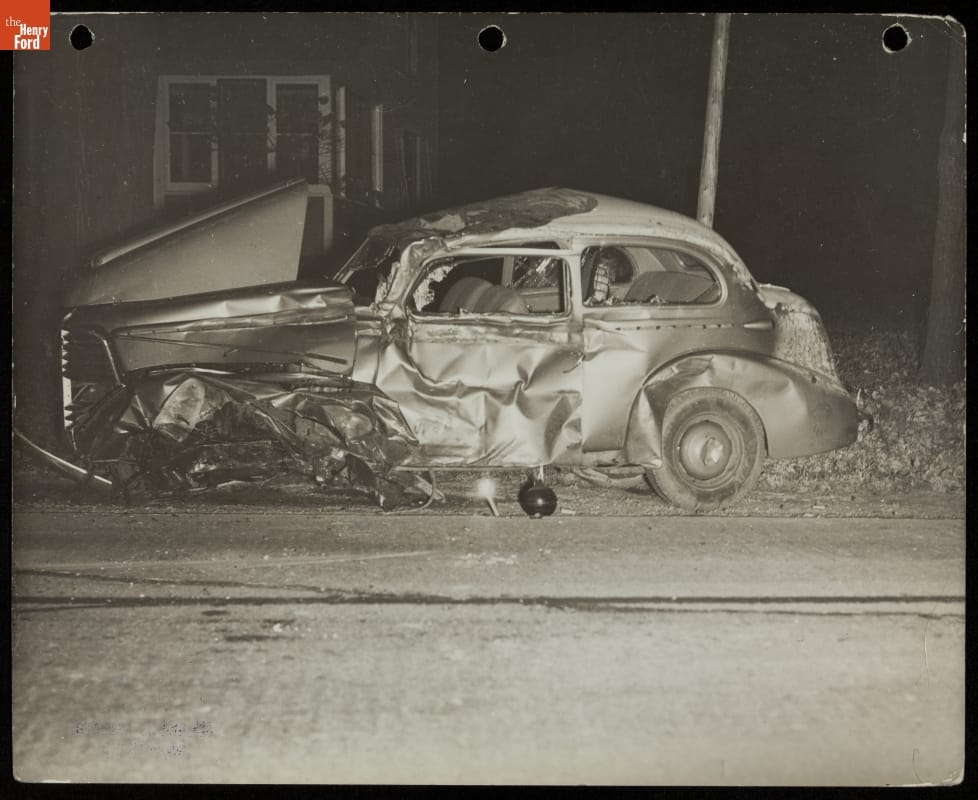
- Damaged Car Following a Traffic Accident in Chicago, Illinois, 1930-1945 - Automobiles are fast, powerful, and potentially dangerous. Accidents like the wreck pictured here became more commonplace as automotive speeds and the number of drivers on American roads rapidly increased in the 20th century. Eventually, manufacturers, governments, and drivers themselves were compelled to improve automotive safety.
- 1930-1945
- Collections - Artifact
Damaged Car Following a Traffic Accident in Chicago, Illinois, 1930-1945
Automobiles are fast, powerful, and potentially dangerous. Accidents like the wreck pictured here became more commonplace as automotive speeds and the number of drivers on American roads rapidly increased in the 20th century. Eventually, manufacturers, governments, and drivers themselves were compelled to improve automotive safety.
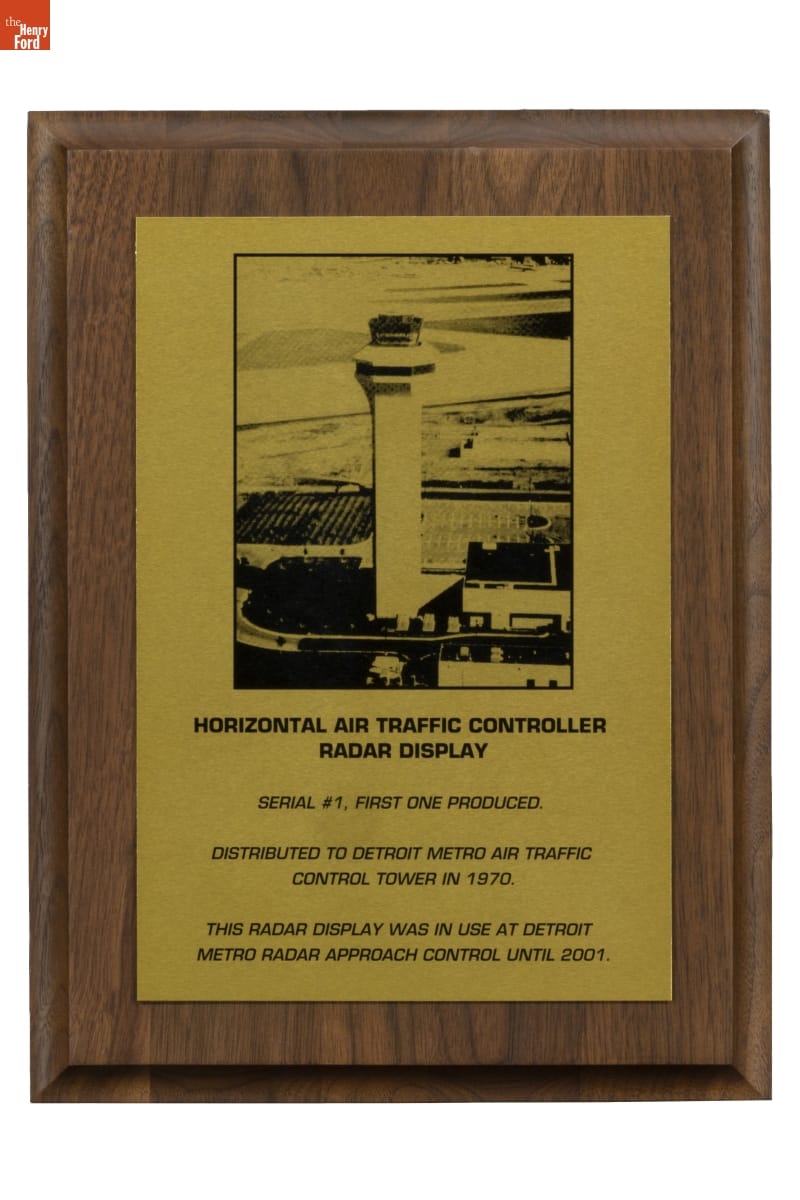
- Horizontal Air Traffic Controller Radar Display Plaque, circa 2001 - Federal oversight of air traffic control began in 1938, but radar technology -- greatly improved during World War II -- was not widely implemented until the late 1950s. Detroit Metro Airport received one of the first computer-integrated radar scopes capable of displaying an airplane's identification number and altitude directly on the screen. This plaque commemorates that unit, used from 1970 to 2001.
- circa 2001
- Collections - Artifact
Horizontal Air Traffic Controller Radar Display Plaque, circa 2001
Federal oversight of air traffic control began in 1938, but radar technology -- greatly improved during World War II -- was not widely implemented until the late 1950s. Detroit Metro Airport received one of the first computer-integrated radar scopes capable of displaying an airplane's identification number and altitude directly on the screen. This plaque commemorates that unit, used from 1970 to 2001.
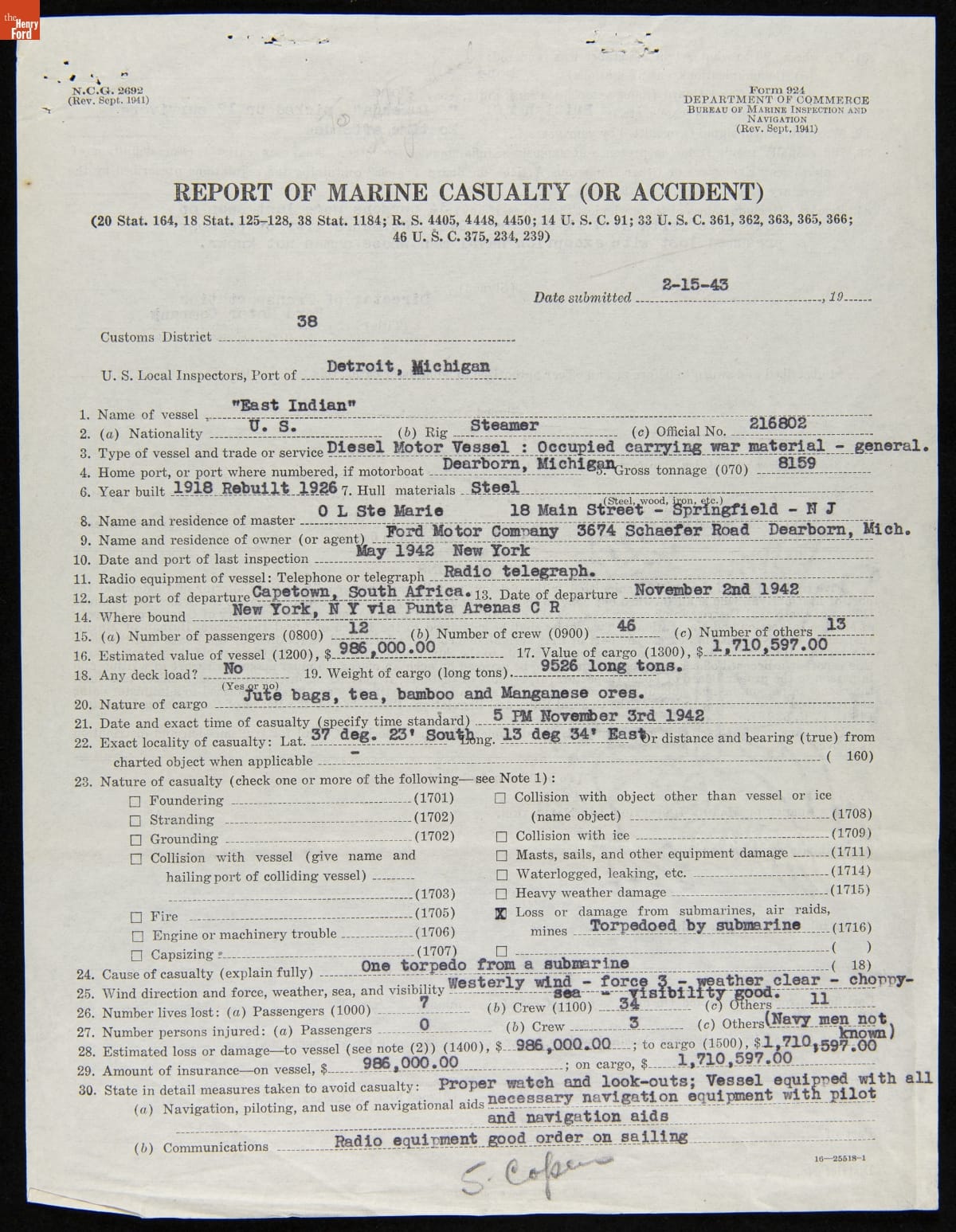
- Report of Marine Casualty or Accident for Sunken Ford Freighter "East Indian," February 15, 1943 - The United States government requisitioned the Ford Motor Company's ocean-going freighter <em>East Indian</em> for wartime service. Newly fitted with anti-submarine and anti-aircraft guns, the freighter left for the Indian Ocean in May 1942. As the <em>East Indian</em> returned to America, the ship was sunk by a German U-boat. Four lifeboats with survivors were lost, but crew members on a fifth were rescued after being adrift nearly two weeks.
- November 03, 1942
- Collections - Artifact
Report of Marine Casualty or Accident for Sunken Ford Freighter "East Indian," February 15, 1943
The United States government requisitioned the Ford Motor Company's ocean-going freighter East Indian for wartime service. Newly fitted with anti-submarine and anti-aircraft guns, the freighter left for the Indian Ocean in May 1942. As the East Indian returned to America, the ship was sunk by a German U-boat. Four lifeboats with survivors were lost, but crew members on a fifth were rescued after being adrift nearly two weeks.