
Search
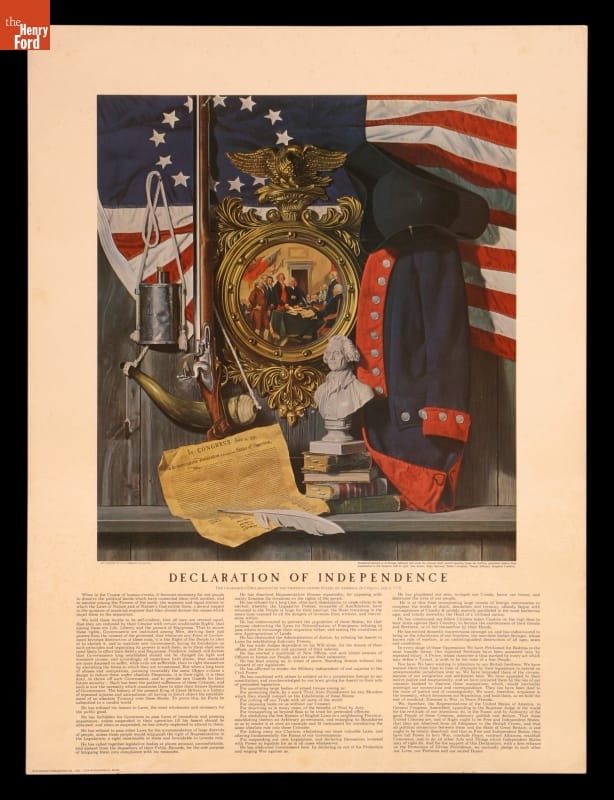
- Poster, "Declaration of Independence," 1976 - The 1976 Bicentennial of American Independence was a major cultural phenomenon. To celebrate, people across the nation purchased commemorative souvenirs, like this poster, and organized innumerable events -- from parades and fireworks displays to television programs and sporting events.
- 1976
- Collections - Artifact
Poster, "Declaration of Independence," 1976
The 1976 Bicentennial of American Independence was a major cultural phenomenon. To celebrate, people across the nation purchased commemorative souvenirs, like this poster, and organized innumerable events -- from parades and fireworks displays to television programs and sporting events.
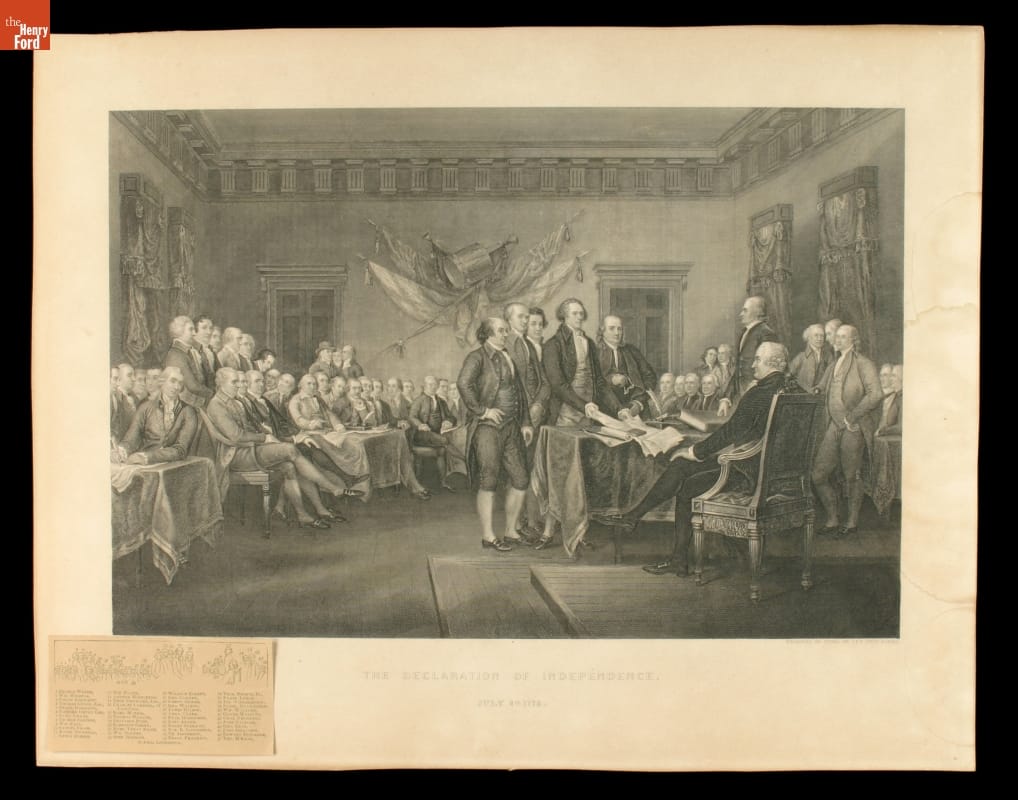
- Engraving, "The Declaration of Independence, July 4, 1776," circa 1850 -
- July 04, 1776
- Collections - Artifact
Engraving, "The Declaration of Independence, July 4, 1776," circa 1850
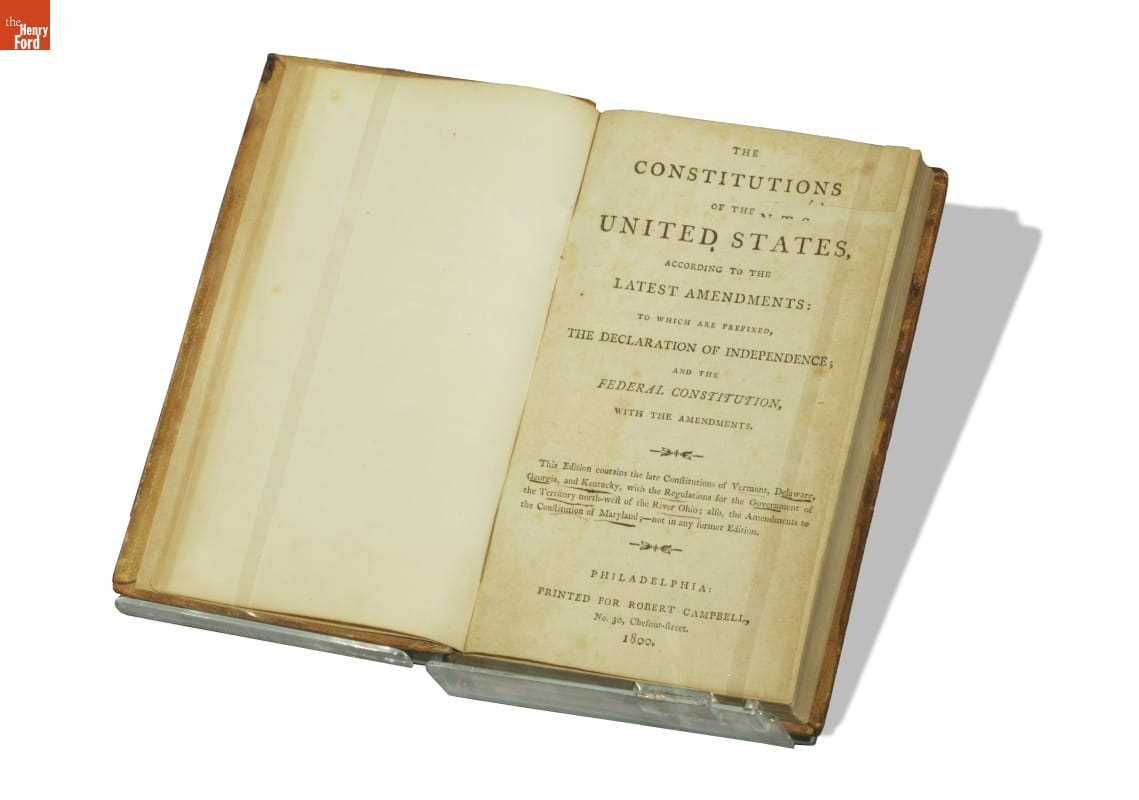
- Book, "The Constitutions of the United States, According to the Latest Amendments," 1800 - At the turn of the nineteenth century, newly independent Americans celebrated the Declaration of Independence and the United States Constitution as embodiments of freedom and democracy. This book - a rare survivor from 1800 - includes the text of both founding documents, constitutions of the fifteen existing states, and the Northwest Ordinance, which regulated the Northwest Territory.
- 1776-1800
- Collections - Artifact
Book, "The Constitutions of the United States, According to the Latest Amendments," 1800
At the turn of the nineteenth century, newly independent Americans celebrated the Declaration of Independence and the United States Constitution as embodiments of freedom and democracy. This book - a rare survivor from 1800 - includes the text of both founding documents, constitutions of the fifteen existing states, and the Northwest Ordinance, which regulated the Northwest Territory.
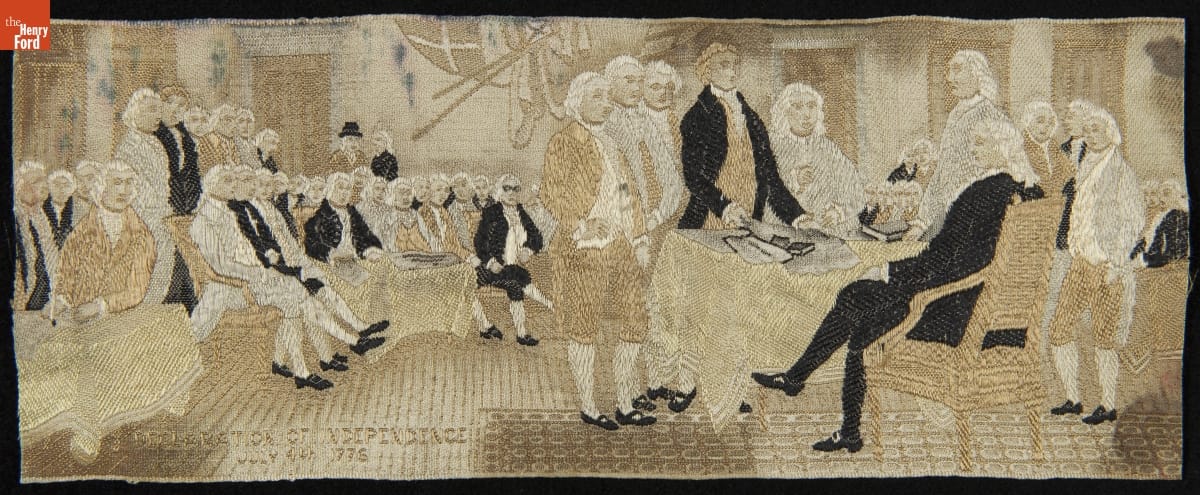
- Silk Picture, "Signing of the Declaration of Independence," 1876 -
- 1876
- Collections - Artifact
Silk Picture, "Signing of the Declaration of Independence," 1876
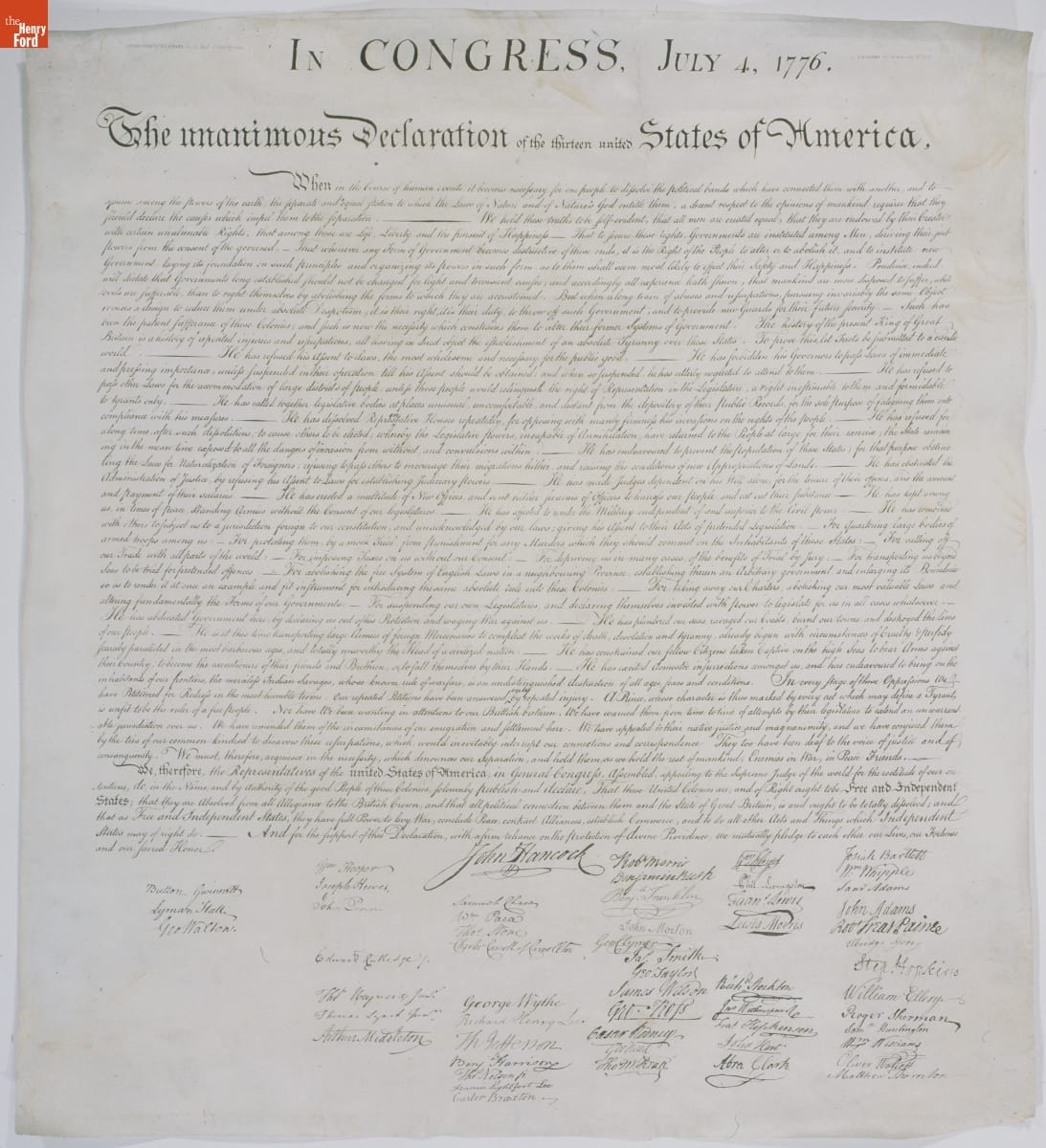
- Engraved Copy of the 1776 Declaration of Independence, Commissioned by John Quincy Adams, Printed 1823 - This is an exact, precise facsimile of one of America's greatest documents. It is one of two hundred copies commissioned by Secretary of State John Quincy Adams in 1820. It is an engraving made from the original document. Two copies each were given to the surviving signers and the rest distributed to Congress, state governments and colleges and universities.
- July 04, 1776
- Collections - Artifact
Engraved Copy of the 1776 Declaration of Independence, Commissioned by John Quincy Adams, Printed 1823
This is an exact, precise facsimile of one of America's greatest documents. It is one of two hundred copies commissioned by Secretary of State John Quincy Adams in 1820. It is an engraving made from the original document. Two copies each were given to the surviving signers and the rest distributed to Congress, state governments and colleges and universities.
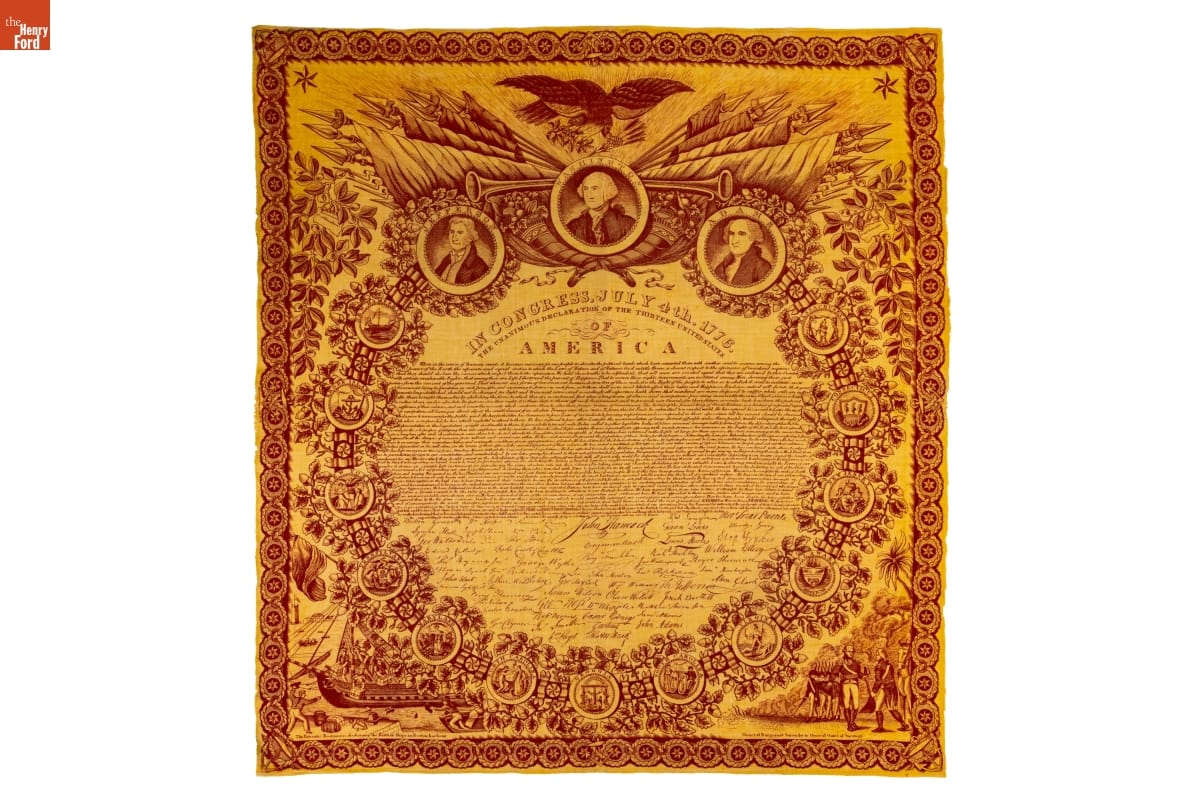
- Declaration of Independence Handkerchief, circa 1821 - Following the American Revolutionary War, there was large demand for accessories with patriotic themes. Brothers Richard and Collin Gillespie of Glasglow, Scotland made this handkerchief for the American market during the 1820s. The handkerchief features the Declaration of Independence in the center, surrounded by depictions of the first three presidents, the thirteen colonies, the Boston Tea Party, and General Burgoyne's surrender at Saratoga.
- circa 1821
- Collections - Artifact
Declaration of Independence Handkerchief, circa 1821
Following the American Revolutionary War, there was large demand for accessories with patriotic themes. Brothers Richard and Collin Gillespie of Glasglow, Scotland made this handkerchief for the American market during the 1820s. The handkerchief features the Declaration of Independence in the center, surrounded by depictions of the first three presidents, the thirteen colonies, the Boston Tea Party, and General Burgoyne's surrender at Saratoga.
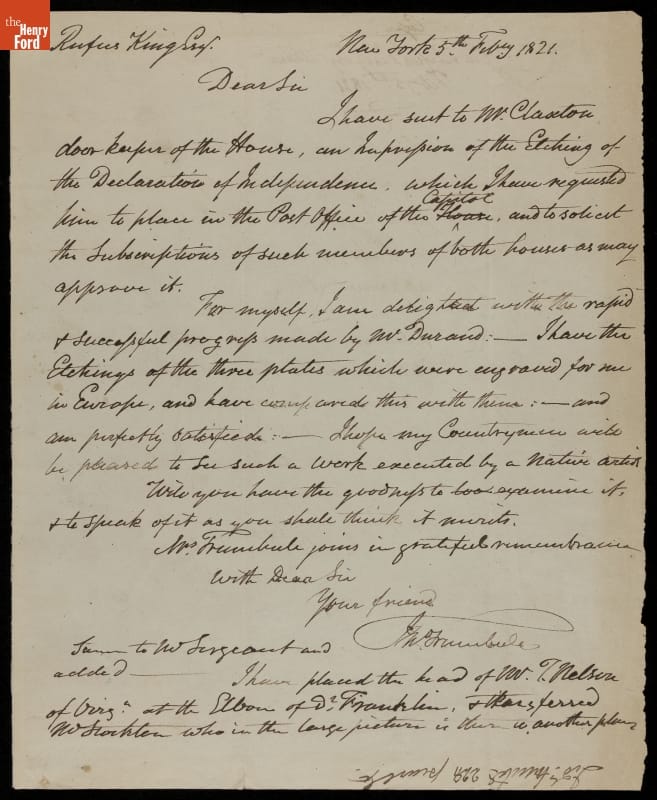
- Letter from John Trumbull to Rufus King, New York, New York, 1821 - In 1817, the U.S. Congress commissioned John Trumbull to paint four Revolutionary-era scenes for the Capitol. As Trumbull completed <EM>Declaration of Independence</EM>, he authorized Asher Durand to create engraving plates of the painting and sent a print to the Capitol Post Office. Trumbull hoped prominent, patriotic citizens, like Senator Rufus King, would approve of the engraver's talent and the print's artistic merit and purchase one.
- February 05, 1821
- Collections - Artifact
Letter from John Trumbull to Rufus King, New York, New York, 1821
In 1817, the U.S. Congress commissioned John Trumbull to paint four Revolutionary-era scenes for the Capitol. As Trumbull completed Declaration of Independence, he authorized Asher Durand to create engraving plates of the painting and sent a print to the Capitol Post Office. Trumbull hoped prominent, patriotic citizens, like Senator Rufus King, would approve of the engraver's talent and the print's artistic merit and purchase one.
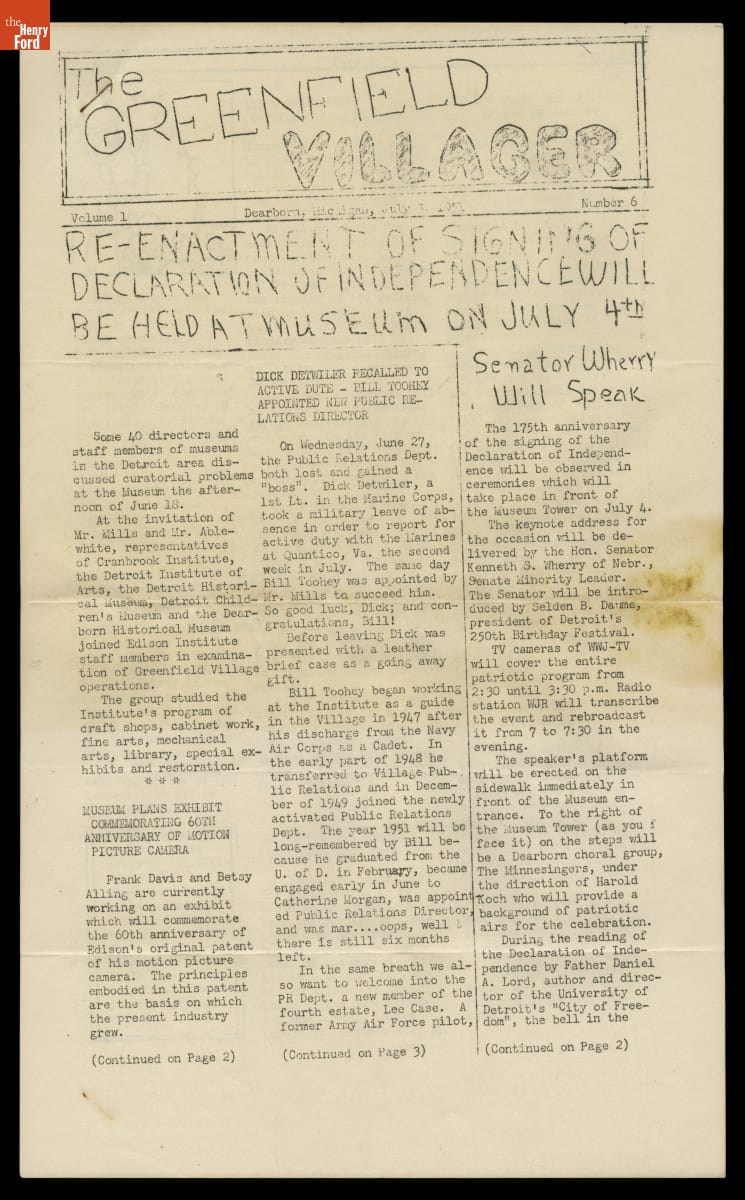
- "The Greenfield Villager," July 3, 1951 - <em>The Greenfield Villager</em> was a regular publication of the Edison Institute created for its employees. First published in 1951, the newspaper kept employees abreast of institutional special events and acquisitions and provided information about employee recreational and educational opportunities, work benefits, and personal milestones. The last issue of <em>The Greenfield Villager</em> came out in 1981.
- July 03, 1951
- Collections - Artifact
"The Greenfield Villager," July 3, 1951
The Greenfield Villager was a regular publication of the Edison Institute created for its employees. First published in 1951, the newspaper kept employees abreast of institutional special events and acquisitions and provided information about employee recreational and educational opportunities, work benefits, and personal milestones. The last issue of The Greenfield Villager came out in 1981.
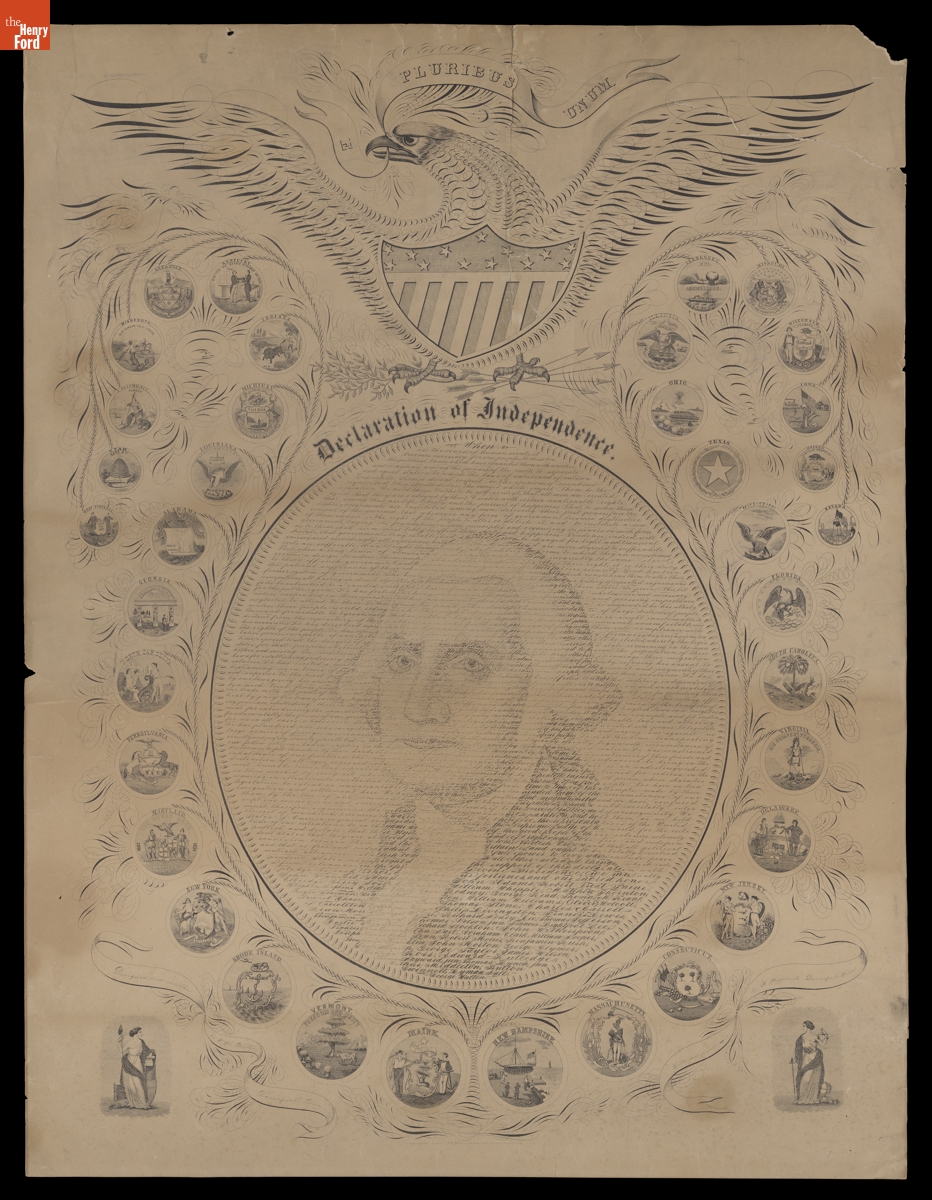
- "Declaration of Independence," Portrait of George Washington, 1865 - In Davenport, Iowa, immediately after the Civil War, William Pratt, a penmanship teacher, and Augustus Hageboeck, a local printer, teamed up to create a chirographic portrait of George Washington. A chirographic portrait renders an image of an individual through handwritten words. Pratt depicted George Washington's likeness -- based on the well-known painting by Gilbert Stuart -- using the words of the Declaration of Independence.
- 1865
- Collections - Artifact
"Declaration of Independence," Portrait of George Washington, 1865
In Davenport, Iowa, immediately after the Civil War, William Pratt, a penmanship teacher, and Augustus Hageboeck, a local printer, teamed up to create a chirographic portrait of George Washington. A chirographic portrait renders an image of an individual through handwritten words. Pratt depicted George Washington's likeness -- based on the well-known painting by Gilbert Stuart -- using the words of the Declaration of Independence.
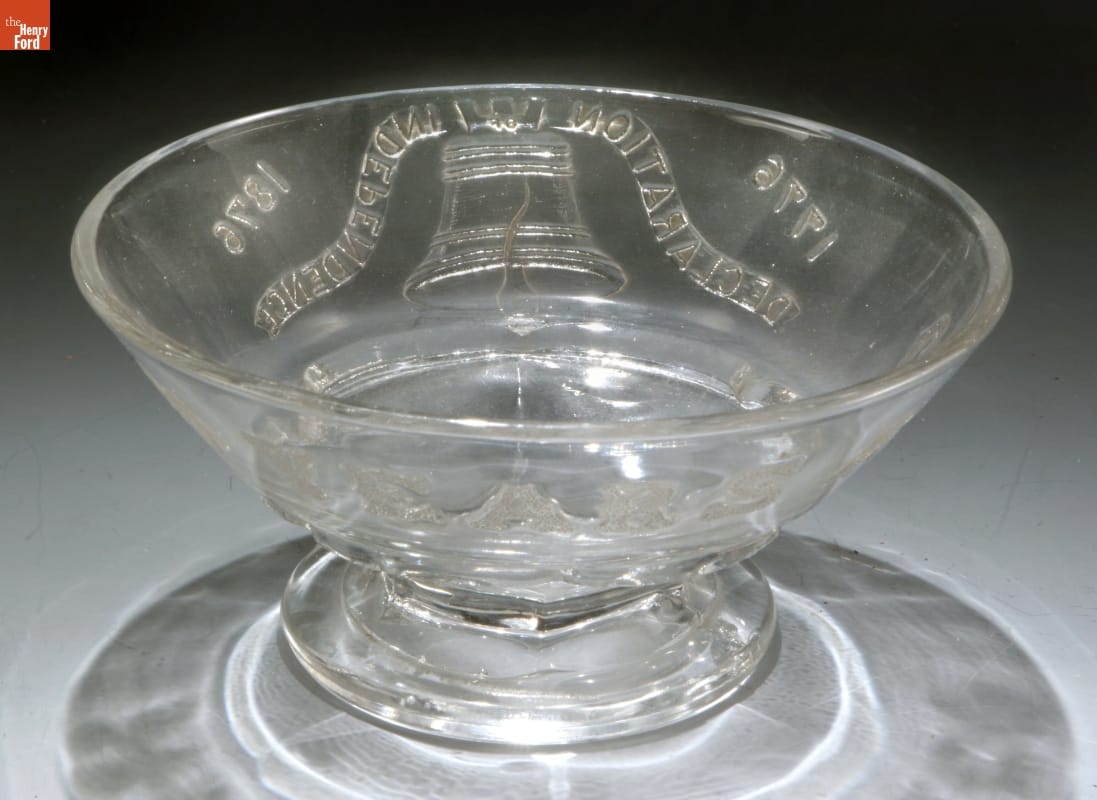
- Commemorative Dish, "Declaration of Independence: 100 Years Ago," 1876 - Glassmakers from around the world, including forty-seven American firms, mounted exhibitions at the 1876 Centennial Exposition in Philadelphia. Gillinder and Sons of Philadelphia constructed an entire working factory. Visitors could watch Gillinder craftsmen blow, press, engrave, and cut glass souvenirs celebrating the 100th anniversary of American independence. This example features an icon of national freedom, the Liberty Bell.
- 1876
- Collections - Artifact
Commemorative Dish, "Declaration of Independence: 100 Years Ago," 1876
Glassmakers from around the world, including forty-seven American firms, mounted exhibitions at the 1876 Centennial Exposition in Philadelphia. Gillinder and Sons of Philadelphia constructed an entire working factory. Visitors could watch Gillinder craftsmen blow, press, engrave, and cut glass souvenirs celebrating the 100th anniversary of American independence. This example features an icon of national freedom, the Liberty Bell.