
Search
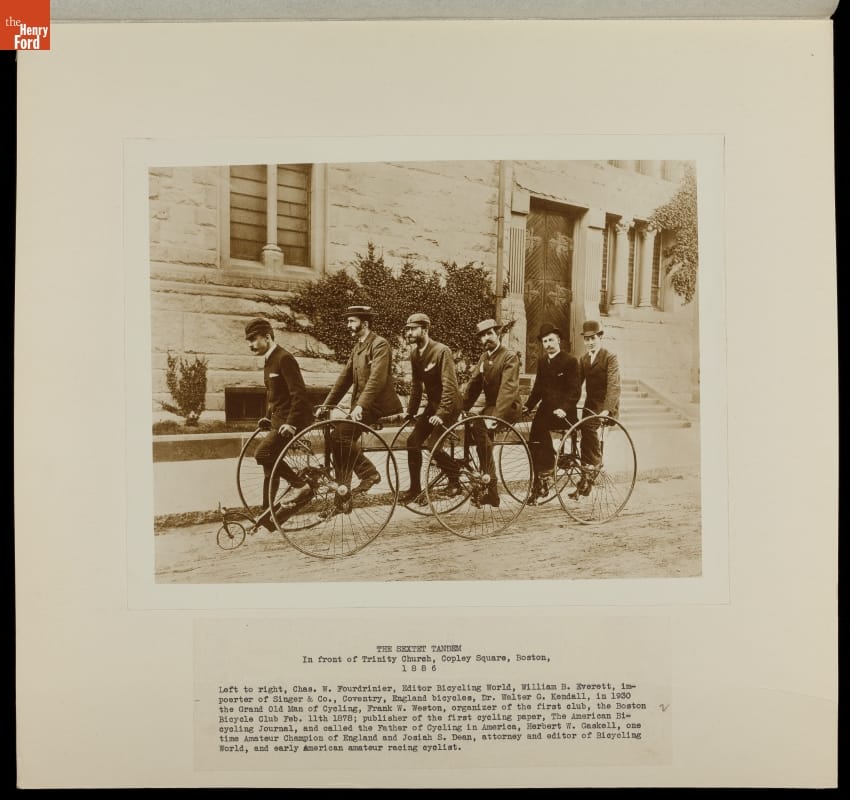
- Men on Sextet High-Wheel Tandem Bicycle, 1886 - Six men pedal a sextet tandem down the streets of Boston, Massachusetts, in 1886. These cycling enthusiasts included local bicycle club members, racers, magazine editors, and bicycle merchants. Large high-wheel bicycles tended to be the preferred mode of transportation among this group and this jaunt probably was taken to promote the benefits of cycling to the general public.
- 1886
- Collections - Artifact
Men on Sextet High-Wheel Tandem Bicycle, 1886
Six men pedal a sextet tandem down the streets of Boston, Massachusetts, in 1886. These cycling enthusiasts included local bicycle club members, racers, magazine editors, and bicycle merchants. Large high-wheel bicycles tended to be the preferred mode of transportation among this group and this jaunt probably was taken to promote the benefits of cycling to the general public.
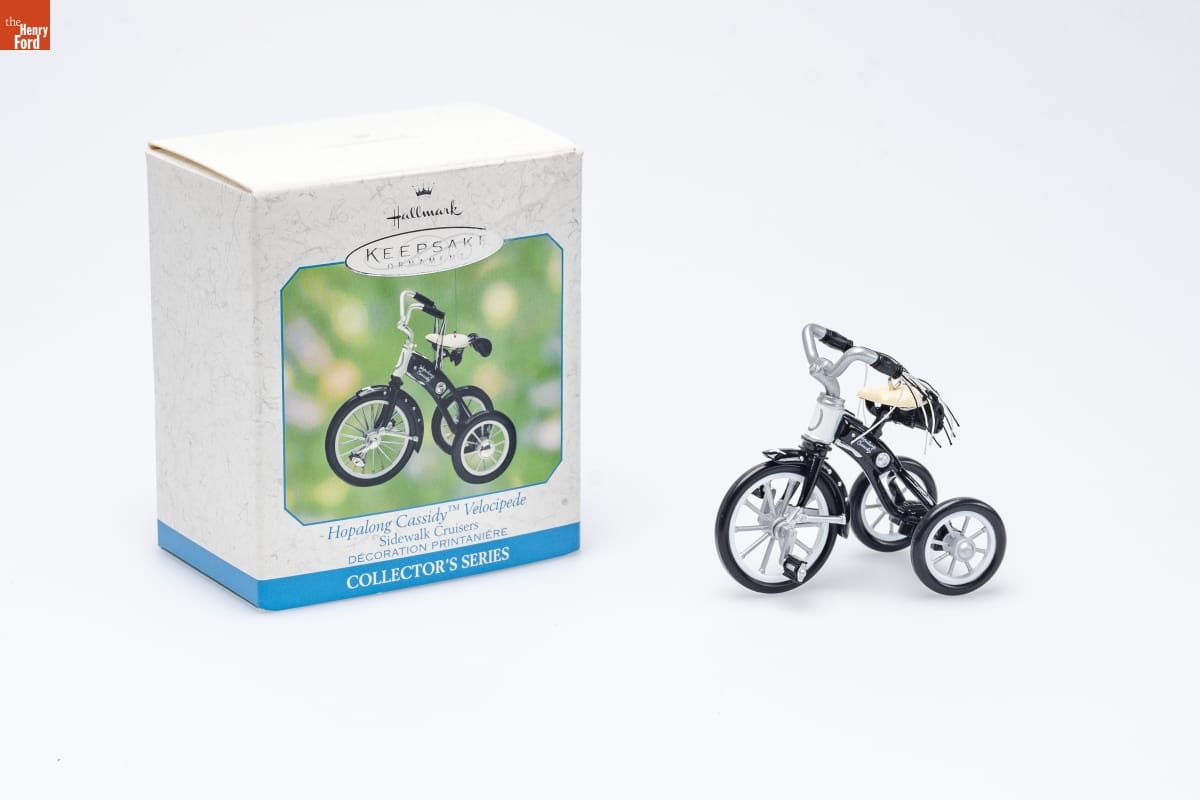
- Hallmark "Sidewalk Cruisers Series: Hopalong Cassidy Velocipede" Spring Ornament, 2000 - Hallmark introduced a line of Christmas ornaments in 1973. These ornaments appealed to customers' interest in marking memories, commemorating milestones, and expressing one's personality and unique tastes. This success led the company to produce ornaments for other holidays. Hallmark marketed and sold Easter and springtime ornaments in several series dating back to the 1990s.
- 2000
- Collections - Artifact
Hallmark "Sidewalk Cruisers Series: Hopalong Cassidy Velocipede" Spring Ornament, 2000
Hallmark introduced a line of Christmas ornaments in 1973. These ornaments appealed to customers' interest in marking memories, commemorating milestones, and expressing one's personality and unique tastes. This success led the company to produce ornaments for other holidays. Hallmark marketed and sold Easter and springtime ornaments in several series dating back to the 1990s.
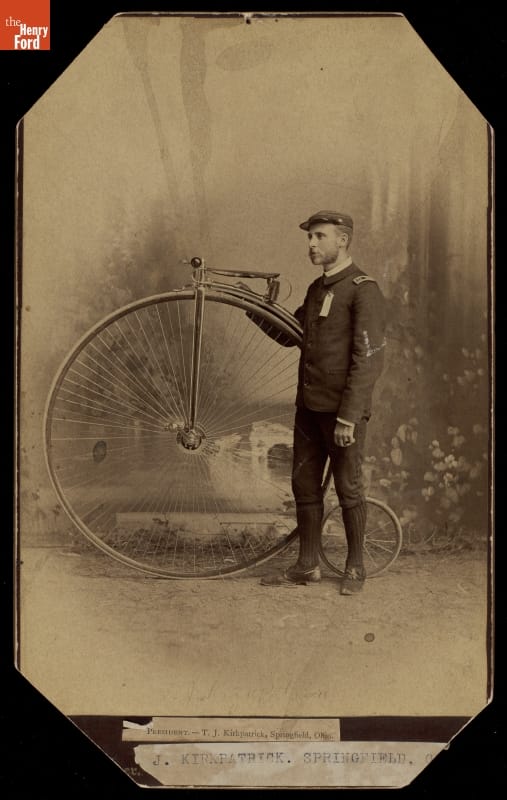
- T. J. Kirkpatrick, President of the League of American Wheelmen, with Velocipede, circa 1889 - Thomas J. Kirkpatrick of Springfield, Ohio, was elected president of the League of American Wheelmen (LAW) in 1887 and 1888. LAW promoted the benefits of cycling and advocated for the creation of better roads. Kirkpatrick would go on to patent a bicycle saddle in the late 1890s.
- circa 1885
- Collections - Artifact
T. J. Kirkpatrick, President of the League of American Wheelmen, with Velocipede, circa 1889
Thomas J. Kirkpatrick of Springfield, Ohio, was elected president of the League of American Wheelmen (LAW) in 1887 and 1888. LAW promoted the benefits of cycling and advocated for the creation of better roads. Kirkpatrick would go on to patent a bicycle saddle in the late 1890s.
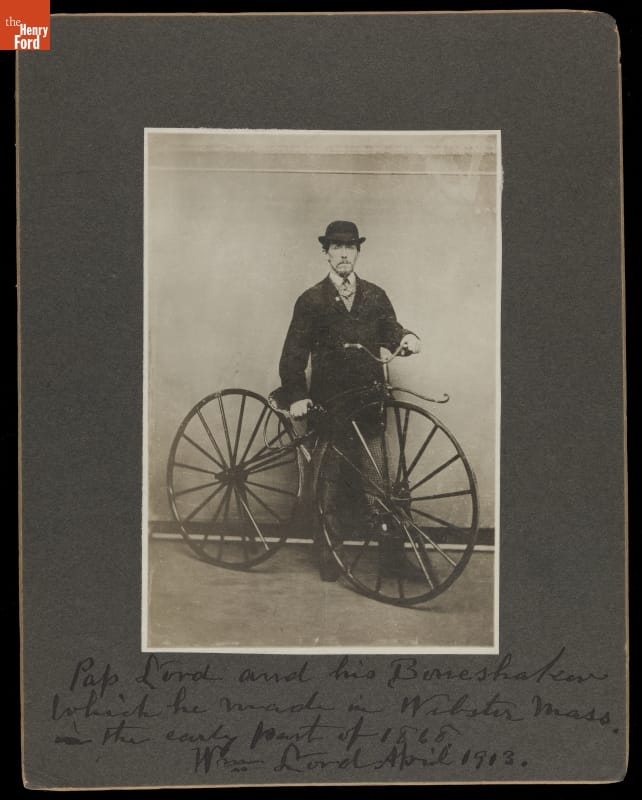
- Pap Lord and his Boneshaker Velocipede, circa 1913 - This photo shows "Pap" Lord posing with his "boneshaker." The notation beneath suggests he made the velocipede in 1868. The velocipede craze swept the United States in the late 1860s, but it did not last long. The velocipede was expensive, it gave a rough ride, and American roads at the time were not conducive to the two-wheeled vehicle.
- 1868
- Collections - Artifact
Pap Lord and his Boneshaker Velocipede, circa 1913
This photo shows "Pap" Lord posing with his "boneshaker." The notation beneath suggests he made the velocipede in 1868. The velocipede craze swept the United States in the late 1860s, but it did not last long. The velocipede was expensive, it gave a rough ride, and American roads at the time were not conducive to the two-wheeled vehicle.
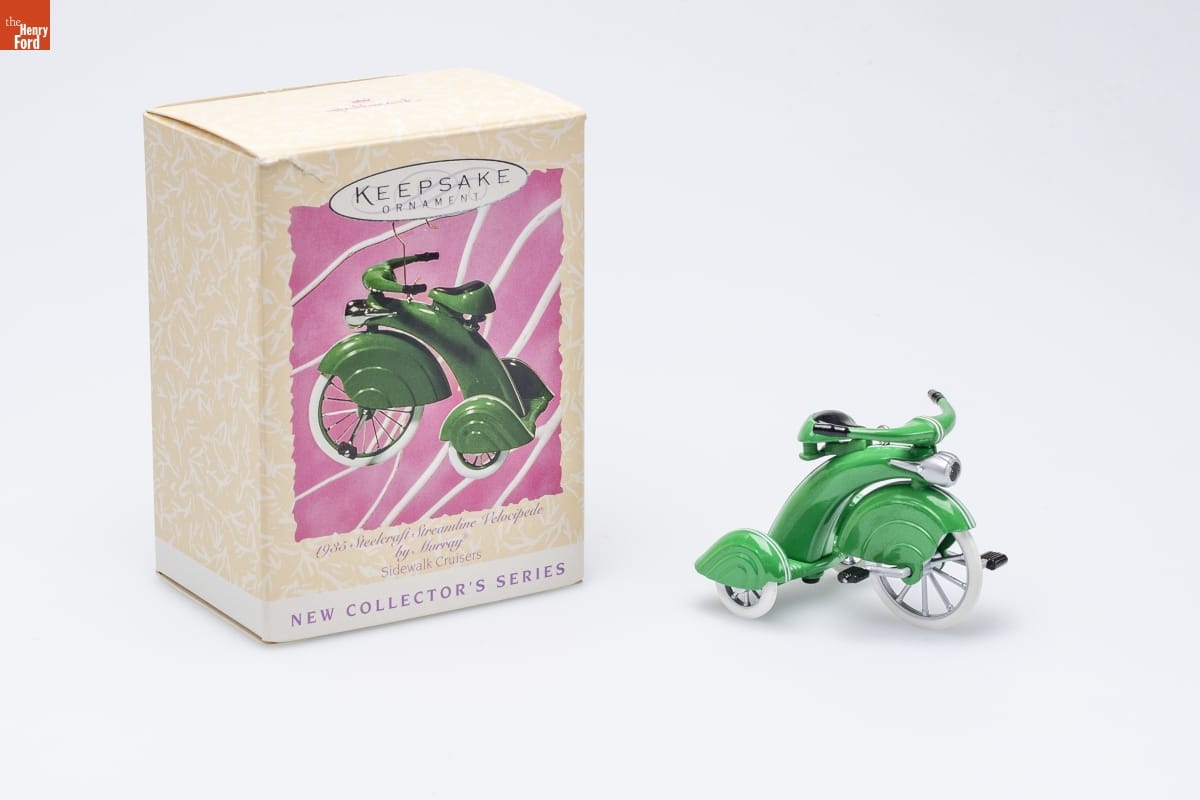
- Hallmark "Sidewalk Cruisers Series: 1935 Steelcraft Streamline Velocipede" Spring Ornament, 1997 - Hallmark introduced a line of Christmas ornaments in 1973. These ornaments appealed to customers' interest in marking memories, commemorating milestones, and expressing one's personality and unique tastes. This success led the company to produce ornaments for other holidays. Hallmark marketed and sold Easter and springtime ornaments in several series dating back to the 1990s.
- 1935
- Collections - Artifact
Hallmark "Sidewalk Cruisers Series: 1935 Steelcraft Streamline Velocipede" Spring Ornament, 1997
Hallmark introduced a line of Christmas ornaments in 1973. These ornaments appealed to customers' interest in marking memories, commemorating milestones, and expressing one's personality and unique tastes. This success led the company to produce ornaments for other holidays. Hallmark marketed and sold Easter and springtime ornaments in several series dating back to the 1990s.
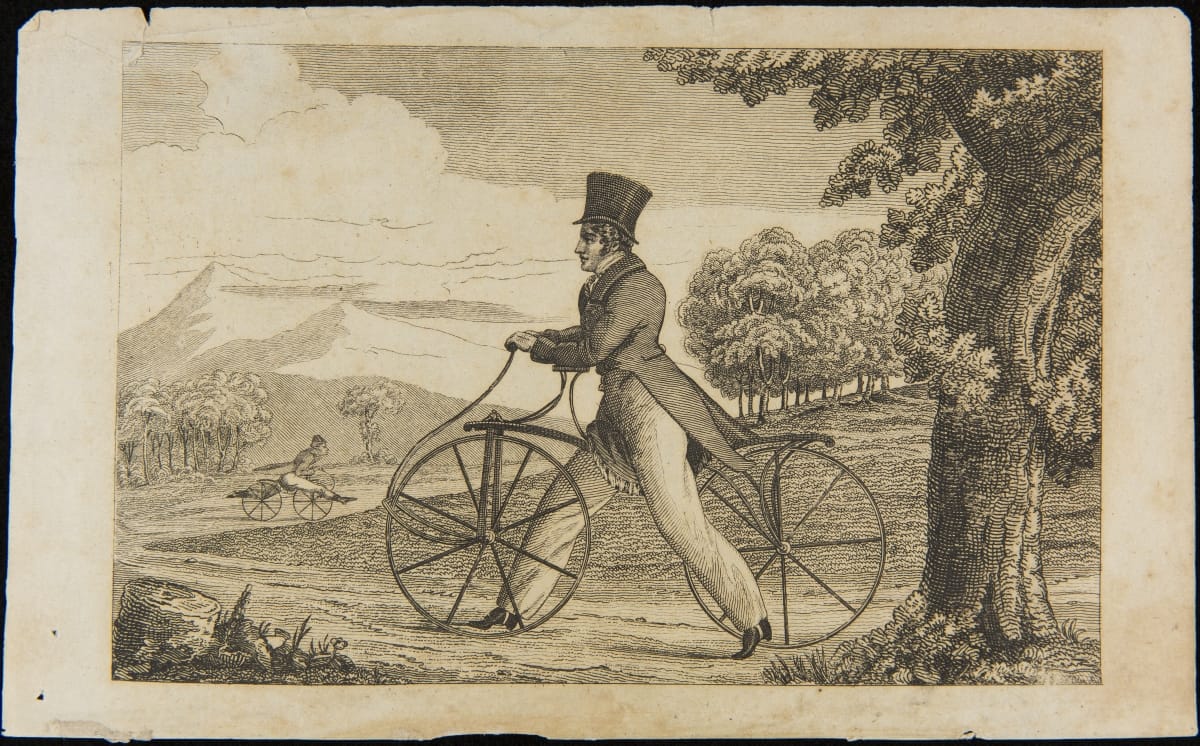
- Man Riding a Velocipede, circa 1819 - The first forerunners to the bicycle appeared in the 1810s. These two-wheeled vehicles were called velocipedes -- an adaptation of the Latin phrase "velox pedis," meaning "swift of foot." The earliest versions had no pedals or crank mechanisms. Riders simply scooted along using foot power.
- circa 1819
- Collections - Artifact
Man Riding a Velocipede, circa 1819
The first forerunners to the bicycle appeared in the 1810s. These two-wheeled vehicles were called velocipedes -- an adaptation of the Latin phrase "velox pedis," meaning "swift of foot." The earliest versions had no pedals or crank mechanisms. Riders simply scooted along using foot power.
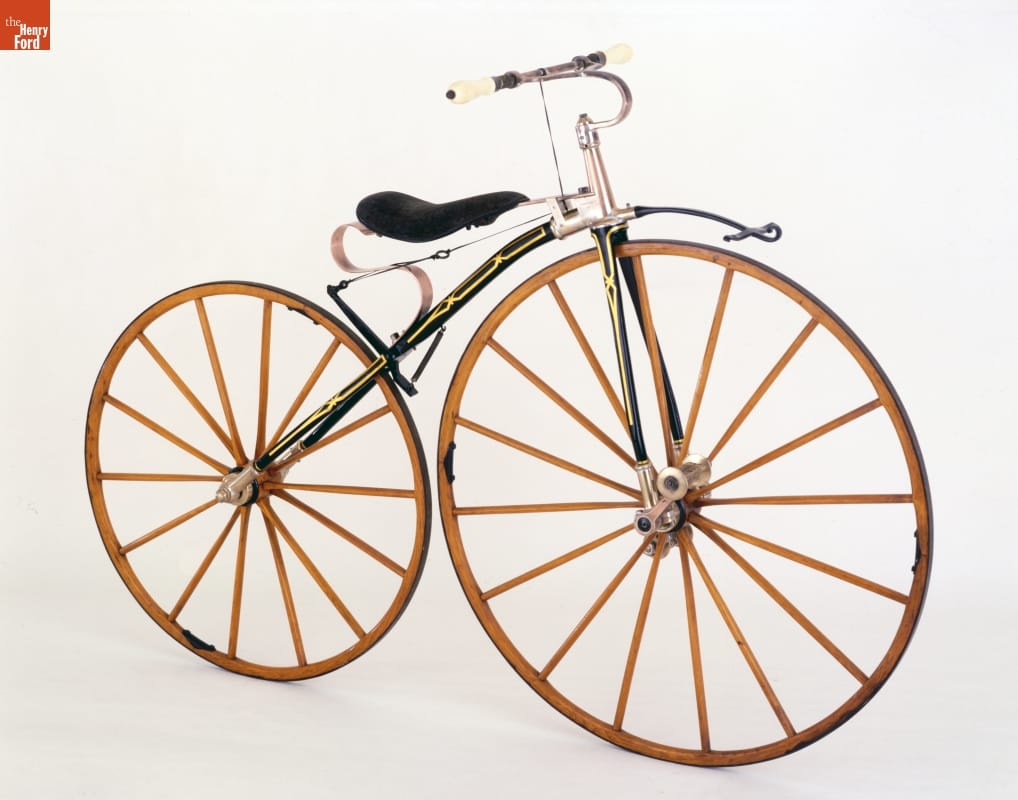
- Pickering Velocipede, circa 1870 - Pickering and Davis of New York developed this velocipede to be durable enough to travel the American roads of the late 1860s. It featured smaller wheels, a lower frame, and sprung handlebars to reduce road shock. The machine's backbone was made from an iron tube rather than cast iron, creating a slightly lighter yet strong vehicle.
- circa 1870
- Collections - Artifact
Pickering Velocipede, circa 1870
Pickering and Davis of New York developed this velocipede to be durable enough to travel the American roads of the late 1860s. It featured smaller wheels, a lower frame, and sprung handlebars to reduce road shock. The machine's backbone was made from an iron tube rather than cast iron, creating a slightly lighter yet strong vehicle.
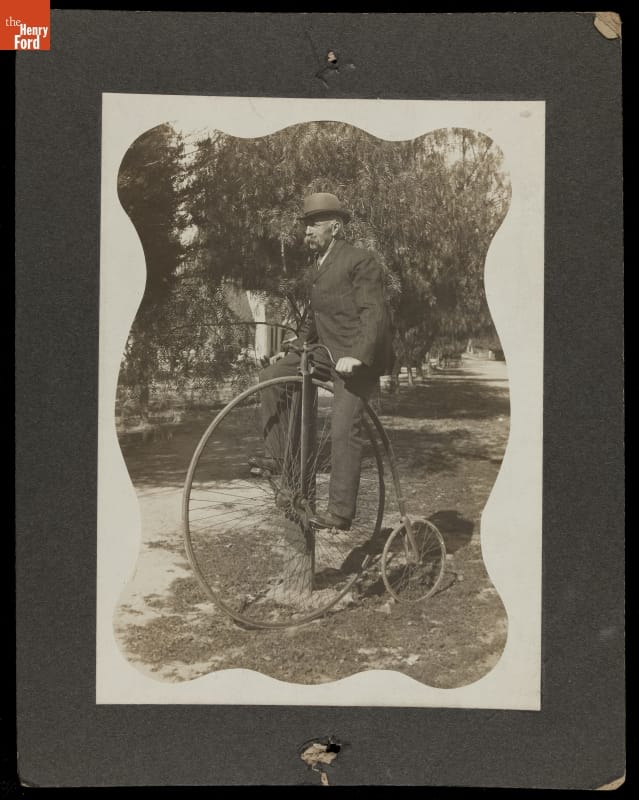
- Edward P. Burnham on His Velocipede, circa 1905 - Edward P. Burnham of Newton, Massachusetts, was a longtime cyclist. In the 1880s he raced bicycles and tricycles and held the ten-mile championship record for 1885. He kept his high-wheel machine when he moved to California after the turn-of-the-century. He also rode it occasionally for special cycling events. This photograph shows Burnham atop his vehicle in the early 1900s.
- circa 1905
- Collections - Artifact
Edward P. Burnham on His Velocipede, circa 1905
Edward P. Burnham of Newton, Massachusetts, was a longtime cyclist. In the 1880s he raced bicycles and tricycles and held the ten-mile championship record for 1885. He kept his high-wheel machine when he moved to California after the turn-of-the-century. He also rode it occasionally for special cycling events. This photograph shows Burnham atop his vehicle in the early 1900s.
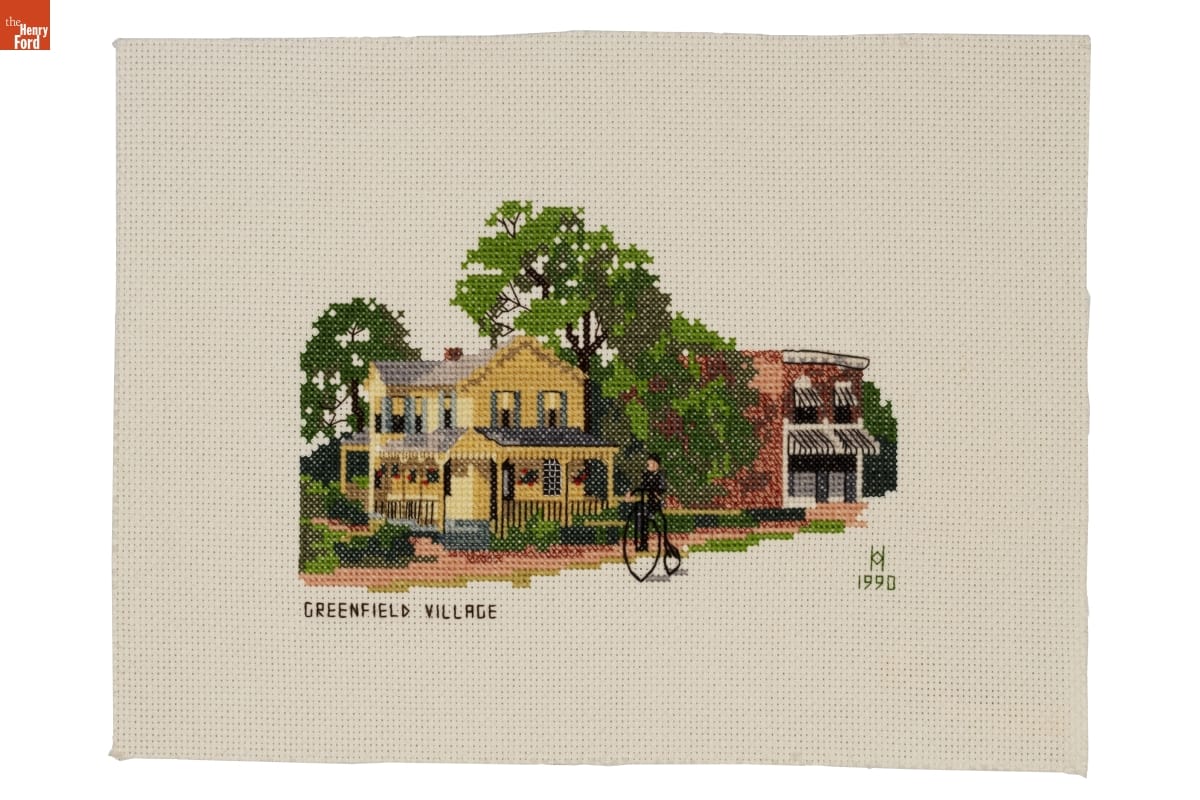
- Wright Home and Cycle Shop Cross Stitch, 1990 -
- 1990
- Collections - Artifact
Wright Home and Cycle Shop Cross Stitch, 1990
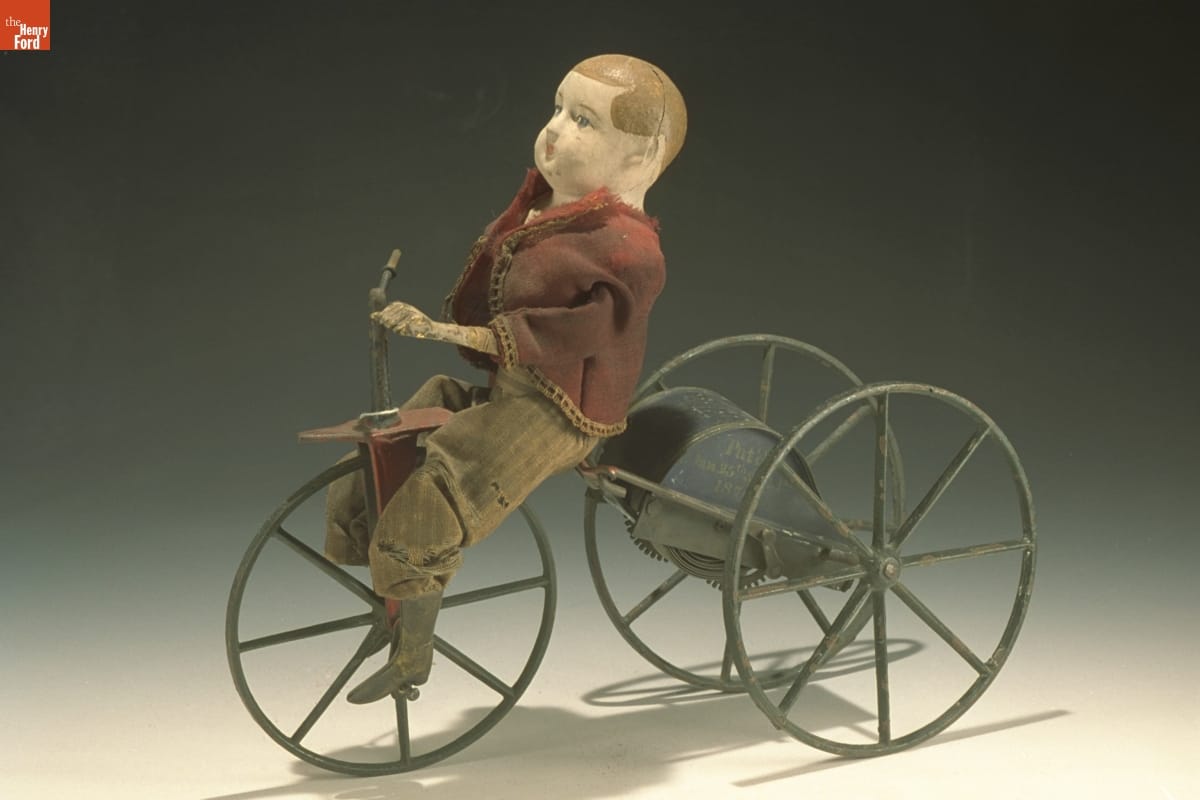
- Boy on Mechanical Velocipede, 1870 - Toy makers have long experimented with ways that toys could simulate human and other real-life action. Key-wound clockwork mechanisms, mass produced by the late 1800s, revolutionized the toy world. In this toy, when a key is wound, the mechanism mounted between the wheels causes the boy's legs to pedal, moving the velocipede forward.
- 1870
- Collections - Artifact
Boy on Mechanical Velocipede, 1870
Toy makers have long experimented with ways that toys could simulate human and other real-life action. Key-wound clockwork mechanisms, mass produced by the late 1800s, revolutionized the toy world. In this toy, when a key is wound, the mechanism mounted between the wheels causes the boy's legs to pedal, moving the velocipede forward.