
Search
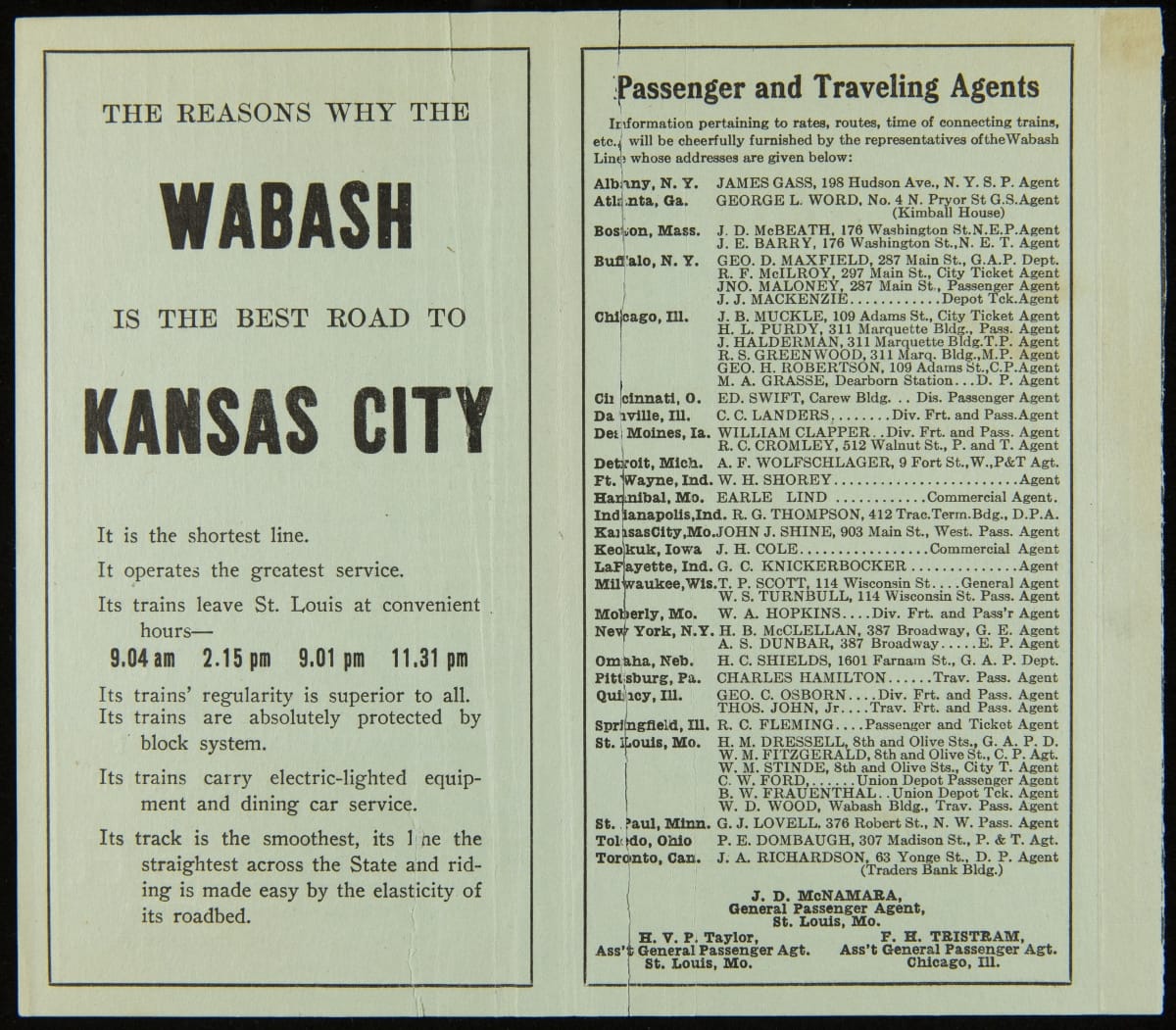
- Wabash Round Trip Homeseekers' Fares to the West and Southwest, On Sale Every First and Third Friday of Each Month, 1910, Via Wabash R.R. - The Wabash Railway, with origins dating back to 1838, was a strong Midwestern carrier until Amtrak took over the national passenger railroad system in 1971. This timetable promoted Wabash's service to Kansas City. Special "homeseekers" or "colonist" fares provided low-cost, one-way service for immigrants traveling to start new lives in the western United States.
- 1910
- Collections - Artifact
Wabash Round Trip Homeseekers' Fares to the West and Southwest, On Sale Every First and Third Friday of Each Month, 1910, Via Wabash R.R.
The Wabash Railway, with origins dating back to 1838, was a strong Midwestern carrier until Amtrak took over the national passenger railroad system in 1971. This timetable promoted Wabash's service to Kansas City. Special "homeseekers" or "colonist" fares provided low-cost, one-way service for immigrants traveling to start new lives in the western United States.
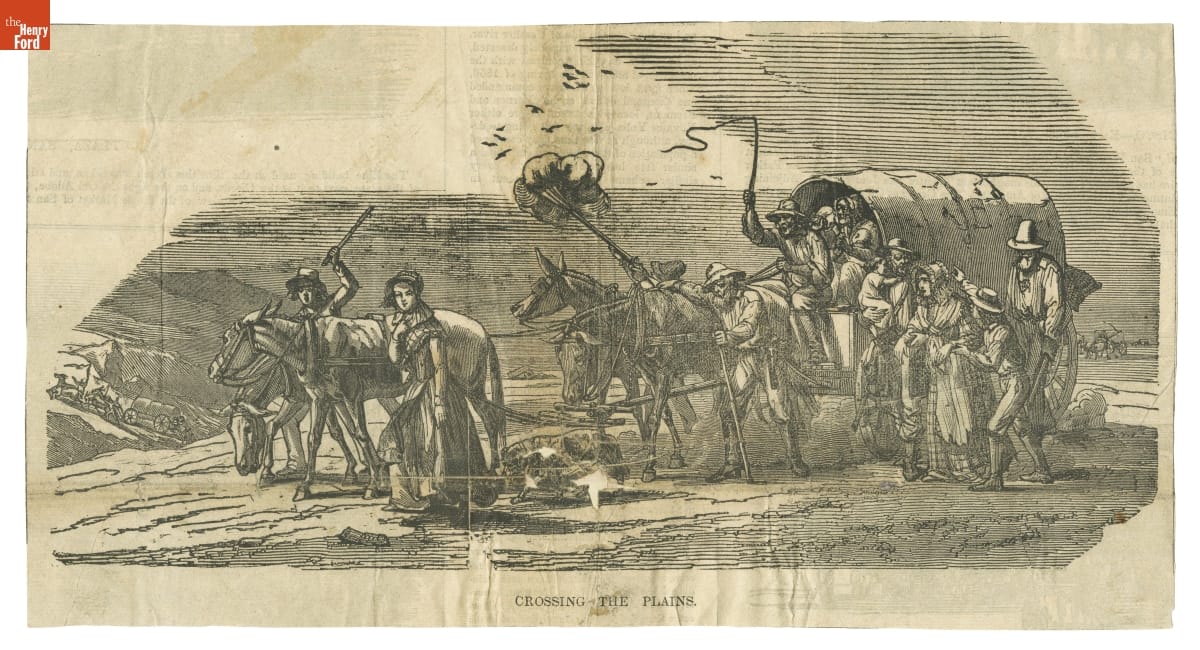
- A Party of Emigrants to California, Crossing the Plains, 1852 - Soon after the Mexican-American War ended in 1848, the newly acquired territory of California became the destination of hundreds of thousands of Americans, especially after gold was discovered at Sutter's Mill outside Sacramento. The California Gold Rush pulled Americans across the continent. This wood engraving is one of the few known portrayals of the migrations created at that time.
- January 01, 1852
- Collections - Artifact
A Party of Emigrants to California, Crossing the Plains, 1852
Soon after the Mexican-American War ended in 1848, the newly acquired territory of California became the destination of hundreds of thousands of Americans, especially after gold was discovered at Sutter's Mill outside Sacramento. The California Gold Rush pulled Americans across the continent. This wood engraving is one of the few known portrayals of the migrations created at that time.
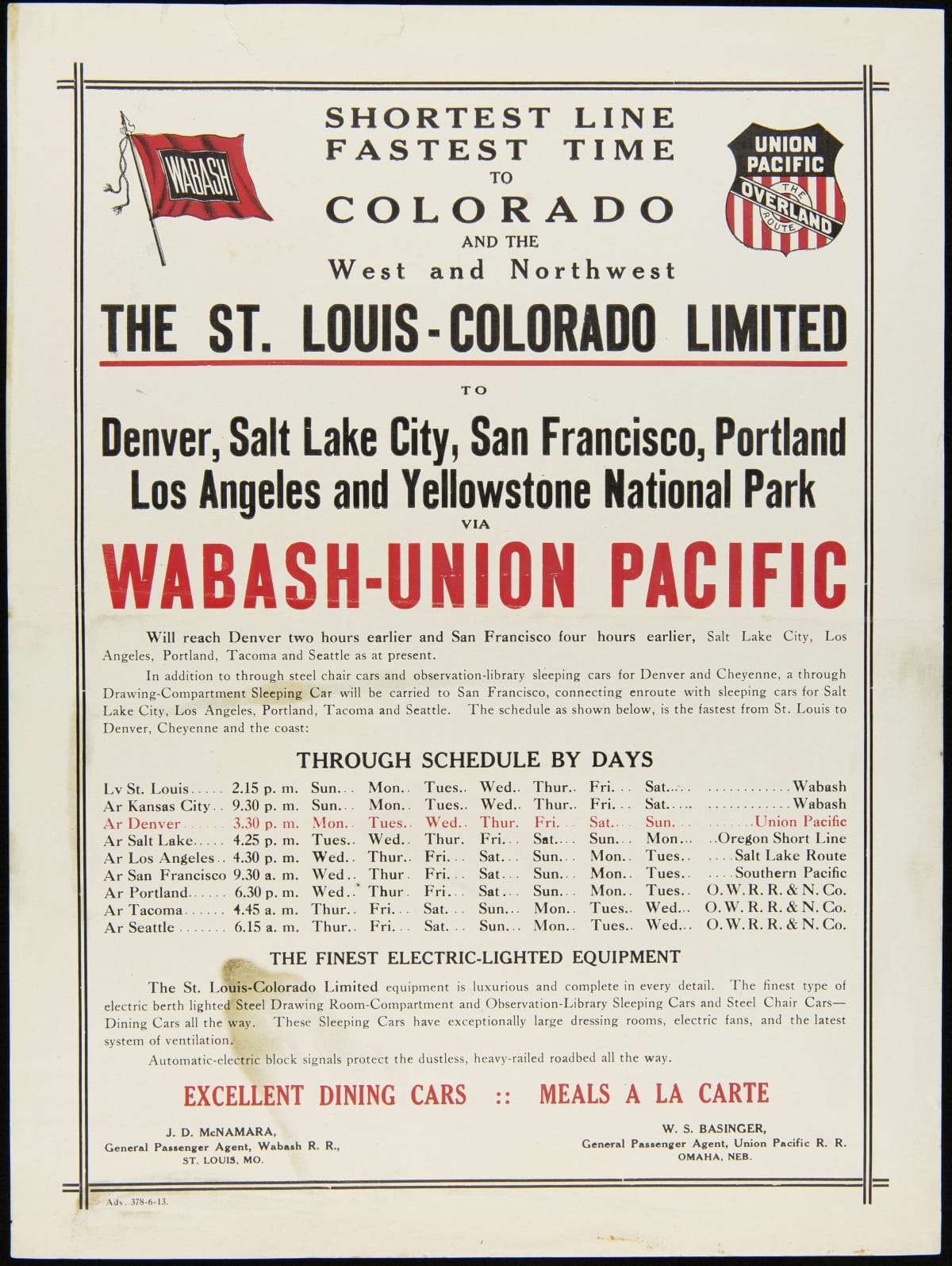
- Shortest Line, Fastest Time to Colorado and the West and Northwest - The St. Louis Colorado Limited, 1913 - The Wabash Railway, with origins dating back to 1838, was a strong Midwestern carrier until Amtrak took over the national passenger railroad system in 1971. Railroads made Yellowstone National Park accessible to tourists until cross-country automobile travel became feasible and popular. This timetable promoted Wabash's through trains to Yellowstone, operated in partnership with Union Pacific.
- 1913
- Collections - Artifact
Shortest Line, Fastest Time to Colorado and the West and Northwest - The St. Louis Colorado Limited, 1913
The Wabash Railway, with origins dating back to 1838, was a strong Midwestern carrier until Amtrak took over the national passenger railroad system in 1971. Railroads made Yellowstone National Park accessible to tourists until cross-country automobile travel became feasible and popular. This timetable promoted Wabash's through trains to Yellowstone, operated in partnership with Union Pacific.
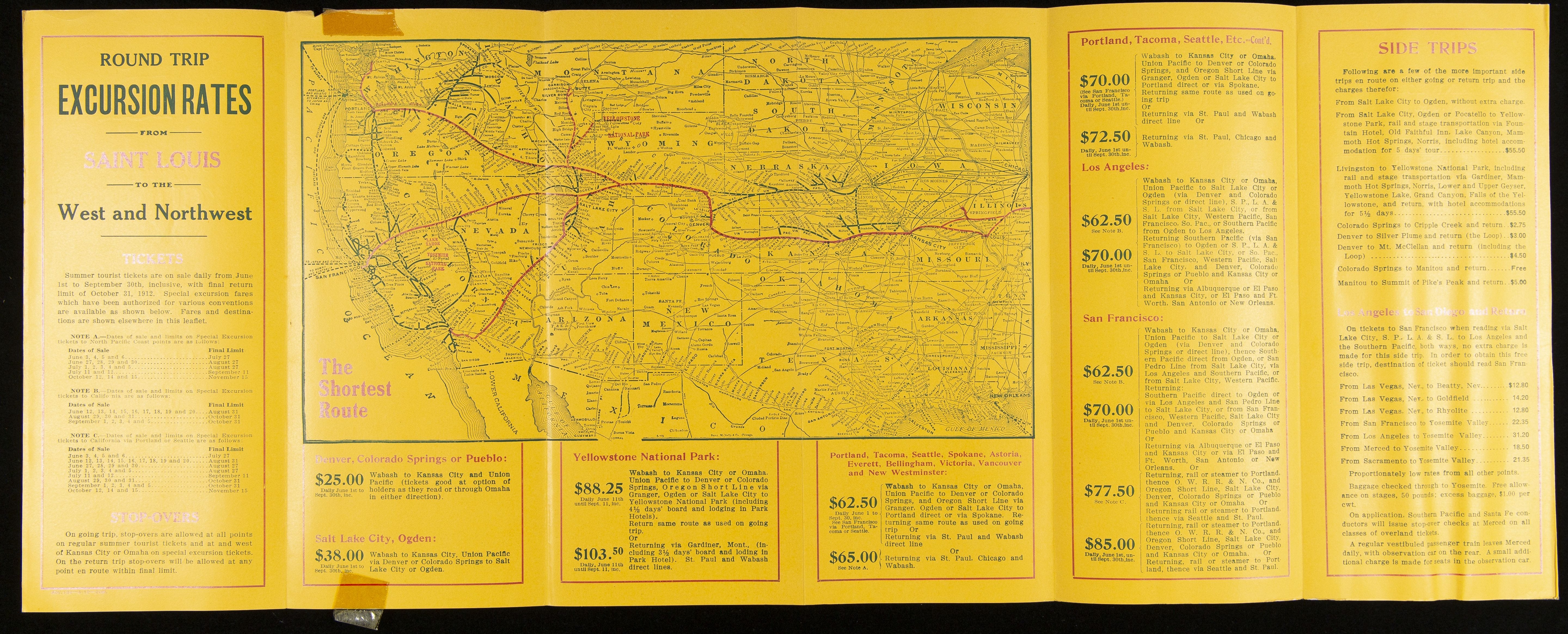
- Wabash-Union Pacific Low Colonist Fares Every Day from March 15 to April 15, 1913 Inclusive - The Wabash Railway, with origins dating back to 1838, was a strong Midwestern carrier until Amtrak took over the national passenger railroad system in 1971. This timetable advertised Wabash's passenger trains to the western United States, operated jointly with Union Pacific. Low-cost "colonist" fares were offered to attract immigrant travelers heading west to start new lives.
- 15 March to 15 April 1913
- Collections - Artifact
Wabash-Union Pacific Low Colonist Fares Every Day from March 15 to April 15, 1913 Inclusive
The Wabash Railway, with origins dating back to 1838, was a strong Midwestern carrier until Amtrak took over the national passenger railroad system in 1971. This timetable advertised Wabash's passenger trains to the western United States, operated jointly with Union Pacific. Low-cost "colonist" fares were offered to attract immigrant travelers heading west to start new lives.
- Letter by California Gold Rush Venturer Charles A. Wood, Written from the Isthmus of Panama, February 1, 1850 - Letter from Charles A. Wood to his wife, Caroline Wood in Neponsett, MA, dated New Oranada, Panama, February 1, 1850, giving a description of his overland trip through the Isthmus of Panama from Yankeetown (Chagres) to New Oranada as part of his journey to California. He gives a detailed description of Yankeetown and Chagres; the vegetation and physical configuration of the jungles; the natives; the "ranchos" owned by Americans which were visited along the route; the conditions on board the steamship "Cherokee" which brought him to Panama; the inland town of Gorgona. Also included is one leaf on which is drawn a rough diagram of the settlement at Yankeetown and a picture of a "rancho" on the River Chagre "as seen from a canoe". On the reverse is a rough architectural drawings of a church and a courthouse.
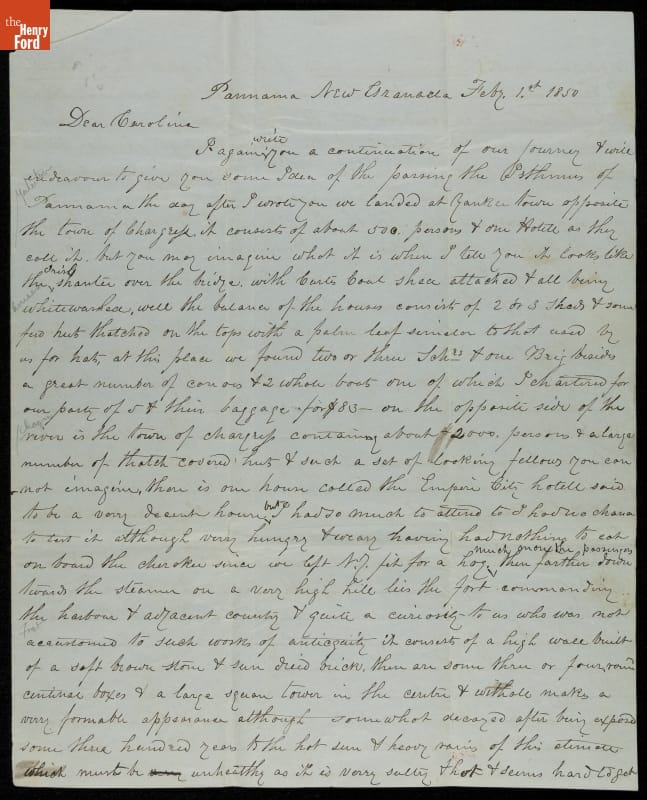
- February 01, 1850
- Collections - Artifact
Letter by California Gold Rush Venturer Charles A. Wood, Written from the Isthmus of Panama, February 1, 1850
Letter from Charles A. Wood to his wife, Caroline Wood in Neponsett, MA, dated New Oranada, Panama, February 1, 1850, giving a description of his overland trip through the Isthmus of Panama from Yankeetown (Chagres) to New Oranada as part of his journey to California. He gives a detailed description of Yankeetown and Chagres; the vegetation and physical configuration of the jungles; the natives; the "ranchos" owned by Americans which were visited along the route; the conditions on board the steamship "Cherokee" which brought him to Panama; the inland town of Gorgona. Also included is one leaf on which is drawn a rough diagram of the settlement at Yankeetown and a picture of a "rancho" on the River Chagre "as seen from a canoe". On the reverse is a rough architectural drawings of a church and a courthouse.
- Letter by California Gold Rush Venturer Charles A. Wood, Written from Chagres Port, Panama, January 26, 1850 - Letter from Charles A. Wood to his wife, Caroline Wood in Neponsett, Mass., dated on board the Steamship "Cherokee" at the port of Chargres (Chagres), Panama, January 26, 1850, concerning the first leg of his trip from New York to the California gold fields by way of Panama. He tells of the people he has met, including Mr. Chamberlain, Mr. Churchman, Mr. Wilder, David Allen (U.S. Consul to the Sandwich Islands), George Welles, and Chris Lilley, a Prizefighter, among others; the ships they have passed, including the Caicos, Empire City, Alabama, Falcon and Severn. He also describes in detail the port of Chagres and the conditions onboard the Cherokee, and gives the latest word from California (i.e., a fire at San Francisco and a murder at Stockton).
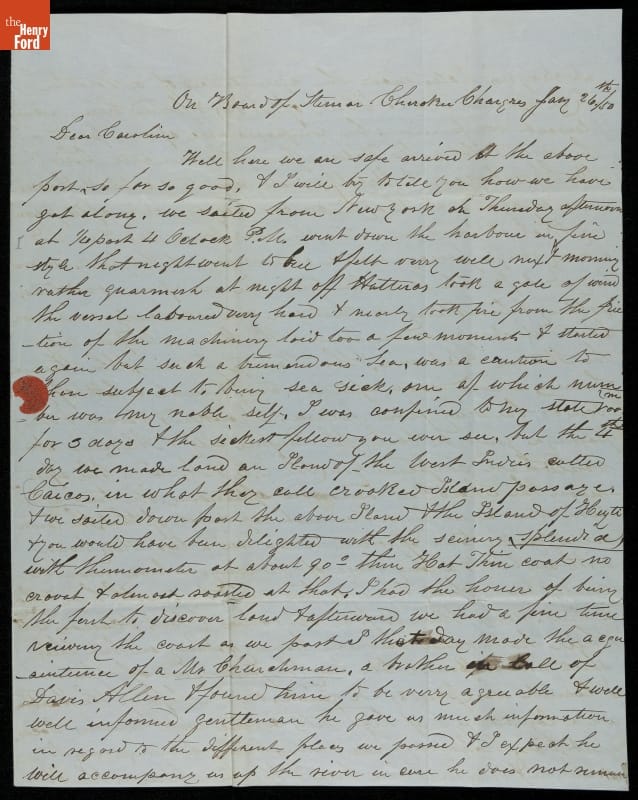
- January 26, 1850
- Collections - Artifact
Letter by California Gold Rush Venturer Charles A. Wood, Written from Chagres Port, Panama, January 26, 1850
Letter from Charles A. Wood to his wife, Caroline Wood in Neponsett, Mass., dated on board the Steamship "Cherokee" at the port of Chargres (Chagres), Panama, January 26, 1850, concerning the first leg of his trip from New York to the California gold fields by way of Panama. He tells of the people he has met, including Mr. Chamberlain, Mr. Churchman, Mr. Wilder, David Allen (U.S. Consul to the Sandwich Islands), George Welles, and Chris Lilley, a Prizefighter, among others; the ships they have passed, including the Caicos, Empire City, Alabama, Falcon and Severn. He also describes in detail the port of Chagres and the conditions onboard the Cherokee, and gives the latest word from California (i.e., a fire at San Francisco and a murder at Stockton).
- Letter by California Gold Rush Venturer Charles A. Wood, Written from Acapulco, Mexico, February 10, 1850 - Letter from Charles A. Wood to his wife, Caroline Wood in Neponsett, Massachusetts, dated Acapulco, Mexico, February 10, 1850, describing his voyage from Panama to Acapulco undertaken as part of his journey to California. He describes in detail his voyage including the outbreak of seasickness among the passengers; gives the latest word from the California gold fields which was received from the steamship <em>California</em> out of the port of San Francisco; and describes the city of Acapulco.
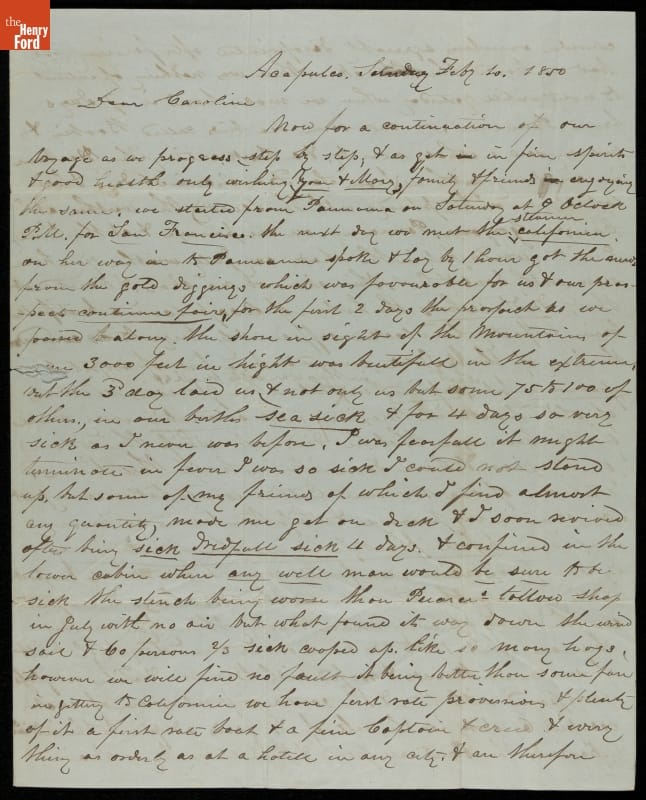
- February 10, 1850
- Collections - Artifact
Letter by California Gold Rush Venturer Charles A. Wood, Written from Acapulco, Mexico, February 10, 1850
Letter from Charles A. Wood to his wife, Caroline Wood in Neponsett, Massachusetts, dated Acapulco, Mexico, February 10, 1850, describing his voyage from Panama to Acapulco undertaken as part of his journey to California. He describes in detail his voyage including the outbreak of seasickness among the passengers; gives the latest word from the California gold fields which was received from the steamship California out of the port of San Francisco; and describes the city of Acapulco.
- Trade Card for Ariosa Coffee, Arbuckle Bros., "Indian Territory and Oklahoma," 1892 - As color printing gained momentum in the late 19th century, trade cards were a major means of advertising goods and services. Americans enjoyed and often saved the vibrant little advertisements found in product packages or distributed by local merchants. This trade card for Arbuckle Bros. Coffee Company provides information about its Ariosa coffee and features a colorful image in a series depicting the United States and its territories.
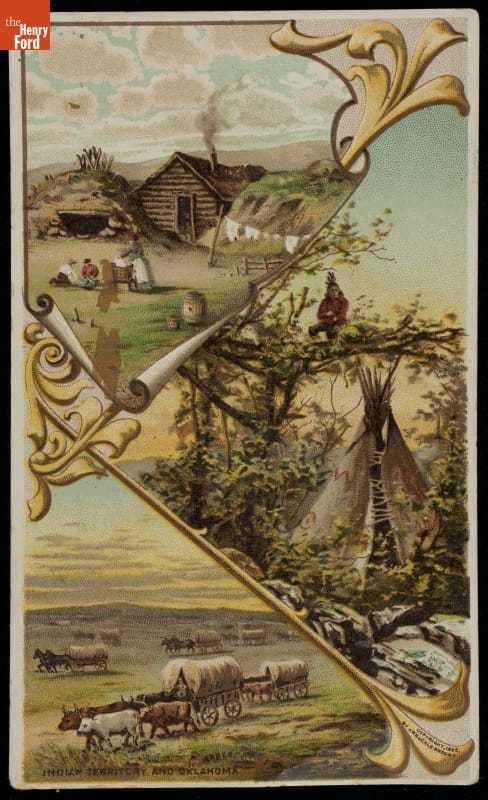
- 1892
- Collections - Artifact
Trade Card for Ariosa Coffee, Arbuckle Bros., "Indian Territory and Oklahoma," 1892
As color printing gained momentum in the late 19th century, trade cards were a major means of advertising goods and services. Americans enjoyed and often saved the vibrant little advertisements found in product packages or distributed by local merchants. This trade card for Arbuckle Bros. Coffee Company provides information about its Ariosa coffee and features a colorful image in a series depicting the United States and its territories.
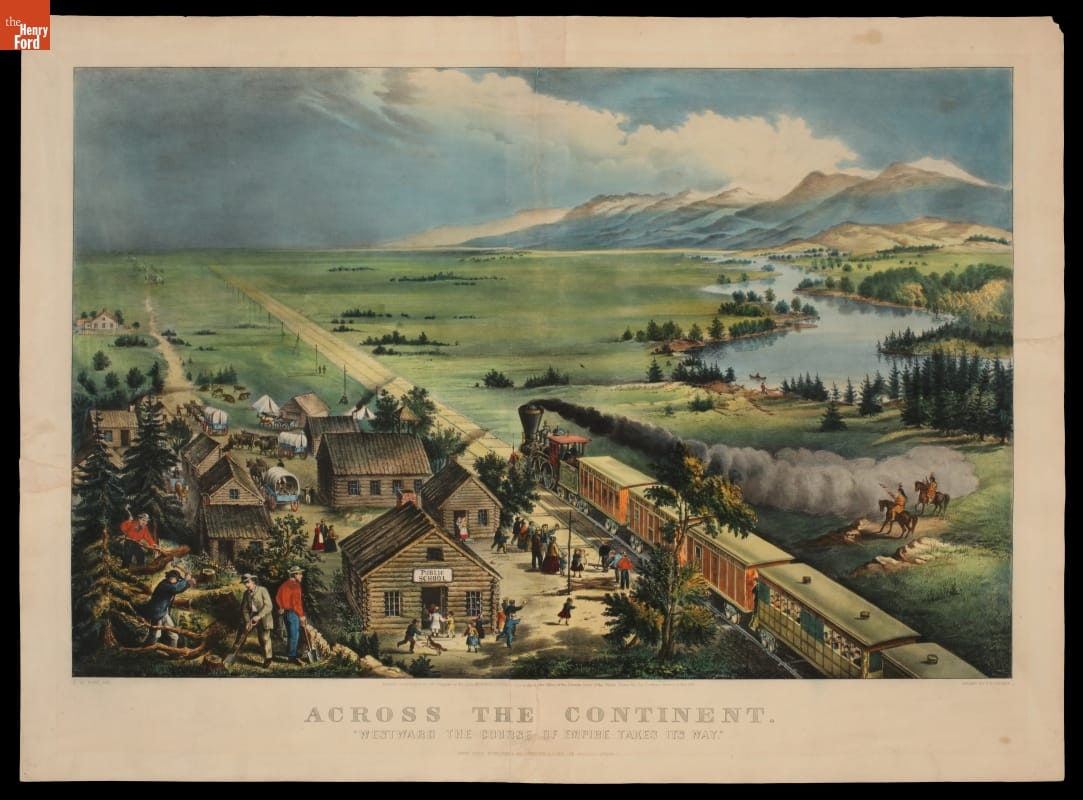
- "Westward the Course of Empire Takes Its Way," 1868 - This 1868 Currier and Ives lithograph captures a 19th-century American's view of westward expansion. The New York to San Francisco through-line train leaves the "civilized" foreground -- land being cleared of forests and dotted with a school, church and homes. The tracks lead to a vast untapped openness while they separate and bypass native peoples and the wilderness.
- 1868
- Collections - Artifact
"Westward the Course of Empire Takes Its Way," 1868
This 1868 Currier and Ives lithograph captures a 19th-century American's view of westward expansion. The New York to San Francisco through-line train leaves the "civilized" foreground -- land being cleared of forests and dotted with a school, church and homes. The tracks lead to a vast untapped openness while they separate and bypass native peoples and the wilderness.
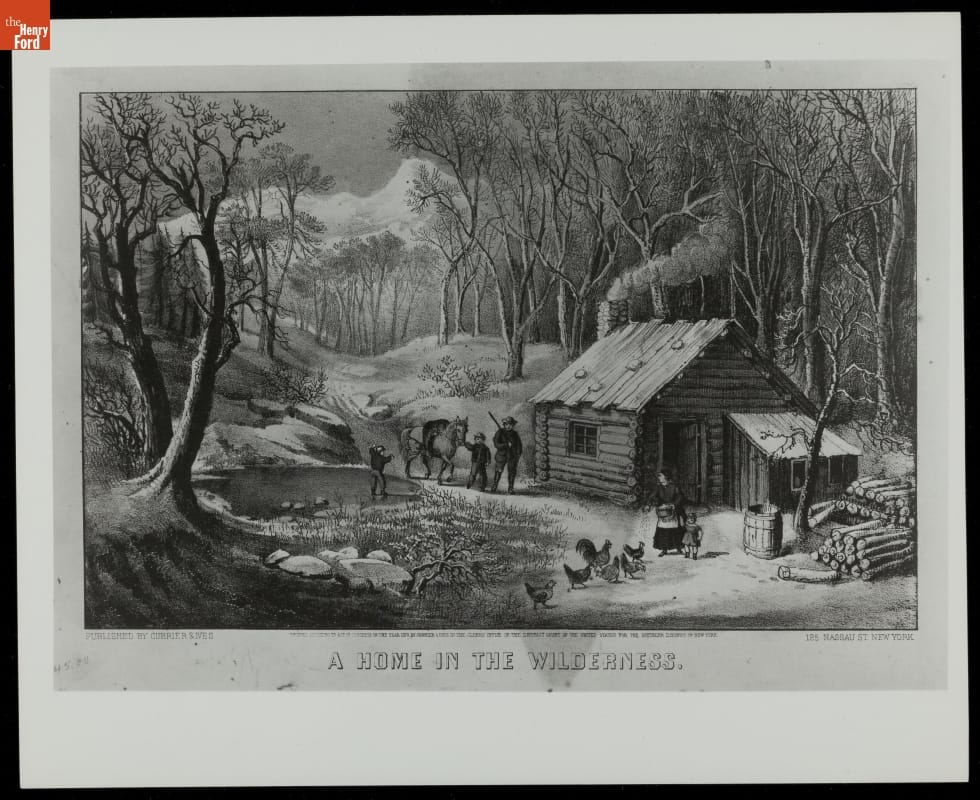
- "A Home in the Wilderness" (Photograph of a Lithograph), circa 1870 -
- circa 1870
- Collections - Artifact
"A Home in the Wilderness" (Photograph of a Lithograph), circa 1870