Engines Exposed: Power, Performance and Innovation
15 artifacts in this set
This expert set is brought to you by:
The staff at The Henry Ford
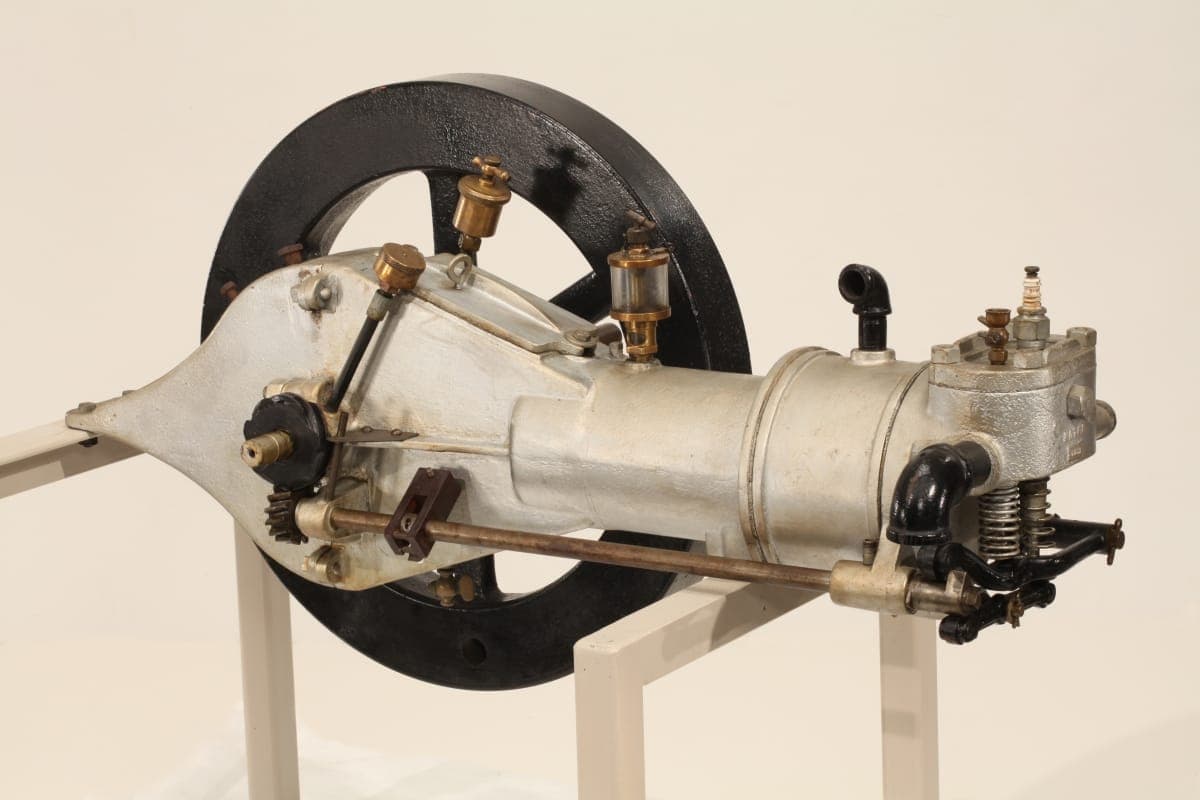
De Dion-Bouton Engine, circa 1900
Automobile engine
Jules-Albert de Dion and George Bouton initially set out to build steam-powered automobiles, but they were soon convinced that gasoline was the future. Their company's one-cylinder gasoline engine, introduced in 1895, was perhaps the first high-speed, lightweight internal combustion engine -- operating at around 2,000 rpm and weighing 40 pounds. De Dion-Bouton supplied engines to other automakers throughout the world.
Oldsmobile 1-cylinder Engine, circa 1903
Automobile engine
This single-cylinder, four-horsepower engine powered the Oldsmobile Curved Dash runabout. It has one cylinder, one piston, one connecting rod and crank, one balance wheel, and two valves. The complications of larger multi-cylinder engines were eliminated. The engine's simplicity and the vehicle's affordable $650 price made the Curved Dash runabout America's first car produced in large numbers.
Ford Model N Inline 4-cylinder Engine, 1906
Automobile engine
Henry Ford's vision was to create light, low-priced automobiles with an "up-to-date engine with ample horsepower, and built of the very best material." This inexpensive engine powered the 1906 Ford Model N. Its four cylinders provided 15 horsepower and the capability of driving 45 miles per hour. At $500, the Model N was a bargain. And it put Ford one step closer to his vision.
Cadillac Engine, 1913
Automobile engine
Cadillac introduced the electric starter in 1912. The device eliminated the difficult and sometimes dangerous work of hand-cranking an engine, and it was quickly adopted by other automakers. Charles Kettering, formerly an engineer with National Cash Register, developed the starter working from electric motors used in cash registers. This engine features an improved starter from Cadillac's 1913 model year.
Lincoln V-8 Automobile Engine, 1923
Automobile engine
Henry Leland's Lincoln automobile may have lacked style, but its engine was excellent. Ford Motor Company, which acquired Lincoln in 1922, initially made few modifications to the V-8. For 1923, its cylinder-head water capacity was increased to assist in cooling, and its iron pistons were replaced with aluminum units. The 90-horsepower engine had a displacement of 358 cubic inches.
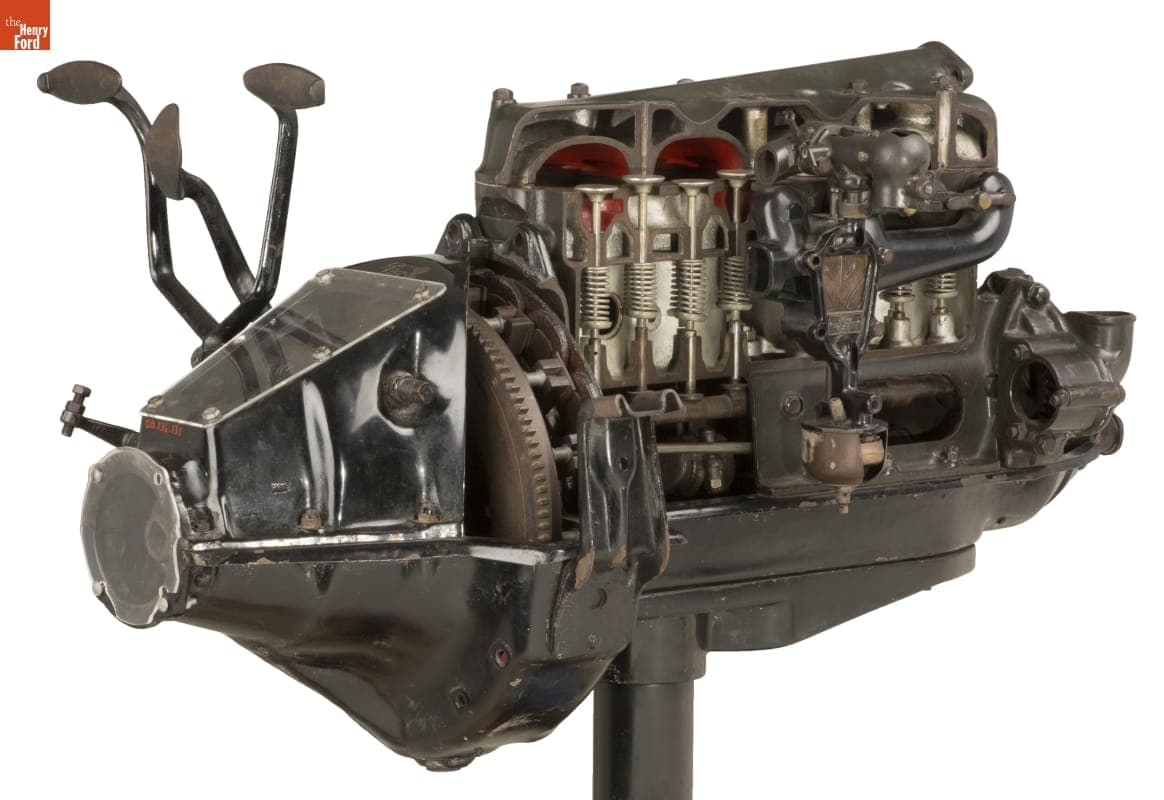
Cutaway Engine from a Ford Model T, circa 1927
Automobile engine
Mechanical simplicity was one of the secrets behind the Model T's success. The engine had no fuel pump, relying on gravity to feed the carburetor. There was no water pump either, as a thermosiphon effect was used to circulate cooling water. The cylinder head removed in one piece for easier servicing. The engine and transmission shared the same lubricating oil.
Ford Model A Cutaway Automobile Engine, 1928-1931
Automobile engine
Like everything else about the Ford Model A, the car's engine was completely redesigned from what had been used in the Ford Model T. The Model A's inline four-cylinder engine had a displacement of 201 cubic inches, and it was rated at 40 horsepower. The engine's basic design remained unchanged throughout the car's production run over the 1928-1931 model years.
1932 Ford V-8 Engine, No. 1
Automobile engine
Henry Ford and his company revolutionized the automobile market again in 1932 with the inexpensive Ford V-8. By casting the engine's crankcase and cylinders as a single unit, Ford cut costs and offered the car at a starting price under $500. A brass plate on this particular engine reads: "THIS IS V-8 NO. 1 MOTOR / HOLD FOR MR. H. FORD."
Chevrolet "Cast Iron Wonder" In-line 6-cylinder Engine, 1935
Automobile engine
Chevrolet introduced the reliable and popular "Cast Iron Wonder" in 1929. The solid design of this six-cylinder engine changed little over the next 25 years. Advertised as "A Six for the Price of Four," Chevrolet hoped it would lure customers away from competitors. It did. Chevrolet and its "Cast Iron Wonder" topped the sales charts during most of the Great Depression years of the 1930s.
Oldsmobile "Rocket" V-8-cylinder Engine, 1949
Automobile engine
Oldsmobile launched its "Rocket" V-8 engine in 1949. The engine was one of the first modern, short-stroke, high compression overhead valve V-8s. Planned for the heavy Oldsmobile 98 series, when placed in their light weight, short-wheel based 88 series the 135 horsepower engine sped into racing history. Compact and efficient, the engine dominated the NASCAR racing circuit from 1949 to 1951.
Chrysler Turbine Automobile Engine, 1964
Automobile engine
Chrysler experimented with gas turbine engines for some 25 years. This fourth-generation version had 80 percent fewer moving parts than a piston engine. Its twin regenerators used exhaust heat to pre-warm air fed to the burner. Chrysler turbine engines powered 50 cars tested by the public. Drivers appreciated the smooth ride and low maintenance, but not the poor fuel economy.
Ford V-8 Engine from GT40 Mark II Race Car, circa 1966
Automobile engine
After disappointing results with the 289-cubic-inch engine in the original GT40, Ford fitted its GT40 Mark II with a modified version of the company's NASCAR-proven 427. The GT40 started winning, and no victory was sweeter than at Le Mans in 1966 where Ford broke Ferrari's six-year winning streak. Ford won again, with the 427-powered Mark IV, in 1967.
Ford "Calliope" V-8 Automobile Engine, 1968
Automobile engine
Ford engineers developed the aluminum-block 427-cubic-inch "calliope" engine for the 1968 Le Mans 24-hour race. Three valves per cylinder were connected to pushrods driven by twin camshafts in the block. The distinctive fuel injector stacks above each cylinder, resembling whistles on a musical calliope, gave the engine its nickname. Rules changes at Le Mans prevented the engine from ever racing.
Cosworth DFX V-8 Engine, 1975-1985
Automobile engine
The Cosworth DFX engine won its first race in 1976. The turbocharged V-8, based on an earlier Formula One engine designed by British company Cosworth and funded by Ford Motor Company, dominated Indy Car racing well into the 1980s. Cosworth DFX engines powered all ten Indianapolis 500 winners between 1978 and 1987.
1985 Mazda Wankel Rotary Engine
Automobile engine
German engineer Felix Wankel conceived the rotary engine as a simpler, lighter, more compact alternative to the traditional piston engine. Various companies tried rotaries, but Mazda was the most successful, with rotary-engine cars dominating its U.S. sales from 1970 through 1972. Owners appreciated the smooth power delivery but not the poor fuel economy. When gas prices rose, Mazda reserved the Wankel rotary for high-performance sports cars.