
A Selection of Hallmark Ornaments: Airplanes
Share
share
Hallmark's ornaments -- with their original designs, increasing variety, and appeal to diverse customers -- have revolutionized Christmas decorating and led to the popularity of ornament collecting. Hallmark designers occasionally looked to the sky for ideas. This set features a selection of ornaments inspired by airplanes.
THF177022
Hallmark "Sky's the Limit Series: The Flight at Kitty Hawk" Christmas Ornament, 1997
Powered, controlled, heavier-than-air flight arrived on December 17, 1903, when Wilbur and Orville Wright flew their first airplane at Kill Devil Hills, near Kitty Hawk, North Carolina. The Wrights' key breakthrough was their control system, effected by warping their airplane's wings to steer. The brothers' first flight covered 120 feet and lasted all of 12 seconds.
View ArtifactTHF352672
Hallmark "Airplane Hangar: Flying School" Christmas Ornament, 2001
Every pilot has to start somewhere, and that somewhere is often a flying school. The Wright brothers established the world's first such school in France in 1909, where they trained pilots as a condition of their contract to build airplanes for French clients. Later that year the Wrights formed another school near their hometown of Dayton, Ohio.
View ArtifactTHF186871
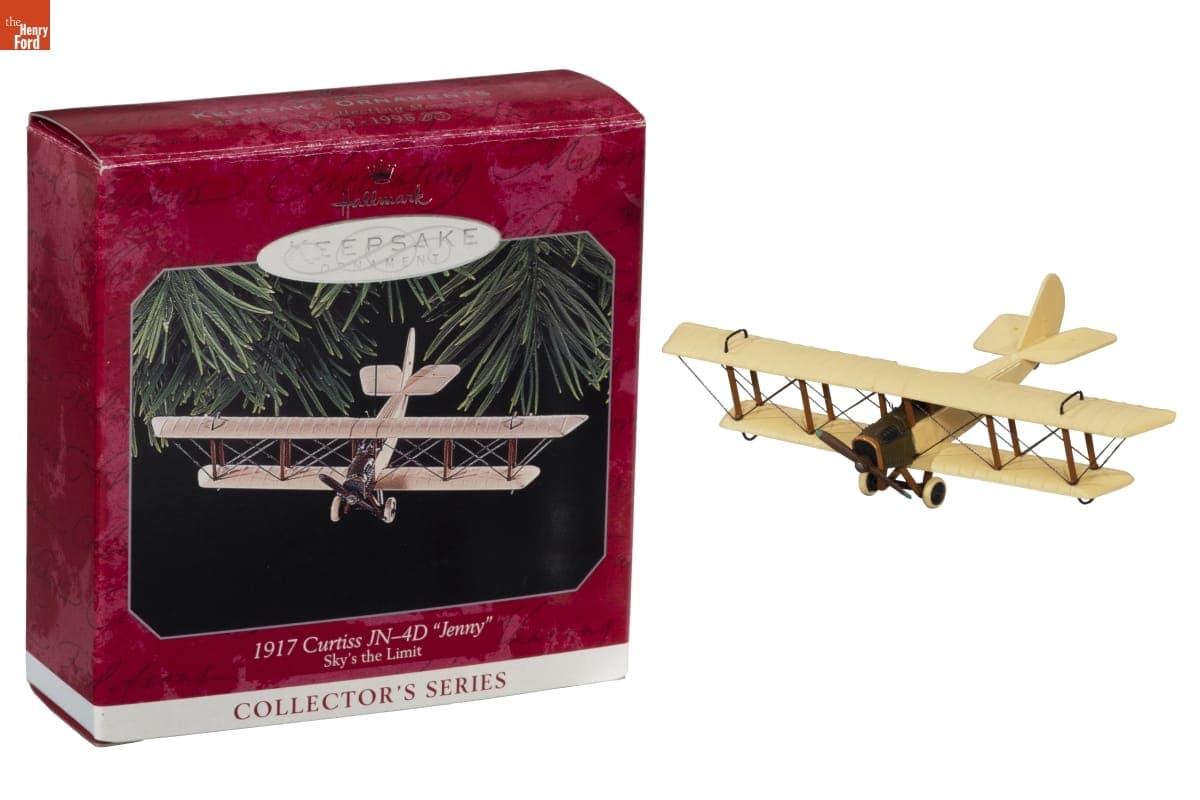
Hallmark "Sky's the Limit Series: 1917 Curtiss JN-4D "Jenny"" Christmas Ornament, 1998
Many early American pilots learned to fly in Curtiss JN-4 "Jenny" airplanes. They were designed for training U.S. Army pilots in World War I. After the armistice, countless surplus Jennys found a second life as trainer aircraft at privately operated flying schools. The planes were cheap, durable, and relatively easy to operate.
View ArtifactTHF354461
Hallmark "LOONEY TUNES Bugs Bunny: Bugs the Barnstormer" Christmas Ornament, 2003
Eager to stay aloft after the war, many former Army pilots went barnstorming. They toured the country and thrilled audiences with death-defying "aerobatic" stunts. For many Americans, a barnstorming exhibition was their first in-person experience with aviation. Barnstorming was exciting, but it also made airplanes seem dangerous -- an association that was difficult to shake in the collective consciousness.
View ArtifactTHF351035
Hallmark "Sky's the Limit Series: Spirit of St. Louis" Christmas Ornament, 2000
The Wrights may have invented the airplane, but no one popularized it -- and aviation generally -- as effectively as Charles Lindbergh. His May 1927 solo transatlantic flight with the Spirit of St. Louis turned Lindbergh into an international celebrity, and it convinced Americans that flying in an airplane was safe, reliable and -- for frequent long-distance travelers -- inevitable.
View ArtifactTHF351525
Hallmark "Disney's Mickey & Co.: Mickey's Sky Rider" Christmas Ornament, 2000
Of course, Charles Lindbergh wasn't alone in putting the airplane into popular culture. Mickey Mouse soared across movie screens in Plane Crazy, widely released in 1929. In fact, the whole plot of the cartoon has Mickey trying to mimic Lindbergh -- right down to Lucky Lindy's toothy grin and tousled hair.
View ArtifactTHF353015
Hallmark "Sky's the Limit Series: Gee Bee R-1 Super Sportster" Christmas Ornament, 2001
Airplanes were sophisticated machines by the early 1930s. Aviation races did much to improve the technology. Streamlined designs, with cowlings to cover engines and fairings (called pants) to cover wheels, helped airplanes slip cleanly through the air. Planes like the Gee Bee R-1 were capable of speeds approaching 300 miles per hour.
View ArtifactTHF356543
Hallmark "Sky's the Limit Series: Cessna 195" Christmas Ornament, 2007
World War II prompted additional leaps in aviation, from pressurized cabins to jet engines. All-metal airplanes predated the war, but combat conditions further proved their superiority. Cessna's 195 airplane, introduced in 1947, was the company's first all-aluminum model. Cessna became a dominant manufacturer of general aviation airplanes in the mid-20th century.
View Artifact

