
Search
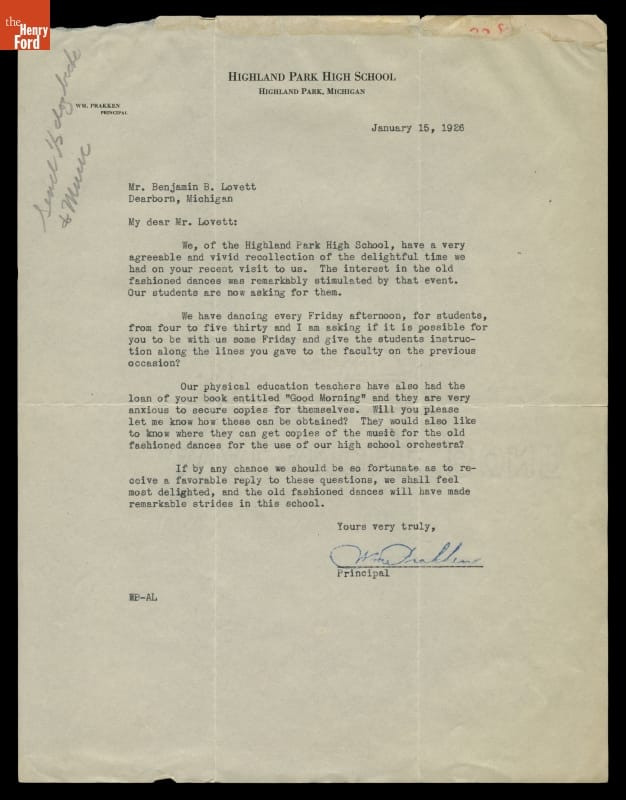
- Letter from Highland Park High School Principal to Benjamin Lovett, January 16, 1926 - Like the collections of antique vehicles, farm equipment and cooking implements Ford began to amass with vigor during the 1920s--music was part of Ford's larger vision for preserving the American past. By this time, much of America had left traditional music behind. But Ford never forgot it. And, through Benjamin Lovett's instruction, Ford wanted to share it with new generations.
- January 16, 1926
- Collections - Artifact
Letter from Highland Park High School Principal to Benjamin Lovett, January 16, 1926
Like the collections of antique vehicles, farm equipment and cooking implements Ford began to amass with vigor during the 1920s--music was part of Ford's larger vision for preserving the American past. By this time, much of America had left traditional music behind. But Ford never forgot it. And, through Benjamin Lovett's instruction, Ford wanted to share it with new generations.
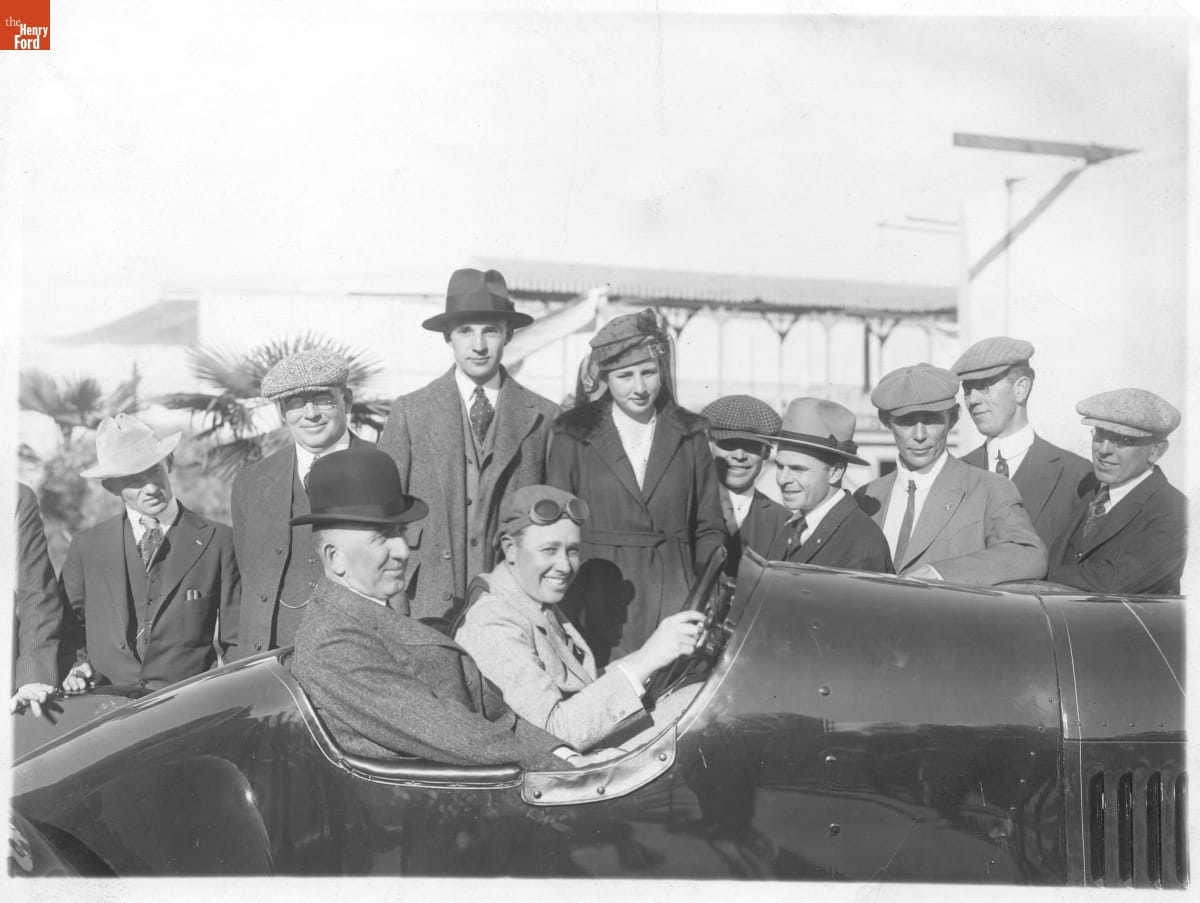
- Edsel and Eleanor Ford Meet Racer Ralph Mulford While Visiting Universal City, California, November 1916 - Ralph Mulford competed in the first Indianapolis 500 in 1911, and he returned to race there nine more times through 1922. Mulford's second-place finish in 1911 was his personal best at Indy. By the time of his death at age 88 in 1973, Mulford was the last surviving driver from the inaugural Indianapolis 500.
- November 16, 1916
- Collections - Artifact
Edsel and Eleanor Ford Meet Racer Ralph Mulford While Visiting Universal City, California, November 1916
Ralph Mulford competed in the first Indianapolis 500 in 1911, and he returned to race there nine more times through 1922. Mulford's second-place finish in 1911 was his personal best at Indy. By the time of his death at age 88 in 1973, Mulford was the last surviving driver from the inaugural Indianapolis 500.
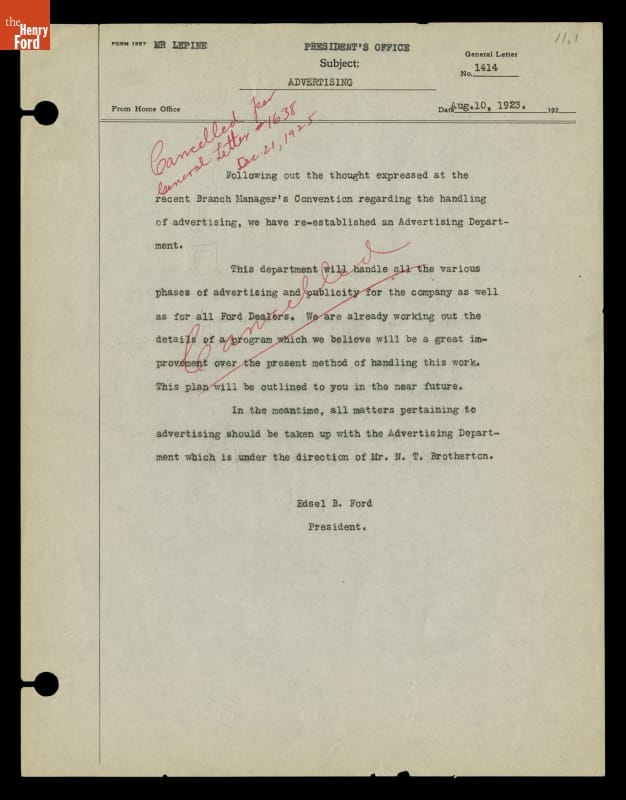
- Memo from Edsel Ford Announcing the New Ford Motor Company Advertising Department, August 10, 1923 - In 1924-25 the Ford Motor Company ran a series of sixteen "institutional" advertisements in the <EM>Saturday Evening Post</EM> and <EM>Country Gentleman</EM> magazines. More in the vein of public relations statements than advertising, the campaign was designed to increase public awareness of the company's wide-ranging activities and to explain its overall mission.
- August 10, 1923
- Collections - Artifact
Memo from Edsel Ford Announcing the New Ford Motor Company Advertising Department, August 10, 1923
In 1924-25 the Ford Motor Company ran a series of sixteen "institutional" advertisements in the Saturday Evening Post and Country Gentleman magazines. More in the vein of public relations statements than advertising, the campaign was designed to increase public awareness of the company's wide-ranging activities and to explain its overall mission.
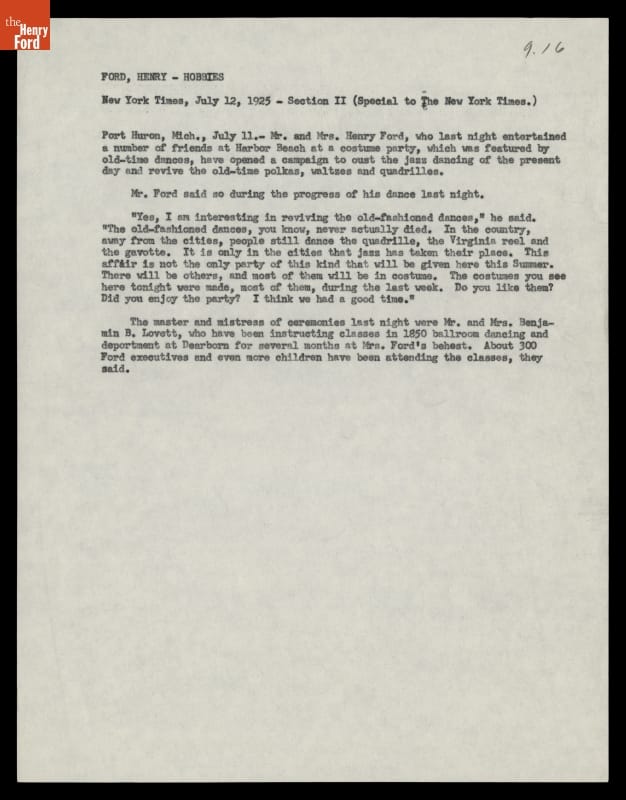
- News Story about Henry Ford's Revival of Old-Fashioned Music and Dancing, July 1925 -
- July 11, 1925
- Collections - Artifact
News Story about Henry Ford's Revival of Old-Fashioned Music and Dancing, July 1925
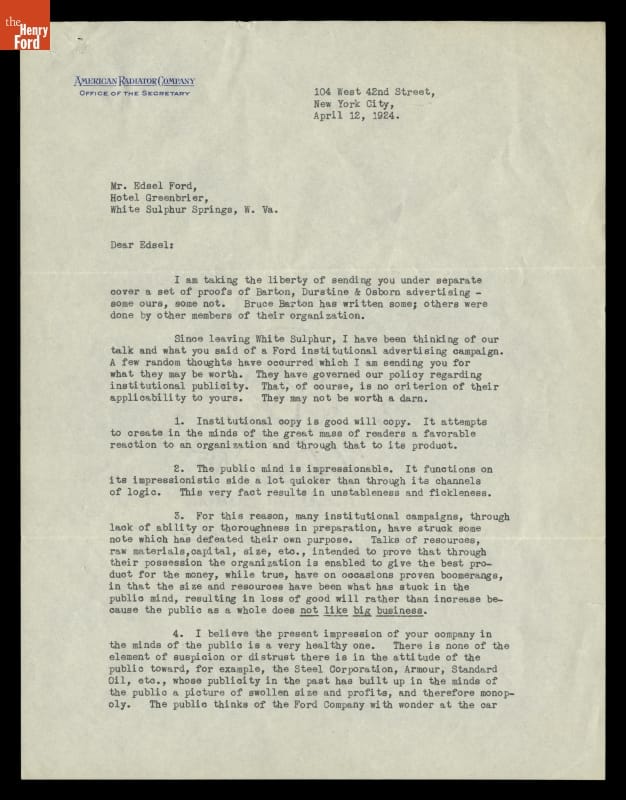
- Letter from Wetmore Hodges to Edsel Ford regarding Ford's 1924 Institutional Message Advertising Campaign, April 12, 1924 - In 1924-25 the Ford Motor Company ran a series of sixteen "institutional" advertisements in the <EM>Saturday Evening Post</EM> and <EM>Country Gentleman</EM> magazines. More in the vein of public relations statements than advertising, the campaign was designed to increase public awareness of the company's wide-ranging activities and to explain its overall mission.
- September 07, 1923
- Collections - Artifact
Letter from Wetmore Hodges to Edsel Ford regarding Ford's 1924 Institutional Message Advertising Campaign, April 12, 1924
In 1924-25 the Ford Motor Company ran a series of sixteen "institutional" advertisements in the Saturday Evening Post and Country Gentleman magazines. More in the vein of public relations statements than advertising, the campaign was designed to increase public awareness of the company's wide-ranging activities and to explain its overall mission.
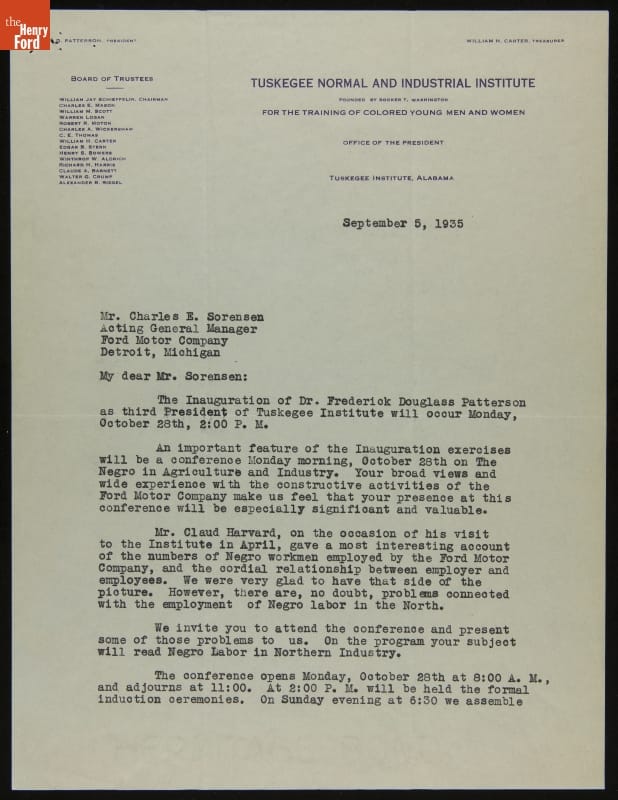
- Letter from William Jay Schieffelin to Charles E. Sorensen regarding Tuskegee Institute's Presidential Inauguration, September 1935 -
- October 28, 1935
- Collections - Artifact
Letter from William Jay Schieffelin to Charles E. Sorensen regarding Tuskegee Institute's Presidential Inauguration, September 1935
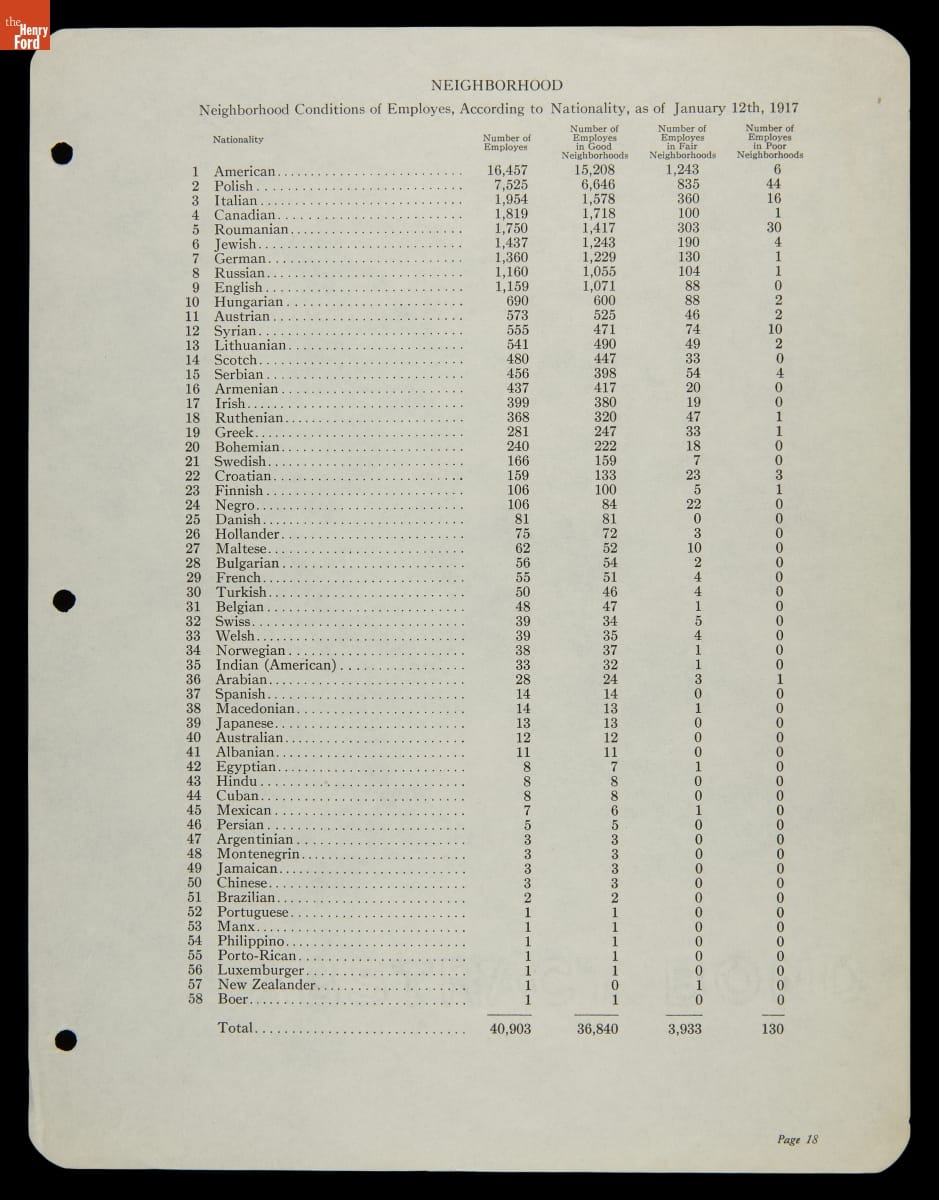
- "Neighborhood Conditions of Employees, According to Nationality, as of January 12th, 1917" - This document is from the publication "Educational Statistics Home Plant, as of January 12th, 1917." It was produced by the Ford Motor Company Sociological (or Educational) Department, and it rates employees' neighborhoods, organized by nationality. The department was created to ensure that employees used their $5 per day wages wisely -- for instance, to escape cheap, ramshackle tenement houses crowded with boarders.
- January 12, 1917
- Collections - Artifact
"Neighborhood Conditions of Employees, According to Nationality, as of January 12th, 1917"
This document is from the publication "Educational Statistics Home Plant, as of January 12th, 1917." It was produced by the Ford Motor Company Sociological (or Educational) Department, and it rates employees' neighborhoods, organized by nationality. The department was created to ensure that employees used their $5 per day wages wisely -- for instance, to escape cheap, ramshackle tenement houses crowded with boarders.
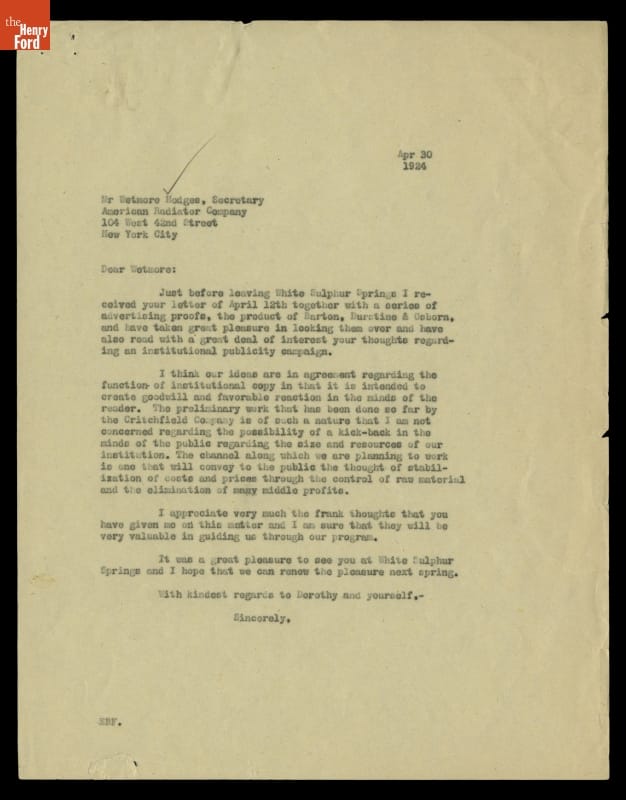
- Letter from Edsel Ford to Wetmore Hodges regarding Ford's 1924 Institutional Message Advertising Campaign, April 30, 1924 - In 1924-25 the Ford Motor Company ran a series of sixteen "institutional" advertisements in the <EM>Saturday Evening Post</EM> and <EM>Country Gentleman</EM> magazines. More in the vein of public relations statements than advertising, the campaign was designed to increase public awareness of the company's wide-ranging activities and to explain its overall mission.
- April 30, 1924
- Collections - Artifact
Letter from Edsel Ford to Wetmore Hodges regarding Ford's 1924 Institutional Message Advertising Campaign, April 30, 1924
In 1924-25 the Ford Motor Company ran a series of sixteen "institutional" advertisements in the Saturday Evening Post and Country Gentleman magazines. More in the vein of public relations statements than advertising, the campaign was designed to increase public awareness of the company's wide-ranging activities and to explain its overall mission.
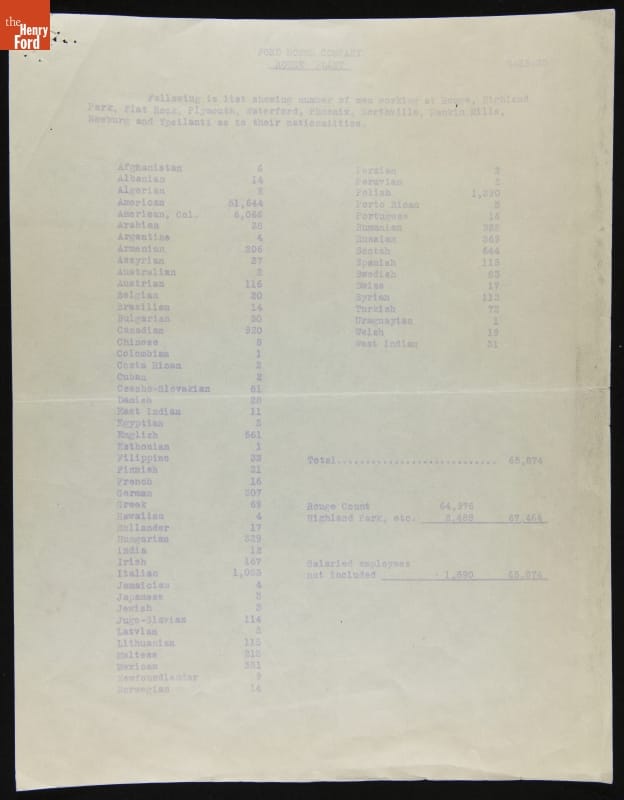
- Number of Men Working in Ford Motor Company Plants Listed by Nationalities, August 1935 - Employees of Ford Motor Company made up a diverse workforce drawn from around the world. This list, compiled in August 1935, shows more than 60 nations and territories represented by 66,000 hourly workers at various Ford plants in southeast Michigan.
- August 28, 1935
- Collections - Artifact
Number of Men Working in Ford Motor Company Plants Listed by Nationalities, August 1935
Employees of Ford Motor Company made up a diverse workforce drawn from around the world. This list, compiled in August 1935, shows more than 60 nations and territories represented by 66,000 hourly workers at various Ford plants in southeast Michigan.
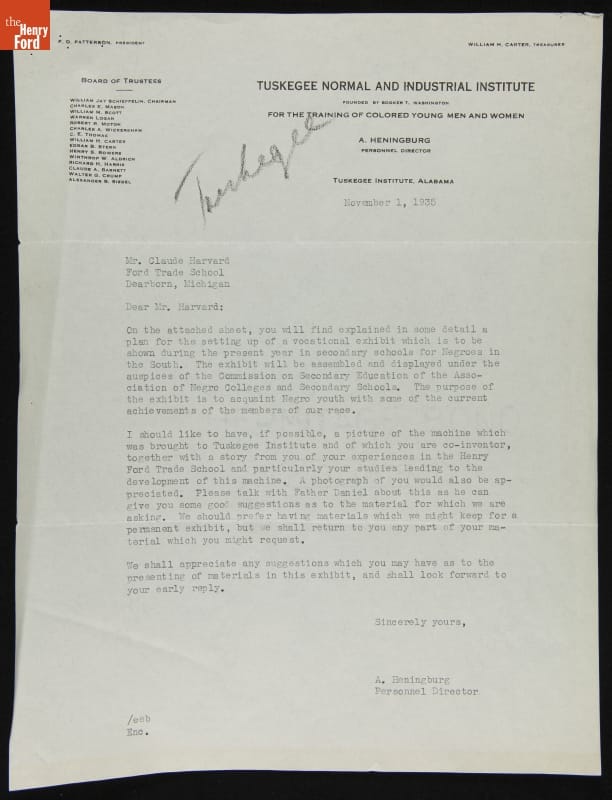
- Letters from Alfonse Heningburg of Tuskegee Institute to Father Everard Daniel and Claude Harvard, November 1, 1935 -
- November 01, 1935
- Collections - Artifact
Letters from Alfonse Heningburg of Tuskegee Institute to Father Everard Daniel and Claude Harvard, November 1, 1935