
Search
- Washington Press, Used at the Cranbrook Academy of Art - The Washington Press established two innovations in printing history: a lightened metal frame for easier transport, and a toggle-joint mechanism to create impressions. Over 6000 of these rugged hand presses were sold between 1835-1902; many specialist printers continue to use them today. This press was donated by George Booth, <em>Detroit News</em> publisher and founder of the Cranbrook Educational Community.
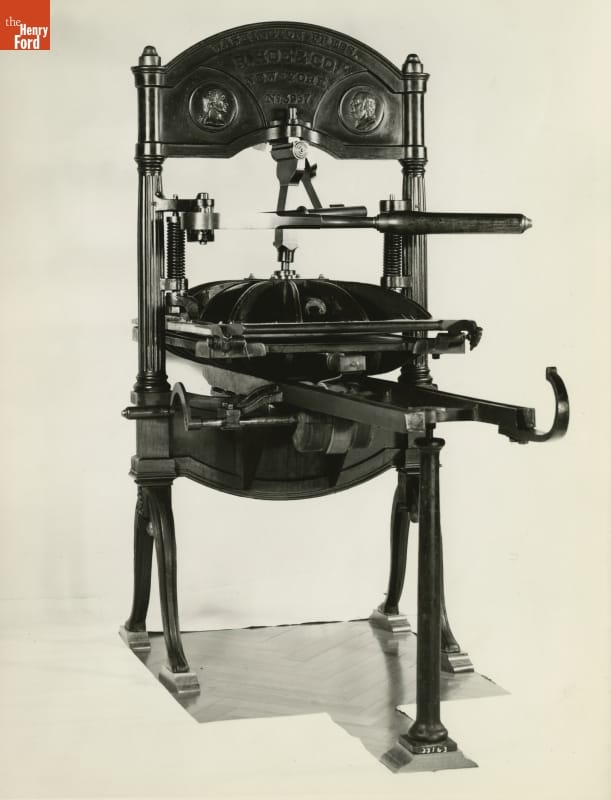
- 1840-1850
- Collections - Artifact
Washington Press, Used at the Cranbrook Academy of Art
The Washington Press established two innovations in printing history: a lightened metal frame for easier transport, and a toggle-joint mechanism to create impressions. Over 6000 of these rugged hand presses were sold between 1835-1902; many specialist printers continue to use them today. This press was donated by George Booth, Detroit News publisher and founder of the Cranbrook Educational Community.
- Diamond Card Press, circa 1872 - This press was invented in 1851 by Stephen P. Ruggles of Boston. Part of a new breed of jobbing presses, the bed and platen were nearly vertical, allowing for the efficient printing of small cards measuring approximately 4 by 5-inches. Ruggles also created the "Engine Press"--the first treadle job press to be manufactured in the United States.
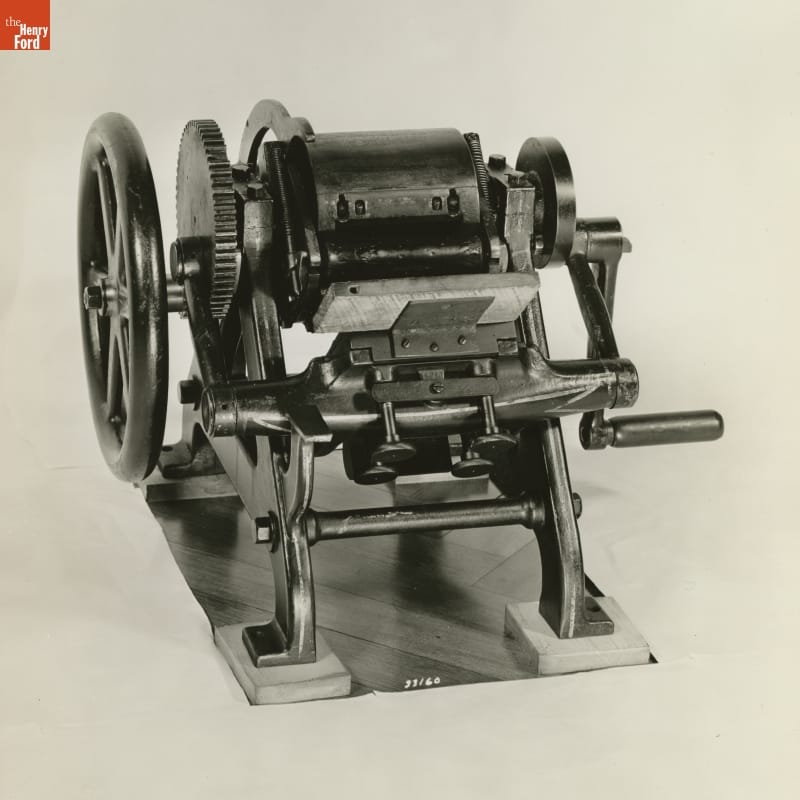
- circa 1872
- Collections - Artifact
Diamond Card Press, circa 1872
This press was invented in 1851 by Stephen P. Ruggles of Boston. Part of a new breed of jobbing presses, the bed and platen were nearly vertical, allowing for the efficient printing of small cards measuring approximately 4 by 5-inches. Ruggles also created the "Engine Press"--the first treadle job press to be manufactured in the United States.
- Stansbury Press, 1867-1885 - Patented by Abraham O. Stansbury in 1821, this press included an innovative "torsion toggle." When the press bar was turned, three inclined rods straightened, exerting pressure on the platen to make a print impression. The spring-loaded platen returned to its starting position once the print was made.
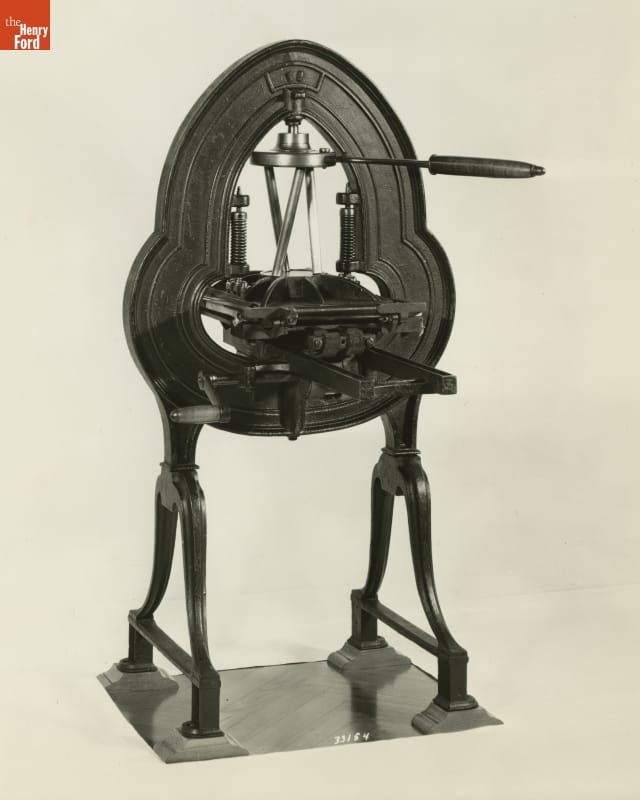
- 1867-1885
- Collections - Artifact
Stansbury Press, 1867-1885
Patented by Abraham O. Stansbury in 1821, this press included an innovative "torsion toggle." When the press bar was turned, three inclined rods straightened, exerting pressure on the platen to make a print impression. The spring-loaded platen returned to its starting position once the print was made.
- Smith Press, 1824-1835 - This was the first all-iron press model built by manufacturers R. Hoe & Co. of New York. It was also the very last press made in its series before being succeeded by the Washington Press. This particular press belonged to C.C. Beavers, who used it to print the <em>Ridgeway News</em> (until 1889) and <em>Mecklenburg Times</em> (until 1929) in Virginia.
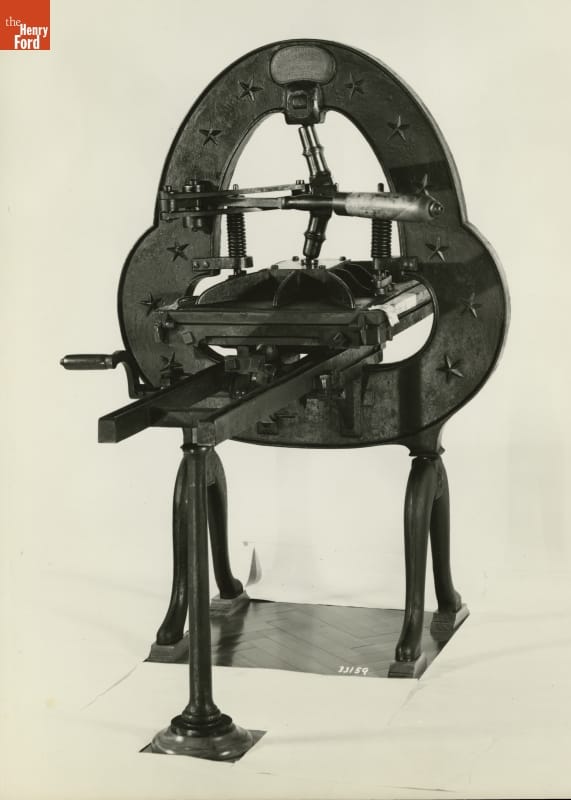
- 1824-1835
- Collections - Artifact
Smith Press, 1824-1835
This was the first all-iron press model built by manufacturers R. Hoe & Co. of New York. It was also the very last press made in its series before being succeeded by the Washington Press. This particular press belonged to C.C. Beavers, who used it to print the Ridgeway News (until 1889) and Mecklenburg Times (until 1929) in Virginia.
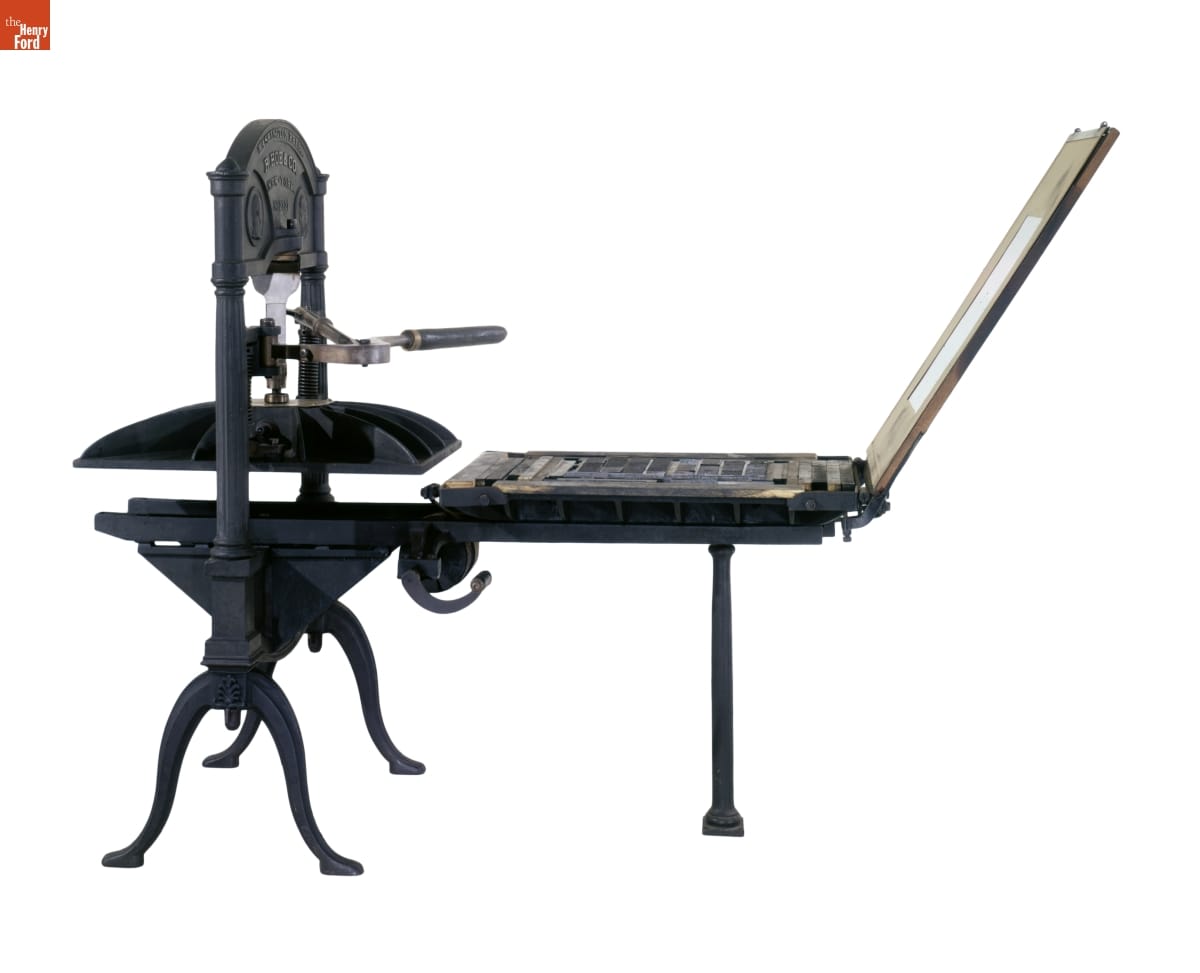
- Washington Press, circa 1848 - This peripatetic press was used to print newspapers in the 19th-century American West. Washington hand presses were rugged and extremely popular; this one crossed the Isthmus of Panama on its way from New Orleans to California's gold fields. In 1851, the press's owner, John Judson Ames, started San Diego's first newspaper. The press also printed newspapers in San Bernardino and Independence, California, and in Aurora, Nevada.
- circa 1848
- Collections - Artifact
Washington Press, circa 1848
This peripatetic press was used to print newspapers in the 19th-century American West. Washington hand presses were rugged and extremely popular; this one crossed the Isthmus of Panama on its way from New Orleans to California's gold fields. In 1851, the press's owner, John Judson Ames, started San Diego's first newspaper. The press also printed newspapers in San Bernardino and Independence, California, and in Aurora, Nevada.
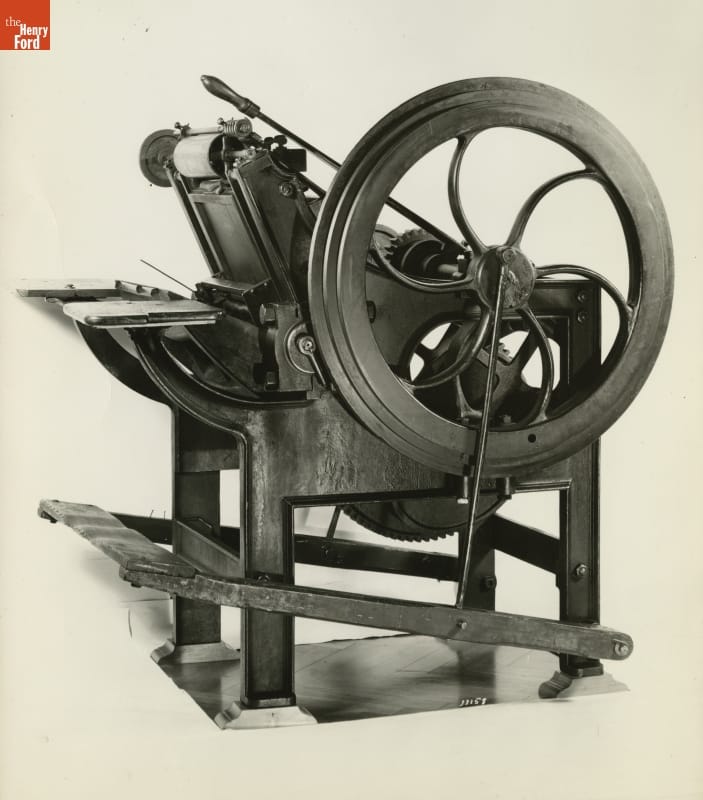
- Adams Bed and Platen Job Press, 1859-1868 - The job press was used for short runs of small items like business cards, handbills, and small books. Its foot-operated treadle made printing efficient--typical operators could produce 1000 prints per hour. This job press could also be adapted to run on steam power, allowing the print process to become mechanized for even greater output.
- 1859-1868
- Collections - Artifact
Adams Bed and Platen Job Press, 1859-1868
The job press was used for short runs of small items like business cards, handbills, and small books. Its foot-operated treadle made printing efficient--typical operators could produce 1000 prints per hour. This job press could also be adapted to run on steam power, allowing the print process to become mechanized for even greater output.
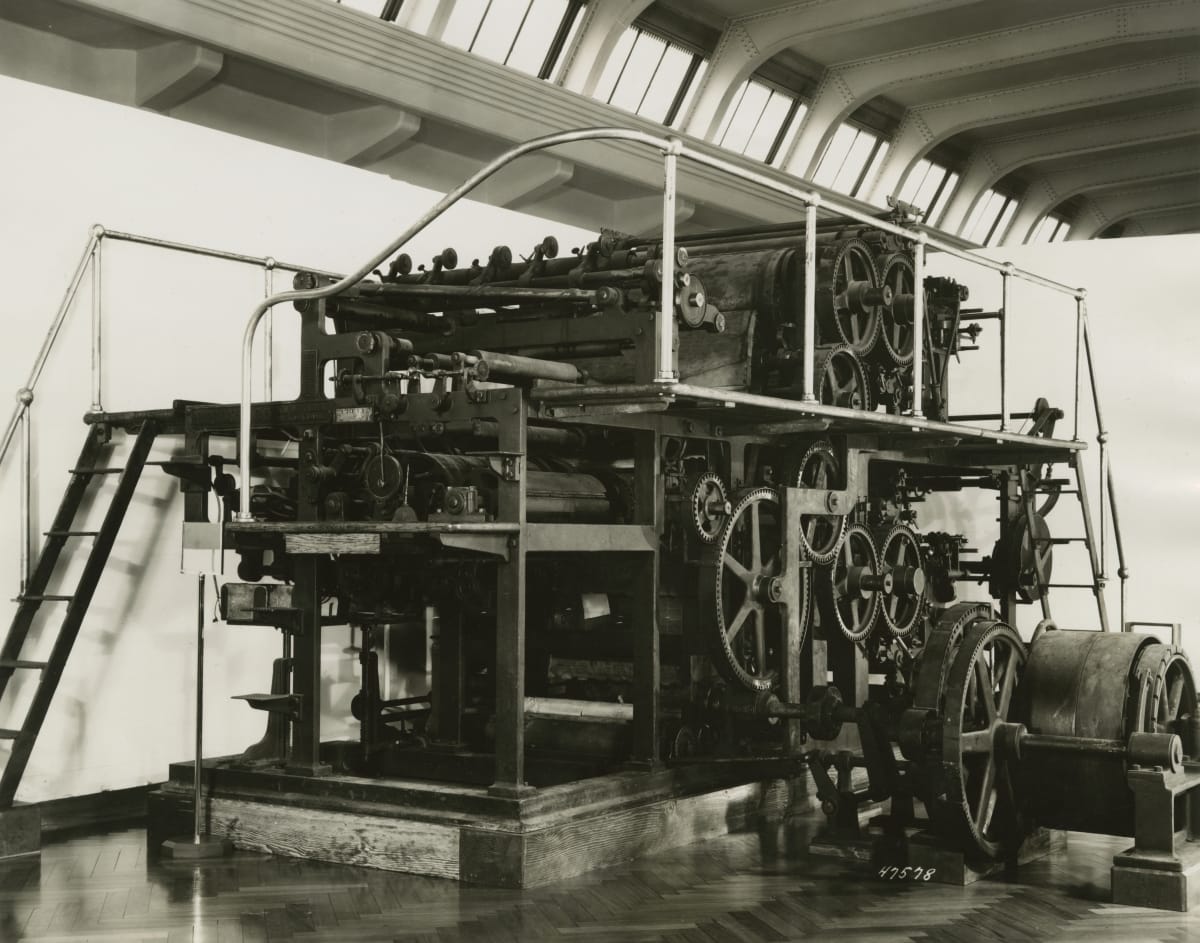
- Rotary Press, Used to Print the Dearborn Independent - This printing press was used to print <em>The Dearborn Independent</em>. Henry Ford purchased the weekly newspaper and published it under his name from 1919 to 1927. The <em>Independent</em> served as a forum for Ford's views, free from other media outlets that had attacked his work and values and were outside his control. <em>The Dearborn Independent</em> covered world events, business and economic news, and fiction from noted authors. Sadly, it also served as an outlet for Ford's anti-Semitic sentiments. Between 1920 and 1922, the paper ran a series of front-page articles that denounced all things Jewish. Even after this series, many articles contained anti-Jewish language. Though Ford later apologized and printed a retraction, these notoriously anti-Semitic editorials and articles forever tarnished the influential automaker's reputation.
- circa 1900
- Collections - Artifact
Rotary Press, Used to Print the Dearborn Independent
This printing press was used to print The Dearborn Independent. Henry Ford purchased the weekly newspaper and published it under his name from 1919 to 1927. The Independent served as a forum for Ford's views, free from other media outlets that had attacked his work and values and were outside his control. The Dearborn Independent covered world events, business and economic news, and fiction from noted authors. Sadly, it also served as an outlet for Ford's anti-Semitic sentiments. Between 1920 and 1922, the paper ran a series of front-page articles that denounced all things Jewish. Even after this series, many articles contained anti-Jewish language. Though Ford later apologized and printed a retraction, these notoriously anti-Semitic editorials and articles forever tarnished the influential automaker's reputation.