
Search
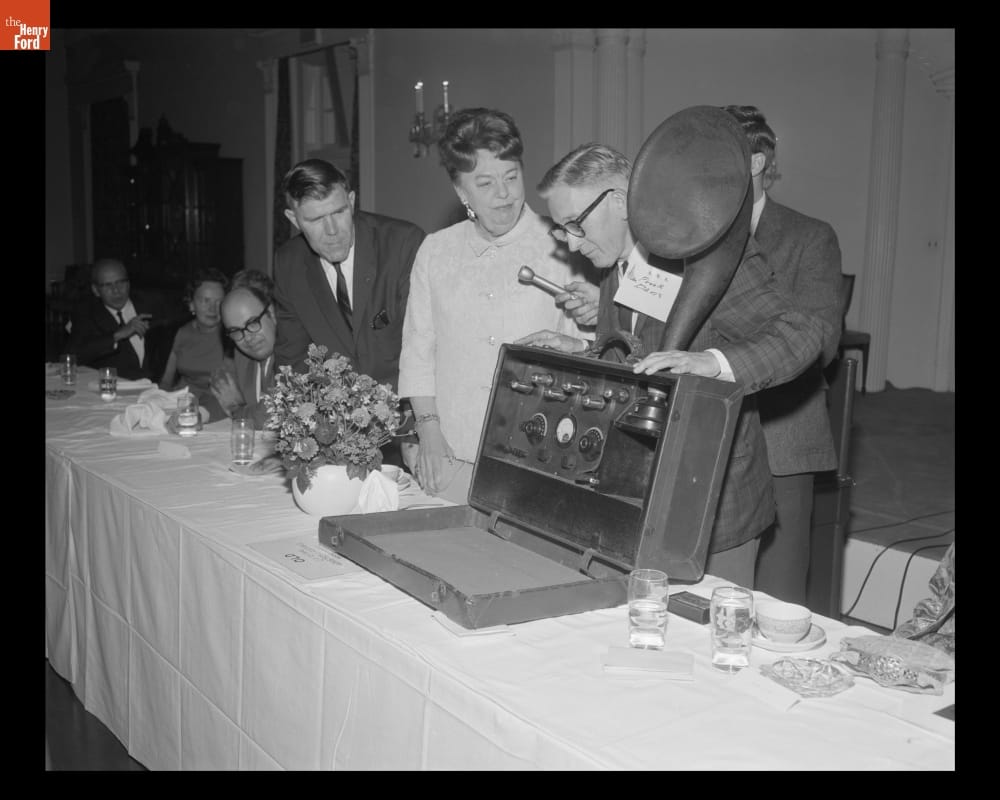
- Marion Armstrong Presents the First Portable Superheterodyne Radio Receiver to Henry Ford Museum, September 22, 1967 - This photograph shows the first portable superheterodyne radio receiver, designed by Edwin Armstrong. Superheterodying was a major communications discovery made by Armstrong. High and low frequencies were mixed to produce powerful, selective radio waves. Following his untimely death, Edwin's wife Marion Armstrong continued to preserve his legacy; she donated this radio to The Henry Ford museum in 1967.
- September 22, 1967
- Collections - Artifact
Marion Armstrong Presents the First Portable Superheterodyne Radio Receiver to Henry Ford Museum, September 22, 1967
This photograph shows the first portable superheterodyne radio receiver, designed by Edwin Armstrong. Superheterodying was a major communications discovery made by Armstrong. High and low frequencies were mixed to produce powerful, selective radio waves. Following his untimely death, Edwin's wife Marion Armstrong continued to preserve his legacy; she donated this radio to The Henry Ford museum in 1967.
- First Portable Superheterodyne Radio Receiver, Made by Edwin Howard Armstrong, 1923 - Edwin H. Armstrong was a pioneer of radio engineering, credited as the inventor of FM radio. In 1918 he filed a patent for the superheterodyne radio circuit. This technology increased the sensitivity and selectivity of radio receivers. The radio depicted is the first portable superheterodyne radio receiver ever made. Armstrong gave it to his wife, Marion, on their 1923 honeymoon.

- 1923
- Collections - Artifact
First Portable Superheterodyne Radio Receiver, Made by Edwin Howard Armstrong, 1923
Edwin H. Armstrong was a pioneer of radio engineering, credited as the inventor of FM radio. In 1918 he filed a patent for the superheterodyne radio circuit. This technology increased the sensitivity and selectivity of radio receivers. The radio depicted is the first portable superheterodyne radio receiver ever made. Armstrong gave it to his wife, Marion, on their 1923 honeymoon.
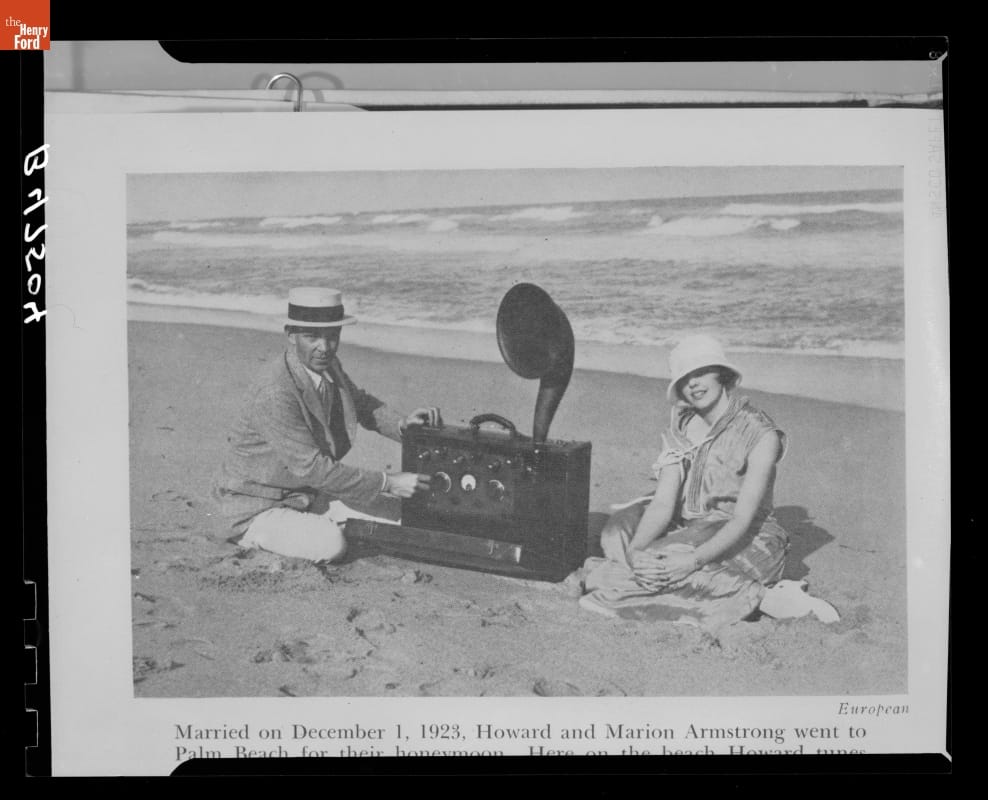
- Edwin H. Armstrong and Marion Armstrong with the First Portable Superheterodyne Radio Receiver, 1923 - Edwin H. Armstrong was a pioneer of radio engineering, credited as the inventor of FM radio. In 1918 he filed a patent for the superheterodyne radio circuit. This technology increased the sensitivity and selectivity of radio receivers. The radio depicted is the first portable superheterodyne radio receiver ever made. Armstrong gave it to his wife, Marion, on their 1923 honeymoon.
- January 01, 1923
- Collections - Artifact
Edwin H. Armstrong and Marion Armstrong with the First Portable Superheterodyne Radio Receiver, 1923
Edwin H. Armstrong was a pioneer of radio engineering, credited as the inventor of FM radio. In 1918 he filed a patent for the superheterodyne radio circuit. This technology increased the sensitivity and selectivity of radio receivers. The radio depicted is the first portable superheterodyne radio receiver ever made. Armstrong gave it to his wife, Marion, on their 1923 honeymoon.