
Marion Armstrong Presents the First Portable Superheterodyne Radio Receiver to Henry Ford Museum, September 22, 1967
THF131774 / Marion Armstrong Presents the First Portable Superheterodyne Radio Receiver to Henry Ford Museum, September 22, 1967
01
Artifact Overview
This photograph shows the first portable superheterodyne radio receiver, designed by Edwin Armstrong. Superheterodying was a major communications discovery made by Armstrong. High and low frequencies were mixed to produce powerful, selective radio waves. Following his untimely death, Edwin's wife Marion Armstrong continued to preserve his legacy; she donated this radio to The Henry Ford museum in 1967.
Artifact Details
Artifact
Negative (Photograph)
Date Made
22 September 1967
Subject Date
22 September 1967
Collection Title
Location
By Request in the Benson Ford Research Center
Object ID
EI.1929.N.B.47446
Credit
From the Collections of The Henry Ford.
Color
Black-and-white (Colors)
Dimensions
Height: 4 in
Width: 5 in
Keywords |
|---|
02
Related Artifacts
 Artifact
First Portable Superheterodyne Radio Receiver, Made by Edwin Howard Armstrong, 1923
Edwin H. Armstrong was a pioneer of radio engineering, credited as the inventor of FM radio. In 1918 he filed a patent for the superheterodyne radio circuit. This technology increased the sensitivity and selectivity of radio receivers. The radio depicted is the first portable superheterodyne radio receiver ever made. Armstrong gave it to his wife, Marion, on their 1923 honeymoon.
03
Related Content
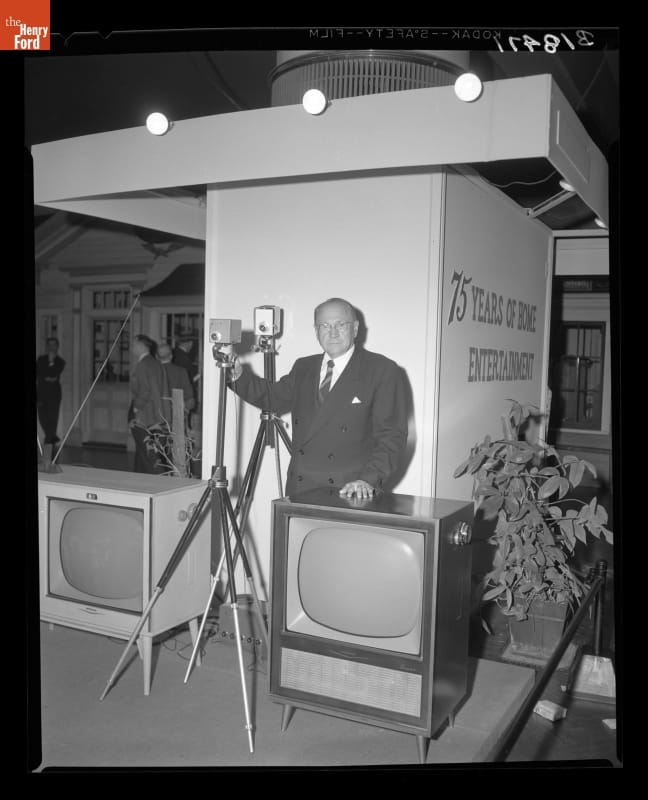 Set
SetHeroes of Radio and Television at The Henry Ford
- 12 Artifacts
Vladimir Zworykin was an early pioneer of television development, employed by Westinghouse and the Radio Corporation of America. Zworykin's iconoscope and kinescope picture tubes were breakthroughs in television history. Together they allowed electronic television to become a viable technology. Zworykin also headed the creation of the electron microscope and infrared tubes used in night vision "sniperscopes" during WWII. article
A “Pocket-Sized” Possibility for the Future
Explore the story of the “Pocket Radio” manufactured by the Auto Indicator Company of Grand Rapids, Michigan, and learn how it fits into the history of radio and audio entertainment. article
A Radio for the Beach
The world’s first portable “superhet” radio receiver was created in 1923 by Edwin Howard Armstrong—an inventor and pioneering electrical engineer.