
Search
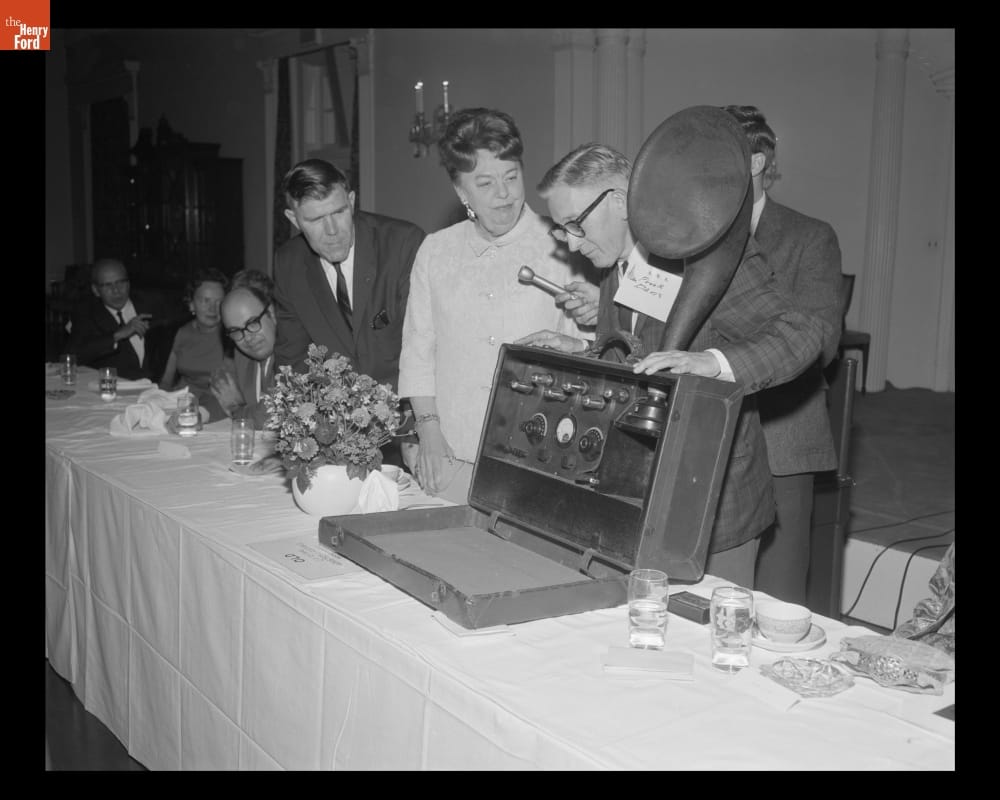
- Marion Armstrong Presents the First Portable Superheterodyne Radio Receiver to Henry Ford Museum, September 22, 1967 - This photograph shows the first portable superheterodyne radio receiver, designed by Edwin Armstrong. Superheterodying was a major communications discovery made by Armstrong. High and low frequencies were mixed to produce powerful, selective radio waves. Following his untimely death, Edwin's wife Marion Armstrong continued to preserve his legacy; she donated this radio to The Henry Ford museum in 1967.
- September 22, 1967
- Collections - Artifact
Marion Armstrong Presents the First Portable Superheterodyne Radio Receiver to Henry Ford Museum, September 22, 1967
This photograph shows the first portable superheterodyne radio receiver, designed by Edwin Armstrong. Superheterodying was a major communications discovery made by Armstrong. High and low frequencies were mixed to produce powerful, selective radio waves. Following his untimely death, Edwin's wife Marion Armstrong continued to preserve his legacy; she donated this radio to The Henry Ford museum in 1967.
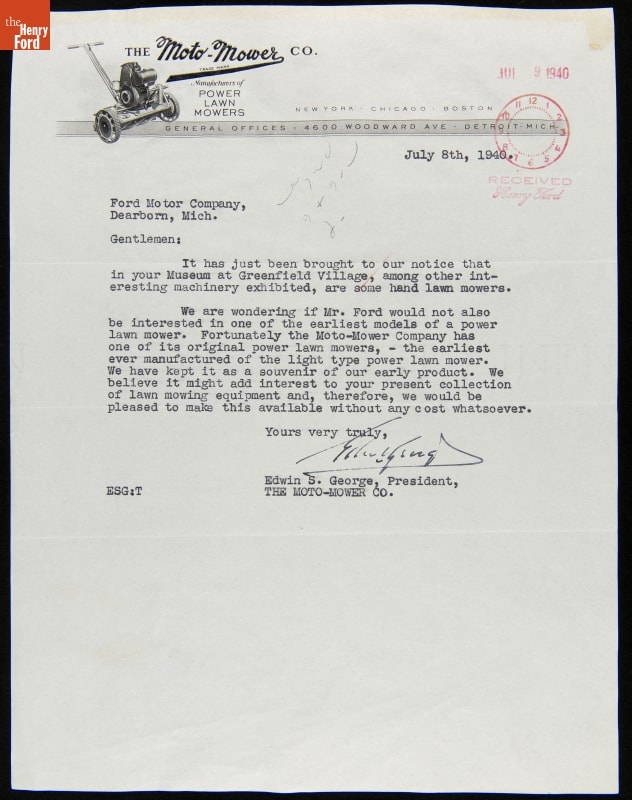
- Donation by Edwin S. George to Henry Ford Museum of a\n Early Moto-Mower Lawn Mower Model, July 8, 1940 - Lawns require regular maintenance. First patented in the United States in 1868, cylinder- or reel-type mowers became an enduring, affordable option for anyone with a small lawn. The basic form consisted of blades that rotated around a horizontal axis, cutting the grass as the user pushed the machine. The Moto-Mower Company motorized this technology around 1920 and later offered an example to Henry Ford.
- 08 July 1940-29 July 1940
- Collections - Artifact
Donation by Edwin S. George to Henry Ford Museum of a\n Early Moto-Mower Lawn Mower Model, July 8, 1940
Lawns require regular maintenance. First patented in the United States in 1868, cylinder- or reel-type mowers became an enduring, affordable option for anyone with a small lawn. The basic form consisted of blades that rotated around a horizontal axis, cutting the grass as the user pushed the machine. The Moto-Mower Company motorized this technology around 1920 and later offered an example to Henry Ford.
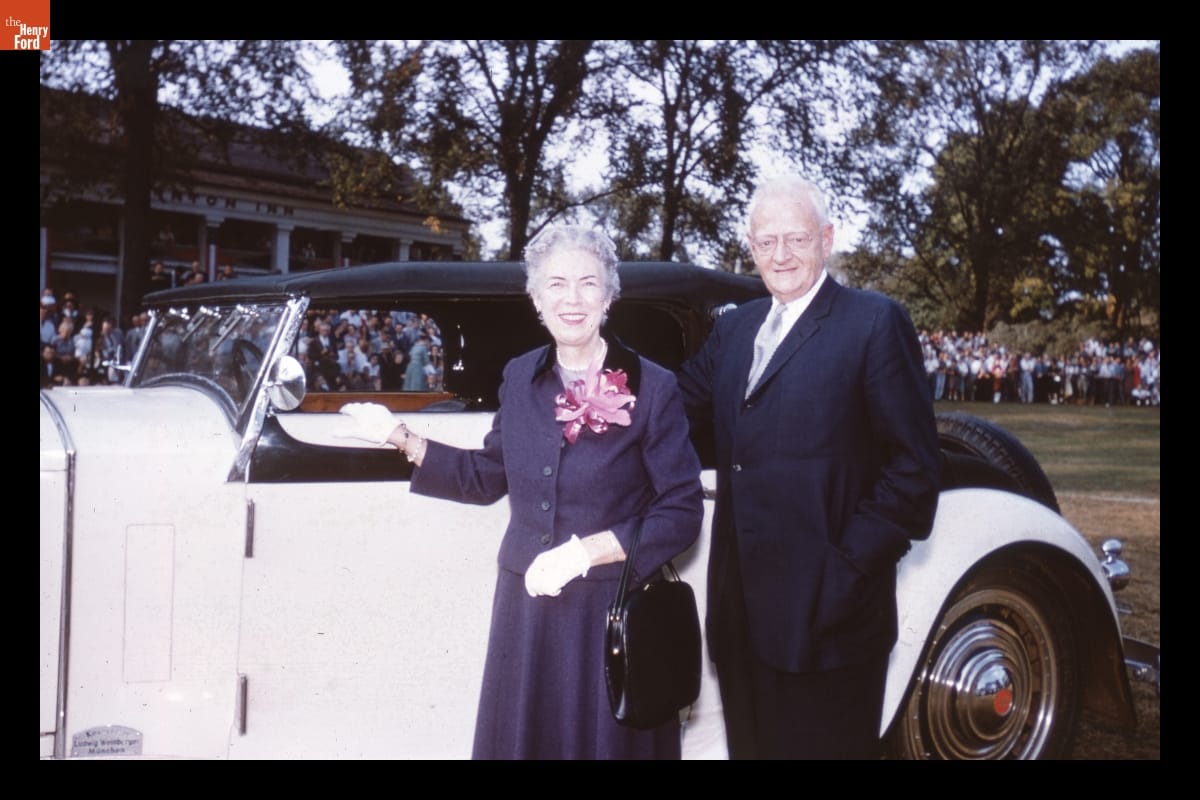
- Presentation of 1931 Bugatti Type 41 Royale Convertible at Old Car Festival in Greenfield Village, September 1959 - Charles and Esther Chayne gifted their 1931 Bugatti Type 41 Royale to The Henry Ford in 1958. They made the formal presentation during ceremonies at the following year's Old Car Festival. The Chaynes bought the car in 1943. Its original owner, German physician Joseph Fuchs, had turned the Bugatti over to a salvage yard after its engine block was damaged.
- September 20, 1959
- Collections - Artifact
Presentation of 1931 Bugatti Type 41 Royale Convertible at Old Car Festival in Greenfield Village, September 1959
Charles and Esther Chayne gifted their 1931 Bugatti Type 41 Royale to The Henry Ford in 1958. They made the formal presentation during ceremonies at the following year's Old Car Festival. The Chaynes bought the car in 1943. Its original owner, German physician Joseph Fuchs, had turned the Bugatti over to a salvage yard after its engine block was damaged.
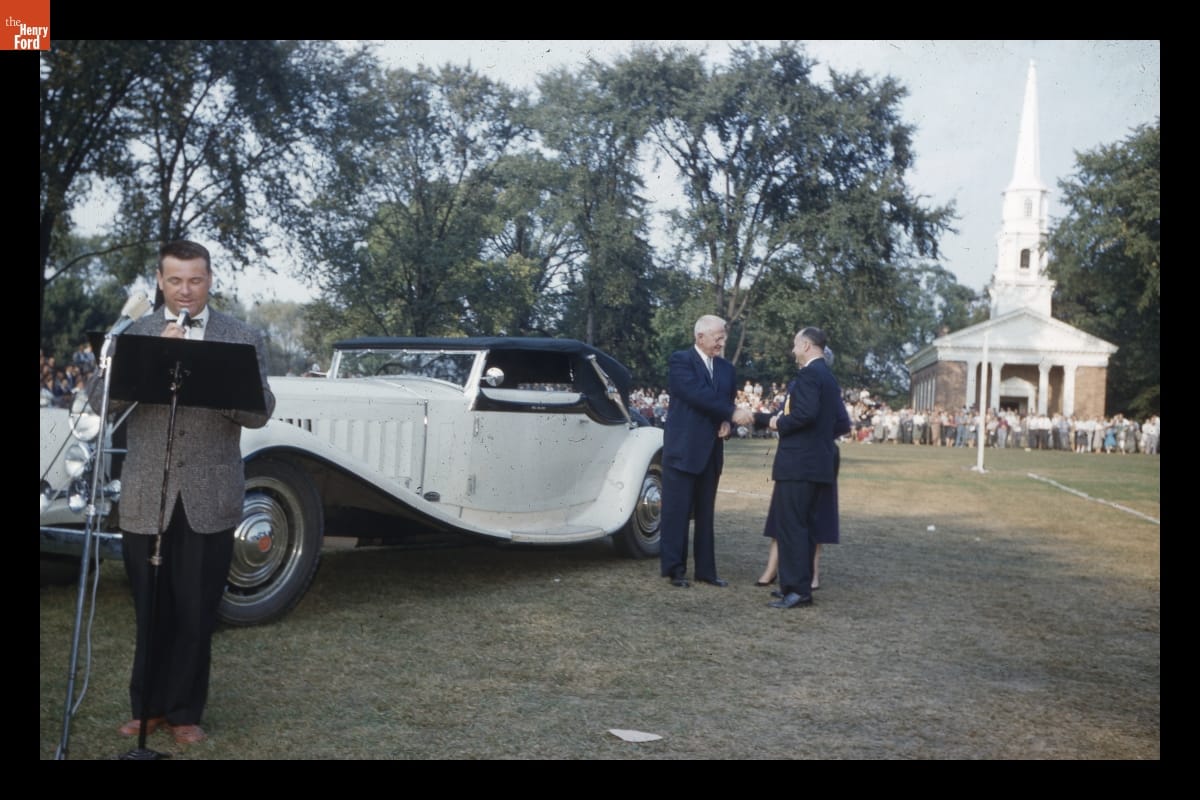
- Presentation of 1931 Bugatti Type 41 Royale Convertible at Old Car Festival in Greenfield Village, September 1959 - Charles and Esther Chayne gifted their 1931 Bugatti Type 41 Royale to The Henry Ford in 1958. They made the formal presentation during ceremonies at the following year's Old Car Festival. The Chaynes bought the car in 1943. Its original owner, German physician Joseph Fuchs, had turned the Bugatti over to a salvage yard after its engine block was damaged.
- September 20, 1959
- Collections - Artifact
Presentation of 1931 Bugatti Type 41 Royale Convertible at Old Car Festival in Greenfield Village, September 1959
Charles and Esther Chayne gifted their 1931 Bugatti Type 41 Royale to The Henry Ford in 1958. They made the formal presentation during ceremonies at the following year's Old Car Festival. The Chaynes bought the car in 1943. Its original owner, German physician Joseph Fuchs, had turned the Bugatti over to a salvage yard after its engine block was damaged.
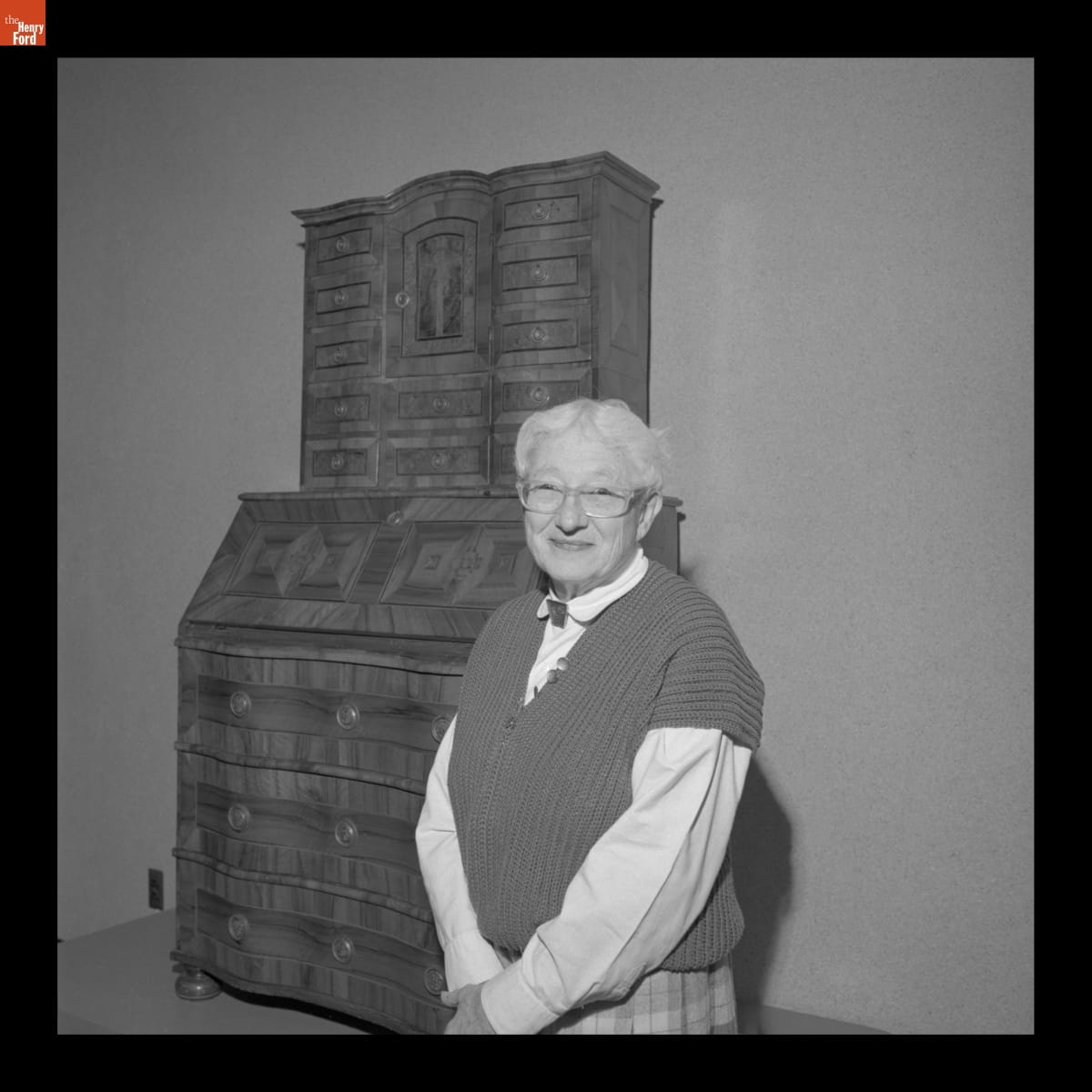
- Donor Ruth Adler Schnee with Secretary Desk at Henry Ford Museum, October 21, 1999 -
- October 21, 1999
- Collections - Artifact
Donor Ruth Adler Schnee with Secretary Desk at Henry Ford Museum, October 21, 1999
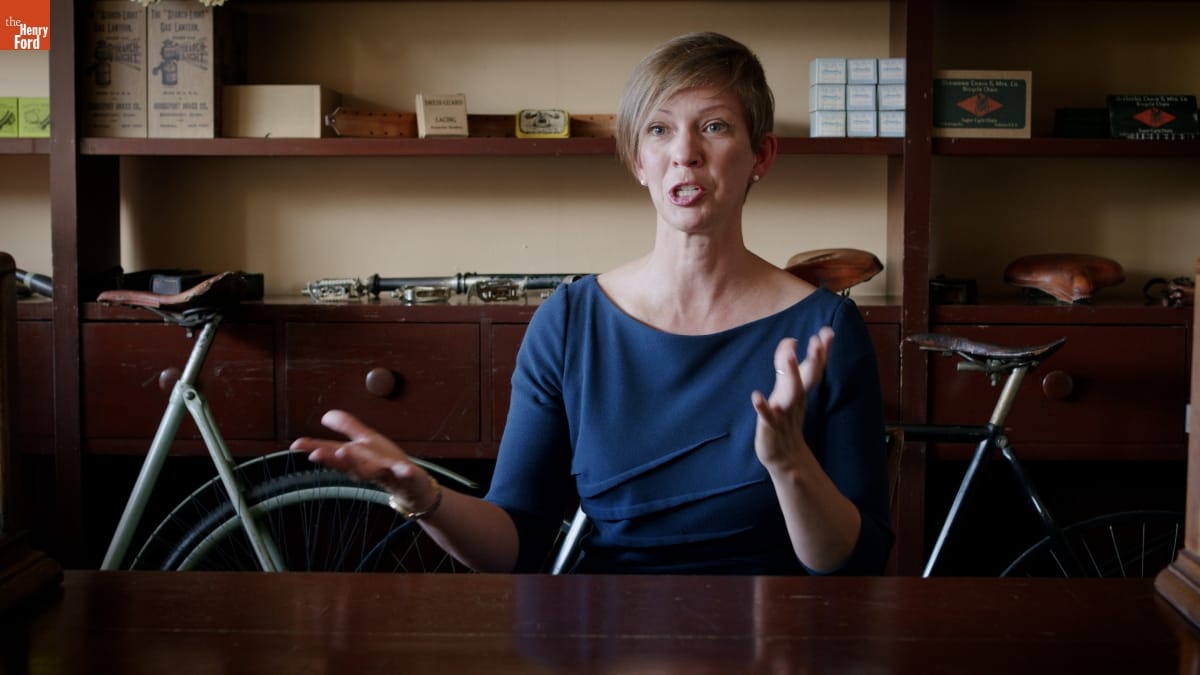
- "Residency Projects," Clip for Interview with Jessica Robinson, August 28, 2020 - Jessica Robinson, co-founder of Detroit Mobility Lab, Michigan Mobility Institute, and Assembly Ventures, was the Spring 2020 Entrepreneur-in-Residence at The Henry Ford, funded by the William Davidson Foundation Initiative for Entrepreneurship. During her interview, Robinson describes how her organizations -- and her residency projects -- encourage technological education in the midst of dramatic new transportation technologies.
- August 28, 2020
- Collections - Artifact
"Residency Projects," Clip for Interview with Jessica Robinson, August 28, 2020
Jessica Robinson, co-founder of Detroit Mobility Lab, Michigan Mobility Institute, and Assembly Ventures, was the Spring 2020 Entrepreneur-in-Residence at The Henry Ford, funded by the William Davidson Foundation Initiative for Entrepreneurship. During her interview, Robinson describes how her organizations -- and her residency projects -- encourage technological education in the midst of dramatic new transportation technologies.