
Search
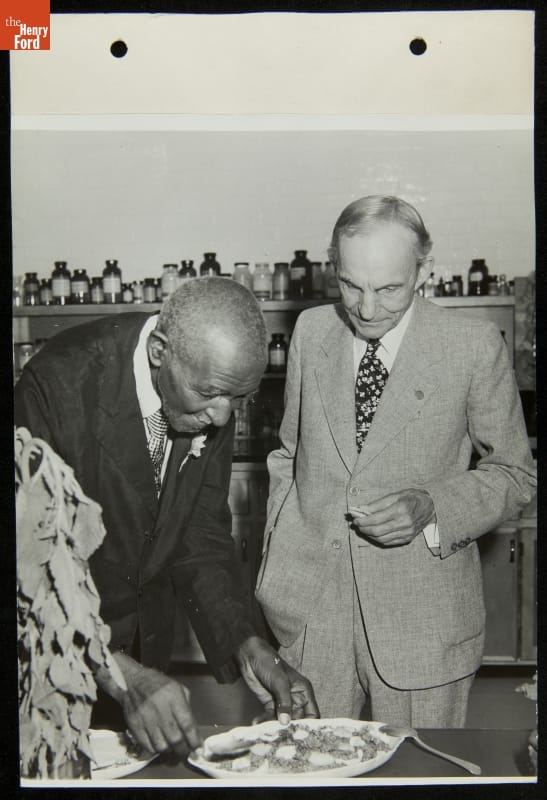
- George Washington Carver and Henry Ford at the Carver Nutrition Laboratory, Dearborn, Michigan, 1942 - George Washington Carver and Henry Ford shared not only an interest in using agricultural products in industry ("chemurgy"), but also some quirky ideas about diet. Here, Carver and Ford share a sandwich of "weed spread," made with wild bergamot, narrow-leafed plantain, purslane, pigweed, milkweed, dandelion, lamb's quarters and wild radish. They shared this meal at Ford Motor Company's George Washington Carver Nutrition Laboratory during Carver's 1942 Dearborn visit.
- July 21, 1942
- Collections - Artifact
George Washington Carver and Henry Ford at the Carver Nutrition Laboratory, Dearborn, Michigan, 1942
George Washington Carver and Henry Ford shared not only an interest in using agricultural products in industry ("chemurgy"), but also some quirky ideas about diet. Here, Carver and Ford share a sandwich of "weed spread," made with wild bergamot, narrow-leafed plantain, purslane, pigweed, milkweed, dandelion, lamb's quarters and wild radish. They shared this meal at Ford Motor Company's George Washington Carver Nutrition Laboratory during Carver's 1942 Dearborn visit.
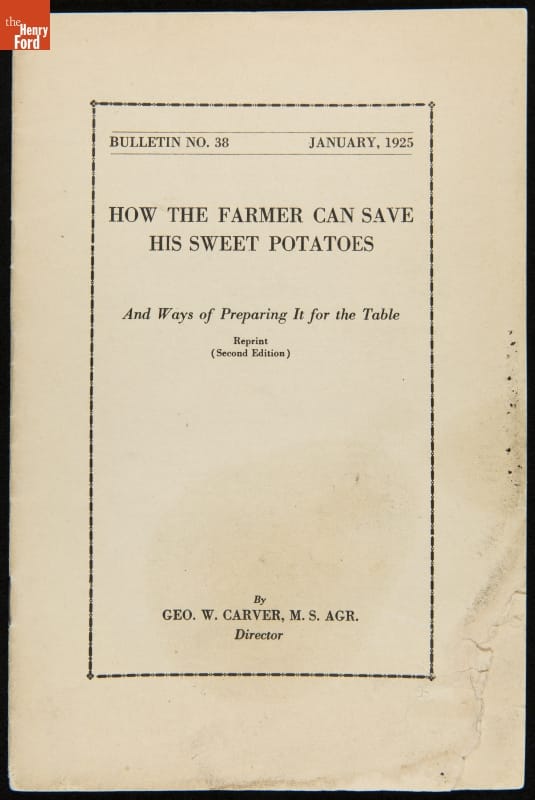
- How the Farmer Can Save His Sweet Potatoes and Ways of Preparing It for the Table, January 1925 (2nd ed.) -
- January 01, 1925
- Collections - Artifact
How the Farmer Can Save His Sweet Potatoes and Ways of Preparing It for the Table, January 1925 (2nd ed.)
- George Washington Carver and Edsel Ford at the Carver Nutrition Laboratory, Dearborn, Michigan, 1942 - In 1942, Henry Ford showed his admiration for his friend and colleague George Washington Carver by naming a Ford Motor Company nutrition laboratory after him. This was appropriate: Carver had dedicated his career to experimental agriculture and to improving farmer nutrition and health as well as crop yields. Though frail, Carver traveled to Dearborn for the dedication. Edsel Ford was also present.

- July 21, 1942
- Collections - Artifact
George Washington Carver and Edsel Ford at the Carver Nutrition Laboratory, Dearborn, Michigan, 1942
In 1942, Henry Ford showed his admiration for his friend and colleague George Washington Carver by naming a Ford Motor Company nutrition laboratory after him. This was appropriate: Carver had dedicated his career to experimental agriculture and to improving farmer nutrition and health as well as crop yields. Though frail, Carver traveled to Dearborn for the dedication. Edsel Ford was also present.
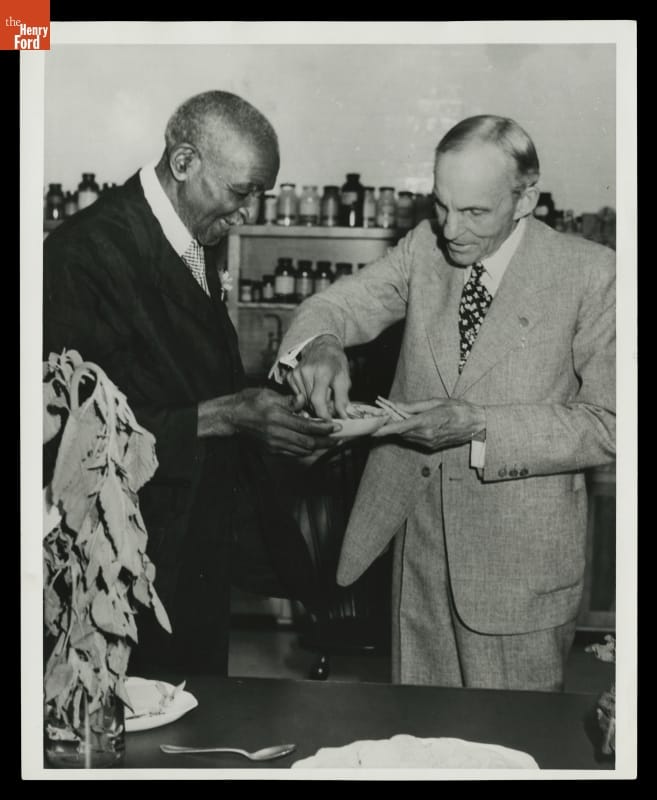
- George Washington Carver and Henry Ford at the Carver Nutrition Laboratory, July 1942 - George Washington Carver and Henry Ford shared not only an interest in using agricultural products in industry ("chemurgy"), but also some quirky ideas about diet. Here, Carver and Ford share a sandwich of "weed spread," made with wild bergamot, narrow-leafed plantain, purslane, pigweed, milkweed, dandelion, lamb's quarters and wild radish. They shared this meal at Ford Motor Company's George Washington Carver Nutrition Laboratory during Carver's 1942 Dearborn visit.
- July 21, 1942
- Collections - Artifact
George Washington Carver and Henry Ford at the Carver Nutrition Laboratory, July 1942
George Washington Carver and Henry Ford shared not only an interest in using agricultural products in industry ("chemurgy"), but also some quirky ideas about diet. Here, Carver and Ford share a sandwich of "weed spread," made with wild bergamot, narrow-leafed plantain, purslane, pigweed, milkweed, dandelion, lamb's quarters and wild radish. They shared this meal at Ford Motor Company's George Washington Carver Nutrition Laboratory during Carver's 1942 Dearborn visit.
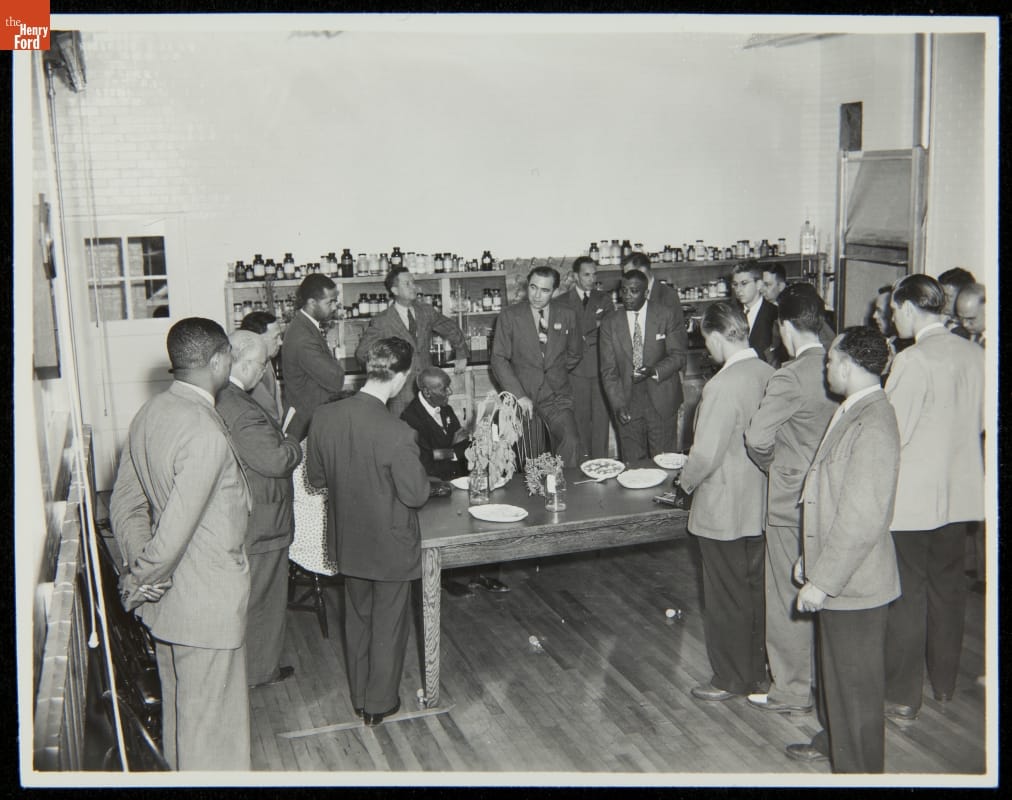
- George Washington Carver at the Dedication of Carver Nutrition Laboratory, Dearborn, Michigan, 1942 - In 1942, Henry Ford showed his admiration for his friend and colleague George Washington Carver by naming a Ford Motor Company nutrition laboratory after him. This was appropriate: Carver had dedicated his career to experimental agriculture and to improving farmer nutrition and health as well as crop yields. Though frail, Carver traveled to Dearborn for the dedication. Edsel Ford was also present.
- July 21, 1942
- Collections - Artifact
George Washington Carver at the Dedication of Carver Nutrition Laboratory, Dearborn, Michigan, 1942
In 1942, Henry Ford showed his admiration for his friend and colleague George Washington Carver by naming a Ford Motor Company nutrition laboratory after him. This was appropriate: Carver had dedicated his career to experimental agriculture and to improving farmer nutrition and health as well as crop yields. Though frail, Carver traveled to Dearborn for the dedication. Edsel Ford was also present.
- George Washington Carver and Henry Ford, Carver Nutrition Laboratory, Dearborn, Michigan, 1942 - George Washington Carver and Henry Ford shared not only an interest in using agricultural products in industry ("chemurgy"), but also some quirky ideas about diet. Here, Carver and Ford share a sandwich of "weed spread," made with wild bergamot, narrow-leafed plantain, purslane, pigweed, milkweed, dandelion, lamb's quarters and wild radish. They shared this meal at Ford Motor Company's George Washington Carver Nutrition Laboratory during Carver's 1942 Dearborn visit.
- July 21, 1942
- Collections - Artifact
George Washington Carver and Henry Ford, Carver Nutrition Laboratory, Dearborn, Michigan, 1942
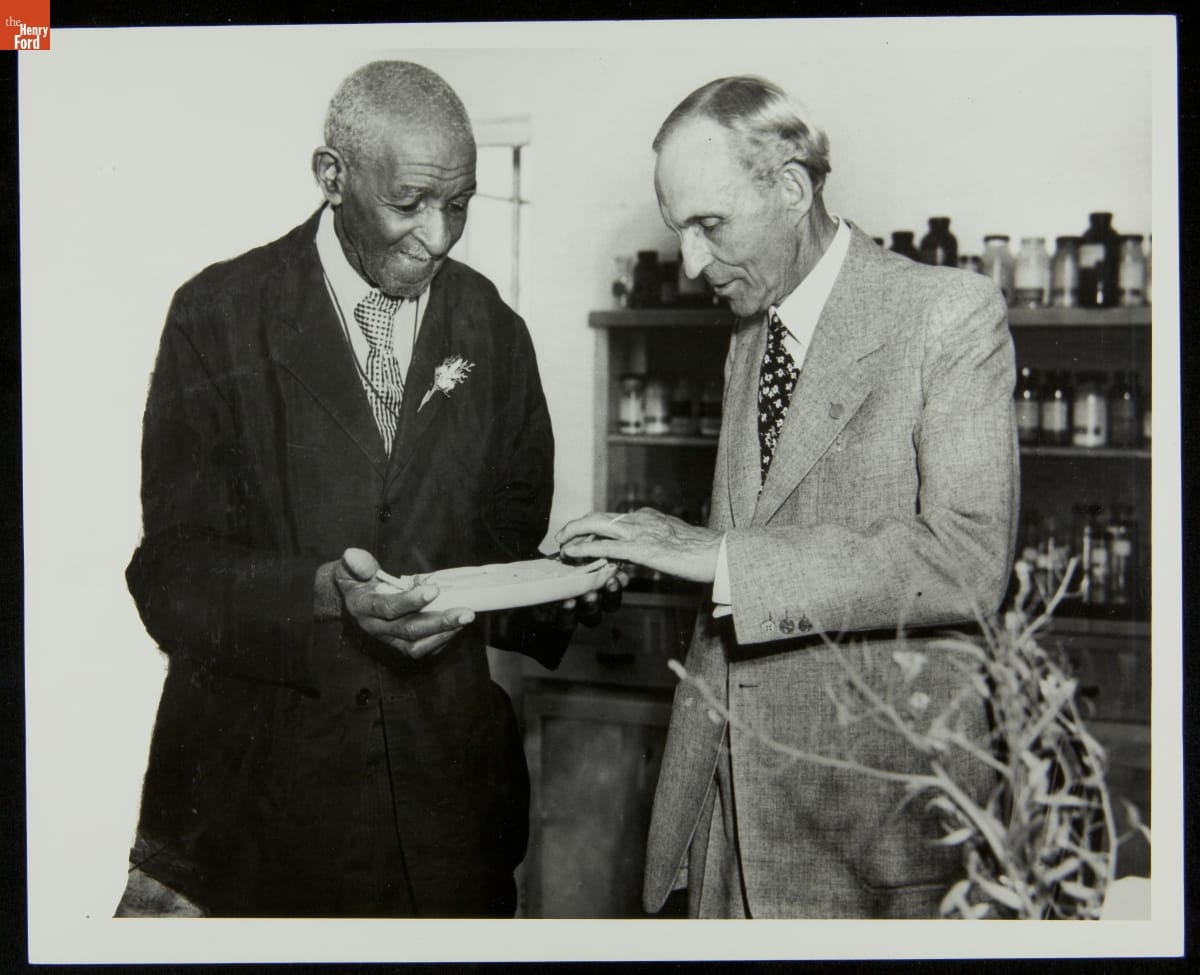
George Washington Carver and Henry Ford shared not only an interest in using agricultural products in industry ("chemurgy"), but also some quirky ideas about diet. Here, Carver and Ford share a sandwich of "weed spread," made with wild bergamot, narrow-leafed plantain, purslane, pigweed, milkweed, dandelion, lamb's quarters and wild radish. They shared this meal at Ford Motor Company's George Washington Carver Nutrition Laboratory during Carver's 1942 Dearborn visit.
- George Washington Carver and Edsel Ford at the Carver Nutrition Laboratory, Dearborn, Michigan, 1942 - In 1942, Henry Ford showed his admiration for his friend and colleague George Washington Carver by naming a Ford Motor Company nutrition laboratory after him. This was appropriate: Carver had dedicated his career to experimental agriculture and to improving farmer nutrition and health as well as crop yields. Though frail, Carver traveled to Dearborn for the dedication. Edsel Ford was also present.
- July 21, 1942
- Collections - Artifact
George Washington Carver and Edsel Ford at the Carver Nutrition Laboratory, Dearborn, Michigan, 1942
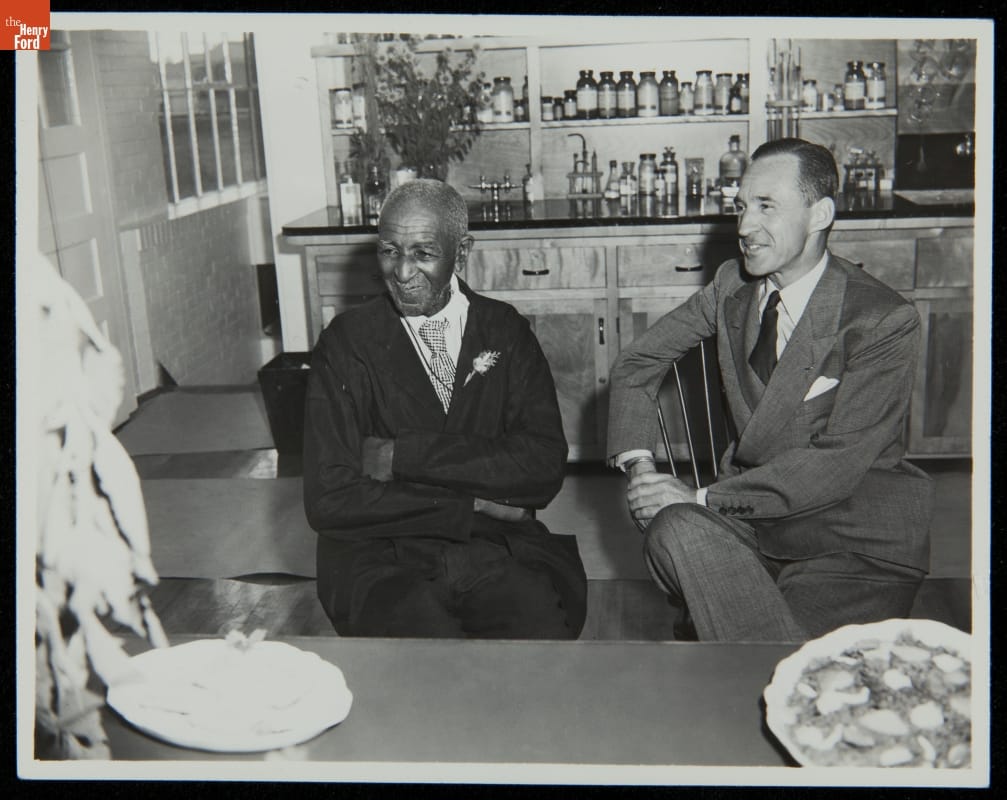
In 1942, Henry Ford showed his admiration for his friend and colleague George Washington Carver by naming a Ford Motor Company nutrition laboratory after him. This was appropriate: Carver had dedicated his career to experimental agriculture and to improving farmer nutrition and health as well as crop yields. Though frail, Carver traveled to Dearborn for the dedication. Edsel Ford was also present.
- Letter from George Washington Carver to Henry Ford, September 3, 1942 - George Washington Carver and Henry Ford became friends in the late 1930s, drawn together by a mutual interest in developing new industrial products from the fruits of the soil. Carver's warm letters to Ford, Clara Ford, and Ford's secretary Frank Campsall speak to the genuine depth of the friendship. Carver often gives Ford advice on research avenues to pursue and suggests recipes for natural health.
- September 03, 1942
- Collections - Artifact
Letter from George Washington Carver to Henry Ford, September 3, 1942
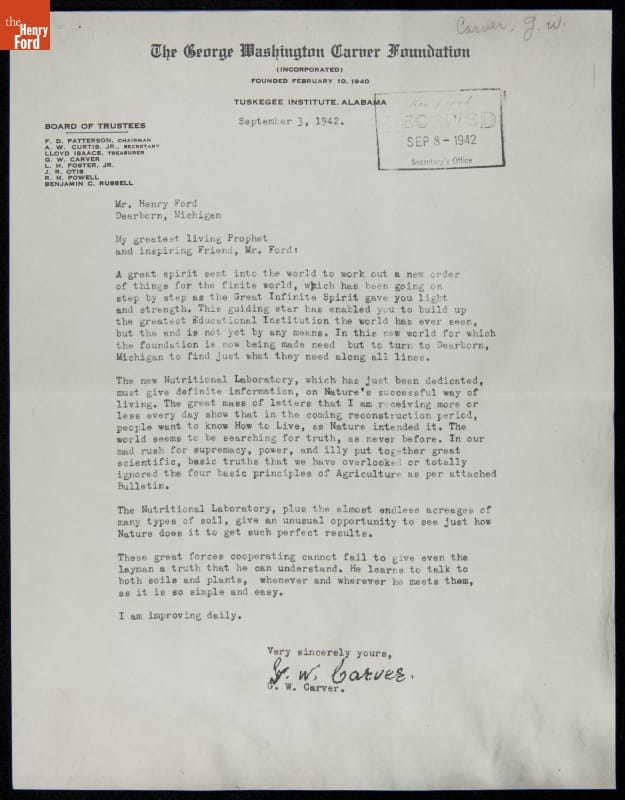
George Washington Carver and Henry Ford became friends in the late 1930s, drawn together by a mutual interest in developing new industrial products from the fruits of the soil. Carver's warm letters to Ford, Clara Ford, and Ford's secretary Frank Campsall speak to the genuine depth of the friendship. Carver often gives Ford advice on research avenues to pursue and suggests recipes for natural health.
- George Washington Carver and Henry Ford at the Carver Nutrition Laboratory, Dearborn, Michigan, 1942 - George Washington Carver and Henry Ford shared not only an interest in using agricultural products in industry ("chemurgy"), but also some quirky ideas about diet. Here, Carver and Ford share a sandwich of "weed spread," made with wild bergamot, narrow-leafed plantain, purslane, pigweed, milkweed, dandelion, lamb's quarters and wild radish. They shared this meal at Ford Motor Company's George Washington Carver Nutrition Laboratory during Carver's 1942 Dearborn visit.
- July 21, 1942
- Collections - Artifact
George Washington Carver and Henry Ford at the Carver Nutrition Laboratory, Dearborn, Michigan, 1942
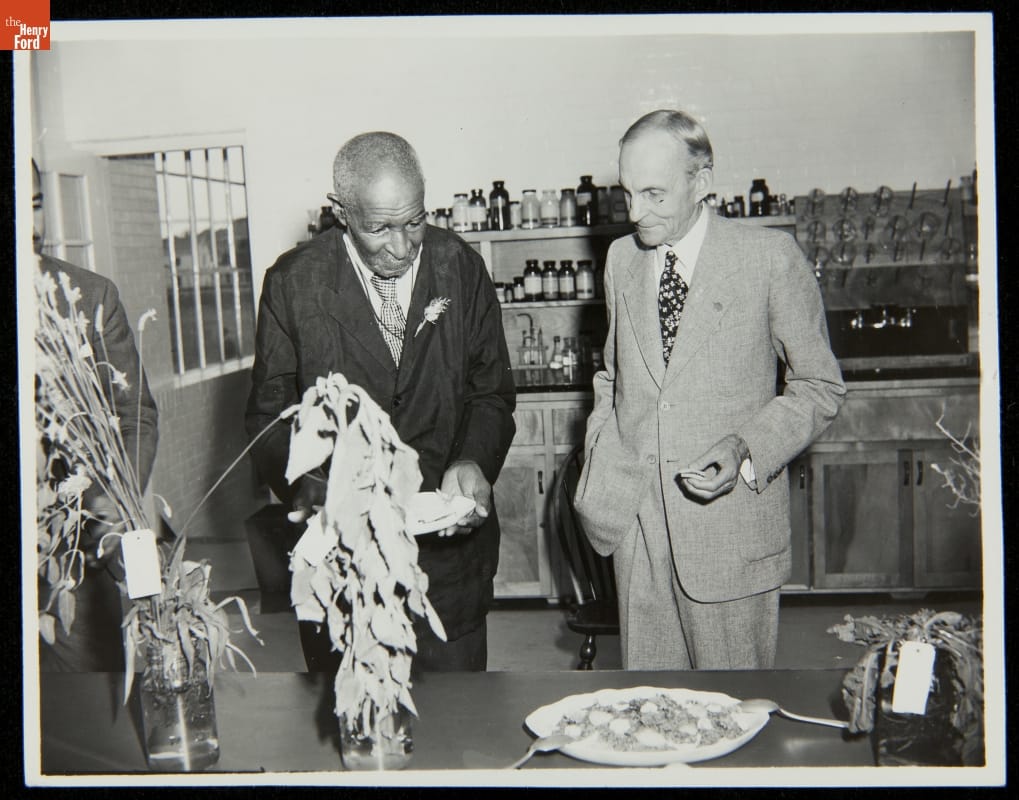
George Washington Carver and Henry Ford shared not only an interest in using agricultural products in industry ("chemurgy"), but also some quirky ideas about diet. Here, Carver and Ford share a sandwich of "weed spread," made with wild bergamot, narrow-leafed plantain, purslane, pigweed, milkweed, dandelion, lamb's quarters and wild radish. They shared this meal at Ford Motor Company's George Washington Carver Nutrition Laboratory during Carver's 1942 Dearborn visit.
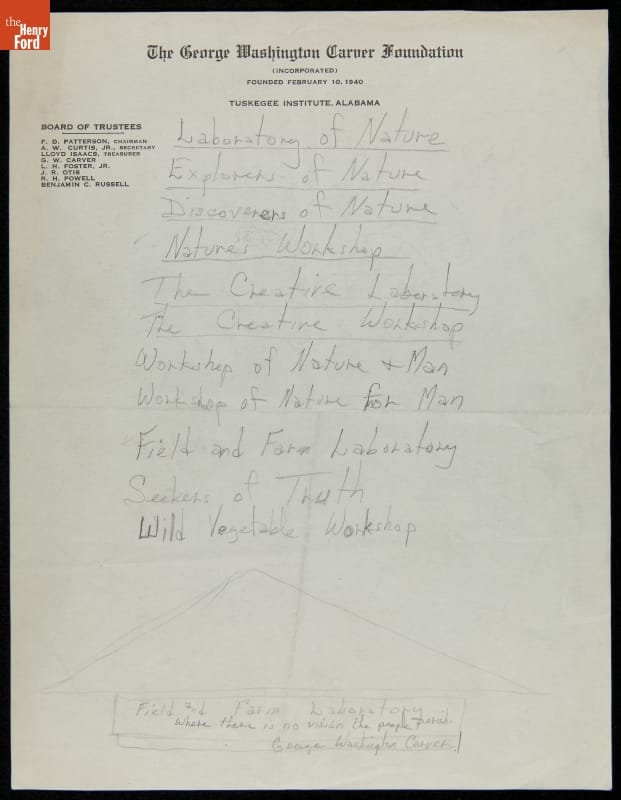
- Document Listing Possible Names for Ford Motor Company's Nutritional Laboratory, July 28, 1942 - This handwritten document with list of possible names for Ford Motor Company's Nutritional Laboratory may have been written by George Washington Carver. The list may have been generated during a discussion between Carver and Irving Bacon, who was painting Carver's portrait. The laboratory was dedicated simply with Carver's name.
- July 01, 1942
- Collections - Artifact
Document Listing Possible Names for Ford Motor Company's Nutritional Laboratory, July 28, 1942
This handwritten document with list of possible names for Ford Motor Company's Nutritional Laboratory may have been written by George Washington Carver. The list may have been generated during a discussion between Carver and Irving Bacon, who was painting Carver's portrait. The laboratory was dedicated simply with Carver's name.