
Search
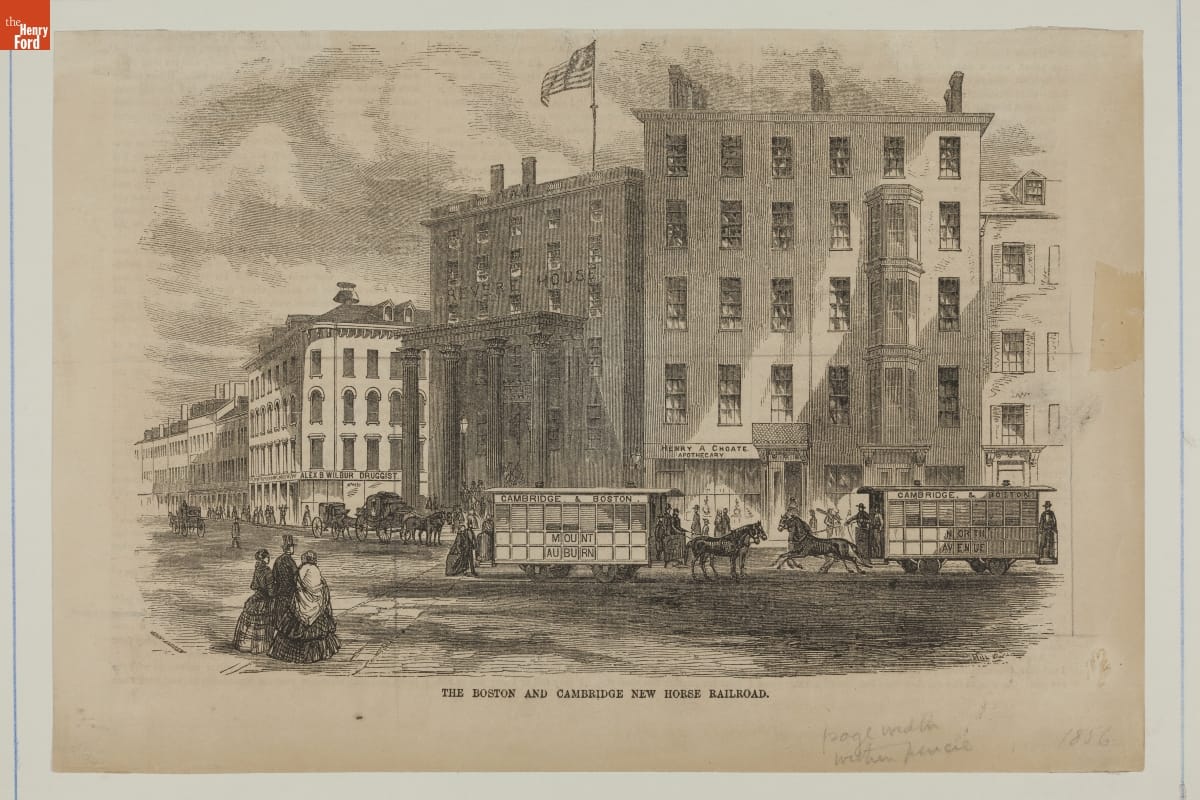
- "The Boston and Cambridge New Horse Railroad," 1856 - This wood engraving depicts the early horse-drawn railroads in 1856 that ran from Boston through Cambridge to Mount Auburn in Massachusetts. The print was originally engraved by printmaker John Andrew for the publication "Ballou's Pictorial."
- 1856
- Collections - Artifact
"The Boston and Cambridge New Horse Railroad," 1856
This wood engraving depicts the early horse-drawn railroads in 1856 that ran from Boston through Cambridge to Mount Auburn in Massachusetts. The print was originally engraved by printmaker John Andrew for the publication "Ballou's Pictorial."
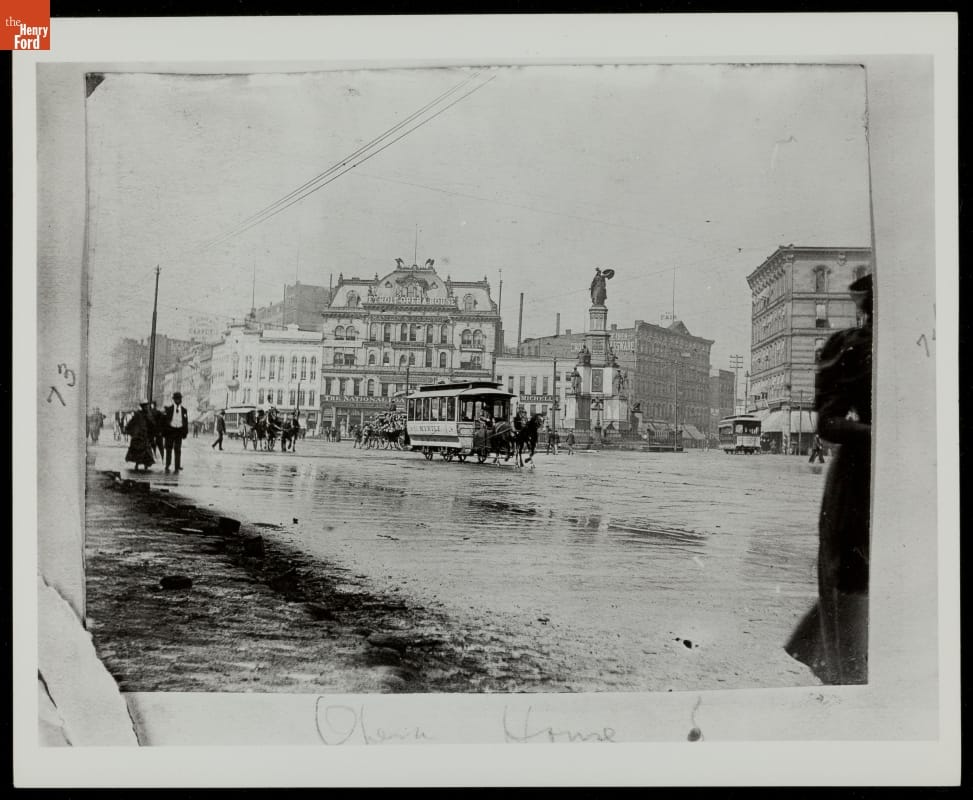
- Detroit Opera House, Detroit, Michigan, circa 1890 - The first Detroit Opera House stands behind a horse-drawn streetcar at Campus Martius, a former military training ground that became the "point of origin" of Detroit's coordinate street system and site of the Michigan Soldiers' and Sailors' Monument. Electric streetcar lines (note the wires strung above the streets) coexisted with horsecars in turn-of-the-ninteenth-century Detroit.
- circa 1890
- Collections - Artifact
Detroit Opera House, Detroit, Michigan, circa 1890
The first Detroit Opera House stands behind a horse-drawn streetcar at Campus Martius, a former military training ground that became the "point of origin" of Detroit's coordinate street system and site of the Michigan Soldiers' and Sailors' Monument. Electric streetcar lines (note the wires strung above the streets) coexisted with horsecars in turn-of-the-ninteenth-century Detroit.
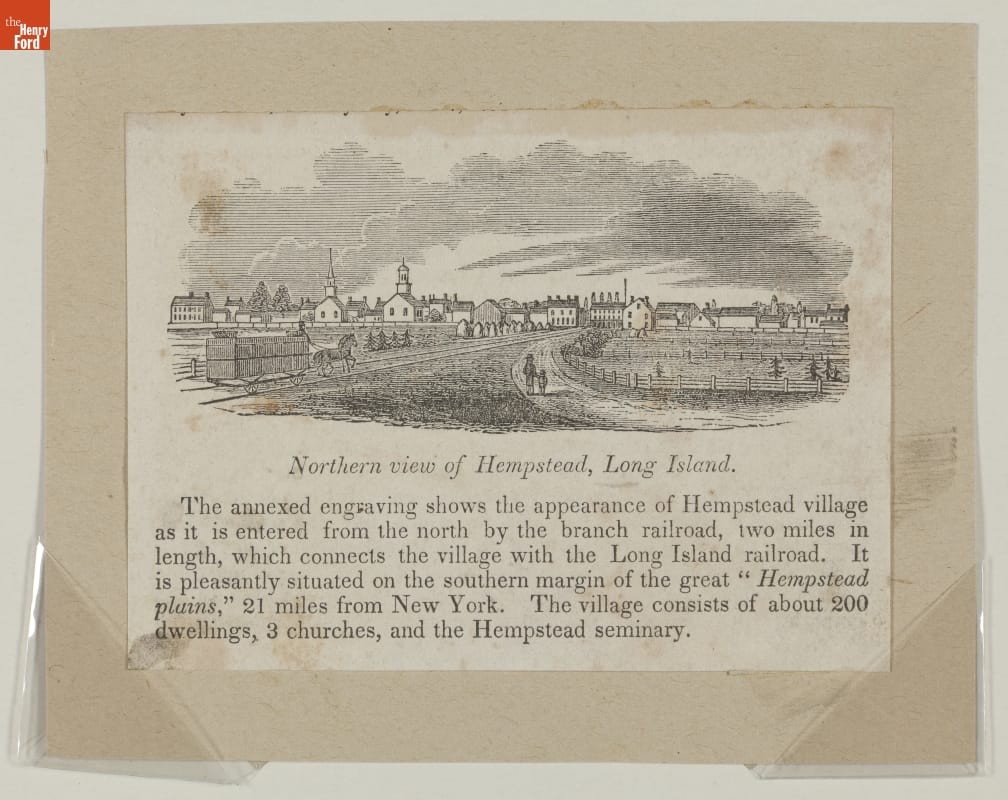
- Wood Engraving, "Northern View of Hempstead, Long Island," circa 1845 - Selecting a railroad's route was a delicate balance between the technical need for easy curves and gentle gradients, and the economic necessity of ready customers. When an important community got bypassed by the mainline, the railroad might build a branch line to it. The Long Island Rail Road built a branch to Hempstead, New York, two miles south of its mainline.
- circa 1845
- Collections - Artifact
Wood Engraving, "Northern View of Hempstead, Long Island," circa 1845
Selecting a railroad's route was a delicate balance between the technical need for easy curves and gentle gradients, and the economic necessity of ready customers. When an important community got bypassed by the mainline, the railroad might build a branch line to it. The Long Island Rail Road built a branch to Hempstead, New York, two miles south of its mainline.
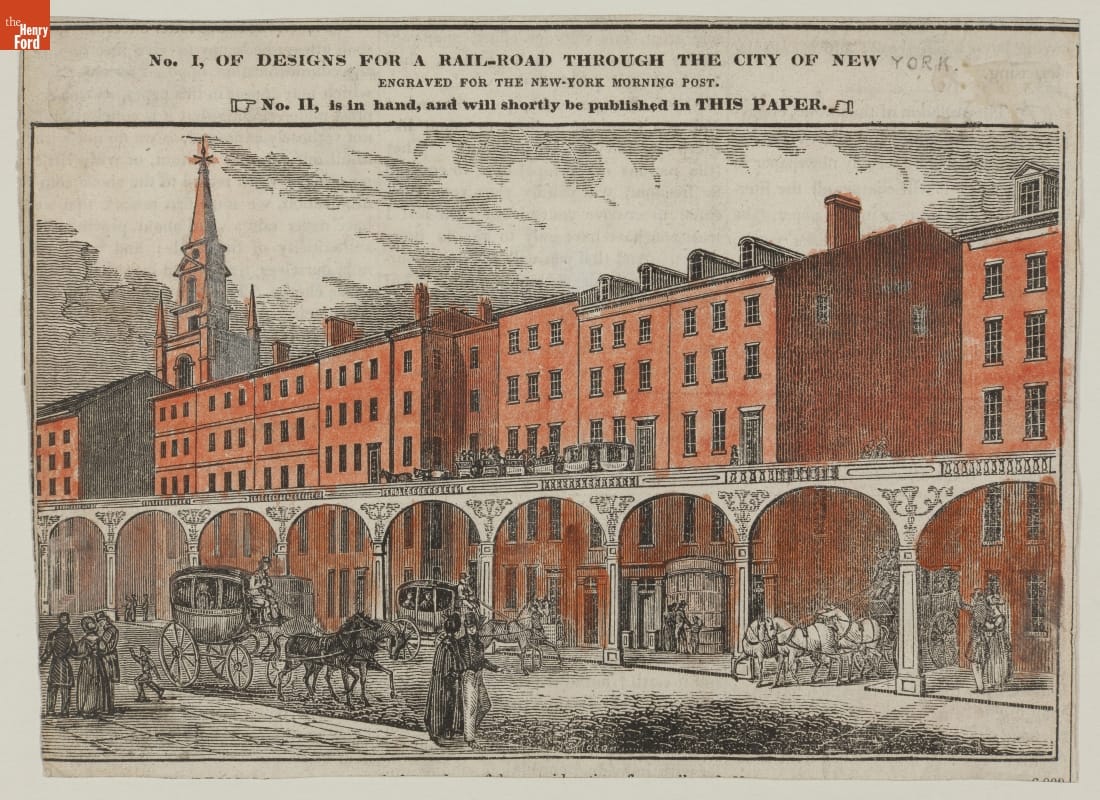
- Wood Engraving, Design for an Elevated Horse-Drawn Railway in New York, circa 1842 - The key to turning mass transit into rapid transit was in removing it from busy streets. One alternative was to build elevated structures that carried streetcars over city traffic. New York City, with its limited land and boundless population, developed a network of elevated lines that covered the length of Manhattan. Other cities, notably Chicago, adopted the technology too.
- circa 1842
- Collections - Artifact
Wood Engraving, Design for an Elevated Horse-Drawn Railway in New York, circa 1842
The key to turning mass transit into rapid transit was in removing it from busy streets. One alternative was to build elevated structures that carried streetcars over city traffic. New York City, with its limited land and boundless population, developed a network of elevated lines that covered the length of Manhattan. Other cities, notably Chicago, adopted the technology too.
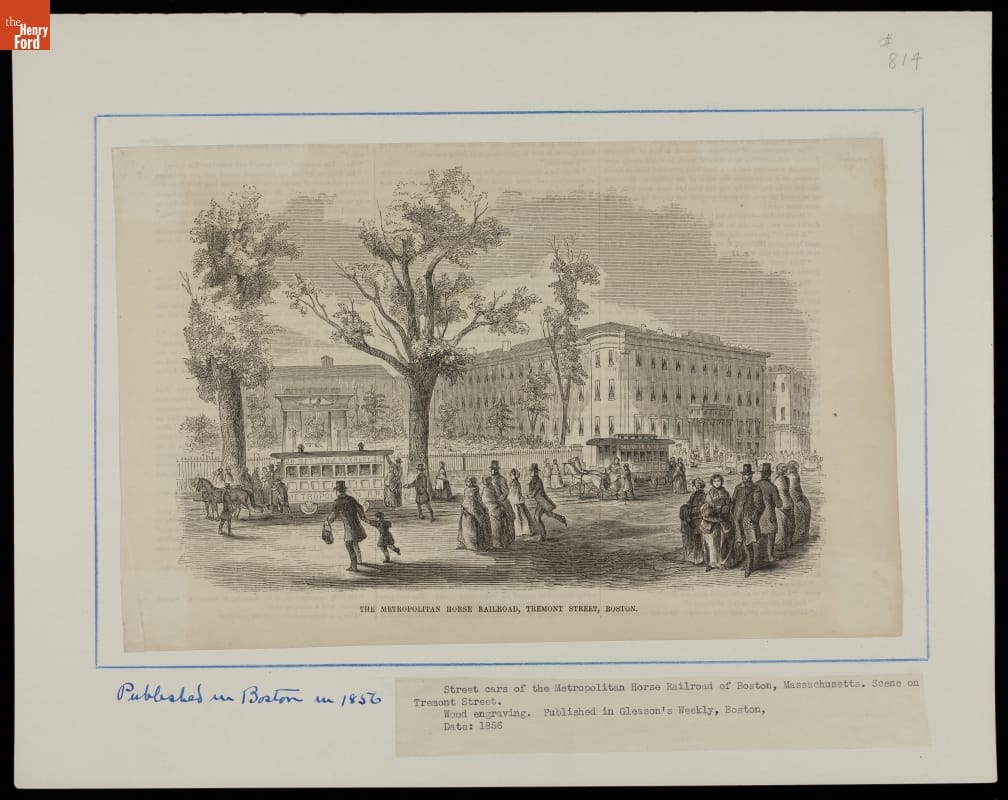
- "Metropolitan Horse Railroad, Tremont Street, Boston," 1856 - City people used streetcars to get to work, do errands, and enjoy leisure activities. But they had to travel on the streetcar's schedule rather than their own.
- 1856
- Collections - Artifact
"Metropolitan Horse Railroad, Tremont Street, Boston," 1856
City people used streetcars to get to work, do errands, and enjoy leisure activities. But they had to travel on the streetcar's schedule rather than their own.