
Search
- Letter from Benjamin Lovett to J. B. Cranfill, October 17, 1927 -
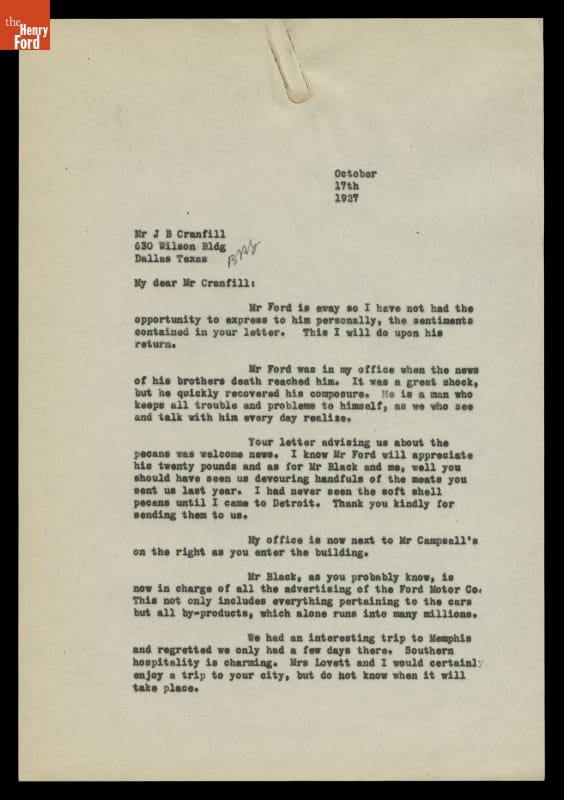
- October 17, 1927
- Collections - Artifact
Letter from Benjamin Lovett to J. B. Cranfill, October 17, 1927
- Letter from Benjamin Lovett to Everett Gibson, February 21, 1927 - In the mid-1920s, Henry Ford was on a crusade to revive the old-fashioned dances of his youth. To encourage participation, Ford published a dance manual, called "Good Morning," and produced recordings of the dance music (with and without the caller calling the steps). Many schools--including colleges--added traditional American dancing to their physical education curriculum.
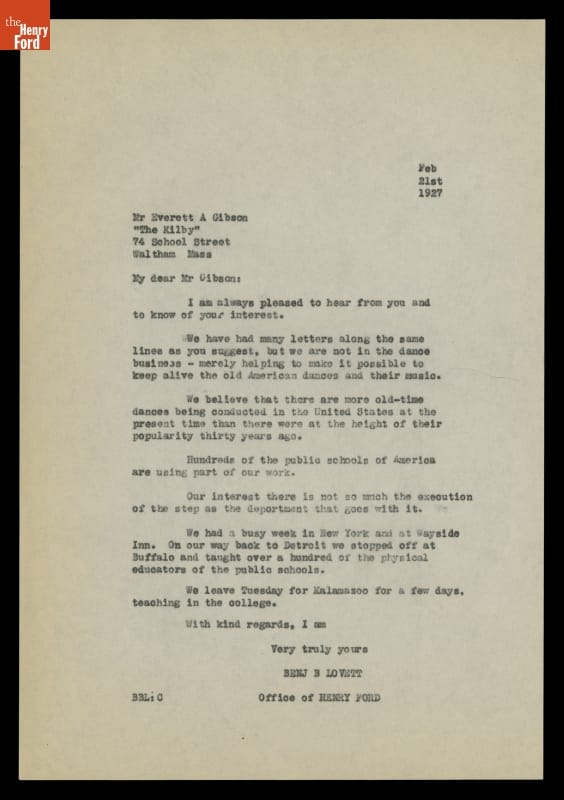
- February 21, 1927
- Collections - Artifact
Letter from Benjamin Lovett to Everett Gibson, February 21, 1927
In the mid-1920s, Henry Ford was on a crusade to revive the old-fashioned dances of his youth. To encourage participation, Ford published a dance manual, called "Good Morning," and produced recordings of the dance music (with and without the caller calling the steps). Many schools--including colleges--added traditional American dancing to their physical education curriculum.
- Letter from Benjamin Lovett to Mary Channing Coleman of the North Carolina College for Women, May 2, 1927 - Henry Ford's dancing master, Benjamin Lovett, accompanied by Ford's Old Time Orchestra, traveled to colleges to instruct students in traditional American dances. While planning his trip to teach at the North Carolina College for Women, Lovett expressed interest in experiencing fiddle music and country dances as well as the company of the rural people of the Greensboro, North Carolina, area.
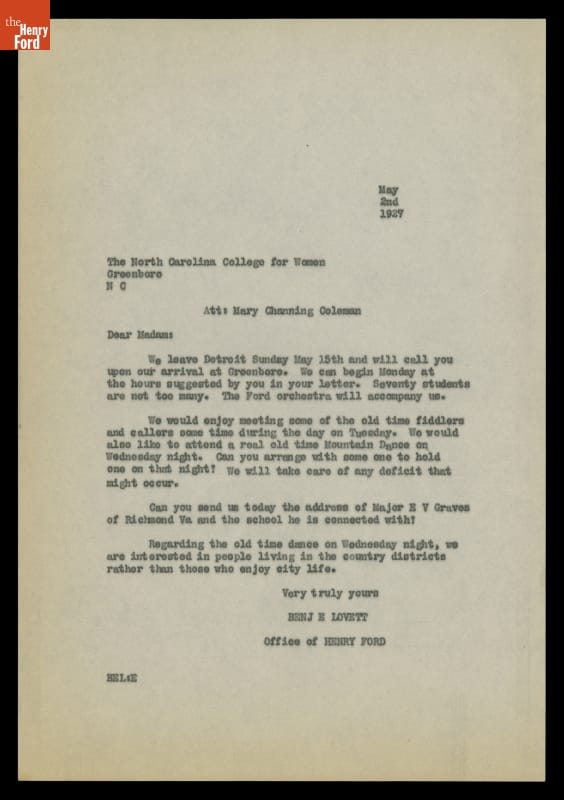
- May 02, 1927
- Collections - Artifact
Letter from Benjamin Lovett to Mary Channing Coleman of the North Carolina College for Women, May 2, 1927
Henry Ford's dancing master, Benjamin Lovett, accompanied by Ford's Old Time Orchestra, traveled to colleges to instruct students in traditional American dances. While planning his trip to teach at the North Carolina College for Women, Lovett expressed interest in experiencing fiddle music and country dances as well as the company of the rural people of the Greensboro, North Carolina, area.
- "Sarah Heinz House...Dedicated to Youth--Recreation, Character--Service," 1915 - In 1901, the Covode House was built as a small boys' club serving the recreational and social needs of local youth. Established by Howard Heinz (son of H.J. Heinz), the club allowed girls to participate two years later and soon outgrew its facility. The Sarah Heinz House (named after Howard's mother) was built around 1913 as its replacement. This booklet describes activities offered here.
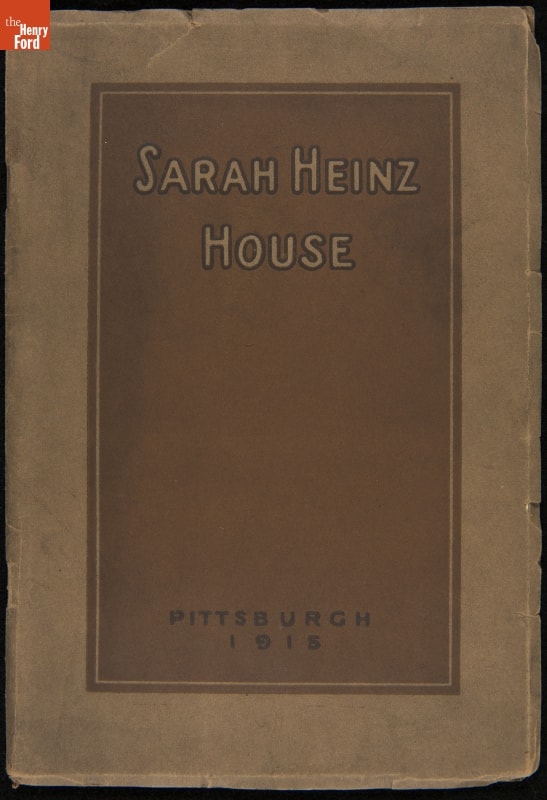
- 1915
- Collections - Artifact
"Sarah Heinz House...Dedicated to Youth--Recreation, Character--Service," 1915
In 1901, the Covode House was built as a small boys' club serving the recreational and social needs of local youth. Established by Howard Heinz (son of H.J. Heinz), the club allowed girls to participate two years later and soon outgrew its facility. The Sarah Heinz House (named after Howard's mother) was built around 1913 as its replacement. This booklet describes activities offered here.
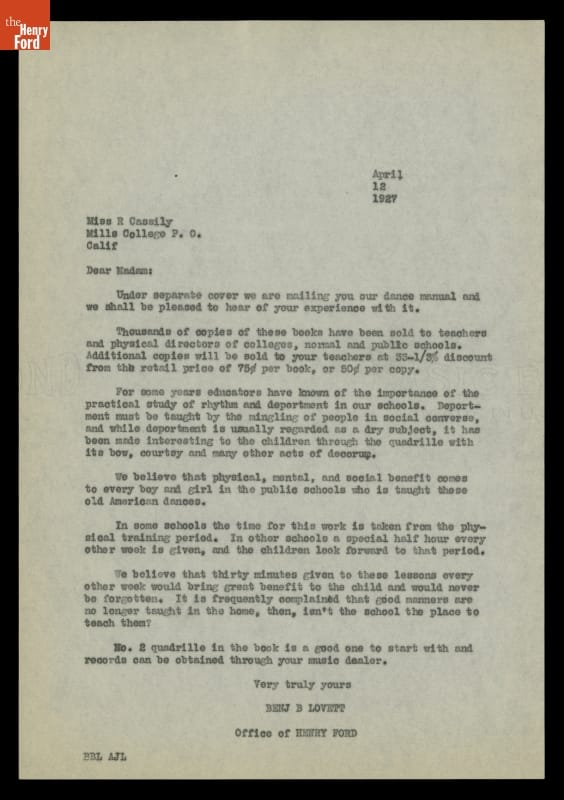
- Letter from Benjamin Lovett to Miss R. Cassily of Mills College, April 12, 1927 - In the mid-1920s, Henry Ford was on a crusade to revive the old-fashioned dances of his youth. To encourage participation, Ford published a dance manual, called "Good Morning," and produced recordings of the dance music (with and without the caller calling the steps). Many schools--including colleges--added traditional American dancing to their physical education curriculum.
- April 12, 1927
- Collections - Artifact
Letter from Benjamin Lovett to Miss R. Cassily of Mills College, April 12, 1927
In the mid-1920s, Henry Ford was on a crusade to revive the old-fashioned dances of his youth. To encourage participation, Ford published a dance manual, called "Good Morning," and produced recordings of the dance music (with and without the caller calling the steps). Many schools--including colleges--added traditional American dancing to their physical education curriculum.