
Search
- Hallmark "Peace on Earth Series: Italy" Christmas Ornament, 1991 - Already known for greeting cards, Hallmark introduced a line of Christmas ornaments in 1973. The company's annual release of an increasing array of ornaments revolutionized Christmas decorating, appealing to customers' interest in marking memories and milestones as well as expressing one's personality and unique tastes.

- 1991
- Collections - Artifact
Hallmark "Peace on Earth Series: Italy" Christmas Ornament, 1991
Already known for greeting cards, Hallmark introduced a line of Christmas ornaments in 1973. The company's annual release of an increasing array of ornaments revolutionized Christmas decorating, appealing to customers' interest in marking memories and milestones as well as expressing one's personality and unique tastes.
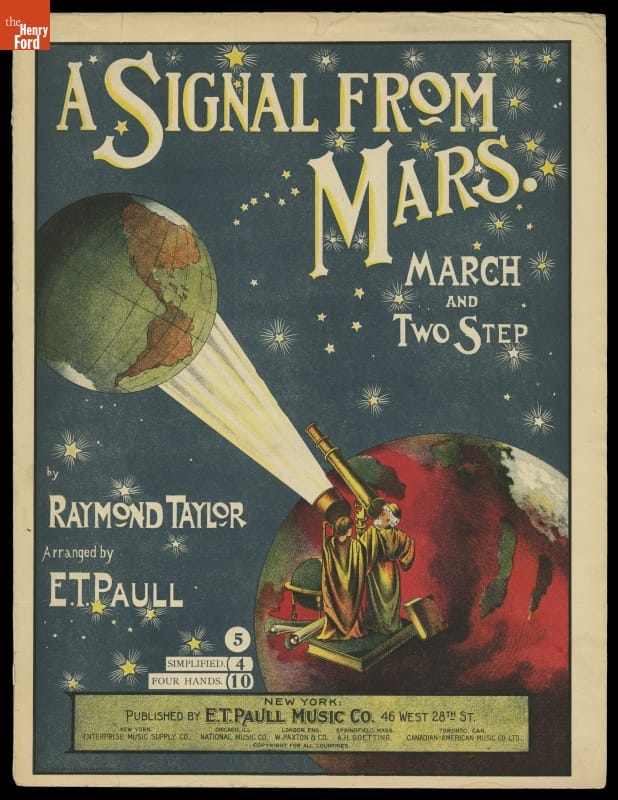
- "A Signal from Mars March and Two-Step," 1901 - The concept of "life on Mars" did not begin in tabloid magazines. In 1877, when astronomer Giovanni Schiaparelli's Mars report was translated into English, one word--canali--was misinterpreted to mean "canal." The idea of intelligent Martian lifeforms was influenced by this misunderstanding. This music documents the rise of "Mars Fever" and its impact upon popular, artistic and scientific cultures.
- 1901
- Collections - Artifact
"A Signal from Mars March and Two-Step," 1901
The concept of "life on Mars" did not begin in tabloid magazines. In 1877, when astronomer Giovanni Schiaparelli's Mars report was translated into English, one word--canali--was misinterpreted to mean "canal." The idea of intelligent Martian lifeforms was influenced by this misunderstanding. This music documents the rise of "Mars Fever" and its impact upon popular, artistic and scientific cultures.
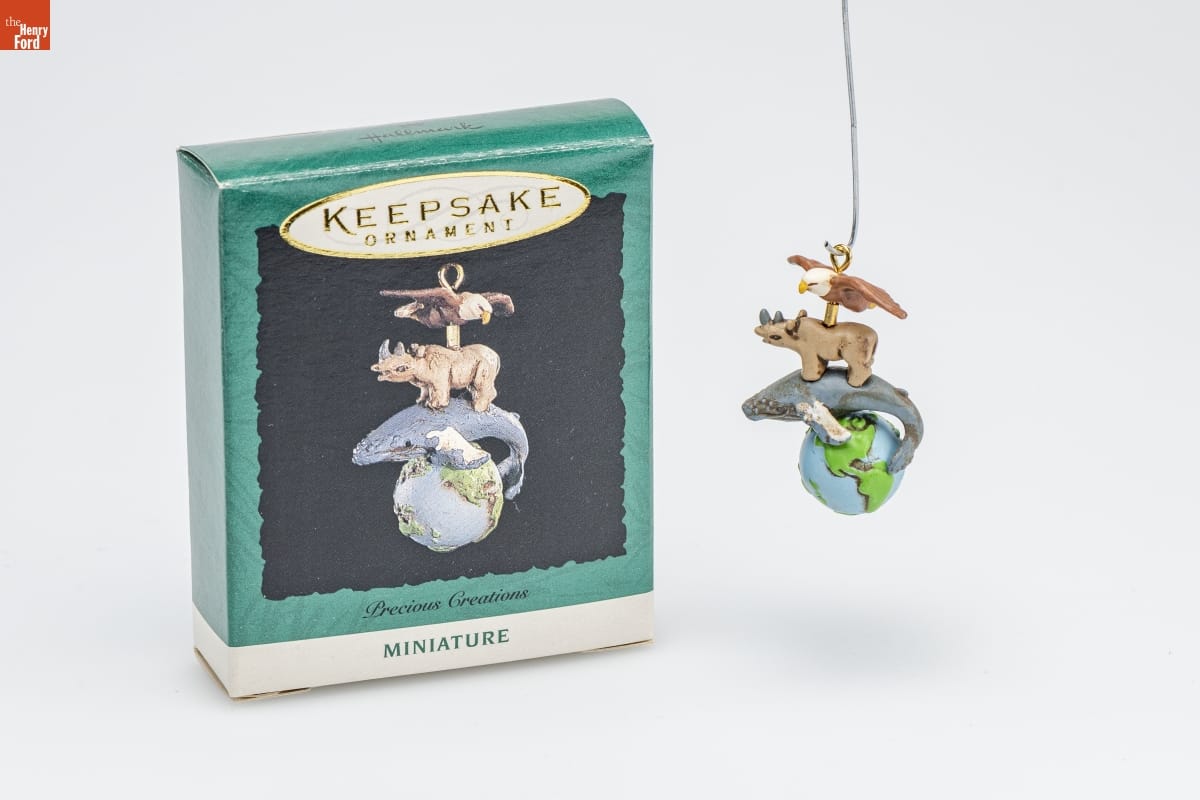
- Hallmark "Precious Creations" Miniature Christmas Ornament, 1995 - Already known for greeting cards, Hallmark introduced a line of Christmas ornaments in 1973. The company's annual release of an increasing array of ornaments revolutionized Christmas decorating, appealing to customers' interest in marking memories and milestones as well as expressing one's personality and unique tastes.
- 1995
- Collections - Artifact
Hallmark "Precious Creations" Miniature Christmas Ornament, 1995
Already known for greeting cards, Hallmark introduced a line of Christmas ornaments in 1973. The company's annual release of an increasing array of ornaments revolutionized Christmas decorating, appealing to customers' interest in marking memories and milestones as well as expressing one's personality and unique tastes.
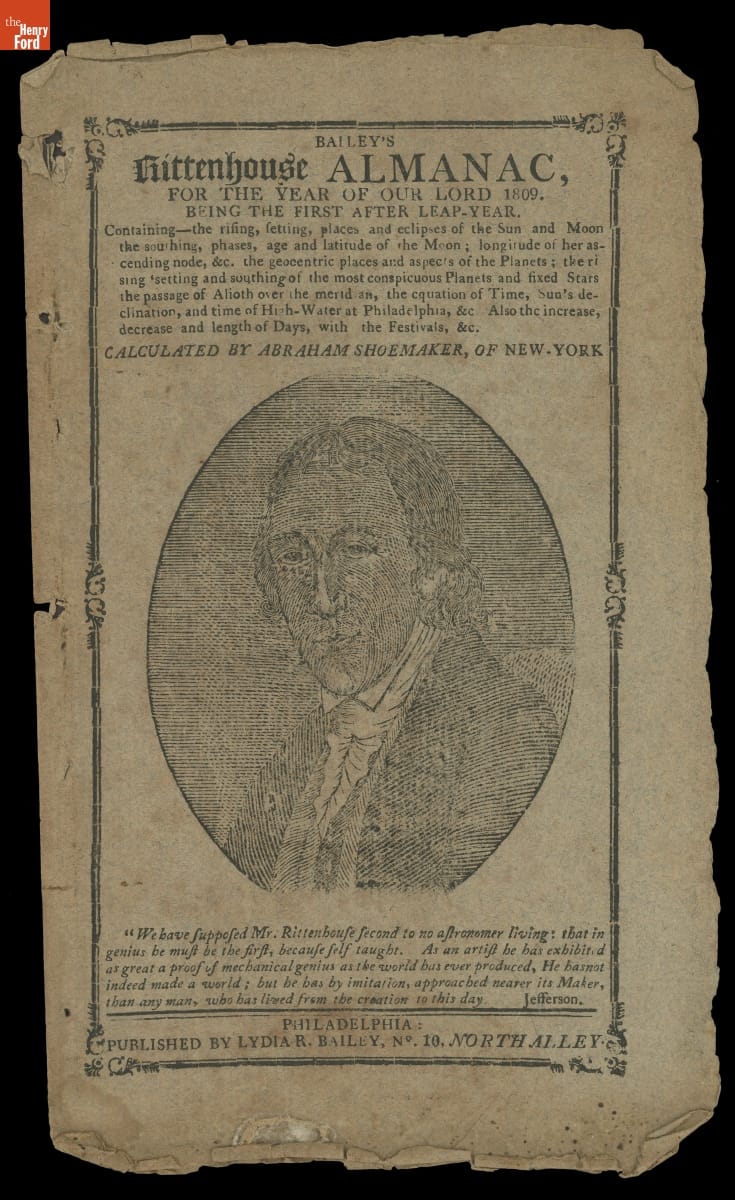
- "Bailey's Rittenhouse Almanac, for the Year of our Lord 1809" - Bailey's Rittenhouse Almanac, named for the noted astronomer David Rittenhouse (1732-1796), was a Philadelphia-focused almanac providing astronomical calculations (times of sunrises and sets, the tides, moon phases, and eclipses, etc.) The almanac also provided remedies, recipes, court schedules, and bits of sage advice among its pages. The almanac's printer, Lydia Bailey, operated one of Philadelphia's largest printing shops.
- 1809
- Collections - Artifact
"Bailey's Rittenhouse Almanac, for the Year of our Lord 1809"
Bailey's Rittenhouse Almanac, named for the noted astronomer David Rittenhouse (1732-1796), was a Philadelphia-focused almanac providing astronomical calculations (times of sunrises and sets, the tides, moon phases, and eclipses, etc.) The almanac also provided remedies, recipes, court schedules, and bits of sage advice among its pages. The almanac's printer, Lydia Bailey, operated one of Philadelphia's largest printing shops.
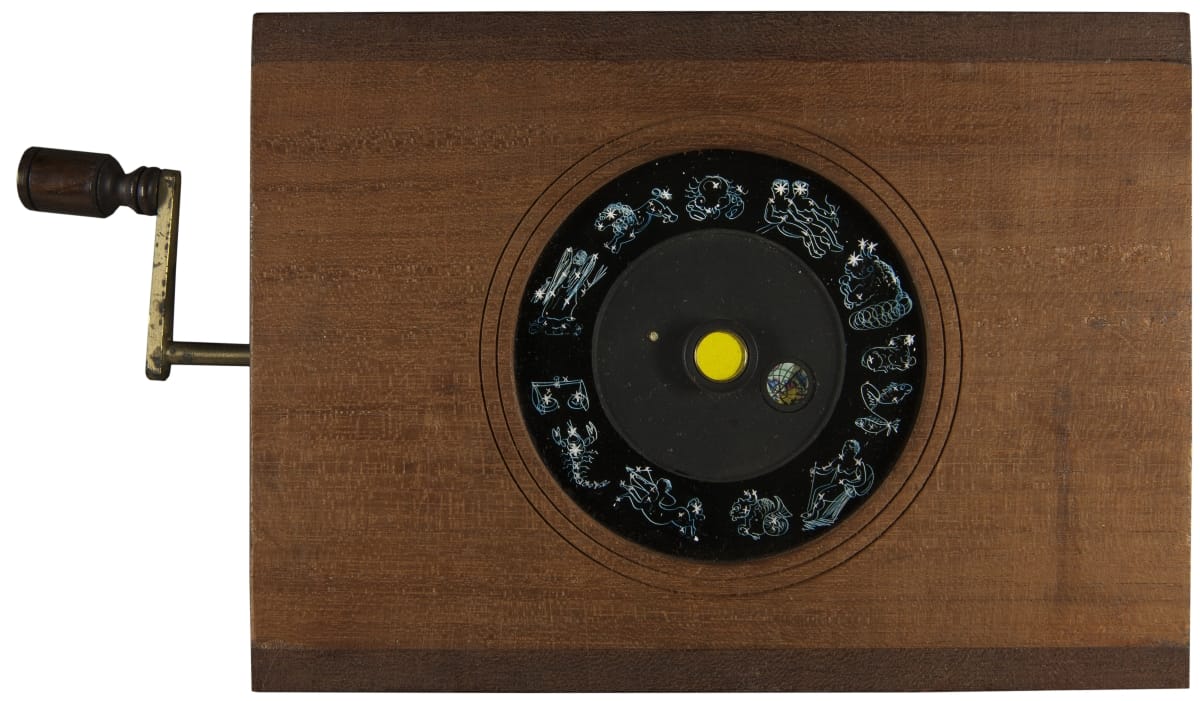
- Mechanical Lantern Slide, Earth's Orbit and Astrological Constellations, 1860-1900 - Magic lanterns use a concave mirror and light source to project images on glass slides with painted or photographic scenes. Developed in the 17th century, magic lanterns predate slide projectors and motion pictures. In the hands of magicians, they became "lanterns of fright," projecting wondrous images and apparitions. Slide themes ranged widely: exotic travel, folklore, advertising, history, science, and art.
- 1860-1900
- Collections - Artifact
Mechanical Lantern Slide, Earth's Orbit and Astrological Constellations, 1860-1900
Magic lanterns use a concave mirror and light source to project images on glass slides with painted or photographic scenes. Developed in the 17th century, magic lanterns predate slide projectors and motion pictures. In the hands of magicians, they became "lanterns of fright," projecting wondrous images and apparitions. Slide themes ranged widely: exotic travel, folklore, advertising, history, science, and art.
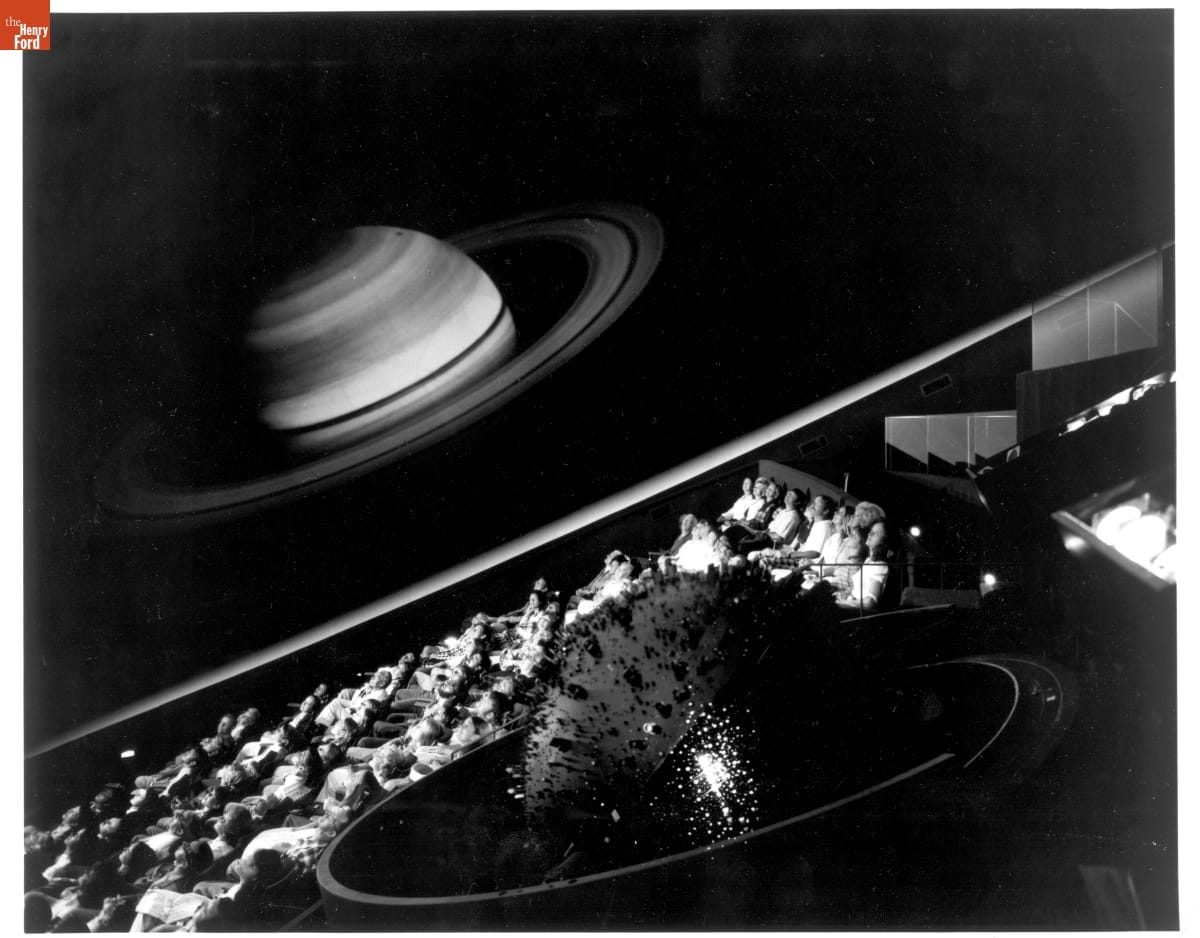
- Audience in the Fleet Science Center Theatre in San Diego during an IMAX Showing of "Voyage to the Outer Planets," circa 1973 - The Fleet Science Center museum and planetarium opened in San Diego, California, in 1973. The center's IMAX Dome theater was a signature attraction, showing educational films like <em>Voyage to the Outer Planets</em> projected through a fisheye lens onto an immersive dome screen. The impressive theater system was soon adopted by other science centers around the world.
- circa 1973
- Collections - Artifact
Audience in the Fleet Science Center Theatre in San Diego during an IMAX Showing of "Voyage to the Outer Planets," circa 1973
The Fleet Science Center museum and planetarium opened in San Diego, California, in 1973. The center's IMAX Dome theater was a signature attraction, showing educational films like Voyage to the Outer Planets projected through a fisheye lens onto an immersive dome screen. The impressive theater system was soon adopted by other science centers around the world.
- Button, "Give Earth a Chance," 1970 - University of Michigan students formed the Environmental Action for Survival Committee (ENACT) in 1969. They created this button to promote a four-day "Teach-in on the Environment," held in March 1970 (before the official Earth Day, April 22, 1970). It was sold to Earth Day advocates who wore it in support of environmental education, direct action to reduce pollution, and regulation to ensure a future for the planet and its inhabitants.

- 1970
- Collections - Artifact
Button, "Give Earth a Chance," 1970
University of Michigan students formed the Environmental Action for Survival Committee (ENACT) in 1969. They created this button to promote a four-day "Teach-in on the Environment," held in March 1970 (before the official Earth Day, April 22, 1970). It was sold to Earth Day advocates who wore it in support of environmental education, direct action to reduce pollution, and regulation to ensure a future for the planet and its inhabitants.
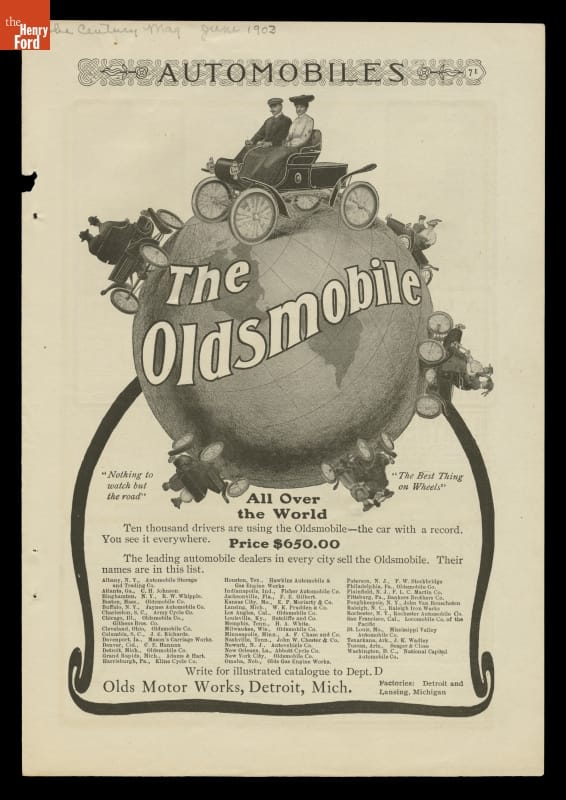
- Olds Motor Works Advertisement from June 1903, "The Oldsmobile All Over the World" - The Curved Dash Oldsmobile arguably was the world's first mass-produced automobile. By 1904, Olds Motor Works built 5,000 cars a year. At just $650, the little runabout was within the means of middle-class buyers. This 1903 advertisement promotes the Oldsmobile's wide use and availability. It also hints at the car's dependability: "Nothing to watch but the road."
- June 01, 1903
- Collections - Artifact
Olds Motor Works Advertisement from June 1903, "The Oldsmobile All Over the World"
The Curved Dash Oldsmobile arguably was the world's first mass-produced automobile. By 1904, Olds Motor Works built 5,000 cars a year. At just $650, the little runabout was within the means of middle-class buyers. This 1903 advertisement promotes the Oldsmobile's wide use and availability. It also hints at the car's dependability: "Nothing to watch but the road."
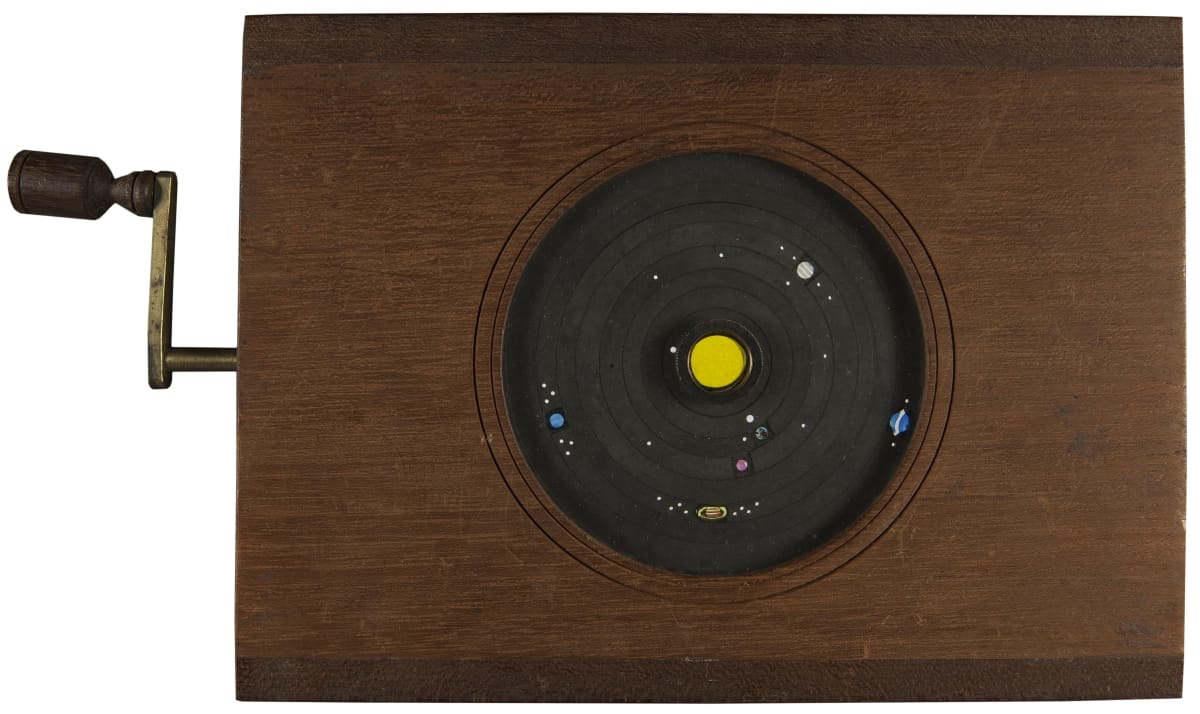
- Mechanical Lantern Slide, the Solar System, 1860-1900 - Magic lanterns use a concave mirror and light source to project images on glass slides with painted or photographic scenes. Developed in the 17th century, magic lanterns predate slide projectors and motion pictures. In the hands of magicians, they became "lanterns of fright," projecting wondrous images and apparitions. Slide themes ranged widely: exotic travel, folklore, advertising, history, science, and art.
- 1860-1900
- Collections - Artifact
Mechanical Lantern Slide, the Solar System, 1860-1900
Magic lanterns use a concave mirror and light source to project images on glass slides with painted or photographic scenes. Developed in the 17th century, magic lanterns predate slide projectors and motion pictures. In the hands of magicians, they became "lanterns of fright," projecting wondrous images and apparitions. Slide themes ranged widely: exotic travel, folklore, advertising, history, science, and art.
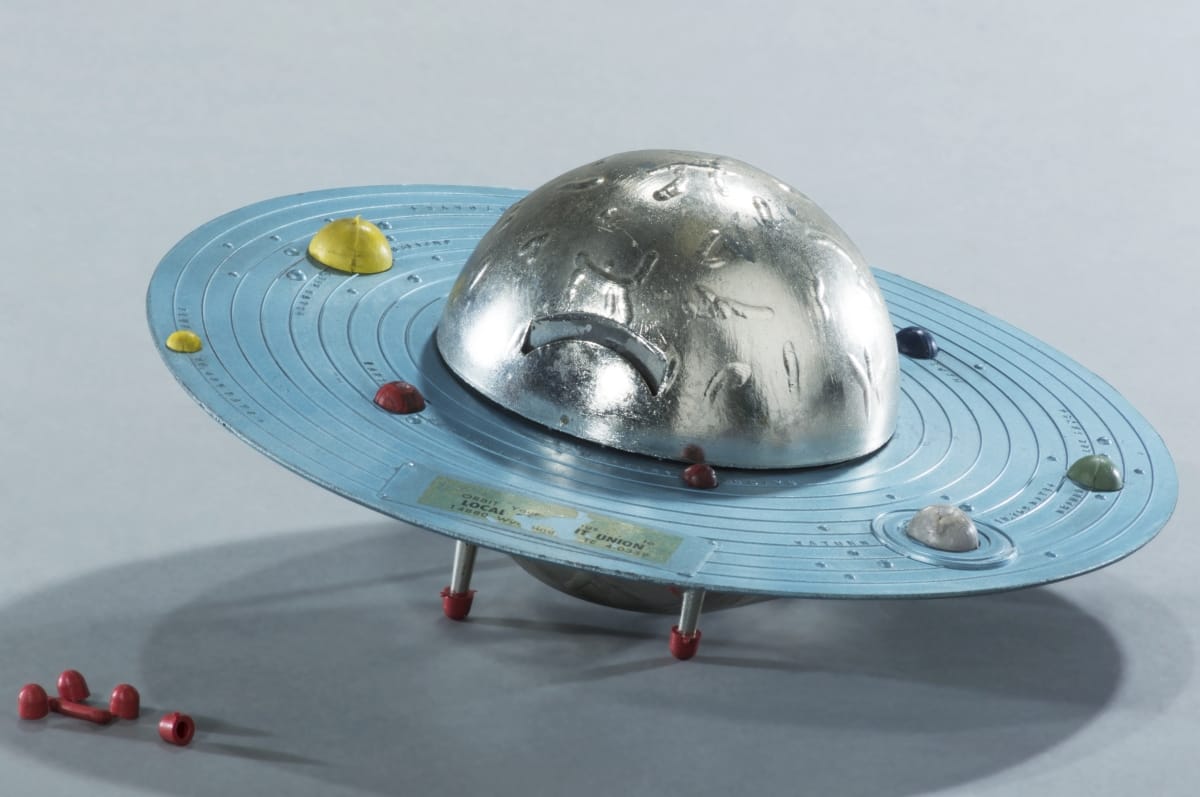
- "Plan-It" Mechanical Bank, circa 1959 - Many early space toys depicted outer space as a futuristic fantasy world. But when space travel became possible, these toys portrayed a more realistic and scientific vision. The "Plan-It" bank from about 1959 features the then nine planets -- possible destinations for future American astronauts as the U.S. entered the space race.
- circa 1959
- Collections - Artifact
"Plan-It" Mechanical Bank, circa 1959
Many early space toys depicted outer space as a futuristic fantasy world. But when space travel became possible, these toys portrayed a more realistic and scientific vision. The "Plan-It" bank from about 1959 features the then nine planets -- possible destinations for future American astronauts as the U.S. entered the space race.