
Fish Brothers Farm Wagon, 1895-1902
THF80599 / Fish Brothers Farm Wagon, 1895-1902
01
Artifact Overview
Farm wagons were all-purpose vehicles that could haul crops from the field to the barn or to market. This wagon body was used in the field for harvesting corn by hand, but it could be changed for other purposes, such as hauling hay or gravel. Franz Eilerman of Shelby County, Ohio, bought this farm wagon in 1902 for his son, Henry.
Artifact Details
Artifact
Farm wagon
Date Made
1895-1902
Creators
Place of Creation
Location
at Henry Ford Museum in Agriculture
Object ID
75.77.1
Credit
From the Collections of The Henry Ford.
Material
Iron (Metal)
Paint (Coating)
Wood (Plant Material)
Color
Black (Color)
Green
Red
Yellow (Color)
White (Color)
Dimensions
Height: 72 in
Width: 74 in
Length: 144 in
Wheelbase: 80 in
Diameter: 39.5 in (Wheel Diameter)
Diameter: 43.5 in (Wheel Diameter)
Inscriptions
On each side of the wagon box is a manufacturer's decal with a picture of a fish and the name of the maker:
FISH BROS. / WAGON COMPANY / RACINE, WISC. / U.S.A.
The maker's name is stencilled on the back of the driver's seat: FISH BROS. WAGON CO.
Stencilled on both of the lower side extension boards is the name of the dealer:
SOLD AND WARRANTED BY / B. KRAMPE / LORAMIE, OHIO.
Keywords |
|---|
02
Related Content
 Set
SetOnline Horse-Drawn Vehicles Collection
- 29 Artifacts
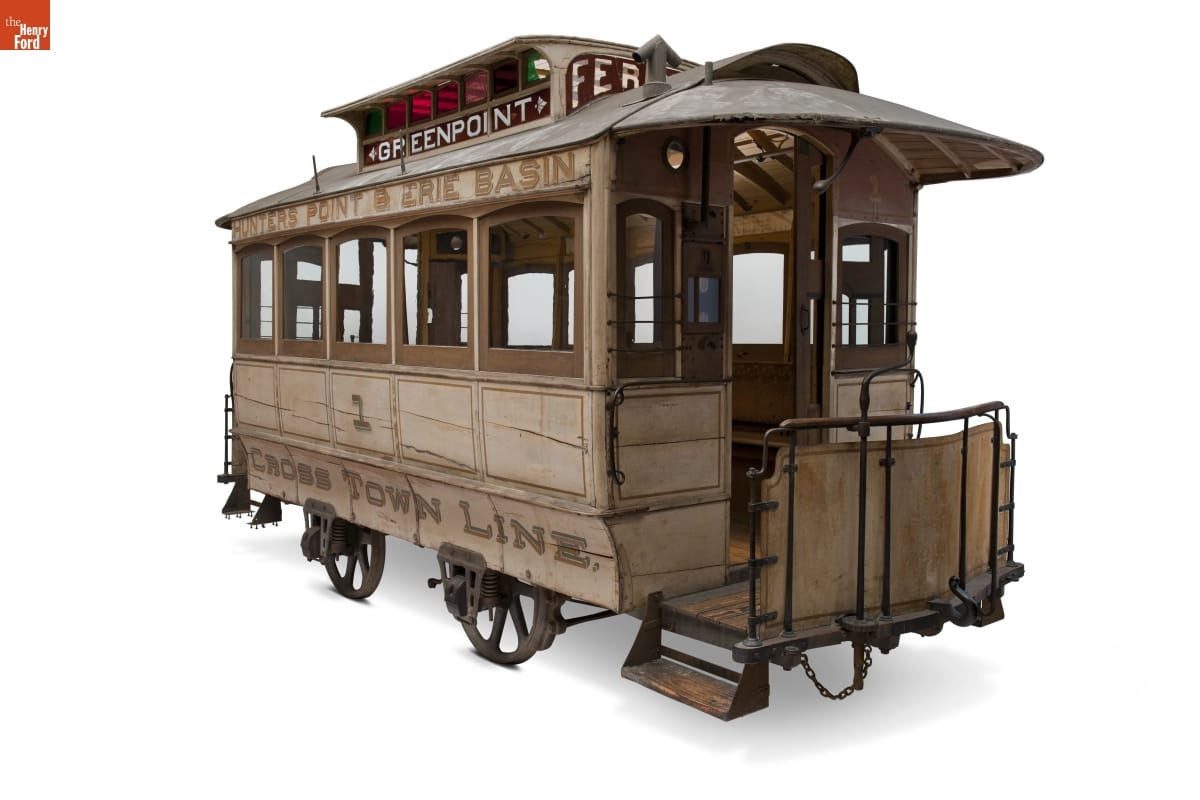
The horse-drawn streetcar was an important means of public transportation in 19th-century American cities. New York's Brooklyn City Railroad ran this car on its line between Hunters Point in Long Island City, and Erie Basin in South Brooklyn. But horses were expensive to stable and feed -- and messy too. Operators embraced electric streetcars starting in the late 1880s. Set
SetCurators' Choice: Agriculture & the Environment
- 25 Artifacts
Calling it his "automotive plow," Henry Ford had Joseph Galamb and C.J. Smith construct this experimental machine. It is powered by a 1905 Ford Model B engine with copper water jackets. This tractor represents either the first or, more probably, the second of several experimental lightweight tractor designs which culminated in the production of the Fordson tractor for U.S. markets in 1918.