
De Forest Singing Arc Type Radiophone Transmitter, 1907
THF156578 / De Forest Singing Arc Type Radiophone Transmitter, 1907
01
Artifact Overview
Lee de Forest was a telecommunications inventor, responsible for the Audion vacuum tube. In 1907, his "radiophone" allowed phonograph music and human voice to broadcast wirelessly. The device used a "singing arc" to generate radio carrier signals. The US Navy purchased six radiotelephones for installation on the Great White Fleet. This is one of the earliest radiotelephones made by de Forest.
Artifact Details
Artifact
Radiophone
Date Made
1907
Creators
Place of Creation
Location
Not on exhibit to the public.
Object ID
40.581.6
Credit
From the Collections of The Henry Ford.
Material
Brass (Alloy)
Iron alloy
Nickel (Metal)
Rubber (Material)
Wood (Plant material)
Dimensions
Height: 17.5 in
Width: 12.5 in
Length: 17 in
Inscriptions
top, plaque:
De Forest Radio-Telephone System
Pats. No. 836015, 803199, 803513, 850917 and Other Patents
No. D-60
The Radio-Telephone Co. New York, U.S.A.
top, plaque:
Transmitter
Radio Telephone
Swinging Arc Type
1907
Keywords |
|---|
02
Related Content
 Set
SetHeroes of Radio and Television at The Henry Ford
- 12 Artifacts
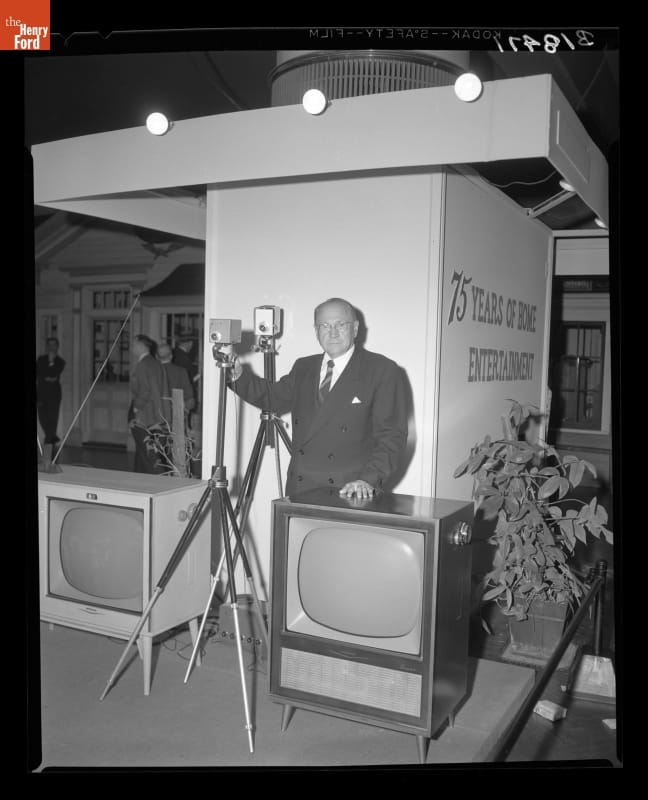
Vladimir Zworykin was an early pioneer of television development, employed by Westinghouse and the Radio Corporation of America. Zworykin's iconoscope and kinescope picture tubes were breakthroughs in television history. Together they allowed electronic television to become a viable technology. Zworykin also headed the creation of the electron microscope and infrared tubes used in night vision "sniperscopes" during WWII. Set
SetTop Twenty: IMLS Communications Grant
- 20 Artifacts
A group of exceptional communications artifacts, conserved and digitized through a 2013-2015 grant from the Institute of Museum and Library Services.