
Rural Free Delivery in a Horse-Drawn Mail Delivery Wagon, 1895-1920
THF143935 / Rural Free Delivery in a Horse-Drawn Mail Delivery Wagon, 1895-1920
01
Artifact Overview
Officially adopted by the Post Office Department in 1896, Rural Free Delivery was a boon to residents who were previously required to personally collect their mail in the nearest town. Rural routes were long and served hundreds of customers. To facilitate their perennial labor, carriers often purchased horse-drawn wagons like this, with a cash box, foot-warmer, and small sorting desk.
Artifact Details
Artifact
Photographic print
Date Made
1895-1920
Subject Date
1895-1920
Creators
Place of Creation
Creator Notes
Made by the National Photo Company, Washington, D.C.
Collection Title
Location
By Request in the Benson Ford Research Center
Object ID
2000.32.46
Credit
From the Collections of The Henry Ford.
Material
Paper (Fiber product)
Technique
Gelatin silver process
Color
Black-and-white (Colors)
Dimensions
Height: 3.375 in
Width: 5.438 in
Inscriptions
Handwritten on ink on verso: DUTTON JUNE 9 THIS IS CHARLEY AND HIS MAN'S WAGON SIDE OF OUR BARN MOTHER
Keywords |
|---|
02
Related Content
 Set
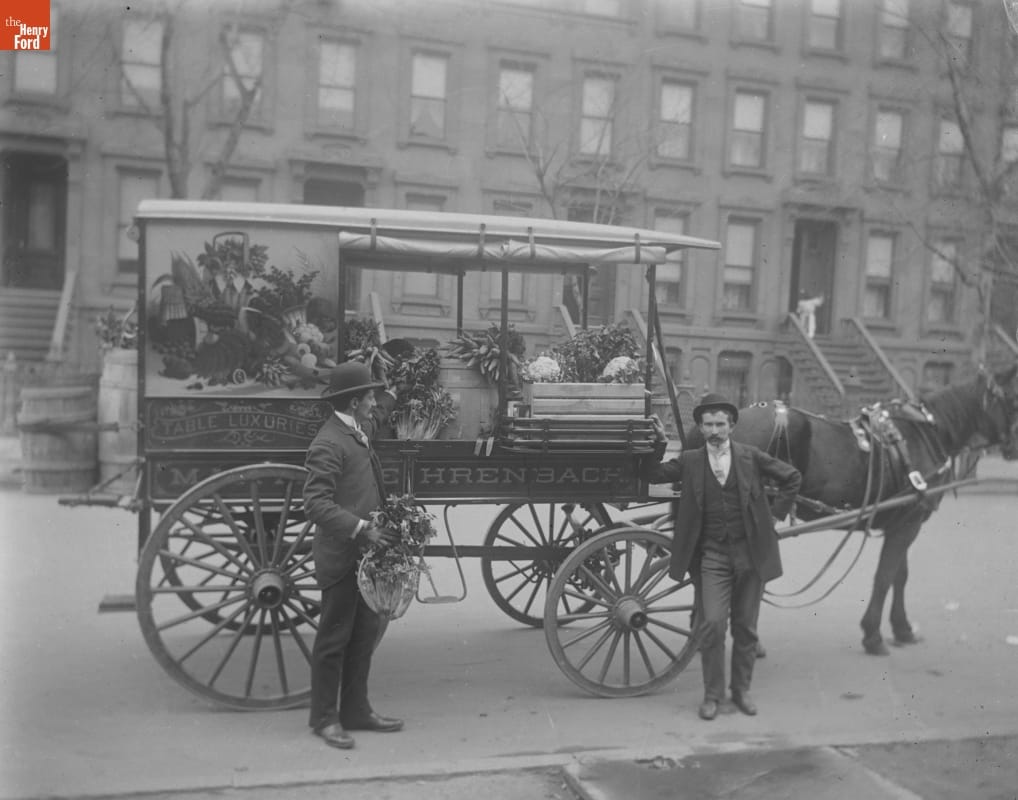
SetHorse-drawn Deliveries
- 11 Artifacts
Horse-drawn delivery wagons remained in use well into the automobile age. Even in the 1920s, it wasn't unusual to see milk, ice, or produce delivered by horse--especially in smaller towns. Horses were well suited to the frequent stops and starts along a route and could negotiate poor roads better than early motorized vehicles. As roads improved and trucks became less expensive to operate and maintain, the horse-drawn delivery wagon faded away.