
Sign Noting Toll Rates for the Detroit and Birmingham Plank Road, 1844-1850
THF69356 / Sign Noting Toll Rates for the Detroit and Birmingham Plank Road, 1844-1850
01
Artifact Overview
In the mid-19th century, road builders experimented with "plank roads" consisting of wood planks laid across longitudinal wood beams. Wood provided a smoother surface than dirt or gravel, especially in wet weather, but it deteriorated quickly. Maintenance costs, financed by user tolls, were prohibitively expensive and most plank roads were gradually resurfaced with gravel.
Artifact Details
Artifact
Sign (Notice)
Date Made
1844-1850
Place of Creation
Location
Not on exhibit to the public.
Object ID
00.1756.1
Credit
From the Collections of The Henry Ford.
Material
Paint (Coating)
Wood (Plant material)
Color
Black (Color)
White (Color)
Inscriptions
Painted on face of sign:
LEGAL RATE OF / Tolls Of Detroit And / Birmingham Plank Road / For Evry vehicle or carriage / Drawn by two animals }2 / Do By more than two for / Every additional animal 3/4 ct /.../
Keywords |
|---|
02
Related Content
 Set
SetMigration & Immigration
- 10 Artifacts
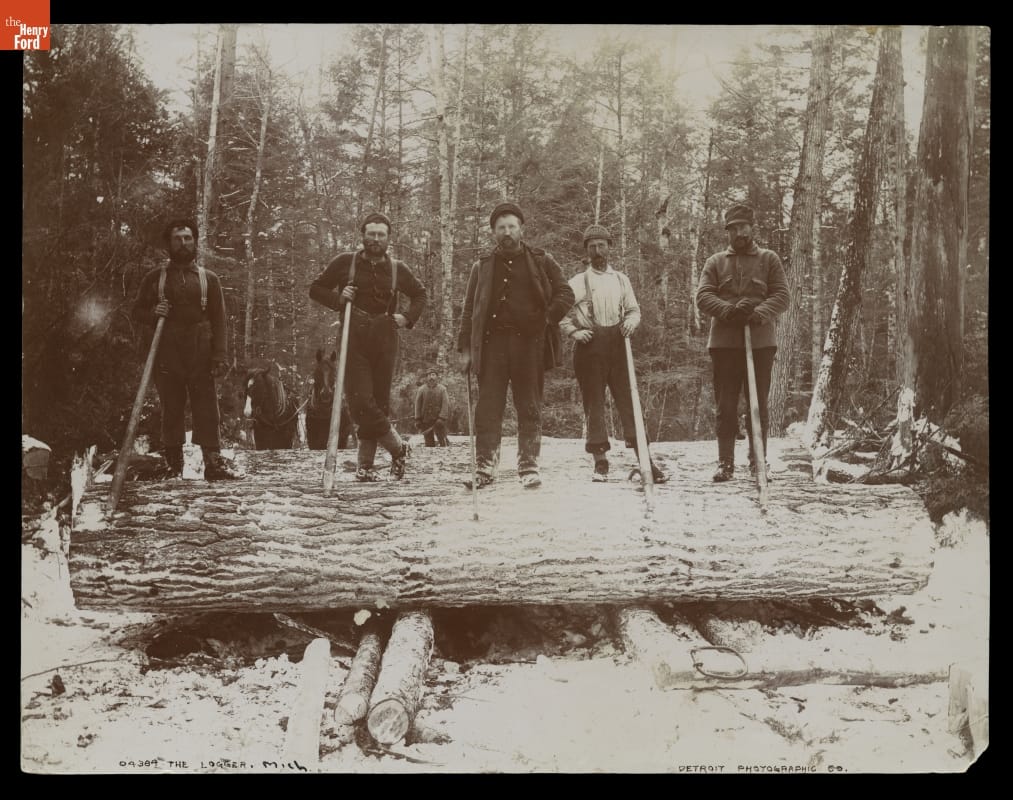
A group of five men posed for a picture on top of a large log with their "cant hooks," a common logging tool used to maneuver logs, in the late nineteenth century. When Maine and New York were unable to supply the growing demand for lumber, Michigan became the next logical lumbering destination as part of the northern pine belt.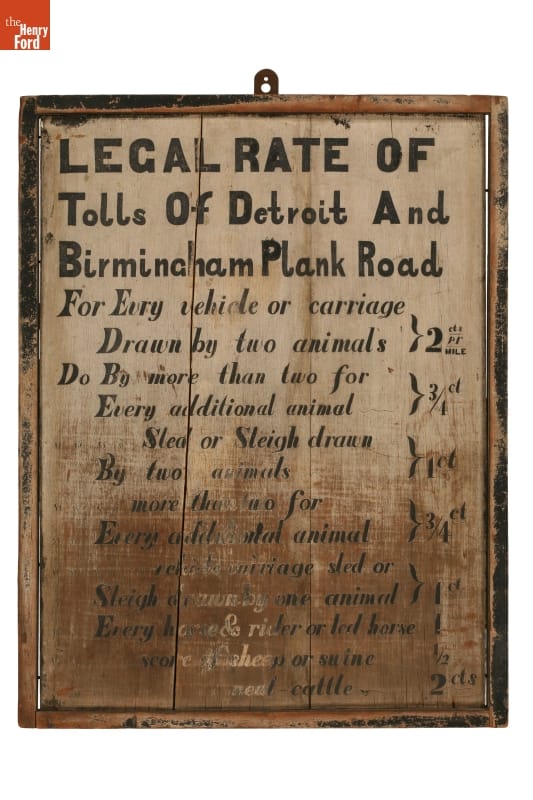 Set
SetLesson: Funding Public Goods
- 3 Artifacts
In the mid-19th century, road builders experimented with "plank roads" consisting of wood planks laid across longitudinal wood beams. Wood provided a smoother surface than dirt or gravel, especially in wet weather, but it deteriorated quickly. Maintenance costs, financed by user tolls, were prohibitively expensive and most plank roads were gradually resurfaced with gravel.