
"Celestial Mechanics" from Mathematica: A World of Numbers and Beyond Exhibition, 1960-1961
THF166585 / "Celestial Mechanics" from Mathematica: A World of Numbers and Beyond Exhibition, 1960-1961
01
Artifact Overview
Mathematica was the first exhibition to be designed by the Eames Office, produced through sponsorship by IBM. One of the first immersive exhibits dedicated to mathematics, its mechanical and static displays teach people about the abstract qualities of mathematics in a non-mathematical way--through direct interaction and visual storytelling. This interactive demonstrates Kepler and Newton's planetary and gravitational theories.
Artifact Details
Artifact
Installation (Exhibition)
Date Made
1960-1961
Creators
Place of Creation
Creator Notes
Created by Eames Office under the direction of Charles and Ray Eames and mathematical consultant Raymond Redheffer. Funding provided by International Business Machines Corporation.
Location
at Henry Ford Museum in Mathematica: A World of Numbers and Beyond
Object ID
2015.16.1.4
Credit
From the Collections of The Henry Ford.
Material
Laminate
Metal
Plastic
Rubber (Material)
Thermoplastic
Wire
Wood (Plant material)
Dimensions
Height: 76 in
Width: 78 in
Length: 75 in
Keywords |
|---|
02
Related Content
 Set
SetFeatured on The Henry Ford's Innovation Nation: Season 4
- 26 Artifacts
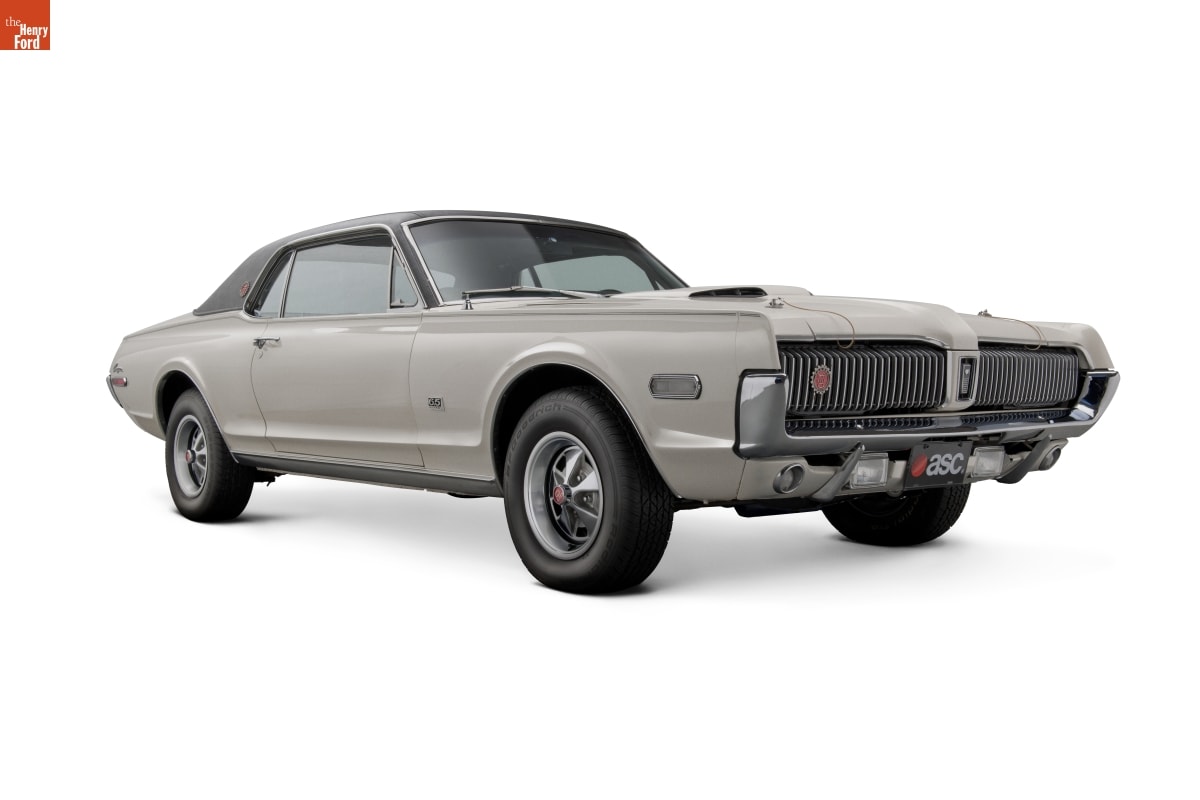
Ford Motor Company's Mustang, introduced in 1964, was such a success that other car makers soon copied it, including Ford itself. Mercury's Cougar was based on the Mustang, but with more upscale styling and interior appointments that made it something of a "poor man's Jaguar." This Cougar has the rare XR7-G package with a hood scoop, sun roof, and other special trim features.