
Ford "Mode: Flex" Functional Bicycle Prototype, 2015
THF172635 / Ford "Mode: Flex" Functional Bicycle Prototype, 2015
01
Artifact Overview
Automakers increasingly considered themselves "mobility providers" in the 2010s. Ford Motor Company's MoDe:Flex bicycle prototype was born of that thinking. The power-assisted bike operated via an Apple iPhone app that controlled the electric motor, monitored the rider's speed and heart rate, and provided navigation assistance and traffic updates. When disassembled, the bike fit neatly into the trunk of a compact car.
Artifact Details
Artifact
Bicycle
Date Made
2015
Creators
Place of Creation
Location
Not on exhibit to the public.
Object ID
2017.93.1
Credit
From the Collections of The Henry Ford. Gift of Ford Motor Company.
Material
Aluminum (Metal)
Color
Silver (Color)
Black (Color)
Blue
Dimensions
Height: 43.5 in (Bicycle)
Width: 24.125 in (Bicycle)
Length: 54.75 in (Bicycle)
Wheelbase: 44.5 in (Bicycle)
Height: 0.25 in (Phone)
Width: 2.625 in (Phone)
Length: 5.375 in (Phone)
Inscriptions
on bicycle tires:
SCHWALBE / MARATHON SUPREME
on bicycle wheels:
MODE FLEX
on bicycle sides, above pedals:
FORD
on top of bicycle seat:
ROYAL GEL / SR / SELLE ROYAL
on proper right side of bicycle seat, from back to front:
COOL X SENIUM / respiro
on back of phone:
iPhone / Designed by Apple in California. Assembled in China. Model A1549
Keywords |
|---|
02
Related Artifacts
 Artifact
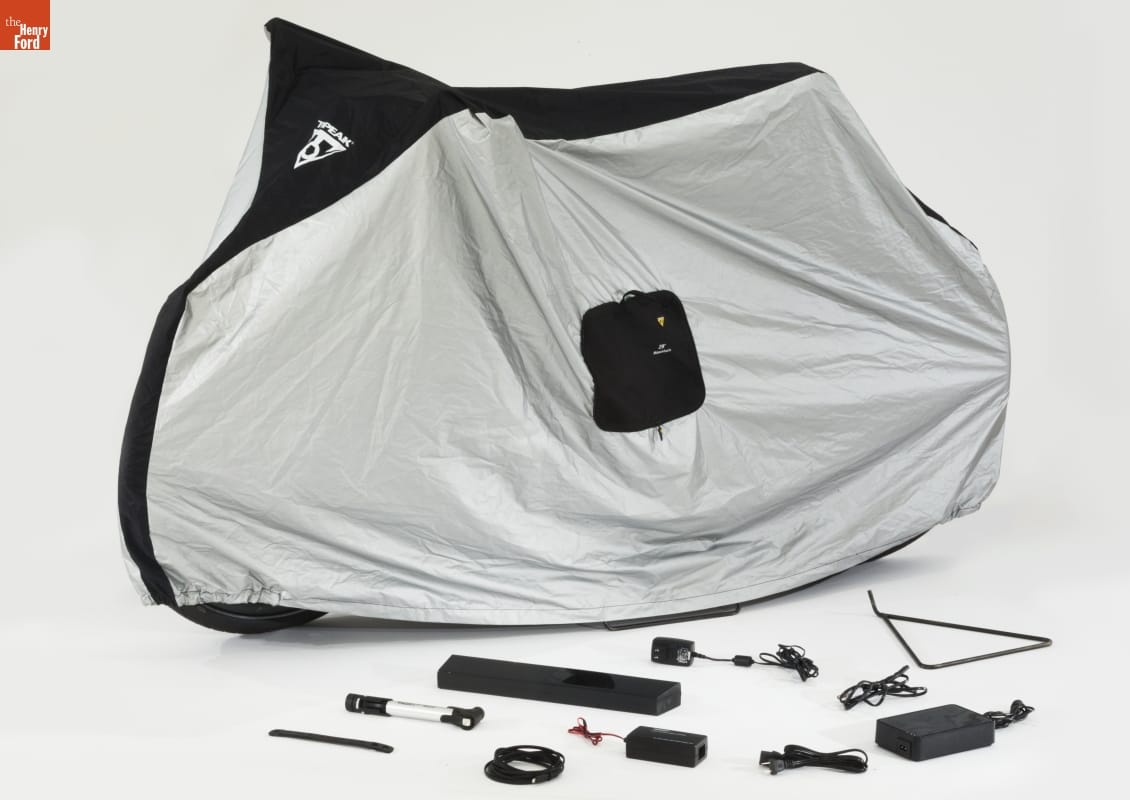
Parts for the Ford "Mode: Flex" Non-Functional Bicycle Prototypes, 2015
Automakers increasingly considered themselves "mobility providers" in the 2010s. Ford Motor Company's MoDe:Flex bicycle prototype was born of that thinking. The power-assisted bike operated via an Apple iPhone app that controlled the electric motor, monitored the rider's speed and heart rate, and provided navigation assistance and traffic updates. When disassembled, the bike fit neatly into the trunk of a compact car.
03
Related Content
 Set
SetFeatured on The Henry Ford's Innovation Nation: Season 6
- 25 Artifacts
Small sawmills played a fundamental role in rural communities in nineteenth century America, processing locally-logged wood to provide sawn lumber for construction in the immediate area. While many such mills were water powered, this was steam-powered from the outset. It was simple but refined -- a modest, self-sufficient industrial operation (water and fuel was available onsite), comfortably wedded to its rural location. Set
SetBicycles
- 25 Artifacts
Charles Metz of Waltham, Massachusetts, built the Orient Oriten in 1896 as a way to promote his Orient line of bicycles. Metz featured this 23-foot-long, 305-pound ten-seater at bicycle meets and races throughout the country. Though difficult to ride, the vehicle could reach speeds of 45 miles per hour. The Henry Ford owns the only surviving Oriten. Set
SetCollecting Mobility
- 31 Artifacts
Modern fans might find the Mustang II undersized and underpowered. But its specifications were typical for the mid-1970s into the mid-1980s, when American automakers struggled with new safety, efficiency and emissions requirements, and against growing competition from high-quality foreign cars. Regardless, buyers embraced the smaller Mustang II and Ford sold more than 1.1 million of them from 1974-1978. article
Ford’s Mode:Flex Bicycle: Automakers Go Multimodal
These electric-assist bicycle prototypes from Ford Motor Company are evidence of automaker attempts to broaden their product lines in response to evolving trends in personal transportation.