
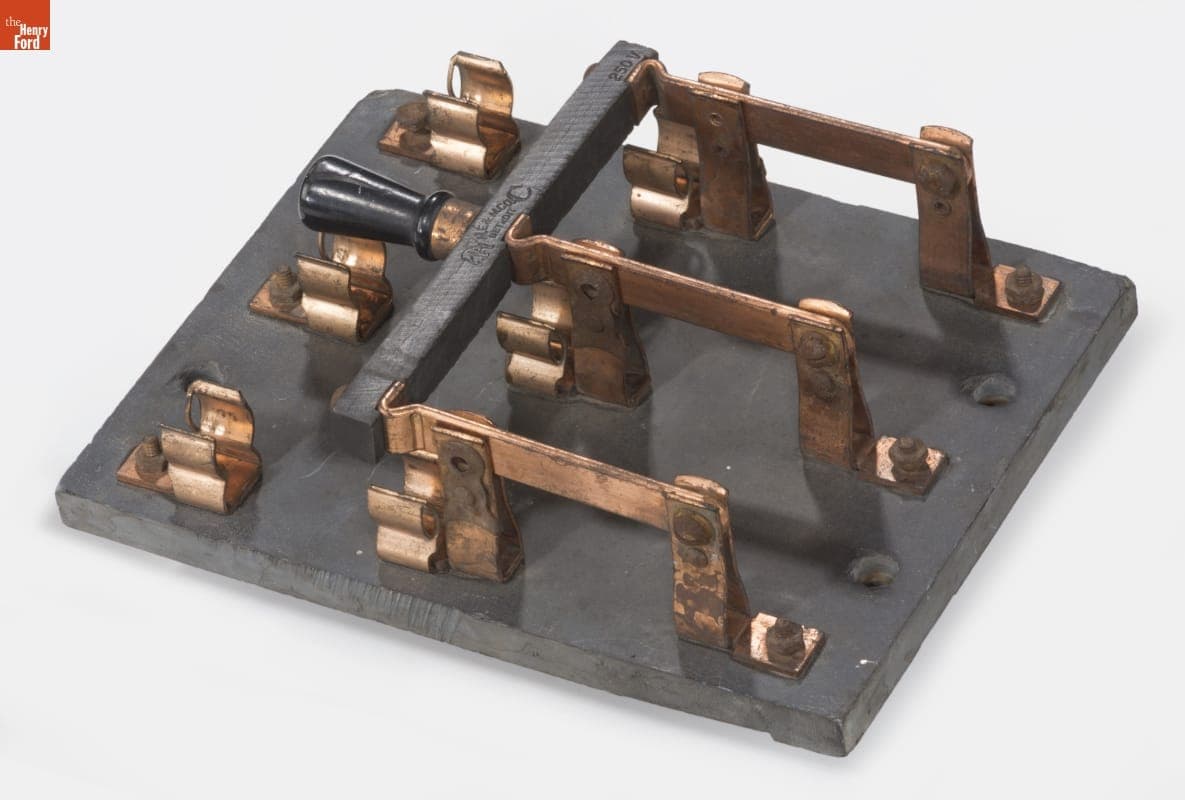
Westinghouse Shallenberger Ampere-hour Meter, 1888-1890
01
Artifact Overview
Oliver B. Shallenberger, chief electrician at Westinghouse, invented the first successful AC ampere-hour meter in 1888. This meter measures the flow of electric current through a circuit. Early meters like this helped companies that supplied electricity to customers monitor usage and charge appropriate rates. Shallenberger's meter also paved the way for the acceptance of AC power distribution.
Artifact Details
Artifact
Meter (Measuring device)
Date Made
1888-1890
Place of Creation
Creator Notes
Manufactured by Westinghouse Electric Company, Pittsburgh, Pennsylvania, using the patents of O. B. (Oliver Blackburn) Shallenberger.
Collection Title
Location
Not on exhibit to the public.
Object ID
29.1333.4
Credit
From the Collections of The Henry Ford. Gift of Westinghouse Electric and Manufacturing Company.
Material
Metal
Brass (Alloy)
Color
Black (Color)
Gold (Color)
White (Color)
Dimensions
Height: 9 in
Width: 6.25 in
Length: 7 in
Inscriptions
on plate:
NO. 11586/ WESTINGHOUSE ELECTRIC CO./ PITTSBURGH PENNA. U.S.A./ O. B. SHALLENBERGER'S PATENTS/ AUGUST 14 1888./ NO. 388003 & 388004/ CAPACITY 40 AMPERS
on readout:
WESTINGHOUSE ELECTRIC CO./ PITTSBURGH PA U.S.A./ O. B. SHALLENBERGER'S/ PATENTS NO'S 388003/ AUG. 14, 1888 388004/ NO. 11586 CAPACITY 40 AMPS
Keywords |
|---|
03
Related Content
Set
Electric Stories - 2015-2017 IMLS Grant Project
- 22 Artifacts
In 2015, The Henry Ford received a grant from the Institute of Museum and Library Services (IMLS) to digitize a selection of artifacts related to electric power generation and distribution. Many hidden stories have come to light as staff cataloged, photographed, and conserved these objects. This expert set presents just a small sampling of those artifacts and their stories preserved by The Henry Ford.